1019
Slice-POCS-ICE: a navigator-free reconstruction for SMS-accelerated multi-shot spiral-based diffusion-weighted imaging1Center for Biomedical Imaging Research, Department of Biomedical Engineering, School of Medicine, Tsinghua University, Beijing, China, 2MR R&D, Philips Health Technology (Suzhou), Suzhou, China
Synopsis
Keywords: Diffusion Acquisition, Diffusion/other diffusion imaging techniques, Spiral diffusion imaging
Motivation: Simultaneous multi-slice (SMS) technique can further enhance the acquisition efficiency of spiral-based diffusion imaging.
Goal(s): Our goal was to achieve SMS-accelerated navigator-free multi-shot spiral-based diffusion imaging.
Approach: RF pulse phase encoding strategy was optimized to introduce the CAIPI phase modulation. Furthermore, we proposed the slice-POCS-ICE algorithm to simultaneously perform CAIPI phase demodulation, inter-shot phase error correction, and diffusion image reconstruction. The proposed algorithm was tested on simulated and in-vivo data.
Results: Our proposed slice-POCS-ICE algorithm can simultaneously accomplish CAIPI phase demodulation and remove the shot-to-shot phase variations, for SMS-accelerated multi-shot navigator-free spiral-based DWI. The proposed slice-POCS-ICE has a stable convergence behavior.
Impact: The proposed slice-POCS-ICE reconstruction algorithm can successfully reconstruct multi-shot diffusion images from SMS-accelerated navigator-free spiral acquisitions with optimized CAIPI phase modulation, which may be valuable for speeding up multi-shot spiral-based DWI acquisitions, to facilitate both neuroscience research and clinical diagnosis.
Introduction
Diffusion-weighted imaging (DWI) is a powerful tool for clinical diagnosis and neuroscience studies. Center-out spiral acquisition has been shown to have a higher SNR behavior for diffusion imaging compared to EPI 1-4. Multi-shot spiral acquisitions can be utilized to achieve high-resolution DWI. If the multi-shot spiral acquisition is combined with simultaneous multi-slice (SMS) imaging techniques 5-6, the scan efficiency can be further enhanced. For SMS-accelerated multi-shot navigator-free DWI, the key challenge is to correct for phase variations among different shots and to recover the diffusion images of multiple simultaneously excited slices. In this study, a reconstruction algorithm, termed “slice-POCS-ICE”, was proposed to accomplish CAIPI phase demodulation, inter-shot phase error correction, and diffusion image reconstruction simultaneously.Theory
1. CAIPI phase modulationFor SMS-accelerated multi-shot spiral acquisition, CAIPI phase modulation 7-9 is optimized and introduced to reduce g-factor in this work.
$$RF_{SMS}(t) = \sum _{n = 1}^{R_{SMS}}RF(t)·e^{j\omega _{n}t + \varphi _{n}}$$
where $$$RF(t)$$$ is a single-band RF pulse, $$$RF_{SMS}(t)$$$ is a multi-band RF pulse. $$$R_{SMS}$$$ is the number of simultaneously excited slices. $$$\varphi _{n}$$$ is the phase modulation for the $$$n$$$-th slice.
Further, the CAIPI phase modulation $$$\Psi_{i,n}$$$ for SMS-msh-spiral DWI acquisition can be expressed as
$$\Psi_{i,n} = \begin{bmatrix} e^{-j \varphi_{n}[1] } & \cdots & 0 \\ \vdots & \ddots & \vdots \\ 0 & \cdots & e^{-j \varphi_{n}[N_{shot}] } \end{bmatrix}$$
where the subscript $$$n$$$ denotes the $$$n$$$-th slice, $$$n=1,2,\dots ,R_{SMS}$$$. The subscript $$$i$$$ denotes the $$$i$$$-th shot, $$$i=1,2,\dots ,N_{shot}$$$, $$$N_{shot}$$$ is the number of shots. Then the phase modulation for the $$$i$$$-th shot and the $$$n$$$-th slice is $$$\varphi_{n}[i]=(i-1)(n-1)\frac{2\pi }{N_{caipi}}$$$. In general, $$$N_{caipi}=R_{SMS}$$$ for CAIPI phase modulation, or optionally $$$N_{caipi}=max\{N_{shot},R_{SMS}\}$$$, etc. The sequence is shown in Figure 1a.
2. Slice-POCS-ICE reconstruction algorithm
In this work, a new reconstruction method is proposed to address the inter-shot phase variations in SMS-accelerated multi-shot navigator-free spiral diffusion imaging. The core reconstruction pipeline is shown in Figure 1b.
For SMS-accelerated multi-shot DWI, the acquired k-space data $$$d_{i}$$$ can be given by
$$d_{i}=\Psi_{i,n}FS_{n}\phi_{i,n}I_{i,n}$$
where $$$d_{i}$$$ donates the acquired k-space data of the $$$i$$$-th shot, $$$I_{i,n}$$$ is the diffusion-weighted image to be reconstructed, $$$\phi_{i,n}$$$ is the phase variations induced by physiological motion, $$$S_{n}$$$ is the sensitivity map of the $$$n$$$-th slice, $$$F$$$ donates the Fourier Transform, $$$\Psi_{i,n}$$$ is the introduced CAIPI phase modulation.
Similar to POCS-ICE algorithm 10, data projection, channel combination, shot averaging, image update, and phase recovery were implemented for each iteration. Specifically, for the proposed slice-POCS-ICE algorithm, the DWI images of simultaneously excited slices are reconstructed together.
Methods
1. Numerical SimulationTo evaluate the effectiveness of our proposed slice-POCS-ICE algorithm, numerical simulations were performed using acquired T2-weighted TSE images. The 32-channel complex coil sensitivity maps were computed using ESPIRiT 11. The multi-shot spiral DWI data were simulated by multiplying the T2W images with spatially varying second-order phase maps. The simulated phase variations were random for each shot and for different slices. Furthermore, to test the robustness of the proposed algorithm, simulations with different numbers of shots (from three to eight) and different numbers of simultaneously excited slices (from two to three) were conducted. The quality of the reconstructed images was evaluated by using the normalized root mean square error (nRMSE).
2. In Vivo Experiments
All spiral diffusion imaging experiments were performed using a Stejskal-Tanner diffusion sequence on a Ingenia CX 3.0T scanner (Philips) using a 32-channel head coil. The gradient system was operated at a maximum gradient strength of 31 mT/m and a maximum slew rate of 200 T/m/s. In all experiments, SPIR technique was used to suppress fat signals. In addition, low-resolution B0 field maps acquired with a multi-echo GRE sequence were used for deblurring. This study was approved by the local Institutional Review Board and written informed consent was obtained from all participants.
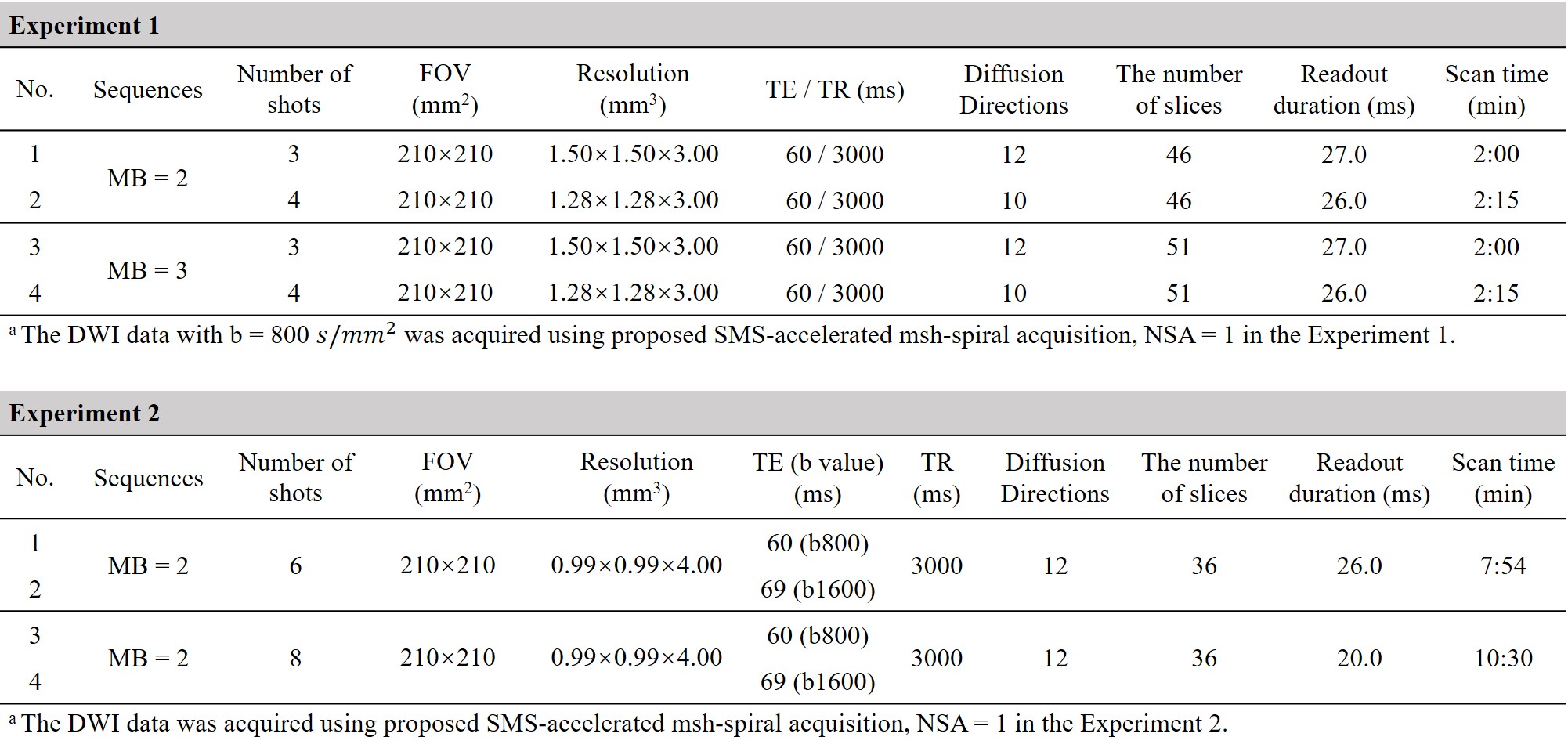
The detailed scan parameters of in-vivo experiments are listed in Table 1.
Results and Discussion
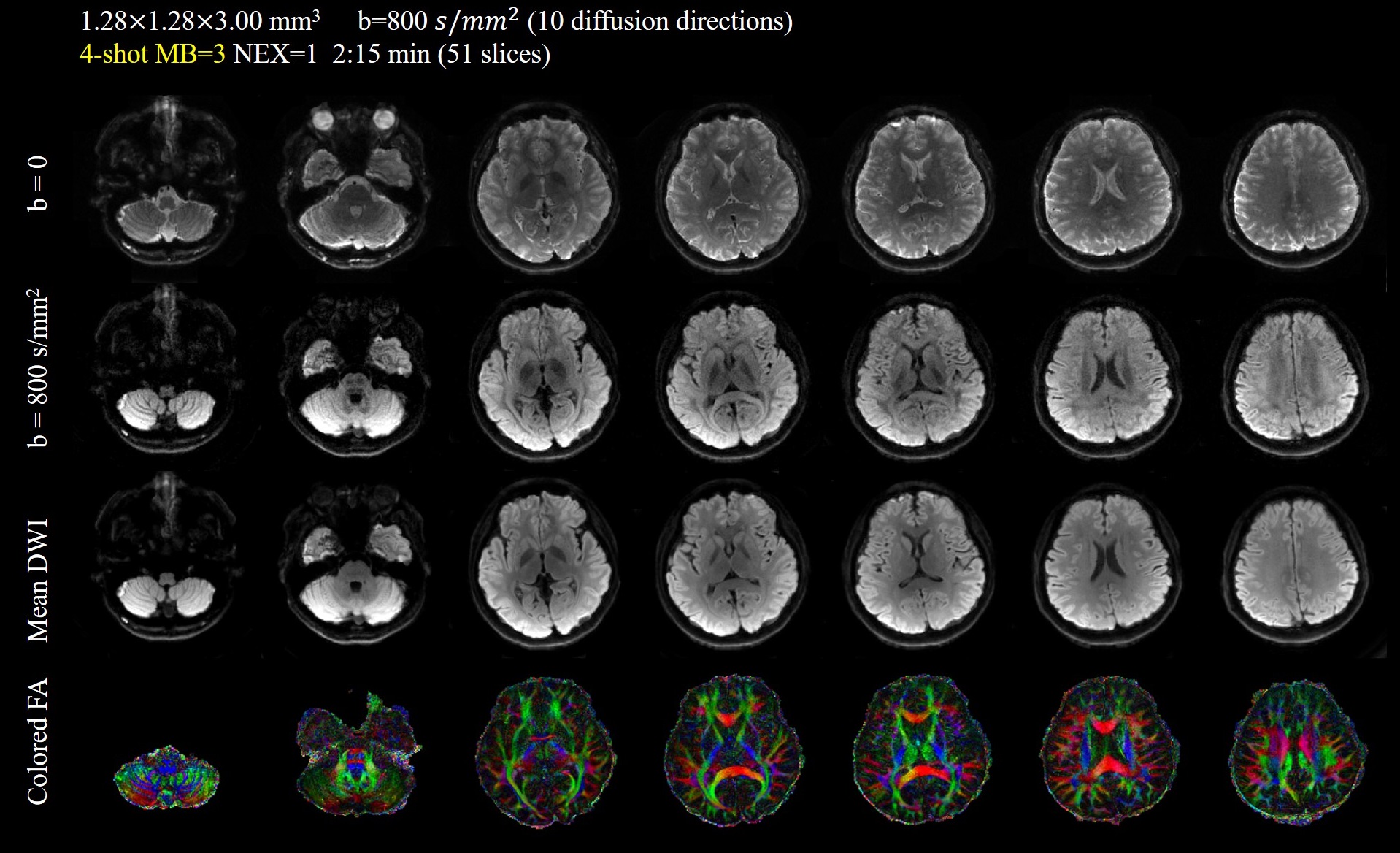
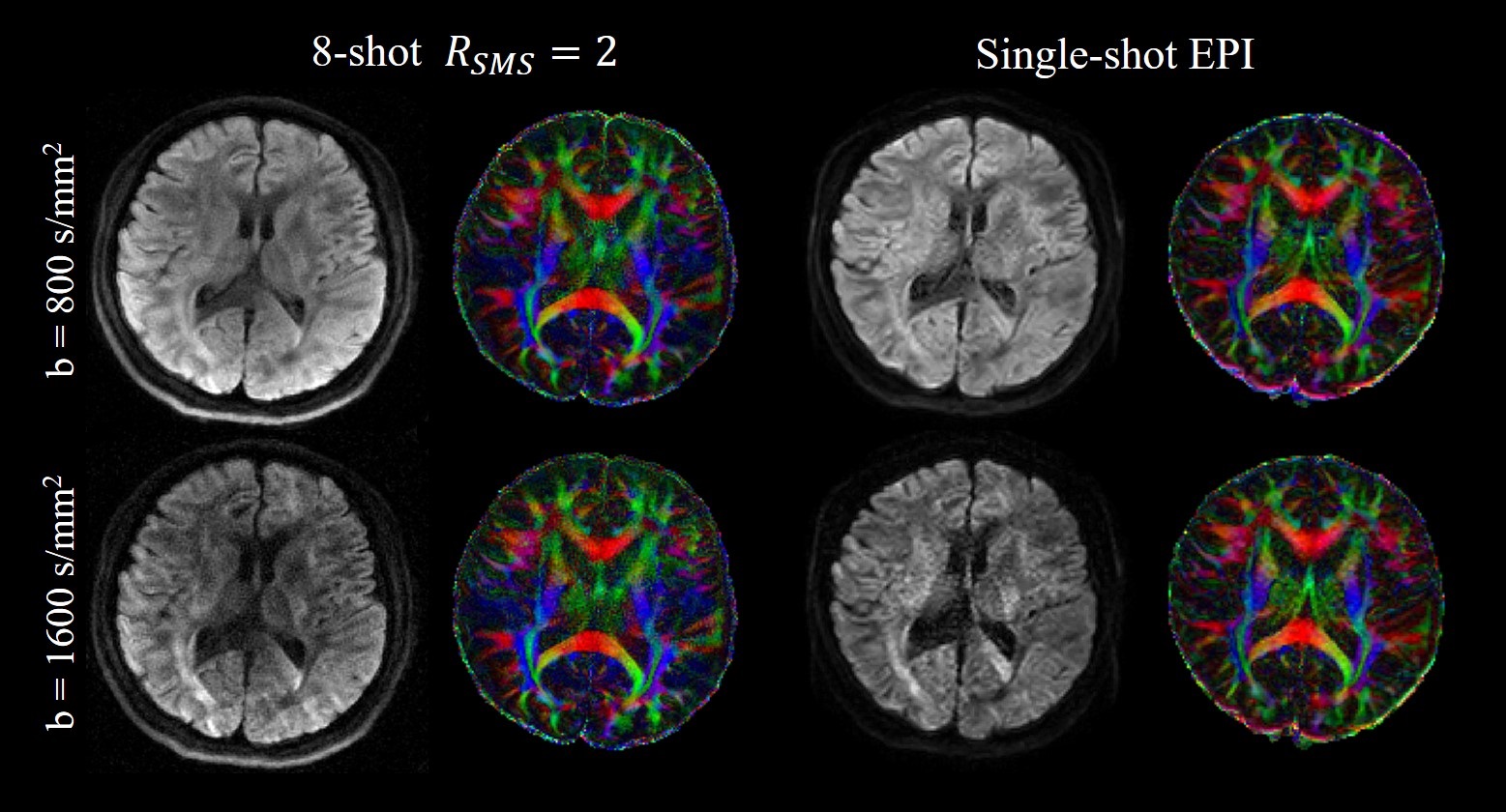
Figure 2 shows the simulation results of 4-shot spiral acquisition with MB = 2. Slice-POCS-ICE successfully estimates the inter-shot phase errors and has a stable convergence behavior. The b = 0 images, single DW images, mean DWI, and color-coded FA maps acquired by the 4-shot spiral acquisitions with MB = 3 are shown in Figure 3. Figure 4 shows the b = 800 s/mm2 and b = 1600 s/mm2 DW images obtained by 8-shot acquisition with MB=2. In addition, the corresponding single-shot EPI DWI data were acquired as a reference.Conclusion
In this study, a new method, named slice-POCS-ICE was proposed for SMS-accelerated multi-shot navigator-free spiral DWI. CAIPI phase demodulation, shot-to-shot phase variations, and DW images of multiple slices can be simultaneously solved using the proposed algorithm.Acknowledgements
No acknowledgement found.References
1. Li G, Li S, and Hua Guo. A comparison of navigator-free multi-shot spiral and EPI in high-resolution DWI. In Proceedings of the 31st Annual Meeting of ISMRM. 2023, 3956
2. Börnert P, Eggers H, Nehrke K, et al. Single-shot Diffusion-weighted Spiral Imaging in the Brain on a Clinical Scanner. In Proceedings of the 27th Annual Meeting of ISMRM. 2019; 0243.
3.Lee Y, Wilm BJ, Brunner DO, et al. On the signal-to-noise ratio benefit of spiral acquisition in diffusion MRI. Magn Reson Med. Apr 2021;85(4):1924-1937.
4. Lee Y, Wilm BJ, Nagy Z, et al. High-Resolution Diffusion MRI: In-Vivo Demonstration of the SNR Benefit of Single-Shot Spiral Acquisition vs. EPI. In Proceedings of the 27th Annual Meeting of ISMRM. 2019; 0767.
5. Barth M, Breuer F, Koopmans P J, et al. Simultaneous multislice (SMS) imaging techniques. Magn Reson Med, 2016, 75(1): 63-81.
6. Herbst M, Deng W, Ernst T, et al. Segmented simultaneous multi-slice diffusion weighted imaging with generalized trajectories. Magn Reson Med, 2017, 78(4): 1476-1481.
7. Breuer FA, Blaimer M, Heidemann RM, et al. Controlled aliasing in parallel imaging results in higher acceleration (CAIPIRINHA) for multi-slice imaging. Magn Reson Med 2005; 53: 684–691.
8. Setsompop K, Gagoski BA, Polimeni JR, et al. Blipped-controlled aliasing in parallel imaging for simultaneous multislice echo planar imaging with reduced g-factor penalty. Magn Reson Med 2012; 67: 1210–1224.
9. Sun, C, Yang, Y, Cai, X, et al. Non-Cartesian slice-GRAPPA and slice-SPIRiT reconstruction methods for multiband spiral cardiac MRI. Magn Reson Med 2020, 1235–1249.
10. Guo, H, Ma, X, Zhang, Z, et al. POCS-enhanced inherent correction of motion-induced phase errors (POCS-ICE) for high-resolution multishot diffusion MRI. Magn Reson Med 2016; 75(1); 169–180.
11. Uecker M, Lai P, Murphy MJ, et al. ESPIRiT—an eigenvalue approach to autocalibrating parallel MRI: where SENSE meets GRAPPA. Magn Reson Med. 2014;71:990-1001.
Figures
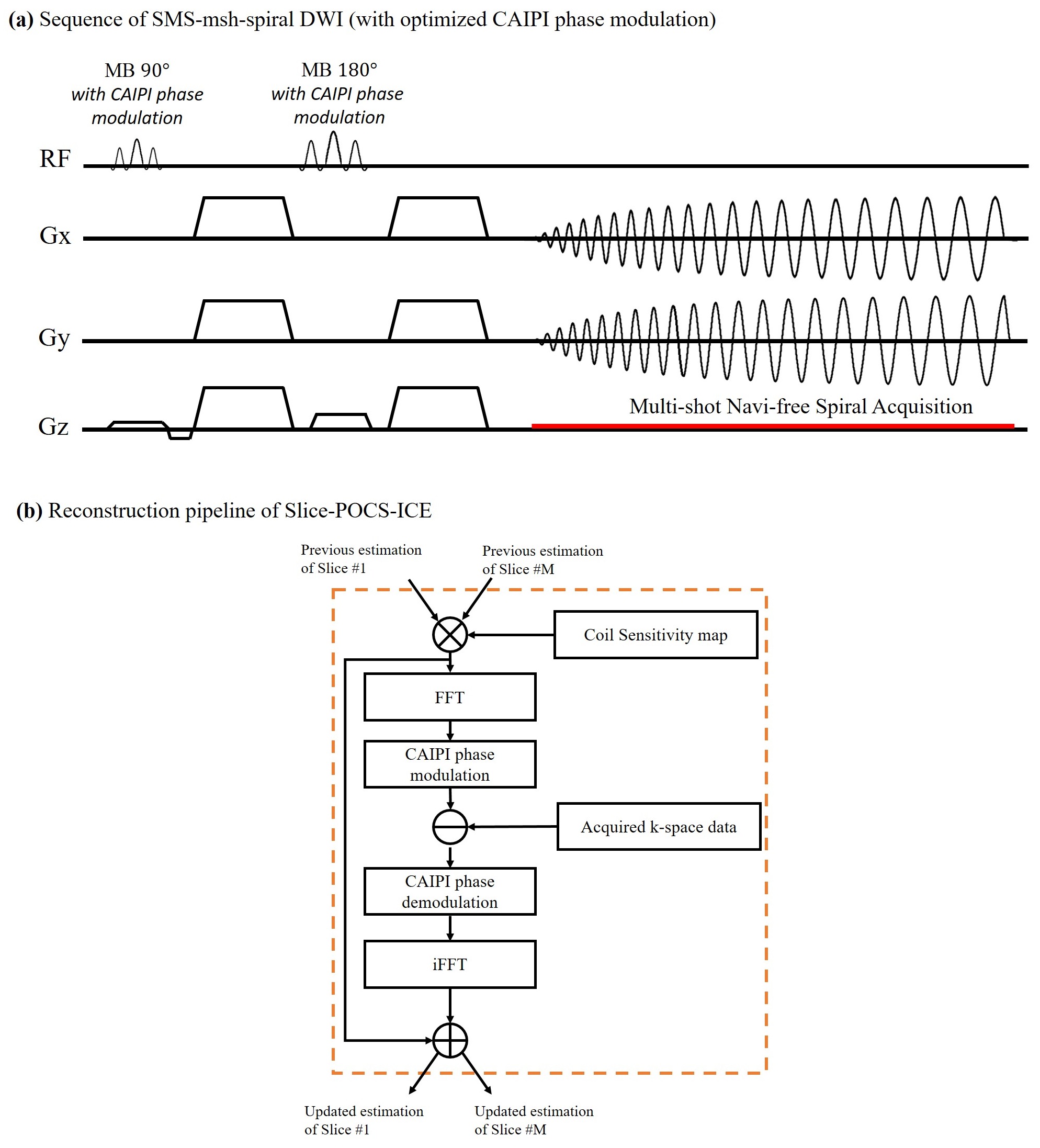
Figure 1: (a) The sequence of SMS-accelerated multi-shot navigator-free spiral-based diffusion imaging. The CAIPI phase modulation is introduced by RF phase encoding. The CAIPI phase modulation is optimized, especially for the spiral acquisitions with a low number of shots.
(b) The reconstruction pipeline of our proposed slice-POCS-ICE algorithm. The information of CAIPI phase modulation is utilized during the iterations. CAIPI phase demodulation, phase variations among shots, and DWI images of the simultaneously excited slices are solved using the proposed method.
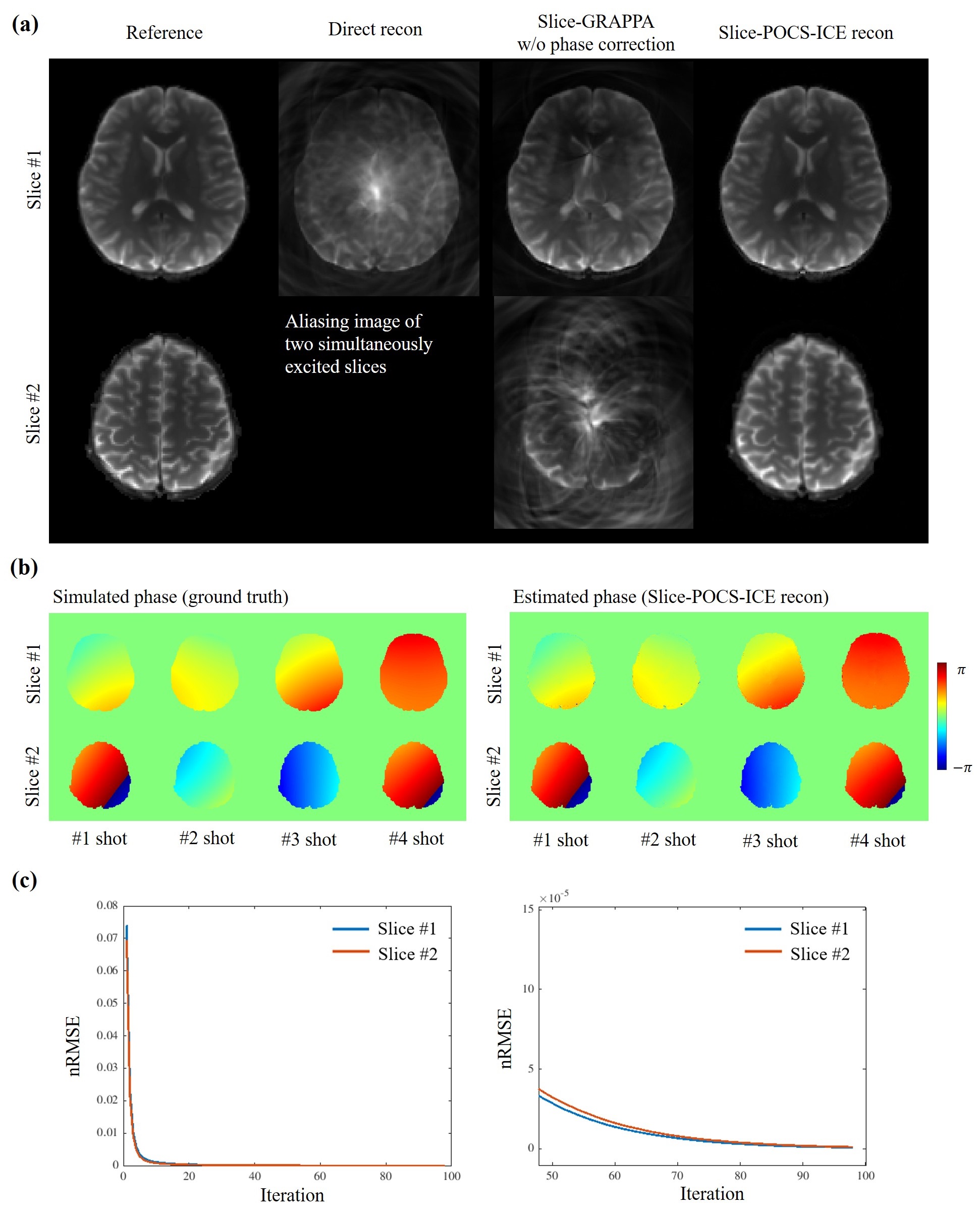
Figure 2: The simulation results of 4-shot spiral acquisition with MB = 2.
(a) From left to right, the reference image, direct reconstruction, the results reconstructed w/o resolving inter-shot phase error, and the results reconstructed by our proposed method.
(b) Simulated phase variations (left panel) and estimated phase variations (right panel) by our proposed algorithm. The estimation results are closer to the ground truth.
(c) The nRMSE plot of the two simultaneously excited slices reconstructed by slice-POCS-ICE. Slice-POCS-ICE has a stable convergence behavior.