0950
Arc-ZTE: Incoherent k-space sampling in time using continuously-slewed gradients for flexible, dynamic, quiet Zero TE MRI1Electrical Engineering and Computer Sciences, University of California, Berkeley, Berkeley, CA, United States, 2Neuroimaging, King’s College London, London, United Kingdom
Synopsis
Keywords: New Trajectories & Spatial Encoding Methods, New Trajectories & Spatial Encoding Methods, ZTE, Dynamic MRI, Quiet MRI
Motivation: Existing Zero TE methods are constrained due to gradient slew limits between spokes, which hinders their use in dynamic imaging applications.
Goal(s): We aim to improve temporal k-space sampling in time by increasing the possible angular distance between consecutive spokes via continuously-slewed gradients, while still maintaining minimal gradient refocusing and minimal acoustic noise.
Approach: We parameterize the k-space trajectory using sequential rotations of an arc in k-space, then optimize the rotation angles over metrics for sampling uniformity and refocusing.
Results: We demonstrate a proof-of-concept of this trajectory and show improvement over radial ZTE in k-space coverage metrics and reconstructions for various temporal resolutions.
Impact: By improving temporal k-space sampling for Zero-TE MRI, our work enables quiet, dynamic imaging with flexible temporal resolution. Potential applications include quiet DCE or respiratory motion-resolved imaging for neonates and other sound-sensitive populations.
Introduction
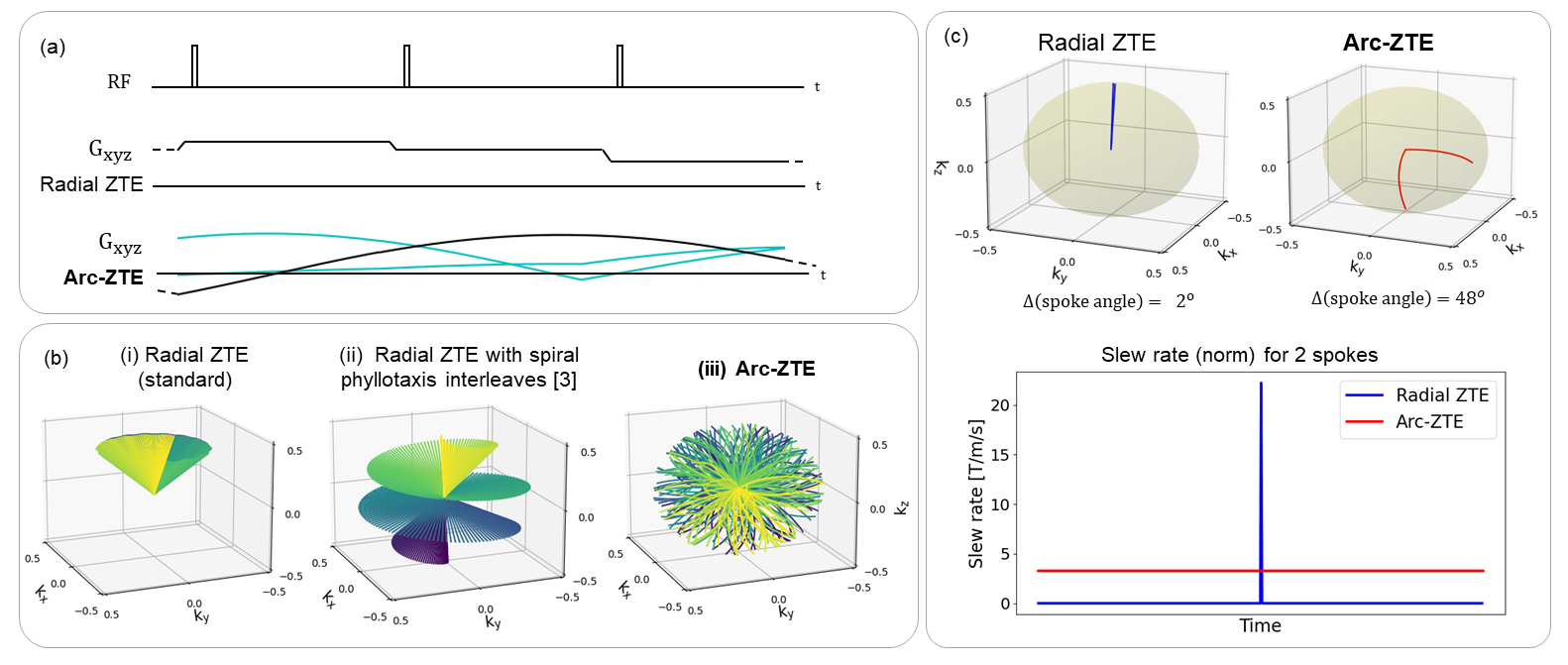
Zero echo time (ZTE) imaging1 is a fast technique that enables quiet MRI2 with extremely high sampling efficiency. Excitations occur at very short TRs (sub-ms to ~2ms) between which constant gradients are updated by small amounts. Gradient transitions are kept small for quiet operation and spoiling of previous coherences3,4. The resulting temporal ordering of k-space samples(Fig.1b) limits their use in dynamic applications where flexible retrospective data binning, such as in GRASP5, is desired.Flexible temporal resolution has been achieved using golden-angle view ordering for gradient echo and SSFP 3D radial sequences6,7,8. Unlike these sequences, ZTE uses ultra-short TRs and relies on subsequent readout gradients for spoiling. Hence, large angular differences between consecutive spokes can cause previously excited coherences to refocus, resulting in image artifacts. Therefore, we propose Arc-ZTE, a method that uses constant slew-rate curved spokes to improve sampling uniformity in time with minimal gradient refocusing.
Methods
Although ZTE can run continuously, it is typically divided into segments3 between which the gradients are ramped down. Segmenting the gradients is necessary for some systems (including ours) due to sequencer limitations and is also useful for including contrast preparation pulses, like inversion or fat-saturation. Here, we design the trajectory for a single segment and rotate it using golden angles in 3D6.Analytical formulation
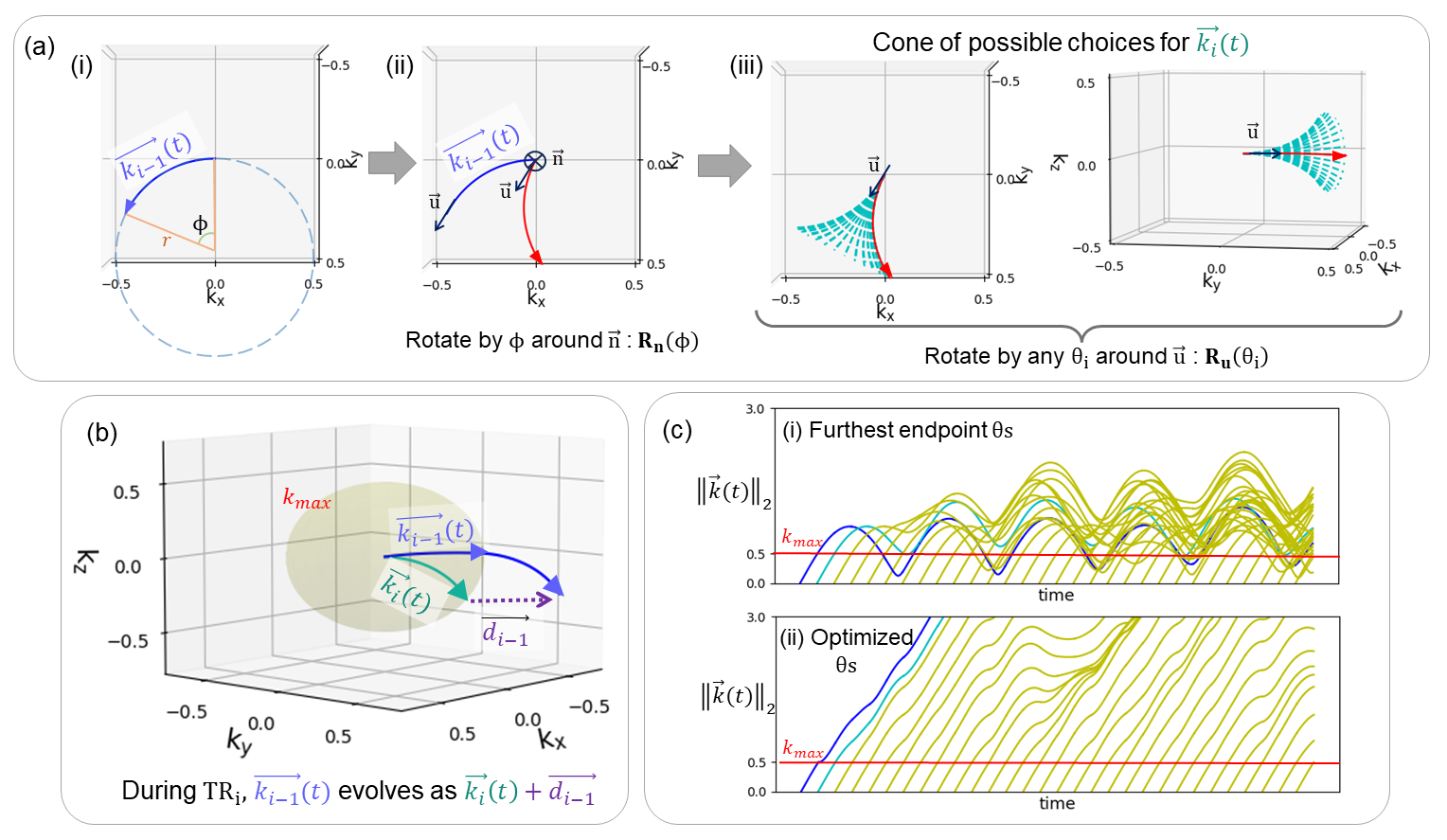
Each curved spoke has a constant slew rate and is defined as an arc that subtends angle $$$\phi$$$ of a circle with radius $$$r$$$(Fig.2a(i)). We define the first spoke $$$\overrightarrow{k_0}(t)$$$ as an arc in the $$$k_x$$$-$$$k_y$$$ plane, and define subsequent spokes recursively as rotations:
$$\vec{k_i}(t) = R_u(\theta_i)R_n(\phi)\overrightarrow{k_{i-1}}(t)$$
$$$R_n(\phi)$$$ is an “in-plane” rotation that rotates spoke $$$\overrightarrow{k_{i-1}}(t)$$$ by $$$\phi$$$ between TRs to maintain continuity of the gradients. In other words, $$$\overrightarrow{k_i}(t)$$$ must start in the direction which $$$\overrightarrow{k_{i-1}}(t)$$$ ends, namely $$$\overrightarrow{u}$$$. The endpoint of spoke $$$\overrightarrow{k_i}(t)$$$ has a single degree of freedom, as any rotation $$$R_u(\theta_i)$$$ around $$$\overrightarrow{u}$$$ is a viable solution that satisfies gradient and slew constraints. Hence, the space of possible solutions for spoke $$$\overrightarrow{k_i}(t)$$$ forms a cone(Fig.2a(iii)). The selection of rotation angles $$$\theta_i$$$ for each TR can have a significant influence on the level of gradient refocusing that occurs(Fig.2c).
Parameter optimization
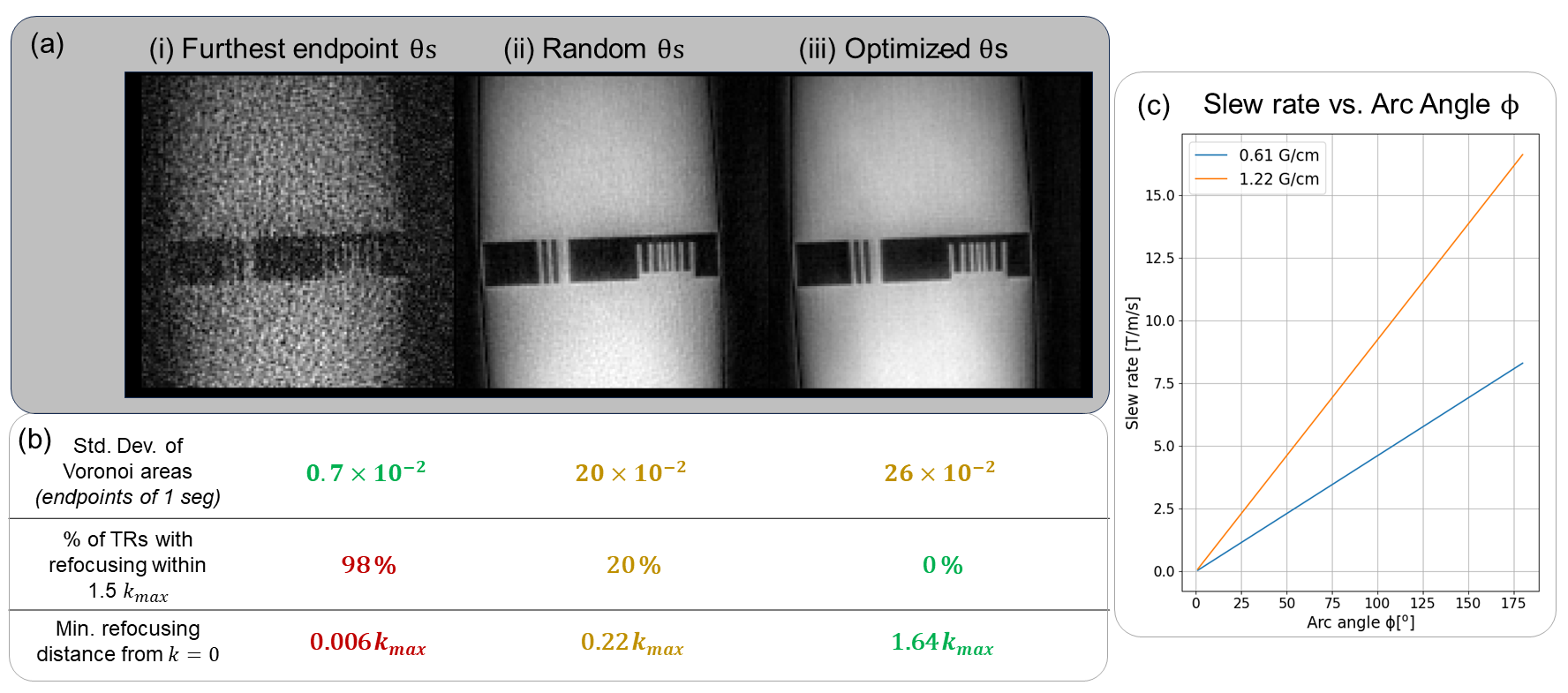
Our formulation has two degrees of freedom: $$$\theta_i$$$ and $$$\phi$$$. The choice of $$$\phi$$$ determines the overall slew rate of the sequence for a given gradient amplitude(Fig.3c).
Given a fixed $$$\phi$$$, the angles $$$\theta_i$$$ must be chosen carefully. For example, greedy selection of $$$\theta_i$$$ that maximizes endpoint distance from previous spokes can result in severe gradient refocusing(Fig.2c(i), Fig.3a(i)). Instead, we propose an optimization approach that penalizes the gradient refocusing:
$$\min_{\theta_i}\| \overrightarrow{k_i}(t_{end}) - \overrightarrow{v_{i, golden}}\|_2 - \lambda \sum_{j < i}^{} \sum_{t}^{} log(\|\overrightarrow{k_i}(t)+\overrightarrow{d_j}\|_2),\ \lambda>0$$
The first term above promotes k-space coverage by guiding the arc endpoints $$$\overrightarrow{k_i}(t_{end})$$$ to be close to golden-angle endpoints7 $$$\overrightarrow{v_{i, golden}}$$$. The second term promotes continued spoiling of previous coherences. We express the pathways of each previous coherence as $$$\overrightarrow{k_i}(t)$$$ translated by a displacement $$$\overrightarrow{d_j}$$$ (Fig.2b). The negative logarithm heavily pushes coherences away from $$$k=0$$$.
The above optimization is not computationally tractable, so we discretize $$$\theta_i$$$ and use a greedy approach that sequentially selects the best one.
Evaluation
We evaluate the sampling coverage using the standard deviation of Voronoi areas around spoke endpoints. Gradient refocusing is evaluated by counting the percentage of “corrupted TRs”, where coherences refocused to within 1.5$$$k_{max}$$$, i.e. <0.75 cycles/pixel of spoiling. The minimum refocusing distance from $$$k=0$$$ is also listed.
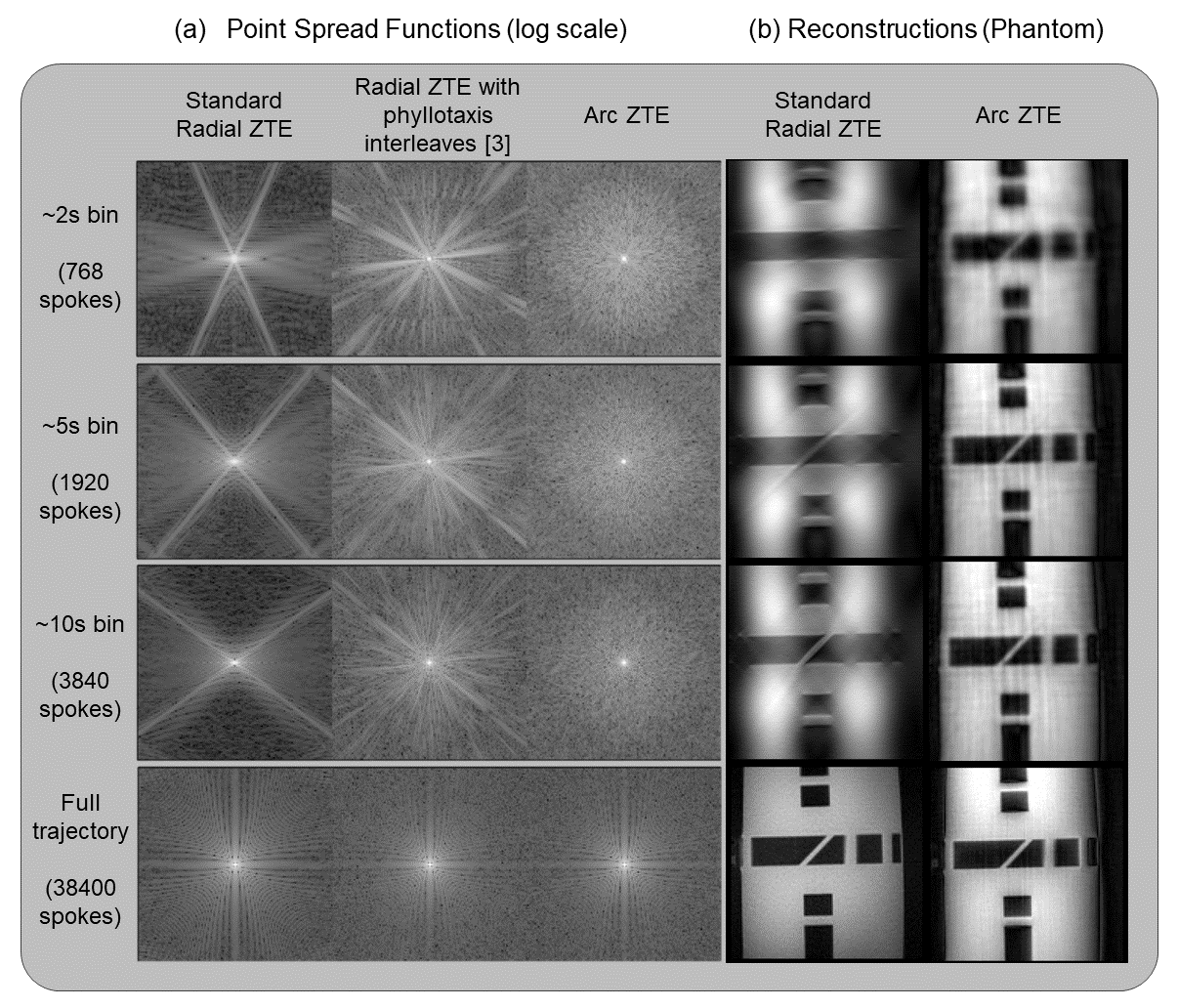
For our proof-of-concept experiments, we chose $$$\phi$$$ of 62.25$$$^o$$$, yielding a ~3 T/m/s slew with 0.61G/cm gradient amplitude. Comparison standard ZTE and spiral phyllotaxis radial ZTE3(s=10) had slew rates of ~22 T/m/s and ~33 T/m/s respectively. All methods had 384 spokes per segment(~0.8s).
Phantom data was acquired on a GE 3T MR750w (TR 2.3ms, $$$\pm$$$31.25kHz BW, 2$$$^o$$$ flip angle, 1mm resolution, 24cm FOV). Data was reconstructed using Kaiser-Bessel gridding9 with coil combination using sensitivities estimated from ESPIRiT10 with gridded WASPI11 spokes.
Results
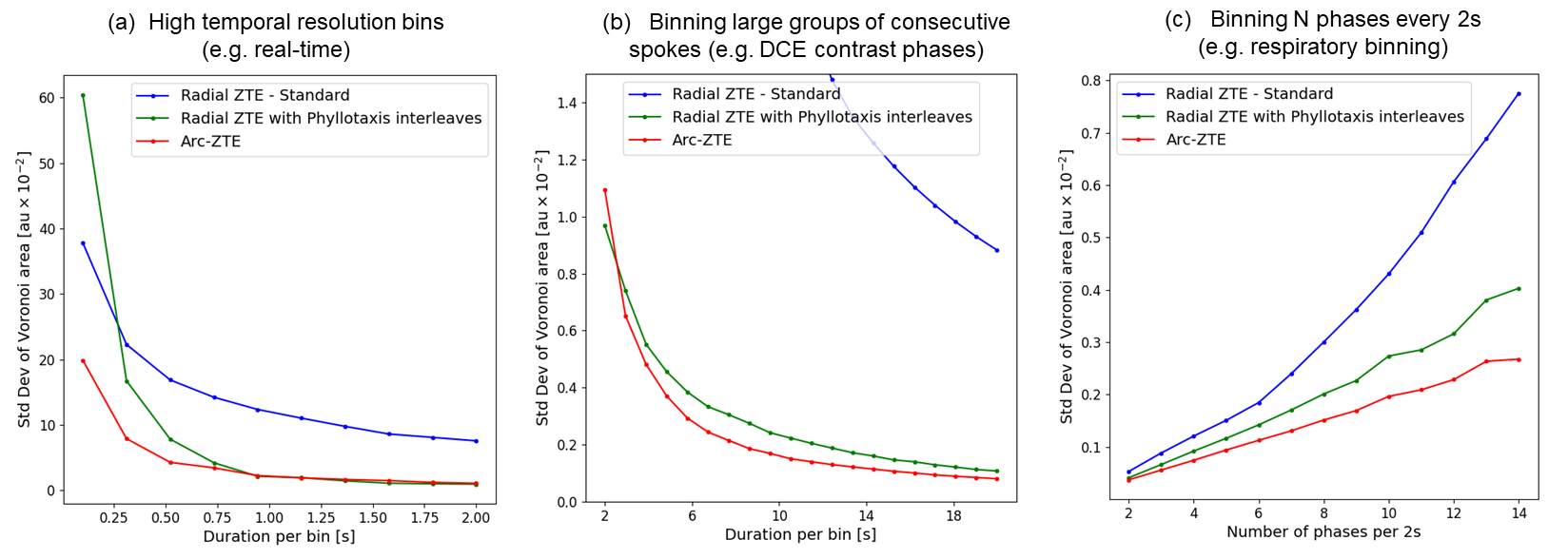
Figure 4 compares sampling coverage between Arc-ZTE and radial ZTE methods3 for common types of data binning in dynamic MRI. Arc-ZTE demonstrates improved coverage across almost all tested bins, especially for periodic binning, such as respiratory phases.Figure 5 shows point spread functions(PSFs) and reconstructions of different temporal bin durations of Arc-ZTE and radial ZTE methods. PSFs of Arc-ZTE demonstrate less streaking, and reconstructions are clearer than the radial ZTE comparison. Compared to standard radial ZTE, shading is visible in the full trajectory Arc-ZTE images, which is likely due to gradient delays.
Conclusion
We propose a method to enable flexible temporal resolution for quiet, dynamic ZTE imaging using continuously-slewed gradients with minimal refocusing.Acknowledgements
We acknowledge funding support from NIH R01EB009690, NIH R01HL136965, and GE Healthcare.References
- Madio, D P, and I J Lowe. “Ultra-fast imaging using low flip angles and FIDs.” Magnetic resonance in medicine vol. 34,4 (1995): 525-9. doi:10.1002/mrm.1910340407
- Ljungberg, Emil et al. “Silent zero TE MR neuroimaging: Current state-of-the-art and future directions.” Progress in nuclear magnetic resonance spectroscopy vol. 123 (2021): 73-93. doi:10.1016/j.pnmrs.2021.03.002E.
- Ljungberg, T. C. Wood, A. B. Solana, S. C. R. Williams, G. J. Barker, and F. Wiesinger, “Motion corrected silent ZTE neuroimaging,” Magn Reson Med, vol. 88, no. 1, pp. 195–210, Jul. 2022, doi: 10.1002/mrm.29201.
- T. Boucneau et al., “AZTEK: Adaptive zero TE k-space trajectories,” Magnetic Resonance in Medicine, vol. 85, no. 2, pp. 926–935, 2021, doi: 10.1002/mrm.28483.
- Feng, L., Grimm, R., Block, K.T., Chandarana, H., Kim, S., Xu, J., Axel, L., Sodickson, D.K. and Otazo, R. (2014), Golden-angle radial sparse parallel MRI: Combination of compressed sensing, parallel imaging, and golden-angle radial sampling for fast and flexible dynamic volumetric MRI. Magn. Reson. Med., 72: 707-717. https://doi.org/10.1002/mrm.24980
- Chan, R.W., Ramsay, E.A., Cunningham, C.H. and Plewes, D.B. (2009), Temporal stability of adaptive 3D radial MRI using multidimensional golden means. Magn. Reson. Med., 61: 354-363. https://doi.org/10.1002/mrm.21837
- A. Fyrdahl, K. Holst, K. Caidahl, M. Ugander, and A. Sigfridsson, “Generalization of three-dimensional golden-angle radial acquisition to reduce eddy current artifacts in bSSFP CMR imaging,” Magn Reson Mater Phy, vol. 34, no. 1, pp. 109–118, Feb. 2021, doi: 10.1007/s10334-020-00859-z.
- Feng, L. (2022), Golden-Angle Radial MRI: Basics, Advances, and Applications. J Magn Reson Imaging, 56: 45-62. https://doi.org/10.1002/jmri.28187
- Beatty PJ, Nishimura DG, Pauly JM. Rapid gridding reconstruction with a minimal oversampling ratio. IEEE Trans Med Imaging. 2005 Jun;24(6):799-808. doi: 10.1109/TMI.2005.848376. PMID: 15959939.
- Uecker, Martin et al. ESPIRiT--an eigenvalue approach to autocalibrating parallel MRI: where SENSE meets GRAPPA. Magnetic resonance in medicine vol. 71,3: 990-1001 (2014). doi:10.1002/mrm.24751
- Wu, Yaotang et al. “Water- and fat-suppressed proton projection MRI (WASPI) of rat femur bone.” Magnetic resonance in medicine vol. 57,3 (2007): 554-67. doi:10.1002/mrm.21174
Figures