0938
Tensor encoded diffusion weighting improves model parameter estimation of SMEX/NEXI1Center of Functionally Integrative Neuroscience (CFIN) and MINDLab, Department of Clinical Medicine, Aarhus University, Aarhus, Denmark, 2Bernard and Irene Schwartz Center for Biomedical Imaging, Department of Radiology, New York University, School of Medicine, New York, NY, United States, 3Champalimaud Research, Champalimaud Center for the Unknown, Lisbon, Portugal, 4Department of Physics and Astronomy, Aarhus University, Aarhus, Denmark
Synopsis
Keywords: Microstructure, Microstructure, Gray Matter, Exchange, Double Diffusion Encoding
Motivation: SMEX is a model of diffusion which may enable gray matter (GM) microstructural mapping in-vivo. However, clinical translation necessitates reliable parameter estimation with short scan time and limited gradient strength.
Goal(s): Resolve degeneracies for SMEX parameter estimation and enable more accurate and precise GM microstructural mapping
Approach: We complement the Single Diffusion Encoding measurement with Double Diffusion Encoding. We analyze the signal theoretically for low b-values in terms of the cumulant expansion, and for high b-values with numerical simulations.
Results: Planar diffusion encoding resolves an intrinsic degeneracy in SMEX at low b, and generally provides higher accuracy and precision in model parameter estimation.
Impact: The improvement in parameter estimation afforded by tensor encoded diffusion may enable shorter sequences and lower gradient strengths, thereby facilitating clinical translation of SMEX.
Introduction
SMEX (Standard Model with Exchange) and NEXI (Neurite Exchange Imaging) have been proposed to characterize diffusion with transmembrane water exchange in gray matter (GM)1,2. So far, these models have only been applied on systems with strong gradients, but potential applications in neurodegenerative diseases provide strong motivation for clinical translation. However, the limited gradient strength may be detrimental for parameter estimation. Indeed, the closely related Standard Model (SM) of white matter3,4, has a degenerate fitting landscape at low b-values5,6. Here we show that SMEX has a similar parameter duality, which is resolved with tensor encoding, like for SM7,8,9,10. We demonstrate the reduction in parameter uncertainty afforded by Double Diffusion Encoding (DDE), a special case of planar tensor encoding11, in the low and high diffusion weighting regimes with numerical simulations.Methods: Theory
SMEX/NEXI extends the Kärger model12,13,14 to anisotropic diffusion to describe exchange between stick-like neurites and extracellular space. We compute the single diffusion encoding (SDE) signal $$$S=\Psi_1+\Psi_2$$$ from a neurite along $$$\hat{n}$$$ and extracellular space in the narrow pulse limit from the exact solution $$$\Psi=(\Psi_1,\Psi_2)^T=U(t,\mathbf{q})\Psi_0$$$, where $$$\mathbf{q}$$$ is the diffusion wave vector, $$$t$$$ the diffusion time, and$$\begin{align*}U(t,\mathbf{q})&=\exp\left(\begin{bmatrix}-r_n-q^2D_n(\hat{q}\cdot\hat{n})^2&r_e\\r_n&-r_e-q^2D_e\\\end{bmatrix}t\right)\\\Psi_0&=\Psi|_{t=0}=\begin{bmatrix}f_n\\1-f_n\\\end{bmatrix}.\end{align*}$$The powder averaged signal is finally found by averaging over $$$\hat{n}$$$. We also consider DDE with mixing time $$$t_m$$$ and diffusion wave vectors $$$\mathbf{q}_1$$$ and $$$\mathbf{q}_2$$$ having relative angle $$$\psi$$$. Using instead $$$\Psi=U(t,\mathbf{q}_2)U(t_m,0)U(t,\mathbf{q}_1)\Psi_0$$$, the signal is otherwise computed as for SDE.Methods: Simulations
For the low b-value experiment, we generated SDE signals corresponding to $$$[D_n,D_e,r_n,f_n] = [3{{\mu}m^2/ms},0.73{{\mu}m^2/ms},0.05{ms^{-1}},0.35]$$$. The SDE protocol from1 was used with b-values scaled to give 130 b-values from 0 to $$$2.2\, {ms/{\mu}m^2}$$$, and $$$t =7.5,11,16{ms}$$$, and was repeated for a fair comparison to DDE. For the DDE amended protocol, we used one repetition of the SDE protocol plus a DDE with perpendicular gradients and the same net b-values, and $$$t_m=0\, {ms}$$$.1000 realizations of Gaussian noise was added to the signal, followed by non-linear least-squares fitting with random initialization of parameters in $$$D_n,D_e\in[0,3.5]{{\mu}m^2/ms}$$$, $$$r_n\in[0.01,1]{ms^{-1}}$$$, and $$$f\in[0,1]$$$. Additional simulations were performed with the original protocol from Olesen et al1 with b-values up to $$$b=110\,{ms/{\mu}m^2}$$$. In the second experiment, we compared the RMSE and bias of SDE and DDE for 81 ground truth parameters defined by all combinations of $$$D_n,D_e=[0.5,1.5,2.5]{{\mu}m^2/ms}$$$, $$$r_n=[0.05,0.1,0.2]{ms^{-1}}$$$, and $$$f=[0.2,0.5,0.8]$$$. Data was numerically generated with the original protocol from Olesen et al1 with 1000 realizations of Gaussian noise at three SNR levels added to the signal for each ground truth parameter combination.Results: Theory
For the cumulant expansion of the SMEX signal15$$\begin{multline*}\ln S(b_1,b_2,t,t_m,\cos\psi)=-D(b_1+b_2)+\frac16D^2K(b_1^2+b_2^2)+b_1b_2\left(\cos^2\psi\left(Z_{3333}-Z_{1133}\right)+Z_{1133}\right) +\mathcal{O}(b^3)\end{multline*}$$we find (kurtosis found in2)$$\begin{align*}D&=f_n\left(\frac{D_n}{3}-D_e\right)+D_e\\K&=K_\infty+K_0\frac{rt-(1-e^{-rt})}{r^2t^2}\\ Z_{3333}&=\frac{D^2}{6}\left(e^{-rt_m}\frac{(1-e^{-rt})^2}{r^2t^2}K_0+2K_\infty\right)\\Z_{1133}&=\frac{D^2}{6}\left(e^{-rt_m}\frac{(1-e^{-rt})^2}{r^2t^2}\left(K_0-3\frac{1-f_n}{f_n}K_\infty\right)-K_\infty\right)\end{align*}$$where$$\begin{eqnarray*}K_0&=&\frac25\frac{f_n(1-f_n)}{D^2}\left(3D_n^2-10D_nD_e+15D_e^2\right)\\K_\infty&=&\frac4{15}\frac{f_n^2D_n^2}{D^2}\end{eqnarray*}$$Using only SDE, $$$r$$$ can be found from the functional dependence on diffusion time $$$t$$$, whereas we find a square root branch duality for the remaining parameters. When $$$D_n\geq\sqrt{5}D_e$$$, the plus branch corresponds to the true model parameters, while the negative branch is a spurious solution$$\begin{align*}\tilde{f}&=f\frac{D_n^2}{fD_n^2+(1-f)5D_e^2}\\\tilde{D}_n&=fD_n+(1-f)\frac{5D_e^2}{D_n}\\\tilde{D}_e&=(1-f)D_e+f\frac{D_n^2}{5D_e},\end{align*}$$and vice-versa for $$$D_n<\sqrt{5}D_e$$$. This duality is resolved only by $$$Z_{1133}$$$, providing a linear equation for $$$f_n$$$. Note that $$$Z_{1133}$$$ is accessible only with non-trivial DDE ($$$\psi\neq0$$$).Results: Simulations
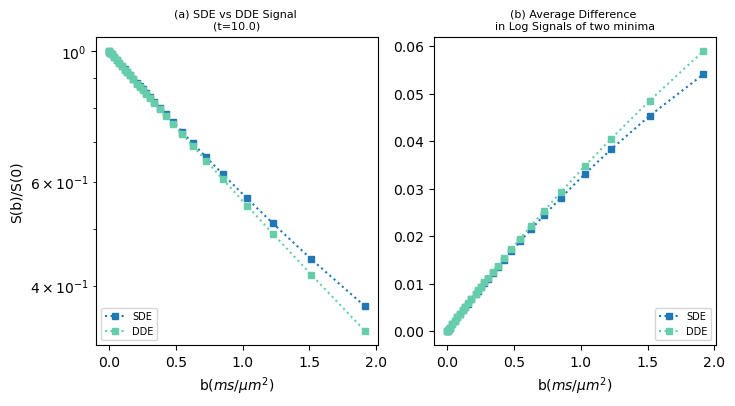
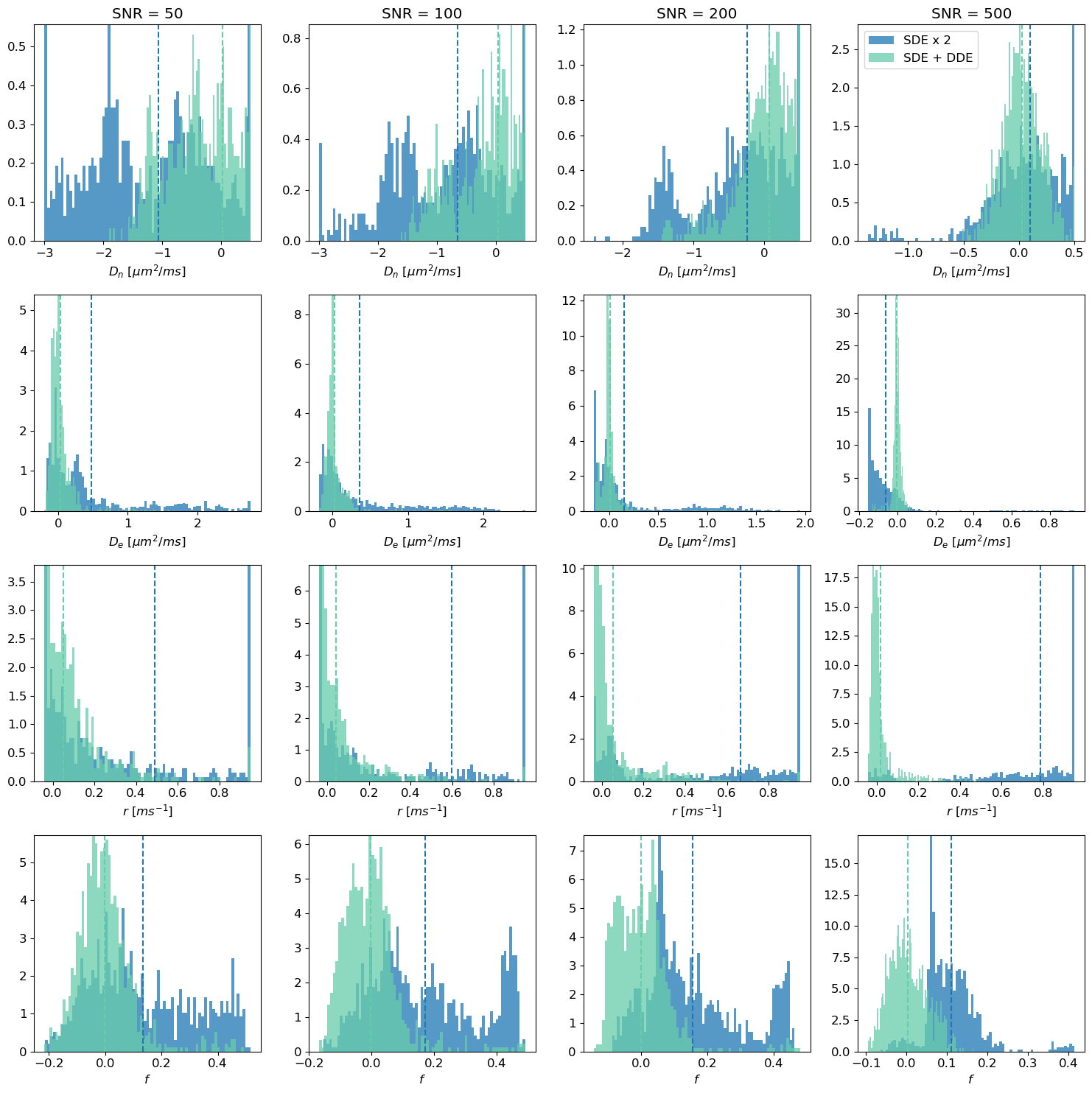
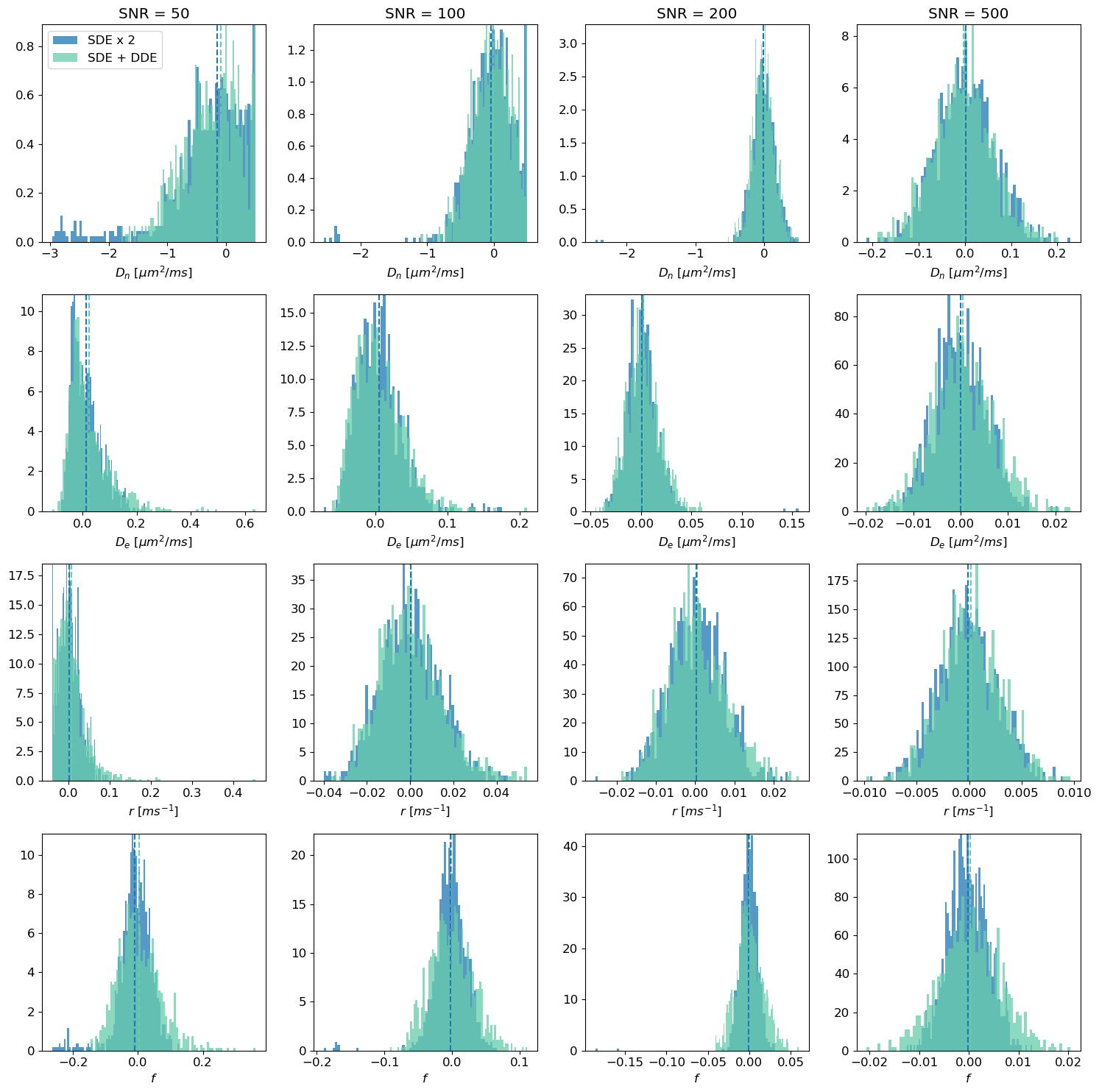
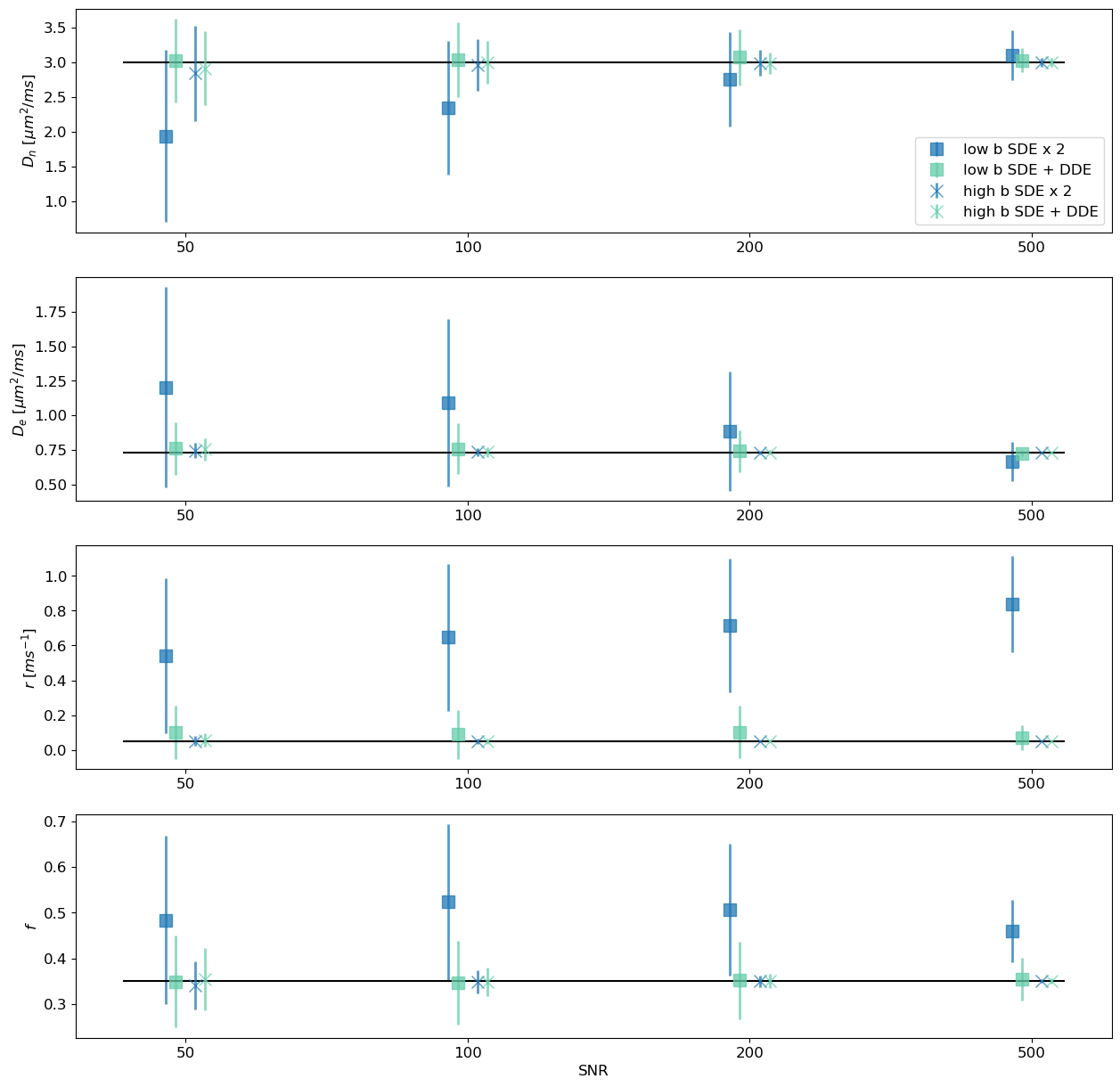
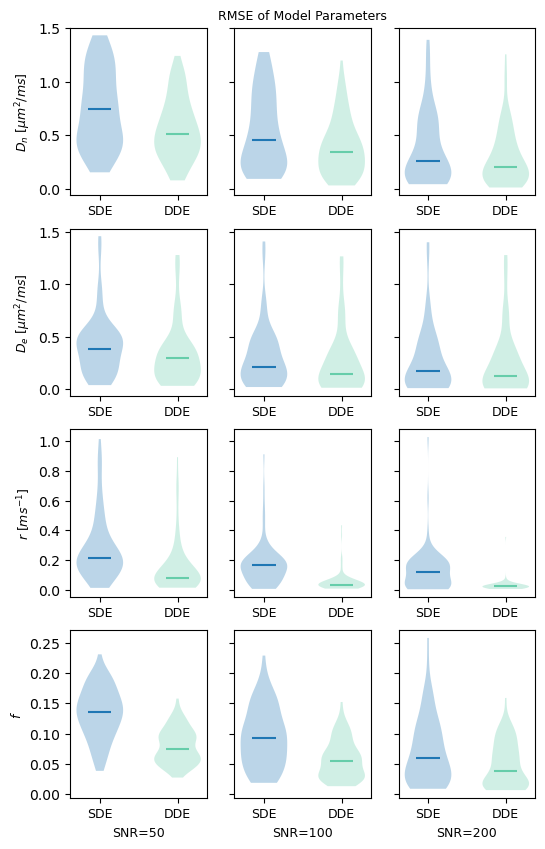
Fig. 1a shows examples of diffusion signals for SDE and DDE at low b, illustrating the additional information in DDE. Fig. 1b shows average log signal differences between true and spurious model parameters over multiple ground truths. Although planar encoding shows a larger difference, the main effect is achieved with increasing b. Nevertheless, histograms of the errors in estimated parameter in Fig. 2 shows that the additional experimental dimensions added with DDE improves parameter estimation substantially. Similar histograms are shown in Fig. 3 for the high b protocol. For this ground truth, SDE and DDE have similar performance. Fig. 4 shows the resulting errors in each of the parameters as a function of SNR. Finally, Fig. 5 shows the distribution of RMSE for the high b protocol and a wide range of plausible ground truths, again highlighting the increased precision of DDE protocols. For the estimation of exchange rate in particular, DDE shows considerably more precision at all SNR levels.Discussion
We showed that adding DDE to the acquisition protocol resolves a degeneracy in SMEX parameter estimation. In practice, this degeneracy is lifted for SDE at very low b, yet the additional experimental dimensions in DDE lead to improvements in parameter estimation. The impact of the number of measurements and combination of different tensor encoding schemes will be further explored in a protocol optimization study8,16 and validated on in-vivo as well as ex-vivo data.Conclusion
Tensor encoding resolves an intrinsic degeneracy in estimation of SMEX/NEXI parameters, and increases accuracy and precision in the presence of noise. This may lead to shorter protocols and more feasible SMEX protocols for clinical scanners.Acknowledgements
NG and SNJ are supported by the Lundbeck foundation grant R396-2022-183.References
[1] J. L. Olesen, L. Østergaard, N. Shemesh, and S. N. Jespersen, “Diffusion time dependence, power-law scaling, and exchange in gray matter,” NeuroImage, vol. 251, p. 118976, 2022.
[2] I. O. Jelescu, A. de Skowronski, F. Geffroy, M. Palombo, and D. S. Novikov, “Neurite exchange imaging (NEXI): A minimal model of diffusion in gray matter with inter-compartment water exchange,” NeuroImage, vol. 256, p. 119277, 2022.
[3] D. S. Novikov, V. G. Kiselev, and S. N. Jespersen, “On modeling, ”Magn Reson Med, vol. 79, no. 6, pp. 3172–3193, 2018.
[4] D. S. Novikov, E. Fieremans, S. N. Jespersen, and V. G. Kiselev, “Quantifying brain microstructure with diffusion MRI: Theory and parameter estimation,” NMR Biomed, vol. 32, no. 4, p. e3998, 2019.
[5] I. O. Jelescu, J. Veraart, E. Fieremans, and D. S. Novikov, “Degeneracy in model parameter estimation for multi-compartmental diffusion in neuronal tissue,” NMR Biomed, vol. 29, no. 1, pp. 33–47, 2016.
[6] D. S. Novikov, J. Veraart, I. O. Jelescu, and E. Fieremans, “Rotationally-invariant mapping of scalar and orientational metrics of neuronal microstructure with diffusion MRI,” NeuroImage, vol. 174, pp. 518–538, 2018.
[7] S. Coelho, J. M. Pozo, S. N. Jespersen, D. K. Jones, and A. F. Frangi, “Resolving degeneracy in diffusion MRI biophysical model parameter estimation using double diffusion encoding,” Magn Reson Med, vol. 82, no. 1, pp. 395–410, 2019.
[8] S. Coelho, S. H. Baete, G. Lemberskiy, B. Ades-Aron, G. Barrol, J. Veraart, D. S. Novikov, and E. Fieremans, “Reproducibility of the standard model of diffusion in white matter on clinical MRI systems,” NeuroImage, vol. 257, p. 119290, 2022.
[9] M. Reisert, V. G. Kiselev, and B. Dhital, “A unique analytical solution of the white matter standard model using linear and planar encodings, ”Magn Reson Med, 2019.
[10] B. Lampinen, F. Szczepankiewicz, J. Martensson, D. van Westen, P. C. Sundgren, and M. Nilsson, “Neurite density imaging versus imaging of microscopic anisotropy in diffusion MRI: A model comparison using spherical tensor encoding,” NeuroImage, vol. 147, pp. 517–531, 2017.
[11] C. F. Westin, F. Szczepankiewicz, O. Pasternak, E. Özarslan, D. Topgaard, H. Knutsson, and M. Nilsson, “Measurement tensors in diffusion MRI: generalizing the concept of diffusion encoding,” Med Image Comput Comput Assist Interv, vol. 17, no. Pt 3, pp. 209–16,2014.
[12] J. Kärger, “NMR self-diffusion studies in heterogeneous systems,” Advances in Colloid and Interface Science, vol. 23, no. 1-4, pp. 129–148, 1985.
[13] E. Fieremans, D. S. Novikov, J. H. Jensen, and J. A. Helpern, “Monte Carlo study of a two-compartment exchange model of diffusion,” NMR Biomed, vol. 23, no. 7, pp. 711–24, 2010.
[14] M. Nilsson, D. van Westen, F. Ståhlberg, P. C. Sundgren, and J. Lätt, “The role of tissue microstructure and water exchange in biophysical modelling of diffusion in white matter,” Magma, vol. 26, no. 4, pp. 345–70, 2013.
[15] S. N. Jespersen, “Equivalence of double and single wave vector diffusion contrast at low diffusion weighting,” NMR Biomed, vol. 25, no. 6, pp. 813–8, 2012.
[16] S. Coelho, J. M. Pozo, S. N. Jespersen, A. F. Frangi, D. Shen, T. Liu, T. M. Peters, L. H. Staib, C. Essert, S. Zhou, P.-T. Yap, and A. Khan, “Optimal experimental design for biophysical modelling in multidimensional diffusion MRI,” MICCAI 2019, pp. 617–625, 2019.
Figures