0937
NEXI for the quantification of human gray matter microstructure on a clinical MRI scanner1Department of Radiology, CHUV, Lausanne, Switzerland, 2UNIL, Lausanne, Switzerland, 3Siemens Healthcare GmbH, Erlangen, Germany, 4Advanced Clinical Imaging Technology, Siemens Healthineers International AG, Lausanne, Switzerland, 5CIBM Center for Biomedical Imaging, Geneva, Switzerland, 6Center of Functionally Integrative Neuroscience (CFIN) & MINDLab, Department of Clinical Medicine, Aarhus University, Aarhus, Denmark
Synopsis
Keywords: Microstructure, Diffusion/other diffusion imaging techniques, Diffusion modeling, Quantitative imaging, Tissue characterization
Motivation: This study assesses the Neurite Exchange Imaging (NEXI) microstructure model in human cortex using clinical MRI data, addressing the model's clinical applicability.
Goal(s): How meaningful, robust, and reproducible are microstructural properties in the human cortex estimated using the NEXI diffusion model on clinical data?
Approach: Scan-rescan clinical data from six volunteers were collected and processed. NEXI was estimated and compared to expected cortical distributions and to the myelin water fraction distribution.
Results: NEXI provided robust, biologically plausible results and maintained inter-subject sensitivity and intra-subject reproducibility. A significant correlation between exchange time and myelin water fraction supports the relationship between membrane permeability and myelination.
Impact: We successfully estimate the Neurite Exchange Imaging (NEXI) model on clinical MRI data and report a strong correlation between the estimated exchange time, a proxy for membrane permeability, and the Myelin Water Fraction in the human cortex.
Background
NEXI1 (or SMEX2) is a two-compartment diffusion model of gray matter (GM) microstructure that accounts for inter-compartment exchange. Its parameters are the inter-compartment exchange time tex, the intra and extra-neurite apparent diffusivities Di and De and the intra-neurite signal fraction f. The narrow-pulse approximation (δ→0) enables an analytical fit using, e.g. standard non-linear least squares (NLS), and is a valid approximation for data acquired on preclinical scanners, on which NEXI was first demonstrated in vivo1 and ex vivo2. Accounting for the actual wide diffusion pulses in the model equations has significant relevance for data acquired on clinical scanners. Here, we aimed to test the performance of NEXI in the human cortex in vivo on a clinical MRI scanner. We compared parameter estimates obtained using the Narrow Pulse Approximation (NEXINPA)1 or the Actual Wide Pulses (NEXIAWP)2 to literature values, and related tex estimates with the myelin water fraction obtained by multicomponent T2 relaxation analysis3, assuming the exchange time mirrors permeability, and is related to myelination.Methods
Clinical data: Six healthy volunteers (3M, 26.5±1.1 years old) were scanned on a 3T system with 80 mT/m gradients (MAGNETOM Prisma, Siemens Healthcare, Erlangen, Germany), five of whom were rescanned on a different day. Acquisition: An MPRAGE was acquired for anatomical reference (1-mm isotropic resolution). Diffusion-weighted images were acquired using a PGSE-EPI research sequence with the following parameters: b-values=1.00, 2.00, 3.20, 4.44 and 5.00ms/µm², 20 directions per shell, diffusion times Δ=28.3, 36.0, 45.0, 55.0 and 65.0ms, δ=16.5ms, 4 b=0 images, spatial resolution=2x2x2 mm3, total scan time: 35min. Multi-echo T2 data were collected using a 3D multi-echo accelerated gradient and spin echo (GRASE) research application sequence4 with voxel-size=1.8x1.8x1.8mm3; ΔTE/N-echoes=10.94ms/32; TR=1s, N-slices=76.Processing: Multi-shell multi-diffusion time data were preprocessed jointly; steps included MP-PCA magnitude denoising5, Gibbs ringing6, distortion and Eddy current corrections7. The gray matter region of interests (ROIs) from the Desikan-Killiany-Tourville atlas8 were segmented on the MPRAGE image using FastSurfer9 and projected onto the diffusion native space using linear registration10. Parametric maps of NEXINPA or NEXIAWP, both corrected for Rician Mean11, were estimated from the powder-average signals using non-linear least-squares. Myelin Water Fractions (MWF) were estimated using the L-curve-I non-parametric T2 relaxometry method for myelin water quantification3. The spatial distribution of NEXI features was also examined using inflated brain surfaces obtained using Connectome Workbench12.
Results and discussion
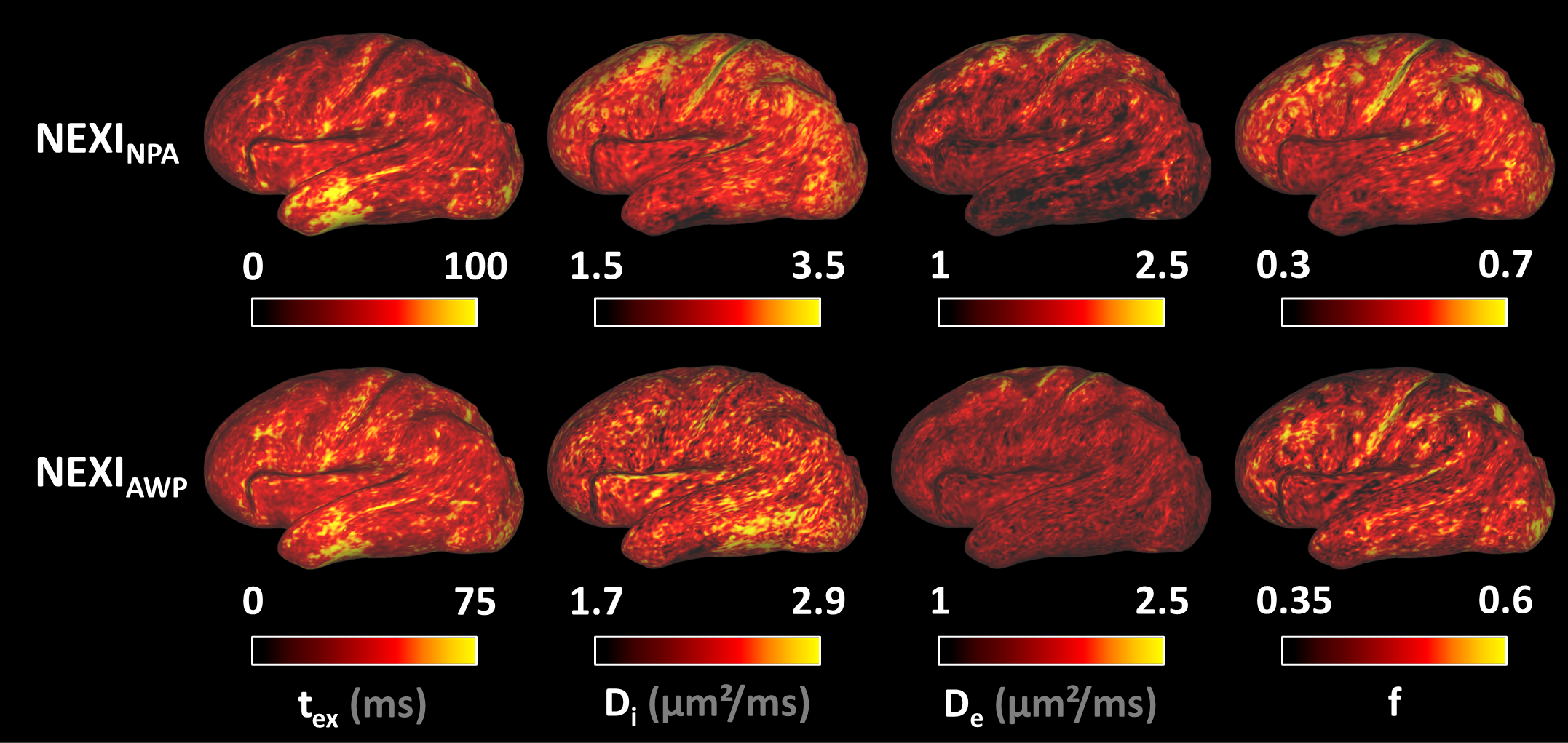
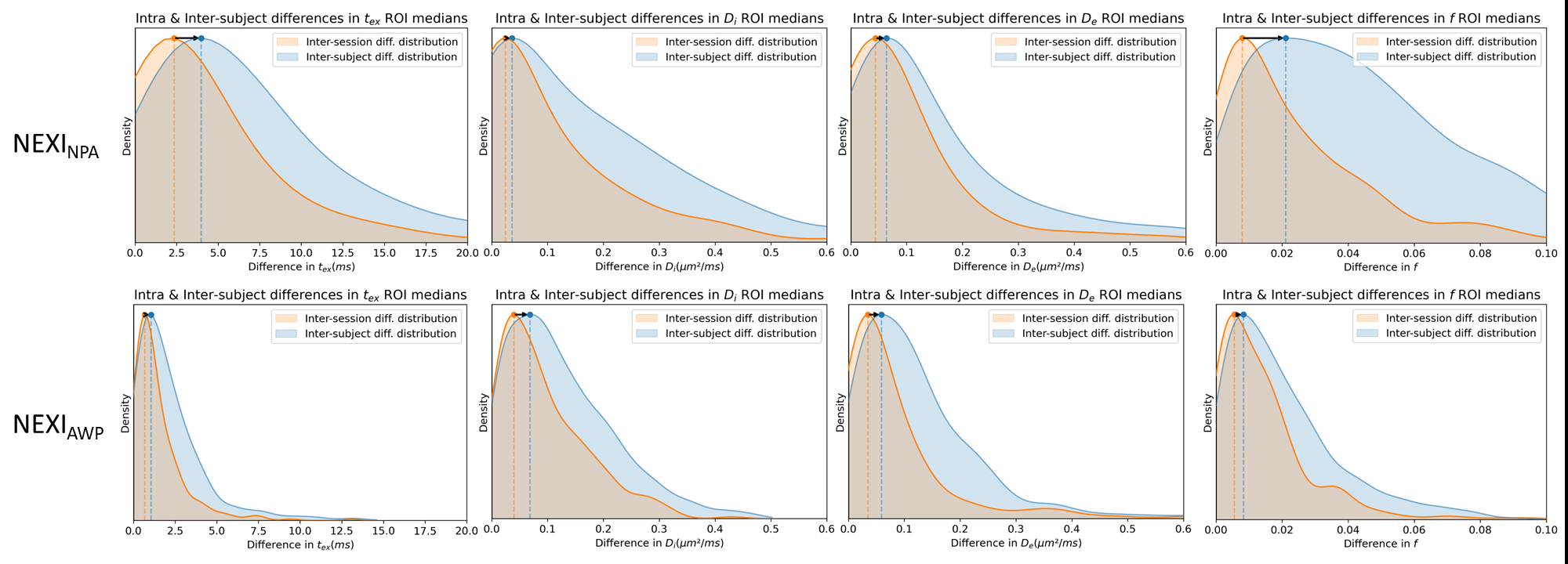
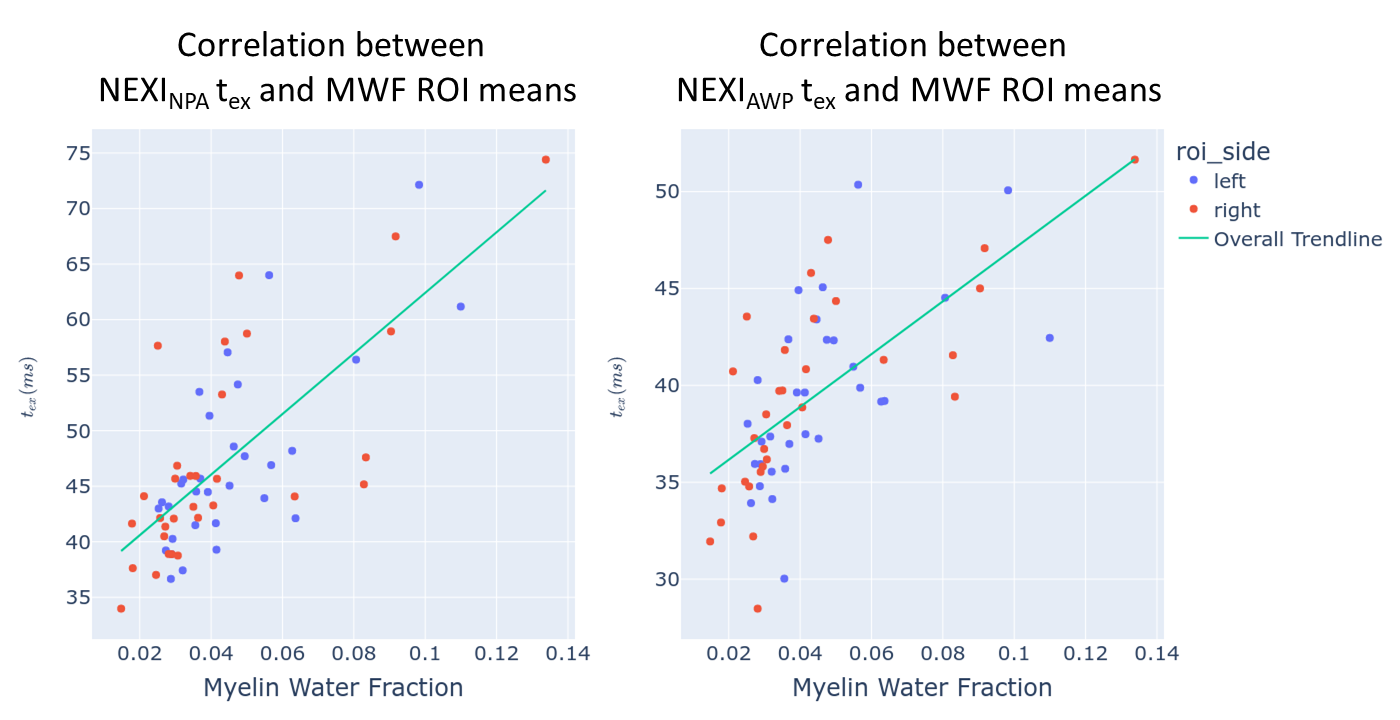
Despite δ being over half of the shortest Δ, NEXINPA and NEXIAWP yielded reasonably similar estimates (Fig. 1): tex ranged 10-30ms, in line with estimates in human gray matter11,13,14 and rat cortex in vivo1, particularly for NEXIAWP. Neurite fraction ranged 0.42-0.46, was the most robust across models and similar to that obtained in humans on a Connectom scanner11. Di was lower with NEXIAWP and overall more biologically plausible15,16, as the NEXINPA estimate exceeds the value in free water. The two versions of NEXI show almost identical patterns across the cortical surface (Fig. 2), in particular higher f in the visual cortex, but also and especially in the motor cortex, which was less apparent in a previous study on Connectom11. Importantly, these NEXI implementations on clinical data retain sensitivity to individual differences and high intra-subject reproducibility (Fig. 3). However, NEXIAWP parameter estimates have a lower variance than NEXINPA ones (Fig. 1). This smaller variance also reduces NEXINPA sensitivity to individual differences, mainly for f (Fig. 3). Finally, we report a significant positive correlation (NEXINPA: r=.73, p<.0001; NEXIAWP: r=.67, p<.0001) between the mean tex and the mean MWF estimated in each cortical ROI (Fig. 4). This agreement suggests the exchange time estimated using NEXI is a reasonable proxy for membrane permeability, which is expected to decrease with myelination. A significant positive correlation with MWF was also found for De (NEXINPA: r=.49, p<.0001; NEXIAWP: r=.68, p<.0001), which may be consistent with myelinated axons/dendrites showing a more coherent organization and faster overall extra-cellular diffusivity. Correlations between MWF and f or Di were non-significant. It remains, however, to be determined how populations with different NEXI parameter values within a voxel would be reflected by a single exchange time estimate.Conclusion
NEXI was successfully estimated in the human cortex on data acquired on a clinical scanner. Results are consistent with previous findings in human gray matter and from in vivo imaging in the rat cortex and display previously observed patterns. The NEXIAWP version, which includes wide diffusion pulses, yields more robust and biologically plausible results, but perhaps with challenging sensitivity to individual differences. Strong correlation of tex with the Myelin Water Fraction is consistent with expected relationship between cell membrane permeability and myelination.Acknowledgements
QU, TP and IJ are supported by SNSF Eccellenza grant PCEFP2_194260.References
[1] Jelescu, NeuroImage 2022 [2] Olesen, NeuroImage 2022 [3] Canales-Rodríguez, Medical Image Analysis 2021 [4] Piredda, MRM 2020 [5] Veerart, NeuroImage 2016 [6] Kellner, MRM 2016 [7] Andersson, NeuroImage 2016 [8] Klein and Tourville, Frontiers in Neuroscience 2012 [9] Henschel, NeuroImage 2020 [10] Avants et al., Insight j, 2009 [11] Uhl, Arxiv 2023 [12] Marcus, Frontiers in Neuroinformatics 2011 [13] Lee, NeuroImage 2020, [14] Veraart, eLife 2020 [15] Dhital, NeuroImage 2019 [16] Howard, NeuroImage 2022Figures
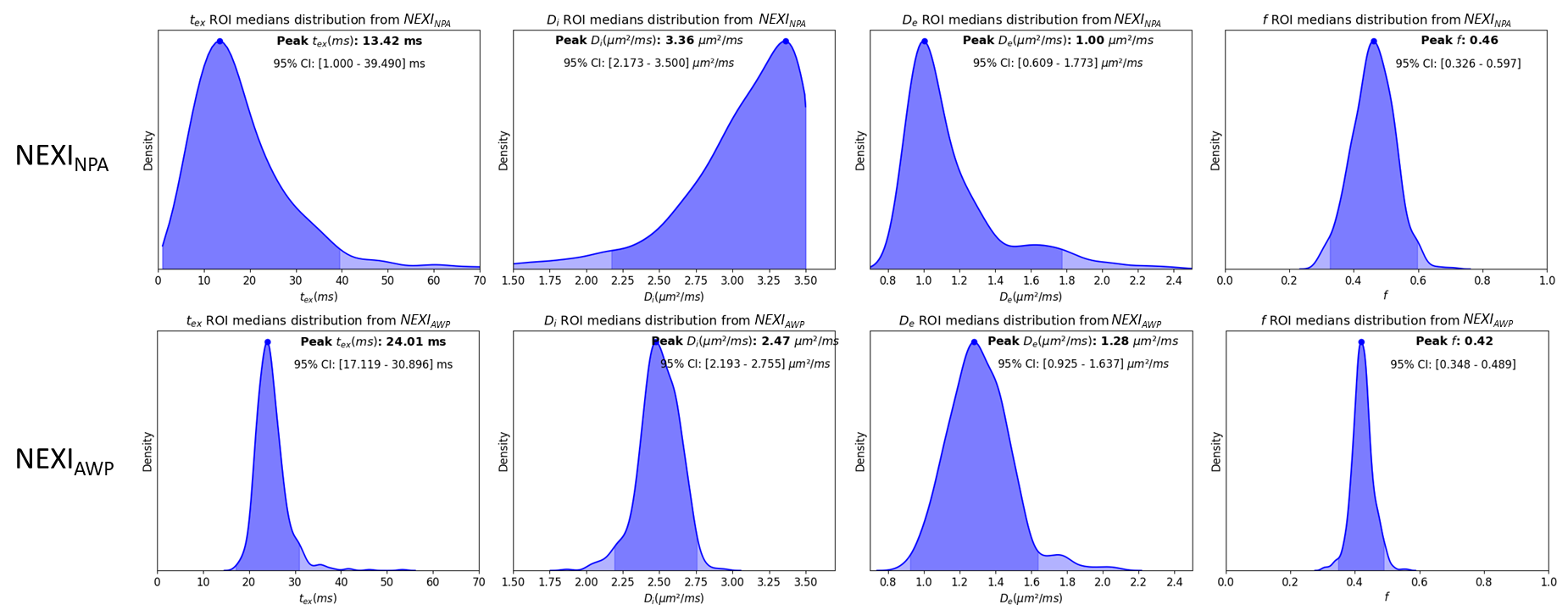
Histograms of the medians of NEXI parameters using the Narrow Pulse Approximation (NEXINPA) or the Actual Wide Pulses (NEXIAWP) in each ROI from the DKT atlas. Median values reduce the impact of outliers from partial volume with either subcortical white matter or CSF. The NEXINPA distributions are wider than those of NEXIAWP. The peak value of Di is more realistic for NEXIAWP. The peak value of tex is higher for NEXIAWP. The peaks of De and f are more stable from one version to another.