0925
Low-rank reconstruction for simultaneous Double-Half-Echo 23Na and undersampled 23Na Multi-Quantum Coherences MRI1Computer Assisted Clinical Medicine, Medical Faculty Mannheim, Heidelberg University, Mannheim, Germany, 2Mannheim Institute for Intelligent Systems in Medicine, Medical Faculty Mannheim, Heidelberg University, Mannheim, Germany, 3CNRS, CRMBM, Aix-Marseille Université, Marseille, France, 4APHM, Hôpital Universitaire Timone, CEMEREM, Marseille, France
Synopsis
Keywords: Non-Proton, Non-Proton, low-rank matrix completion, sequence optimization
Motivation: Sodium (23Na) Multi-Quantum Coherences (MQC) MRI potentially provides richer tissue information. However, 3D 23Na multi-quantum coherences imaging lacks conventional 23Na MRI resolution and requires multiple radiofrequency phase-cycling limiting spatial resolution.
Goal(s): We propose an efficient sequence to simultaneously acquire Cartesian double-half echo (DHE) 23Na and accelerated 23Na MQC MRI.
Approach: Leveraging advanced low-rank matrix completion frameworks to enable simultaneous DHE 23Na and 23Na MQC MRI were tested on numerical simulations, retro- and prospectively undersampled phantom and in vivo brain data acquired at 7T.
Results: Simultaneous Cartesian 23Na and higher resolution 3-fold prospectively undersampled 23Na MQC brain MRI of 4 volunteers were obtained.
Impact: The new sequence, in combination with the low-rank reconstruction frameworks, enables efficient 23Na and higher resolution 23Na MQC MRI while supporting conventional 1H-based acceleration techniques and offers, therefore, a convenient sequence for the sodium MRI community.
Introduction
Conventional sodium (23Na) MRI is an emerging tool to probe tissue ionic homeostasis by quantifying tissue sodium concentration (TSC) associated with cell vitality. However, thanks to its 3/2 spin, 23Na multi-quantum coherences MRI enables disentangling the underlying multi-quantum coherences (MQC) and therefore, holds potentially richer sodium tissue characterization. Nevertheless, 23Na MQC MRI is slow due to the necessity of RF phase-cycling, limiting spatial resolution. Furthermore, 23Na MQC MRI lacks conventional 23Na MRI resolution. However, 23Na MQC MRI consists of a 3D volumetric acquisition sampled along the echo time by leveraging phase-cycling, creating highly redundant signal subspaces.Herein, we aim to tackle two major challenges of 23Na MQC MRI. First, we developed an efficient sequence to obtain conventional 23Na and 23Na MQC MRI simultaneously. The sequence is based on Cartesian sampling. For the first time, we demonstrate the DHE technique to acquire conventional Cartesian sodium images with very short echo times and simultaneously higher resolution, prospectively undersampled Cartesian 23Na MQC MRI. 23Na and 23Na MQC MRI were reconstructed by leveraging the data's intrinsic redundancy.
Methods
All measurements were performed on a 7T MRI (Siemens Terra) with a bird-cage dual-tuned 23Na/1H head coil (RapidBiomedical). 23Na MQC MR images were obtained using a modified CRISTINA1 sequence with the following parameters.For brain in-vivo, 3 healthy volunteers, FoV 240x240x210mm3, 23Na DHE: matrix size 40x40x40mm3, TE=0.6ms; 23Na MQC: matrix size 30x30x26, τ=10ms, BW=330Hz/px, TE/ΔTE/nTE=1.1/4.2ms/10,TR=200ms resulting in TA=2x23min.
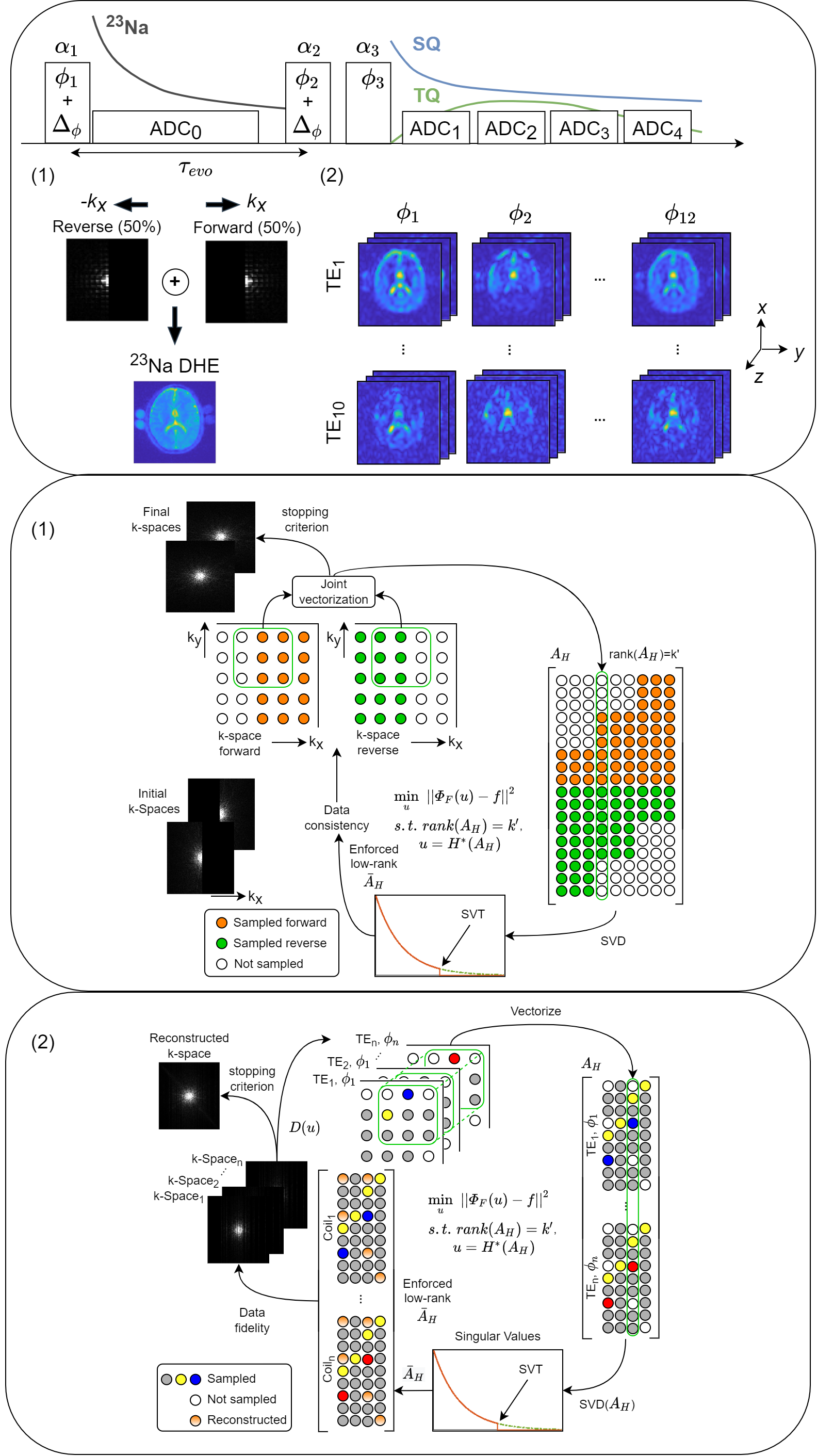
Image reconstruction: For 23Na MRI, the DHE technique leverages strong asymmetric echoes to start sampling at the k-space center. However, the DHE2 technique requires two k-space halves (forward and reverse) to obtain a full k-space line. A low-rank coupling constraint concatenates both lines to form a fully sampled k-space matrix by solving the following optimization problem $$\overset{min}{u} ||\varPhi_F(u) - f||^2 + \lambda_{WT}||\varPsi_F(u)||_1 s.t. rank(A_H)= k', u=H^*(A_H)$$ 23Na MQC data was prospectively undersampled via variable density, by a factor R=3. 23Na MQC MRI exhibits a 5D multi-dimensional space, which is highly redundant. Projecting this signal matrix onto a structured 2D matrix enables efficient exploitation of coherent information. 23Na MQC MRI was reconstructed utilizing the SAKE3 framework solving the following optimization problem $$ \overset{min}{u} ||\varPhi_F(D_{TE,φ}(u)) - f||^2 s.t. rank(A_H)= k', u=H^*(A_H)$$ with $$$\varPhi_F$$$ being the structured Fourier sampling operator with the extension of $$$D_{TE,φ}$$$ that relates the 5D MQC signal structure to the 4D k-space that is exploited for coherent information. $$$\varPsi_F$$$ is the Wavelet transform with the sparsity weighting $$$\lambda_{WT}$$$, $$$u$$$ is the image to reconstruct and $$$f$$$ is the sampled k-space data in the fidelity term. Prior rank $$$k'$$$ is chosen to enforce low-rankness and $$$H^*$$$ is the inverse matrix operator to invert the Hankel-like structured matrix, $$$A_H$$$. SAKE reconstructed images were compared with 5D CS4. The sequence and image reconstruction workflow are given in Figure 1. Phase-cycled 23Na MQC raw data were processed as Fleysher et al5 proposed and in vivo TSC estimation was based on the CSF6.
Results
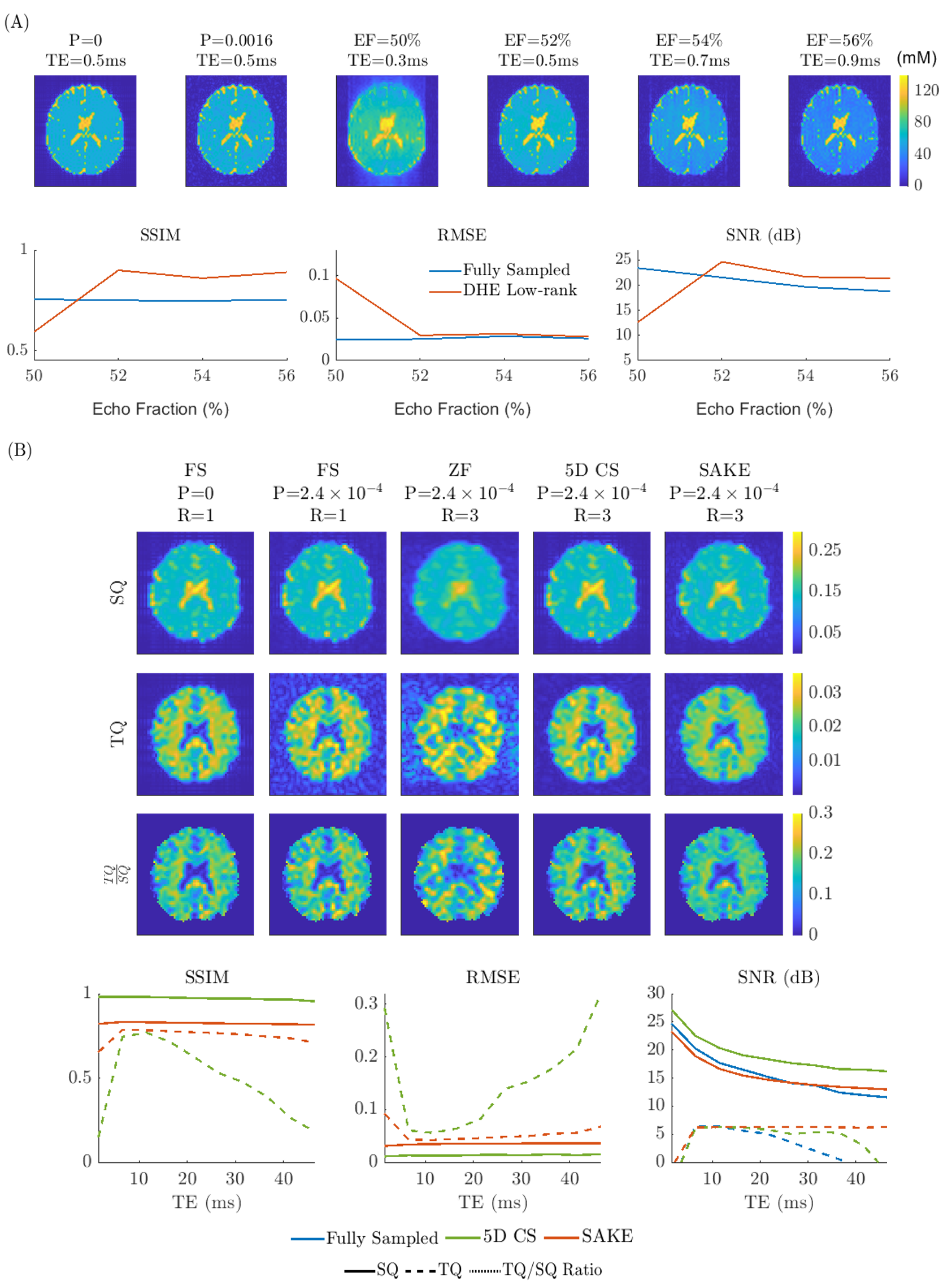
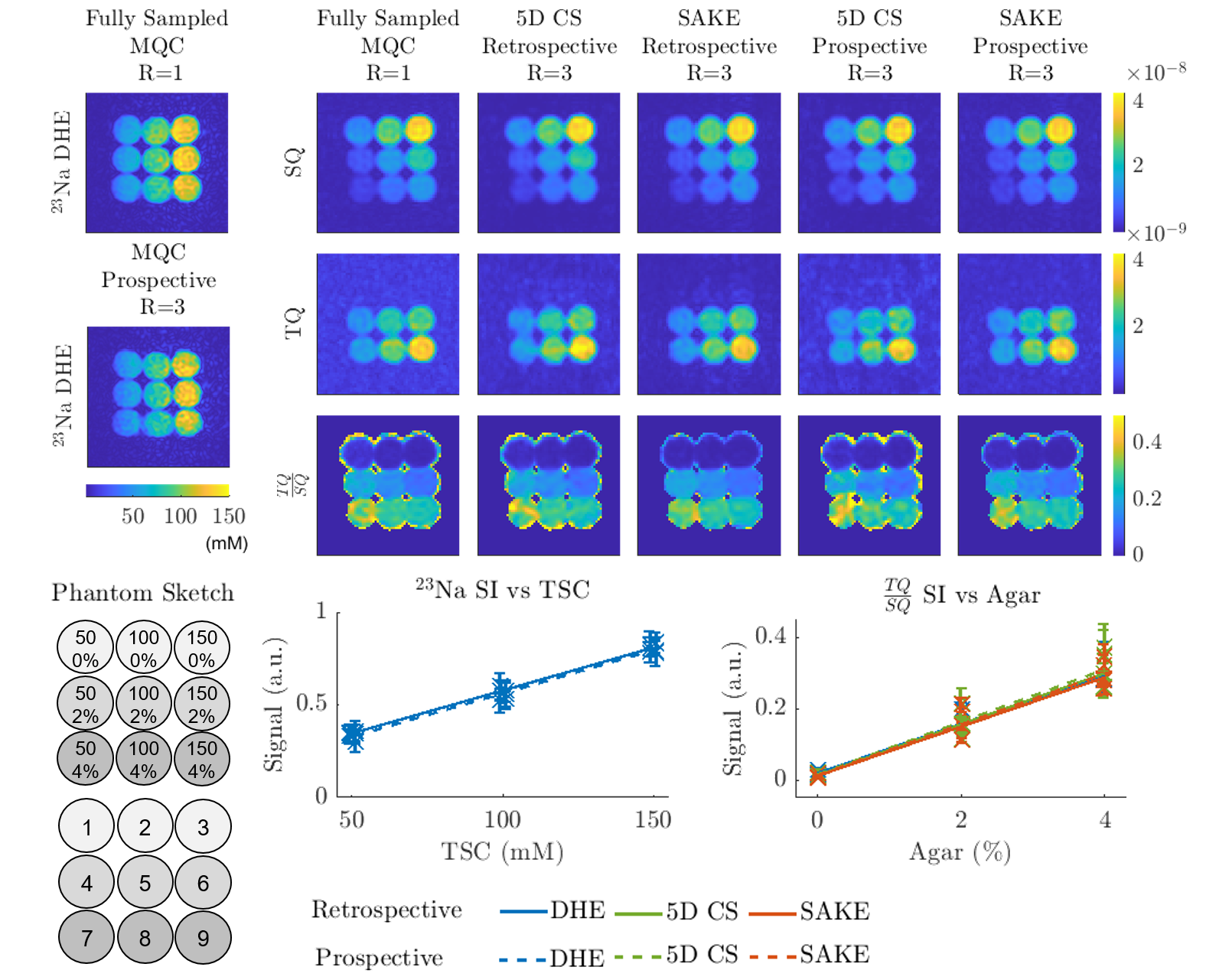
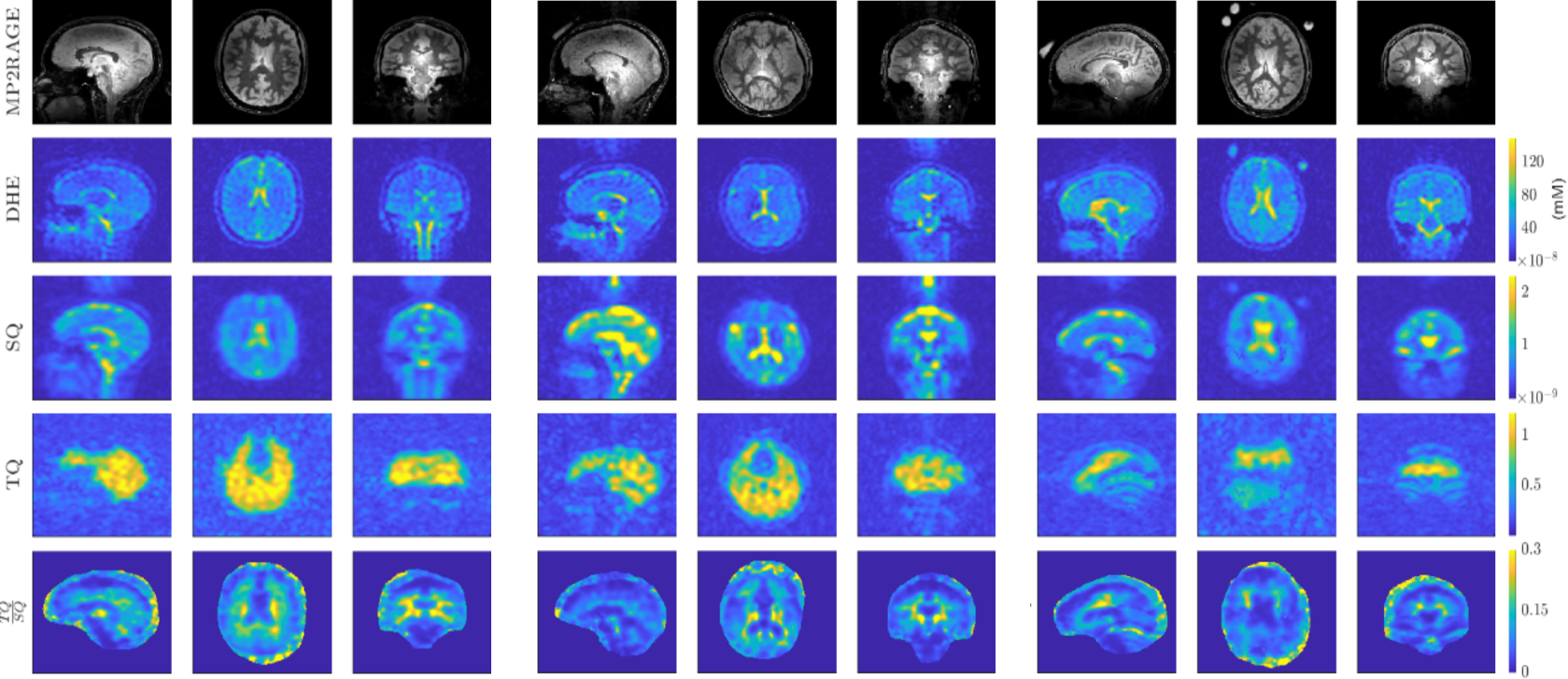
Fig.2: Simulations of DHE reconstruction revealed an optimal echo fraction (EF) of 52% with SSIM=0.90, RMSE=0.029 and improved SNR by 14% when compared to fully sampled noisy data, with TSC values being on par. SAKE improved 23Na TQ signal reconstruction, especially for later echoes (TE5=20 ms to TE10=46 ms), SAKE improved SSIM by 80% and reduced RMSE by 3-fold on average. Fig.3: The phantom study revealed accurate TSC (DHE image), SQ and TQ signal intensities, and SAKE increased SNR for the TQ image by ~10% compared to 5D CS. Linear regression confirmed accurate signal intensity versus prior known NaCl (DHE, R2=0.99) and agar concentrations (TQ/SQ, R2=0.92) for retro- and prospectively undersampled data. Fig.4: In vivo study revealed accurate 23Na and prospectively undersampled 23Na MQC image reconstruction. TSC was 37±11 in WM, 41±9 in GM and 134±23 in CSF, respectively. TQ/SQ ratio was found to be 0.11±0.03 in WM, 0.09±0.02 in GM and 0.05±0.01 in CSF, respectively.Discussion & Conclusion
Maintaining Cartesian acquisitions, which are reliable and reproducible, a dual conventional and multi-quantum coherence sodium MRI sequence was proposed using low-rank approaches. First, double-half echoes for conventional 23Na MRI can be combined by exploiting correlations along the rows due to the low-rankness projection. Second, due to the MQC signal's intrinsic redundancy, the SAKE framework is well suited to reconstruct undersampled 23Na MQC data. We have further demonstrated that despite prospective undersampling, reliable TQ/SQ ratio maps were reconstructed, which shows the potential of TQ/SQ representing an additional quantitative parameter besides TSC.Conclusively, we demonstrated simultaneous Cartesian 23Na DHE and 23Na MQC MRI, with 23Na MQC MRI prospectively undersampled by leveraging two low-rank reconstruction frameworks.
Acknowledgements
Lothar R Schad and Stanislas Rapacchi contributed equally to this work.
This work was supported by ISMRM Research Exchange 2022.
This work was supported by PROCOPE Mobility 2022.
This study received funding from the French government under the “Programme d'Investissement d'Avenir”, Excellence Initiative of Aix-Marseille University-A*MIDEX (AMX-19IET-004), 7 TEAMS Chair.
References
1. Hoesl, MAU, Schad, LR, Rapacchi, S. Efficient 23Na triple-quantum signal imaging on clinical scanners: Cartesian imaging of single and triple-quantum 23Na (CRISTINA). Magn Reson Med. 2020; 84: 2412–2428.
2. Bydder, M, Ali, F, Ghodrati, V, Hu, P, Yao, J, Ellingson, BM. Minimizing echo and repetition times in magnetic resonance imaging using a double half-echo k-space acquisition and low-rank reconstruction. NMR in Biomedicine. 2021; 34:e4458.
3. Shin, P.J., Larson, P.E.Z., Ohliger, M.A., Elad, M., Pauly, J.M., Vigneron, D.B. and Lustig, M. (2014), Calibrationless parallel imaging reconstruction based on structured low-rank matrix completion. Magn. Reson. Med., 72: 959-970.
4. Licht, C., Reichert, S., Guye, M., Schad, LR, Rapacchi, S. Multidimensional compressed sensing to advance 23Na multi-quantum coherences MRI. Magn Reson Med. 2023; 1-16.
5. Fleysher, L., Oesingmann, N. and Inglese, M. (2010), B0 inhomogeneity-insensitive triple-quantum-filtered sodium imaging using a 12-step phase-cycling scheme. NMR Biomed., 23: 1191-1198.
6. Adlung, A. et al. Quantification of tissue sodium concentration in the ischemic stroke: A comparison between external and internal references for 23Na MRI. Journal of neuroscience methods vol. 382 (2022): 109721.
Figures