0907
A Magnetic Vector Potential-Based Linear Predictor to Increase Peripheral Nerve Stimulation Thresholds in Gradient Coil Design1Department of Biomedical Engineering, Zhejiang University, Hangzhou, China, 2Center for Intelligent Biomedical Instrumentation, Zhejiang University Binjiang Research Institute, Hangzhou, China, 3United Imaging Healthcare Co., Ltd, Shanghai, China, 4Beijing United Imaging Research Institute of Intelligent Imaging, Beijing, China
Synopsis
Keywords: Gradients, Gradients, Gradient coil design, peripheral nerve stimulation, MRI safety
Motivation: The linear predictor incorporating a coupled electromagnetic-neurodynamic model shows reliable estimation of Peripheral Nerve Stimulation (PNS) thresholds, which is important for gradient coil design. However, the computational complexity and long computation time within the coupled model leads to difficulties in application.
Goal(s): We proposed a simplified predictor based on the spatial distribution of magnetic fields, circumventing complexity of the coupled model.
Approach: The magnetic vector potential was employed to form a simplified predictor, serving as a constraint for PNS-optimized gradient coil design.
Results: With the simplified predictor, the optimized coil achieved an 84% increase in PNS threshold at a 10% inductance penalty.
Impact: Based on the magnetic vector potential, the proposed predictor enabled the simplified evaluation of PNS thresholds through magnetic field spatial distribution. In addition, the proposed method facilitated PNS optimization in gradient coil design.
Introduction
Peripheral Nerve Stimulation (PNS) induced by MRI gradient switching poses challenges for high-performance MRI applications1, 2. Incorporating PNS-informed linear predictors as constraints during coil design has proven effective in elevating PNS thresholds3, 4. The PNS oracle5 is a useful linear predictor to evaluate PNS thresholds, but the inclusion of numerous computations within the coupled electromagnetic-neurodynamic model results in a cumbersome application. To facilitate PNS assessment, we proposed a linear threshold predictor based on the magnetic vector potential (A-field) as a simplified substitute of PNS oracle and investigated its effectiveness in augmenting PNS thresholds during coil design.Methods
The proposed A-field-based Linear Threshold Predictor (ALTP) in this work provided a precise evaluation of PNS thresholds based on the A-field distribution. The predictor was derived through the subsequent steps: A. Construct an A-field-based Activating Function (AAF) to approximate the spatial derivative of the induced electric field (E-field) projected onto peripheral nerves. B. Determine the relationship between AAF and the reciprocal of PNS thresholds through linear fitting analysis. The obtained ALTP served as a linear constraint facilitating the PNS-optimized gradient coil design. The specific details of the work are as follows:AAF construction: Given the reciprocal relationship between the spatial derivative of the induced E-field projection and PNS threshold6, we utilized AAF to approximately calculate this derivative (defined as the activating function) for PNS assessment. The AAF was characterized as a weighted summation of A-field gradient components. To solve for the weighting coefficients within the AAF, we assumed a set of three-layer asymmetric head gradient coils (Fig. 1) designed by adjusting the magnitude of A-field gradient or B-field at PNS-sensitive target points. Afterward, we formulated a system of equations to compute the activating function values using the A-field gradient components. This resulted in the construction of an overdetermined system. The unknown weighting coefficients were then solved through a least squares method.
Linear fitting analysis: Linear fitting analysis was employed to determine the relationship between AAF and PNS threshold. AAF values were computed with the A-field distribution, and PNS thresholds were simulated through the McIntyre-Richardson-Grill (MRG) neurodynamic model7 (Fig. 2) using the Sim4Life software8. Subsequently, a correlation analysis was performed to determine the linear coefficients between AAF and the reciprocal of PNS threshold. Based on the results, we defined ALTP as the reciprocal of PNS threshold calculated through AAF, which was then applied to PNS assessment and gradient coil design.
PNS-optimized gradient coil design: The PNS simulation and coil design in this work used the X-coil as an example. Considering that PNS thresholds are primarily influenced by the PNS-sensitivity of specific target points, the ALTP values at these critical sites were used to establish a set of constraint equations. As linear constraints, these equations were subsequently incorporated into a finite difference-based design method8 to develop gradient coils with elevated PNS thresholds.
Results
Fig. 3(A) depicts the convergence of the overdetermined equations to compute the weighting coefficients within the AAF. Utilizing over 11 pre-designed coil configurations, the AAF values closely approximate the activating function (maximum estimating error < 1%). Fig. 3(B) shows that the activating function linearly correlated with reciprocal of PNS threshold obtained from the regular coupled model. A higher slope suggests that the head target points exhibit greater sensitivity to variations in the activating function. However, the narrower range of values also indicates a lower potential for optimizing PNS properties at head target points.Fig. 4 presents the winding patterns and linearity deviations of the designed coils with and without PNS constraint. Although the winding patterns vary between the two designs, both designs meet the specified design target (linearity deviation ≤ 5%).
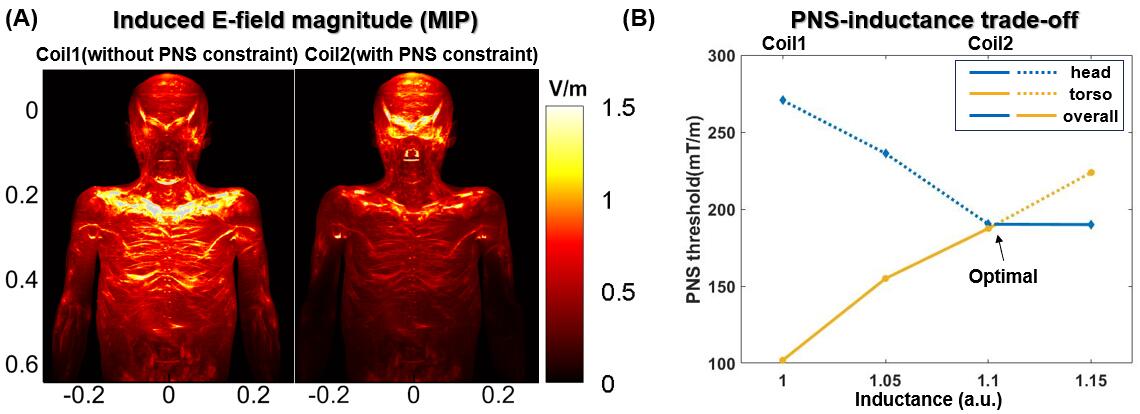
Fig. 5 (A) shows the induced E-field magnitude with and without PNS constraint, and Fig. 5(B) illustrates the trade-off between the PNS thresholds and coil inductance. The inclusion of PNS constraint in coil design results in a substantial reduction in E-field magnitudes, leading to an 84% increase in PNS threshold at a 10% inductance penalty. The coil with optimized PNS properties was achieved by balancing the PNS thresholds at the target points in both the head and torso.
Discussion and Conclusion
Based on the proposed ALTP, PNS thresholds can be evaluated using the spatial distribution of magnetic field, circumventing the complex computation associated with the coupled model. Moreover, this work demonstrated that the PNS threshold can be significantly increased with ALTP as a linear constraint in coil design. Therefore, the proposed ALTP approach could be an efficient tool for designing gradient coils with optimized PNS properties.Acknowledgements
This work is supported by the National Natural Science Foundation of China (81971606, 82122032), and Science and Technology Department of Zhejiang Province (2022C03057, 202006140). The authors acknowledge ZMT Zurich MedTech AG (www.zmt.swiss) for providing a Science License of Sim4Life.References
1. Foo et al., "Highly efficient head‐only magnetic field insert gradient coil for achieving simultaneous high gradient amplitude and slew rate at 3.0T (MAGNUS) for brain microstructure imaging", Magn Reson Med. 2019;83(6):2356-69.
2. Huang et al., "Connectome 2.0: Developing the next-generation ultra-high gradient strength human MRI scanner for bridging studies of the micro-, meso- and macro-connectome", NeuroImage. 2021;243.
3. Davids et al., "Optimization of MRI gradient coils with explicit peripheral nerve stimulation constraints", IEEE T Med Imaging. 2021;40(1):129-42.
4. Davids et al., "Peripheral nerve stimulation informed design of a high‐performance asymmetric head gradient coil", Magn Reson Med. 2023;90(2):784-801.
5. Davids et al., "Optimizing selective stimulation of peripheral nerves with arrays of coils or surface electrodes using a linear peripheral nerve stimulation metric", J Neural Eng. 2020;17(1).
6. Rattay, "Analysis of models for external stimulation of axons", IEEE T Biomed Eng. 1986;33, 974–977.
7. McIntyre et al., "Modeling the excitability of mammalian nerve fibers: Influence of afterpotentials on the recovery cycle", J Neuro Physiol 2002;87, 995–1006.
8. Sim4Life by ZMT Zurich MedTech AG (www.zmt.swiss).
9. Zhu et al., "A Finite Difference Method for the Design of Gradient Coils in MRI—An Initial Framework", IEEE T Biomed Eng. 2012;59(9):2412-21.
Figures
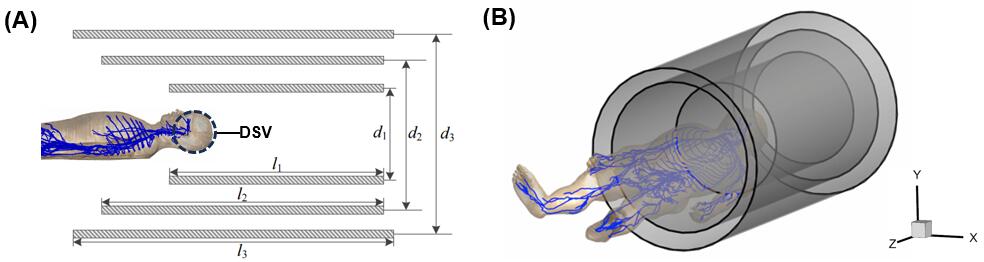
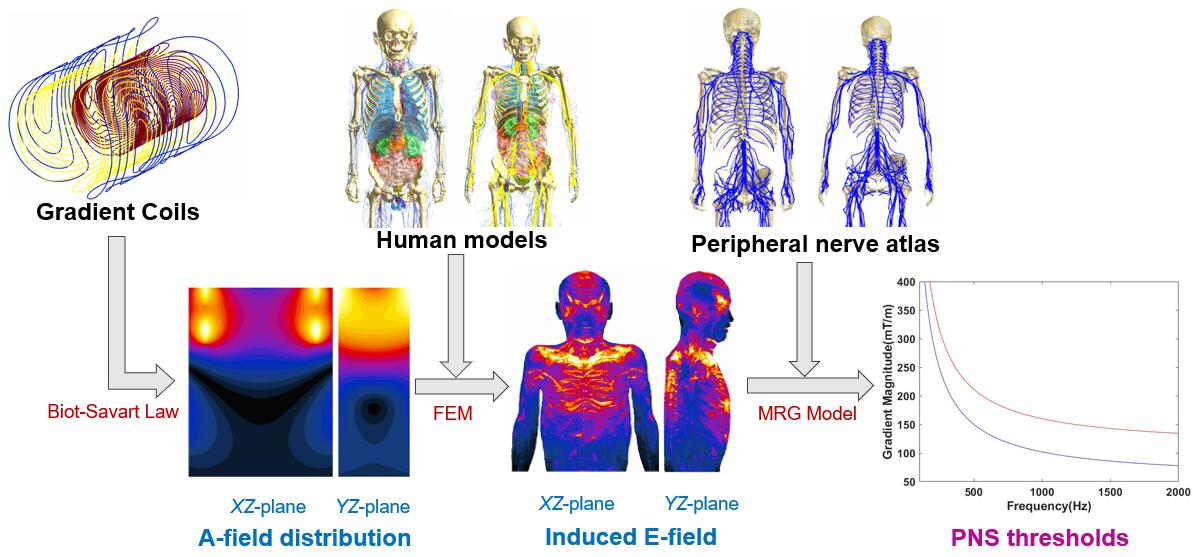
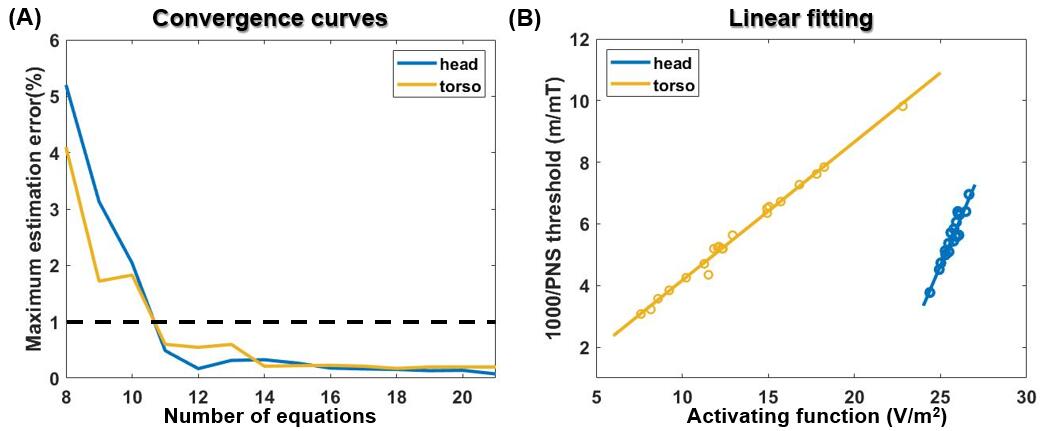
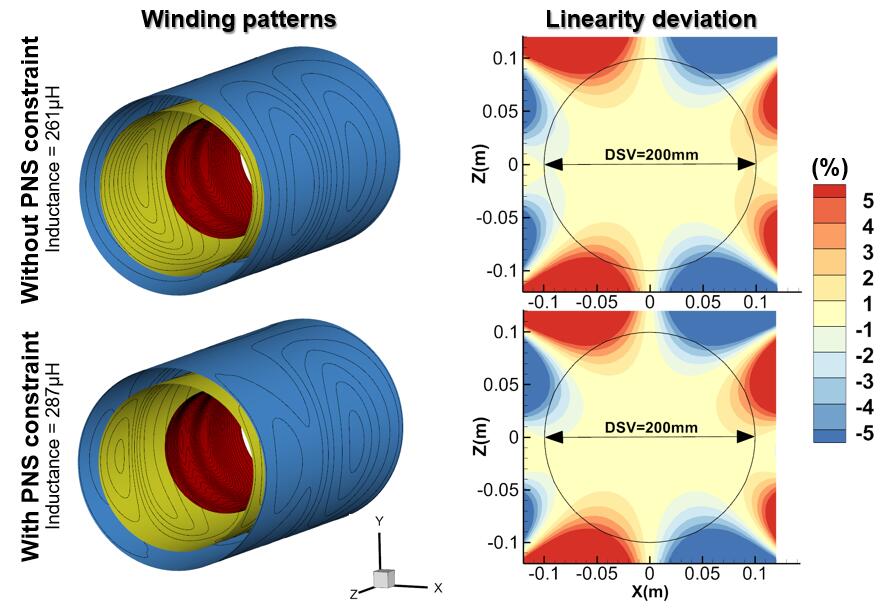
Fig. 4 The winding patterns and linearity deviations of the designed coils with and without PNS constraint. The coil was designed by modifying the PNS constraint, which resulted in a trade-off between PNS and inductance performance. Other coil parameters were kept constant, including linearity deviation (5%), coil efficiency (0.15 mT/m/A), active shielding (1 μT/A on the cryostat surface), maximum torque (0.1 Nm/A), and wire spacing (7 mm).