0906
Impact of third order shim coils on gradient-magnet interactions and gradient waveform fidelity1NeuroSpin, CEA, Gif sur Yvette, France, 2Irfu, CEA, Gif sur Yvette, France, 3Advanced MRI technologies, Sebastopol, CA, United States, 4Helen Wills Neuroscience institute, University of California, Berkeley, CA, United States, 5Department for biomedical Magnetic Resonance, University of Tübingen, Tuebingen, Germany, 6High-field MR center, Max Planck Institute for biological cybernetics, Tuebingen, Germany, 7Skope MRT, Zürich, Switzerland, 8DZNE, Bonn, Germany, 9Helen Wills Neuroscience institute, Universiy of California, Berkeley, CA, United States, 10Montreal Neurological Institute-Hospital, McGill University, Montreal, QC, Canada, 11ETH Zürich, Zürich, Switzerland, 12University of Zürich, Zürich, Switzerland, 13High field MR center, Max Planck Institute for biological cybernetics, Tuebingen, Germany, 14Center for Magnetic Resonance Research, University of Minnesota, Minneapolis, MN, United States, 15University of California, San Francisco, CA, United States, 16San Francisco VA Health Care System, San Francisco, CA, United States
Synopsis
Keywords: Gradients, Gradients
Motivation: Third order shim coils can impact gradient-magnet interactions with consequences on image quality and magnet safety.
Goal(s): To demonstrate the influence of third order shim coils on the SC72 gradient coil using field and vibration measurements.
Approach: The gradient transfer function was measured at 11.7T (Iseult) and at 7T (Terra) with and without connection of the 3rd order shim coils. Vibration measurements were carried out on Iseult from 0 to 11.7T in the two configurations as well.
Results: The data demonstrate a drastic influence of the 3rd order shim coils and their circuits.
Impact: The work suggests caution when using third order shim coils at 7T and above. It also paves the way for further investigations to improve gradient waveform fidelity.
Introduction
Higher magnetic fields and stronger gradients intensify their interaction and put higher demands on the equipment1,2. Besides hardware damage, which is of tremendous importance, these interactions can also lead to field perturbations that can affect data quality. Iseult is a 11.7T whole-body scanner equipped with the SC72 whole-body gradient coil (Siemens Healthcare, Erlangen, Germany), which embeds second and third order shim coils. In a long test-campaign aimed at characterizing the gradient-magnet interactions on that system, it was observed that the connection of the third order shim coils all the way to their shim amplifiers had a significant impact on the results. To rule out possible causes related to magnet design, it was decided to repeat some of the measurements on other systems with the identical gradient coil.Methods
Gradient Transfer Functions (GTF) were characterized using a field camera (Skope MRT, Zürich, Switzerland) on the SC72 at 11.7T (Iseult) and at 7T (Terra). Both systems have the same versions of the electronic chain and scanner software electronic chain generation. The measurements were performed with and without the 3rd order shim coils connected to the filter panel inside the Faraday cage. For further confirmation, the same GTF measurements were carried out on other 7T, 9.4T and 10.5T systems with the same SC72 gradient coil, all with their 3rd order shim coils disconnected. Vibrations were also measured with mono-axial accelerometers (B&K, Naerum, Denmark) glued to the flange of the gradient coil in Iseult from 0T to 11.7T, in steps of 1T, and in the two 3rd order shim configurations (connected and disconnected).Results
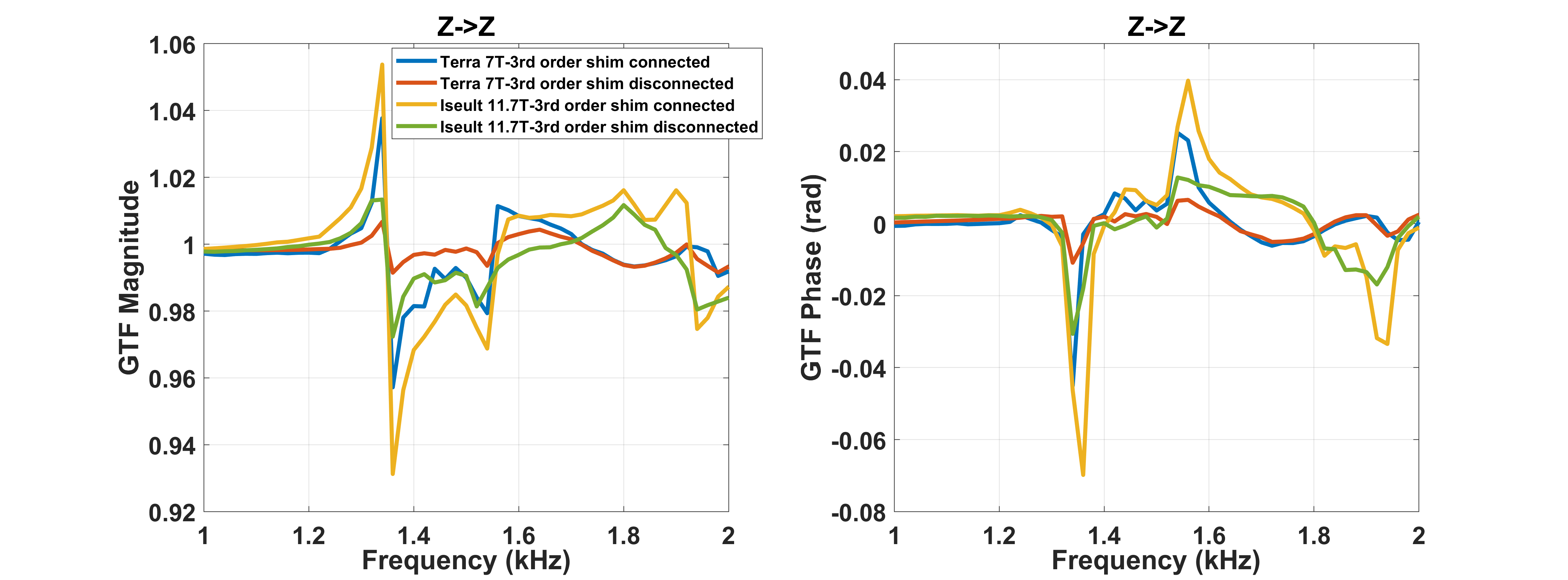
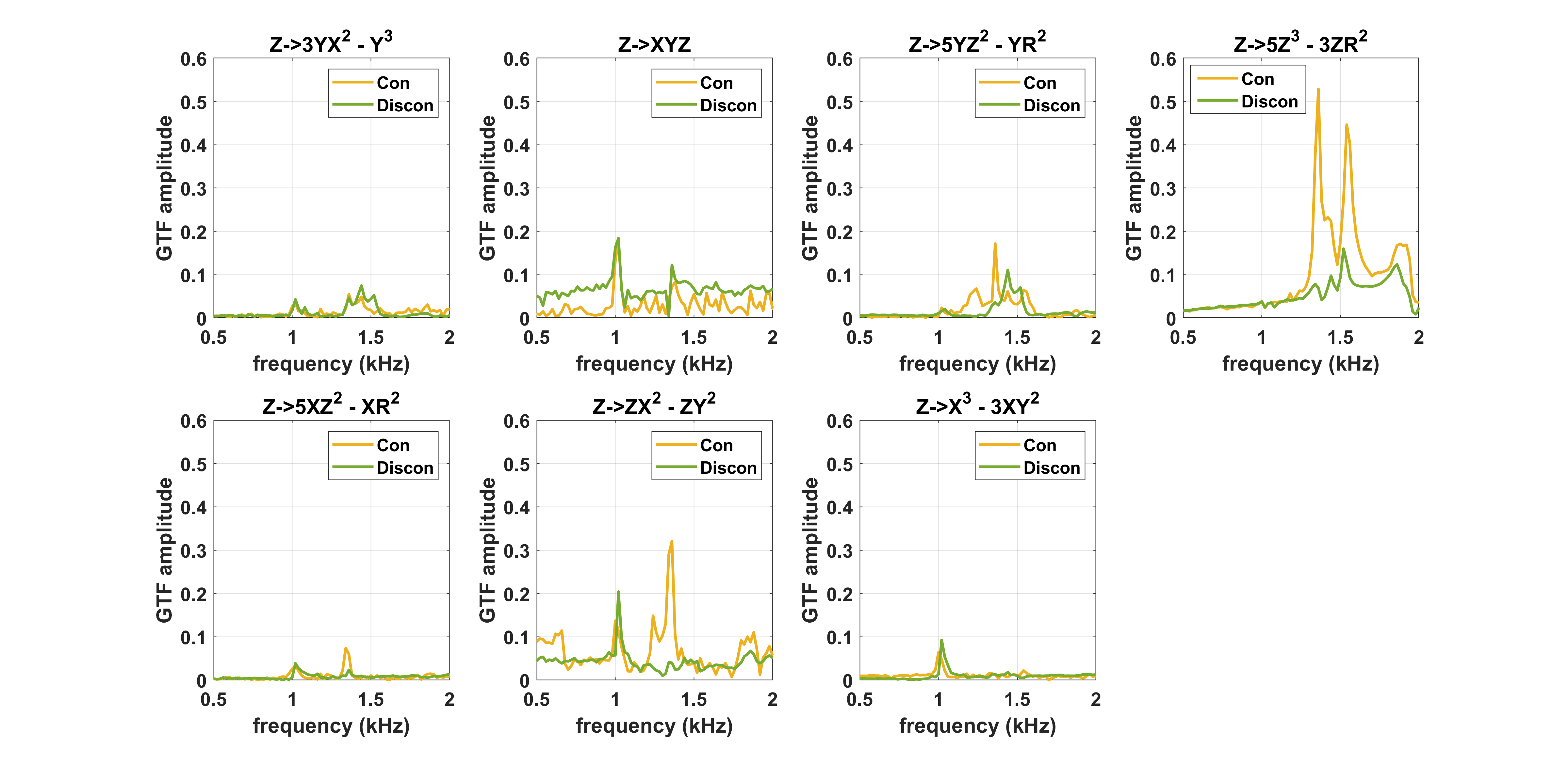
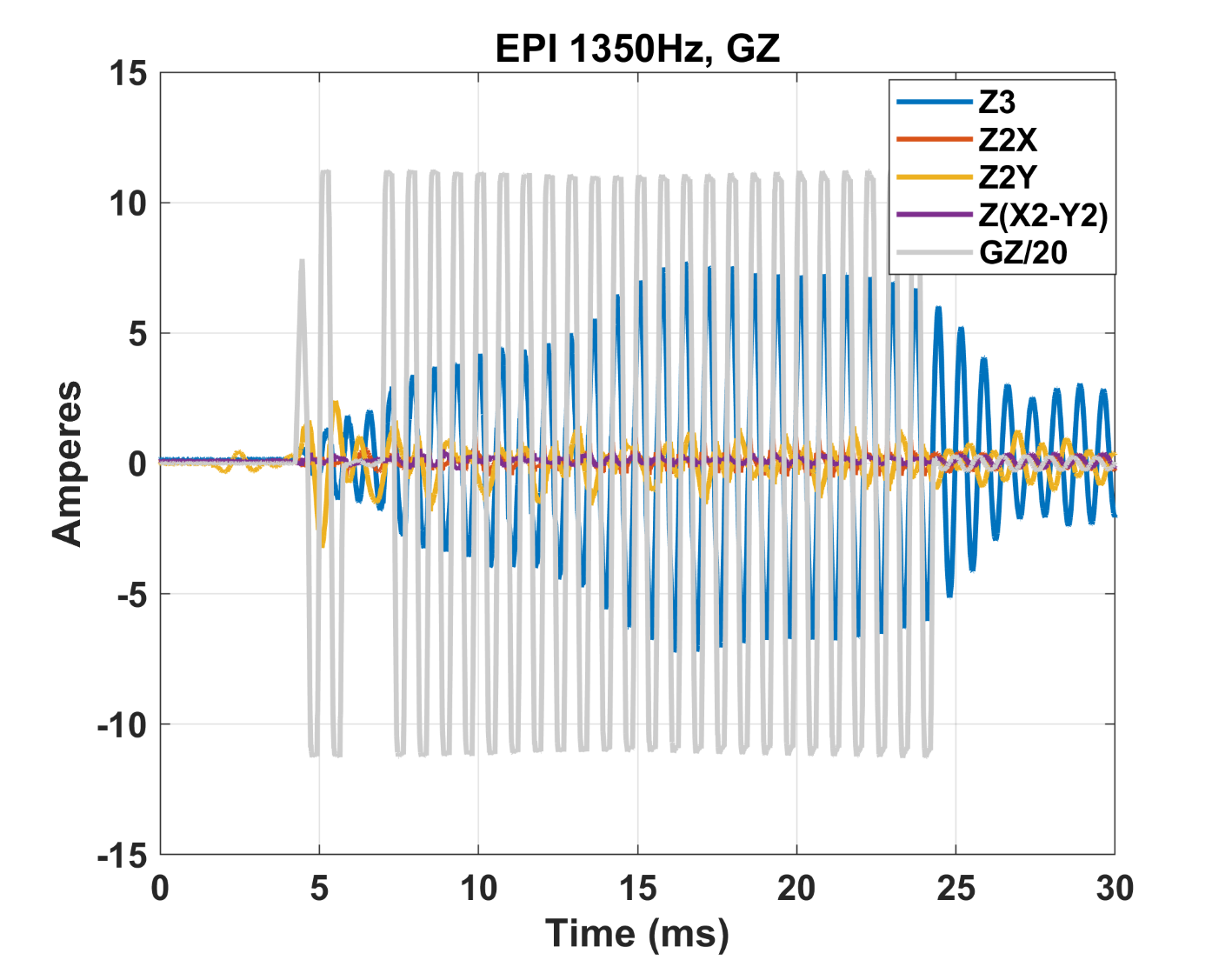
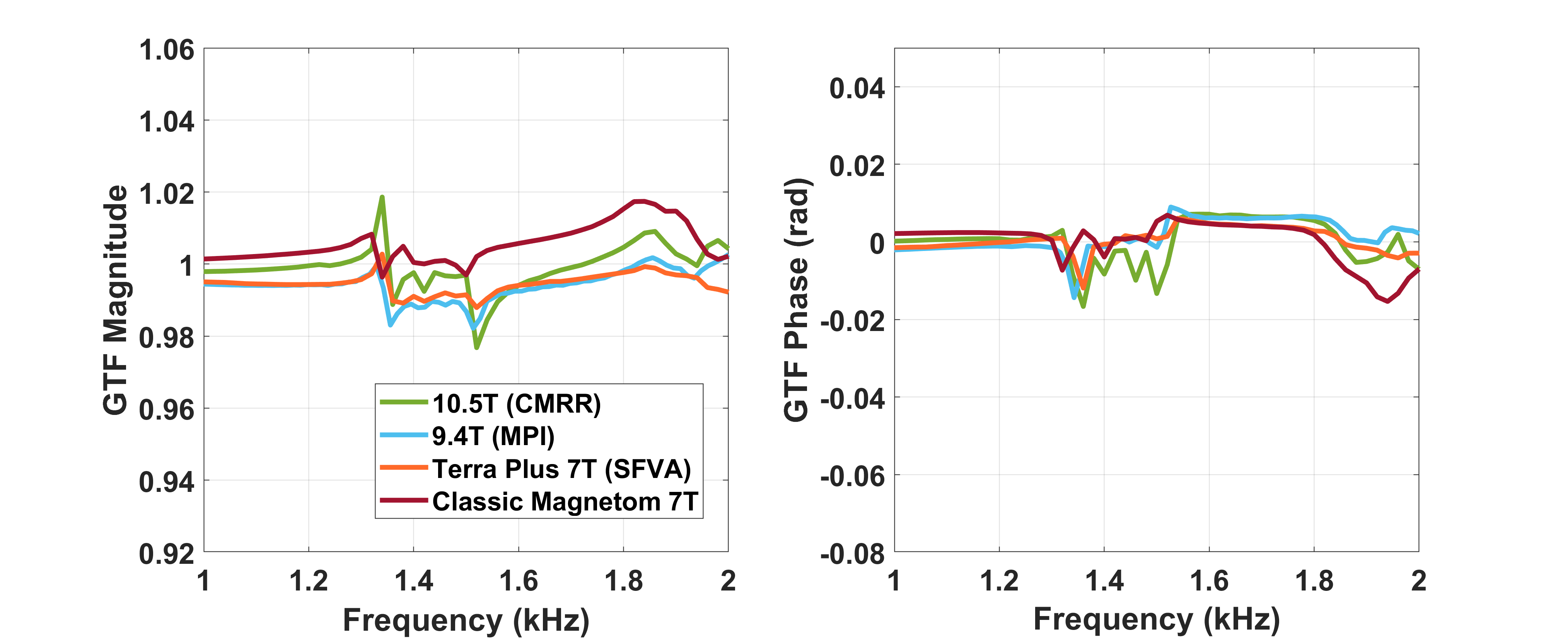
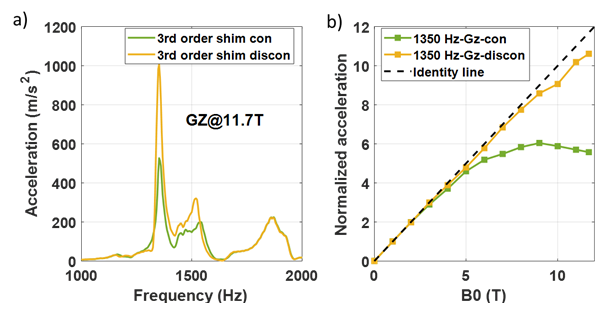
Figure 1 reports the GTF (magnitude and phase) at 11.7T (Iseult) and 7T (Terra) around the most intense resonance peak at 1350 Hz on the gradient Z axis, with and without connection of the 3rd order shim coils, revealing drastic differences. Figure 2 likewise shows the cross terms (Z->3rd order spherical harmonics) characterized by a dynamic field camera at 11.7T, indicating vibration-induced currents circulating in some 3rd order shim coils when running currents in the Z gradient coil, as confirmed by current measurements on the individual shim coils on Figure 3. Figure 4 reports the GTF self-term characterizations on the other 7T, 9.4T and 10.5T systems with 3rd order shim coils disconnected. Finally Figure 5.a shows the acceleration spectrum for the gradient Z axis at 11.7T with 3rd order shim coils connected and disconnected. Figure 5.b reports the normalized height of the main peak acceleration at 11.7T with respect to B0, again showing drastic differences regarding the 3rd order shim coil configurations.Discussion
In this work, we demonstrate that the 3rd order shim coils and their associated circuits greatly impact gradient-magnet interactions and that these effects were consistently observed for various magnet designs (7T Magnetom and Terra) and field strengths (7, 9, 10.5 & 11.7 T). In addition to the potential hardware damage, peaks and dips in the GTF have been shown to affect gradient waveform fidelity in MRI operation3,4 and thus can deteriorate image quality. Although the phenomenon to date is still not completely understood, the connection of the 3rd order shim coils presumably provides a path for the current generated by vibrations to circulate and create field disturbances. Disconnecting the 3rd order shim coils greatly improved the quality of the gradient response. Surprisingly, more vibrations of the gradient coil (Figure 5) could be observed when the 3rd order shim coils were disconnected. When connected, vibrations reached a plateau at around 8T, indicating increased damping. The data suggests that this saturation behavior reflects more interactions between the gradient and the third order shim coils and that vibrations proportional to B0 may in fact be desirable to indicate less interactions.Conclusion
For the setups investigated in this work, 3rd order shim coils and their associated circuits were shown to have great impact on gradient-magnet interactions and gradient waveform fidelity. Although this work focused on the Z gradient axis, similar behaviors were observed for the X and Y axes.Acknowledgements
AROMA H2020 FET-Open (885876). ANR-21-ESRE-0006. ERPT equipment program of the Leducq Foundation. NIH grants NIBIB P41 EB027061, U01 EB025144, and S10 RR029672.References
[1] Boulant N, Quettier L et al. Commissioning of the Iseult CEA 11.7 T whole-body MRI: current status, gradient-magnet interaction tests and first imaging experience. MAGMA 2023 Apr;36(2):175-189. doi: 10.1007/s10334-023-01063-5.
[2] Winkler S.A, Schmitt F, Landes H, DeBever J, Wade T, Alejski A, Rutt B.K. Gradient and shim technologies for ultra-high field MRI. NeuroImage 2018;168:59-70.
[3] Vannesjo SJ, Haeberlin M, Kasper L, Pavan M, Wilm BJ, Barmet C, Pruessmann KP. Gradient system characterization by impulse response measurements with a dynamic field camera. Magn Reson Med 2013; 69:583-593.
[4] Vannesjo SJ, Graedel NN, Kasper L, Gross S, Busch J, Haeberlin M, Barmet C, Pruessmann KP. Image reconstruction using a gradient impulse response model for trajectory prediction. Magn Reson Med 2016; 76:45-58.
Figures