0810
Multidimensional MR Spatiospectral Reconstruction Integrating Subspace Modeling and a Plug&Play Denoiser with Recurrent Features1Beckman Institute for Advanced Science and Technology, University of illinois Urbana-Champaign, Champaign, IL, United States, 2Department of Electrical and Computer Engineering, University of illinois Urbana-Champaign, Champaign, IL, United States, 3Department of Bioengineering, University of illinois Urbana-Champaign, Champaign, IL, United States
Synopsis
Keywords: AI/ML Image Reconstruction, Machine Learning/Artificial Intelligence, Image reconstruction, High dimensional imaging
Motivation: Multidimensional MR spatiospectral imaging (MD-MRSI) has many applications but is challenging due to high dimensionality and limited SNR. Subspace and learning-based methods have both demonstrated success.
Goal(s): To develop a new MD-MRSI reconstruction method synergizing subspace modeling and a spatiospectral denoiser that can be ‘pre-learned’ without noisy/clean image pairs.
Approach: A self-supervised training strategy was proposed to learn a network-based denoiser combining convolutional, fully-connected, and recurrent features and effectively exploiting multidimensional “correlations”. A plug-and-play ADMM-based algorithm was used to integrate the denoising prior and subspace reconstruction.
Results: Impressive SNR-enhancing reconstruction was demonstrated using simulations and in vivo data from different MD-MRSI acquisitions.
Impact: A new approach is proposed for multidimensional MR spatiospectral image reconstruction integrating low-dimensional modeling and a prelearned denoiser trained via multidimensional interpolation using only noisy data. Potential impacts on quantitative molecular imaging are demonstrated using different MRSI acquisitions.
Introduction
Multiplexed, quantitative molecular imaging via multidimensional MR spatiospectral imaging (MD-MRSI) has many potential applications1-3. But the practical utility of MD-MRSI has been rather limited due to the high dimensionality challenge and intrinsic SNR limits. Learning-based reconstruction has shown potentials in addressing these challenges4-6. However, developing learning-based methods for MD-MRSI faces two major issues: 1) the need to consider multidimensional “correlations” in the data, e.g., space, FID/time and another parameter dimension (e.g., TE) and 2) difficulties in obtaining high-resolution, high-SNR training data unlike typical MRI problems. We present here a novel MD-MRSI reconstruction method that integrated explicit subspace modeling and a pre-learned “multidimensional” denoiser using the Plug-and-Play ADMM (PnP-ADMM) formulation7-8. Specifically, the algorithm alternates between a subspace-constrained update incorporating forward encoding model and a proximal update solved by a denoiser pretrained using the Noise2Void (N2V) concept9-11and noisy data only. Our denoising network was trained via multidimensional space-FID-parameter interpolation to effectively separate spectroscopic signals of interest from noise. A recurrent layer12 was included to exploit signal evolutions along the parameter dimension for better denoising. The effectiveness of our method was demonstrated using simulated and in vivo data from a multi-TE and a diffusion-weighted MRSI acquisitions as application examples.Theory and Methods
Formulation and algorithmThe proposed MD-MRSI reconstruction formulation integrates a subspace model and an implicit spatiotemporal/spatiospectral regularizer $$$R(.)$$$, i.e.,
$$\hat{\mathbf{U}},\hat{\mathbf{H}},\hat{\mathbf{Z}}=\operatorname{arg}\underset{\mathbf{U},\mathbf{H},\mathbf{Z}}{\operatorname{min}}\left\|\mathcal{F}_{\mathrm{B}}(\mathbf{U}\hat{\mathbf{V}})-\mathbf{d}\right\|_{\mathbf{F}}^2+\lambda_1R(\mathbf{H})+\frac{\beta_1}{2}\left\|A(\mathbf{U} \hat{\mathbf{V}})-\mathbf{H}+\frac{\mathbf{Z}}{\beta_1}\right\|_{\mathbf{F}}^2, (1)$$
where $$$\mathcal{F}_{\mathrm{B}}, \hat{\mathbf{V}}, \mathbf{d}, \mathbf{U}$$$ represents the forward encoding operator, pre-learned MD subspace/basis13-14, noisy $$$(\mathrm{k}, \mathrm{t}, \theta)$$$-space data and the unknown spatial coefficients. $$$\mathbf{H}$$$ and $$$\mathbf{Z}$$$ are the introduced auxiliary variable and Lagrangian multiplier for the ADMM framework, allowing us to enforce the regularization using our prelearned denoiser. $$$A$$$ is an operator accounting for potential resolution difference between denoiser training data and the modeled image $$$( \mathbf{U} \hat{\mathbf{V}})$$$. The problem was solved by sequentially updating $$$\mathbf{U}$$$, $$$\mathbf{H}$$$ and $$$\mathbf{Z}$$$. While the subproblem for $$$\mathbf{U}$$$ is a quadratically regularized subspace reconstruction, the subproblem for $$$\mathbf{H}$$$:
$$\hat{\mathbf{H}}^{k+1}=\operatorname{arg}\underset{\mathbf{H}}{\operatorname{min}} \lambda_1 R(\mathbf{H})+\frac{\beta_1}{2}\left\|A\left(\hat{\mathbf{U}}^k \hat{\mathbf{V}}\right)-\mathbf{H}+\frac{\hat{\mathbf{Z}}^k}{\beta_1}\right\|_{\mathbf{F}}^2, (2)$$
can be solved via:
$$\hat{\mathbf{H}}=f_{\mathrm{W}}\left(A\left(\hat{\mathbf{U}}^k \hat{\mathbf{V}}\right)+\frac{\hat{\mathbf{Z}}^k}{\beta_1}\right), (3)$$
where $$$f_{\mathrm{W}}$$$ is the pretrained denoiser.
Denoiser learning via multidimensional interpolation
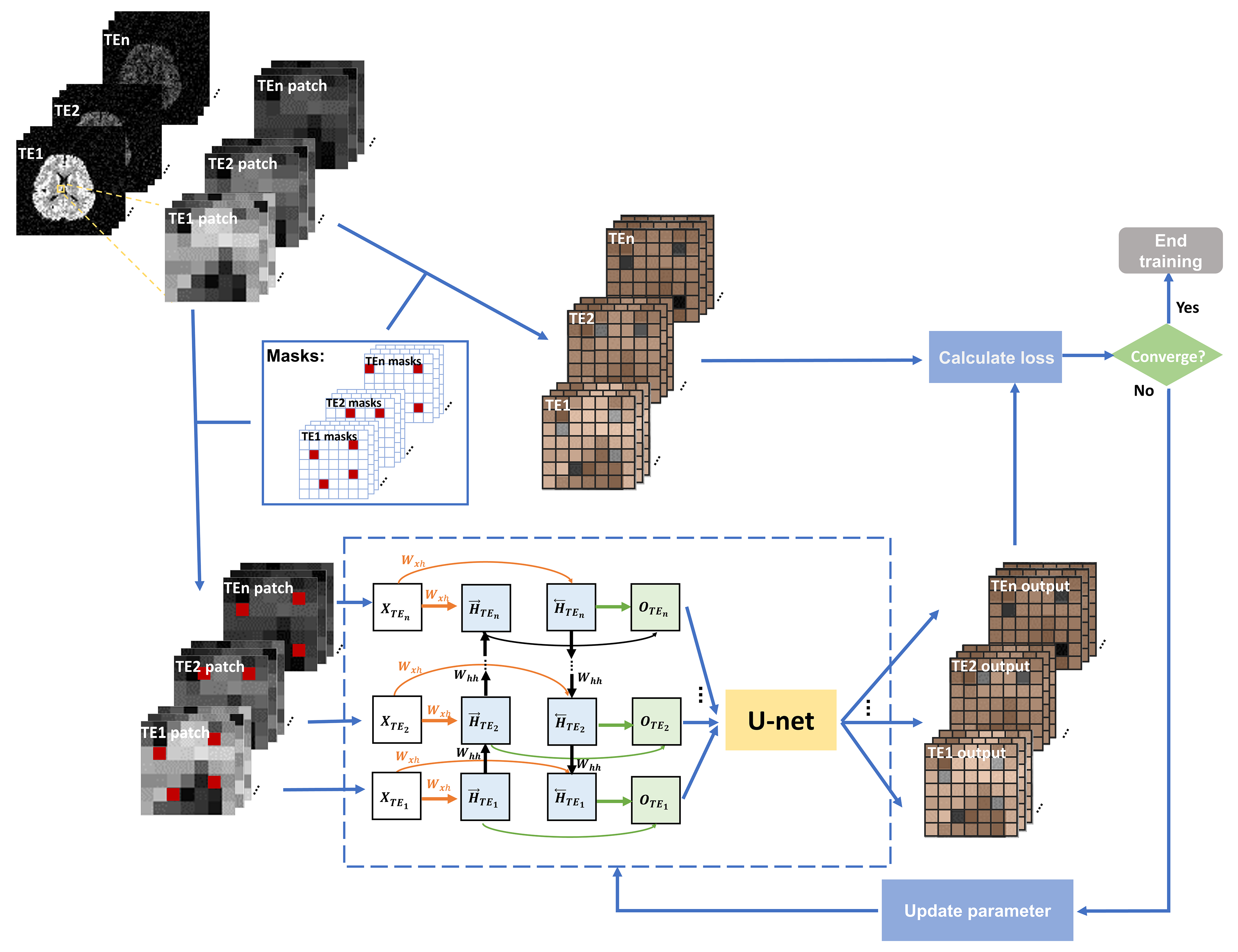
Learning denoiser using standard supervised learning is challenging for MD-MRSI. Self-supervised denoising via training an interpolation network to suppress the spatially independent noise has been proposed 9-11. A unique challenge here is to design the network to effectively exploit the signal characteristics across different dimensions. For example, in multi-TE MRSI, the signals can be considered locally correlated in space and globally correlated along the FID and TE dimensions. Therefore, our network was trained to interpolate locally in space but globally across FID and TEs. Specifically, we partitioned the high-dimensional data into spatial patches each containing entire FIDs and all TEs, and randomly masked out voxels at different time points and TEs for training the network to interpolate missing voxels (Fig. 1).
More specifically, our proposed network integrated spatial convolution, temporal fully-connected combinations (along the FID), and an RNN-based feature extraction along TE. The information flow in the first layer can be expressed as:
$$\overrightarrow{\boldsymbol{H}}_{TE_i}=\operatorname{Relu}\left(\boldsymbol{W}_{xh} * \boldsymbol{X}_{TE_i}+\boldsymbol{W}_{hh} * \overrightarrow{\boldsymbol{H}}_{TE_{i-1}}+\boldsymbol{B}\right), (4) $$
$$\overleftarrow{\boldsymbol{H}}_{TE_i}=\operatorname{Relu}\left(\boldsymbol{W}_{xh} * \boldsymbol{X}_{TE_i}+\boldsymbol{W}_{hh} * \overleftarrow{\boldsymbol{H}}_{TE_{i+1}}+\boldsymbol{B}\right),(5)$$
$$\boldsymbol{O}_{TE_i}=\operatorname{Concat}\left(\overrightarrow{\boldsymbol{H}}_{TE_i}, \overleftarrow{\boldsymbol{H}}_{TE_i}\right),(6)$$
where $$$\boldsymbol{X}_{TE_i}$$$ denotes the input patches at $$$i_{th}$$$ TE, $$$\overrightarrow{\boldsymbol{H}}_{TE_i}$$$ the latent space propagated forward, and $$$\overleftarrow{\boldsymbol{H}}_{TE_i}$$$ the one propagated backward. $$$\boldsymbol{W}_{xh}, \boldsymbol{W}_{hh}$$$ and $$$\boldsymbol{B}$$$ represent shared convolution kernels and biases. Multi-TE features were concatenated in the output as $$$\boldsymbol{O}_{TE_i}$$$ and then further taken by a U-net for multidimensional interpolation (Fig. 1). This feature effectively mined information across TEs for improved denoising.
Experiments and Results
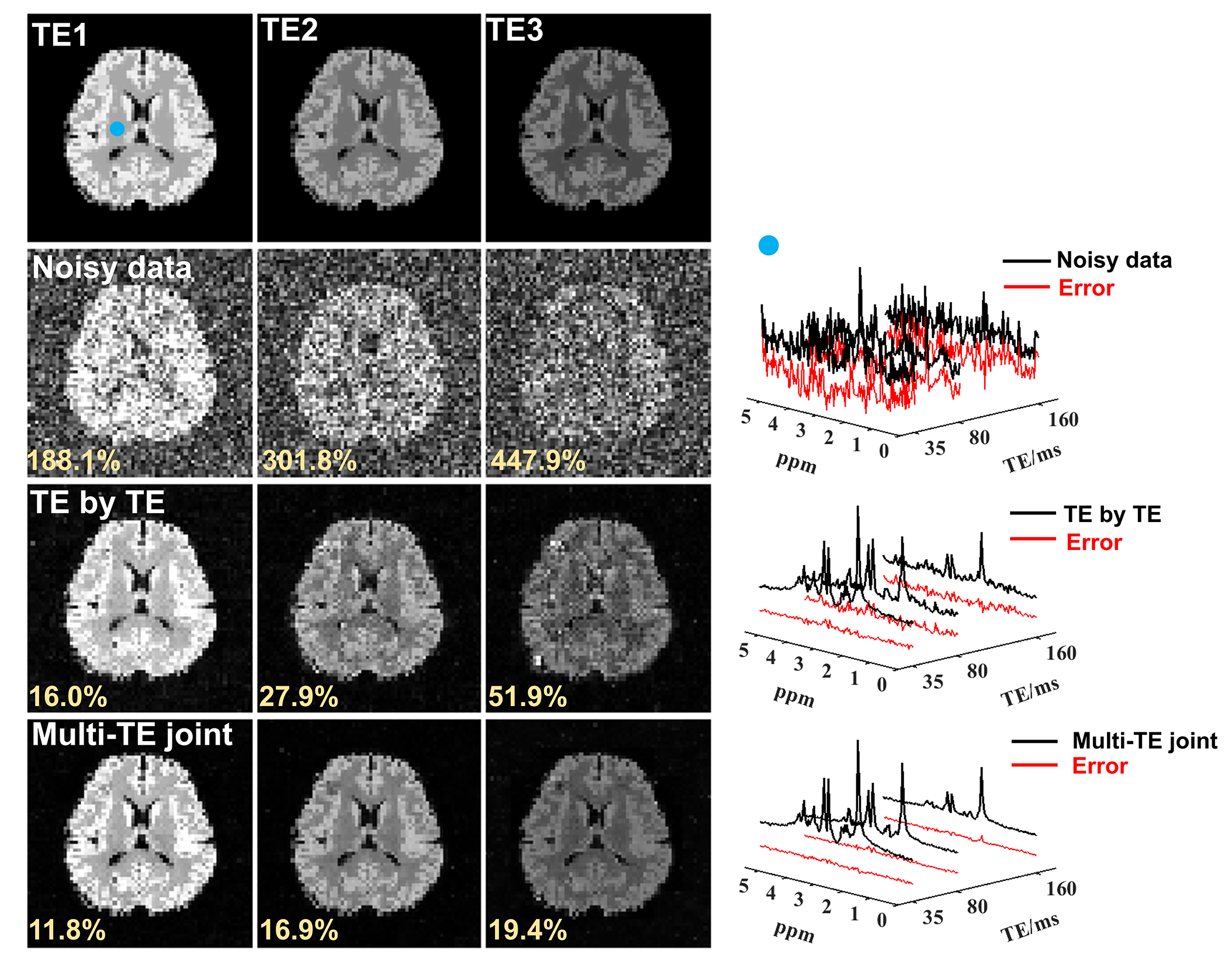
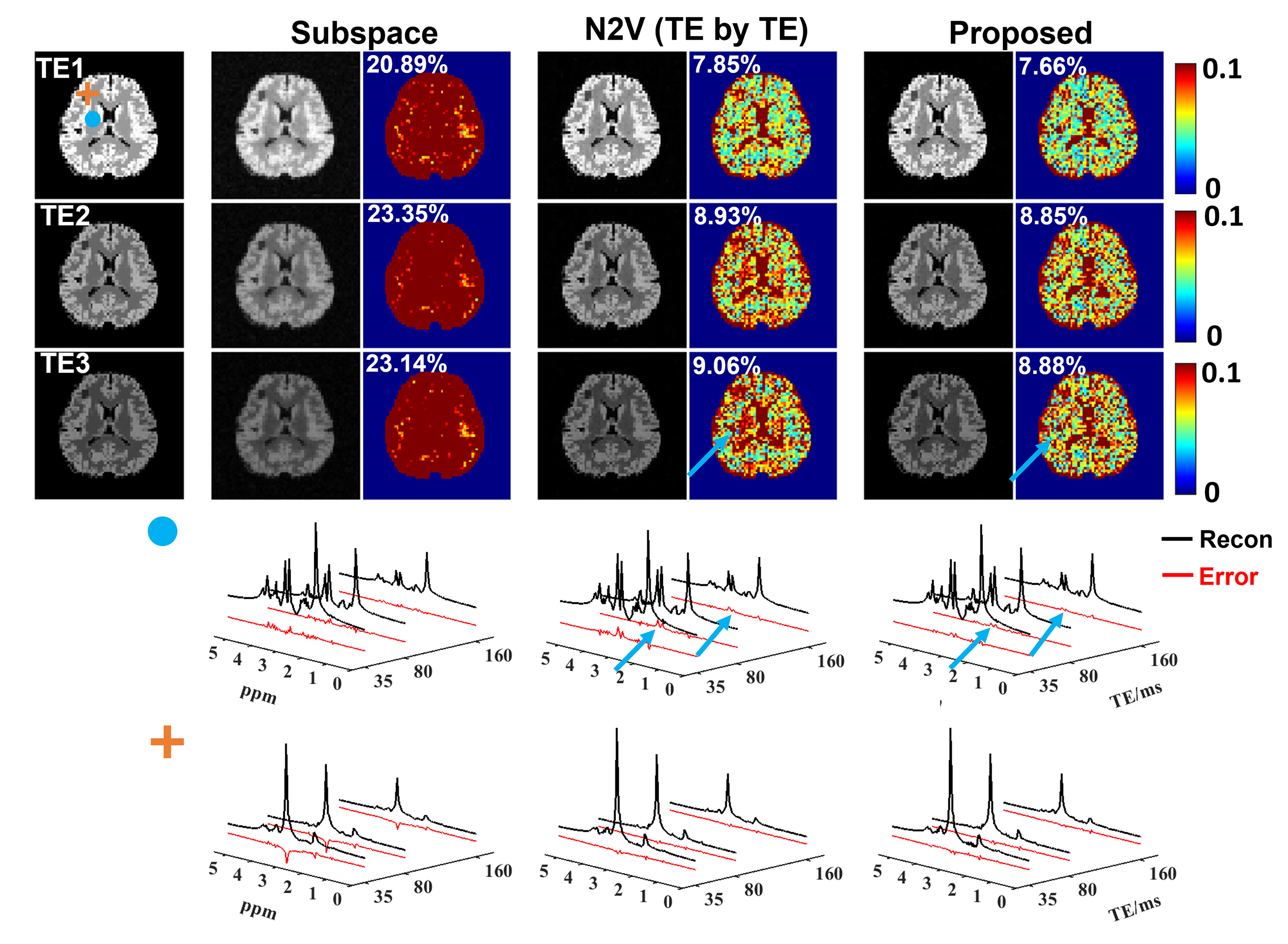
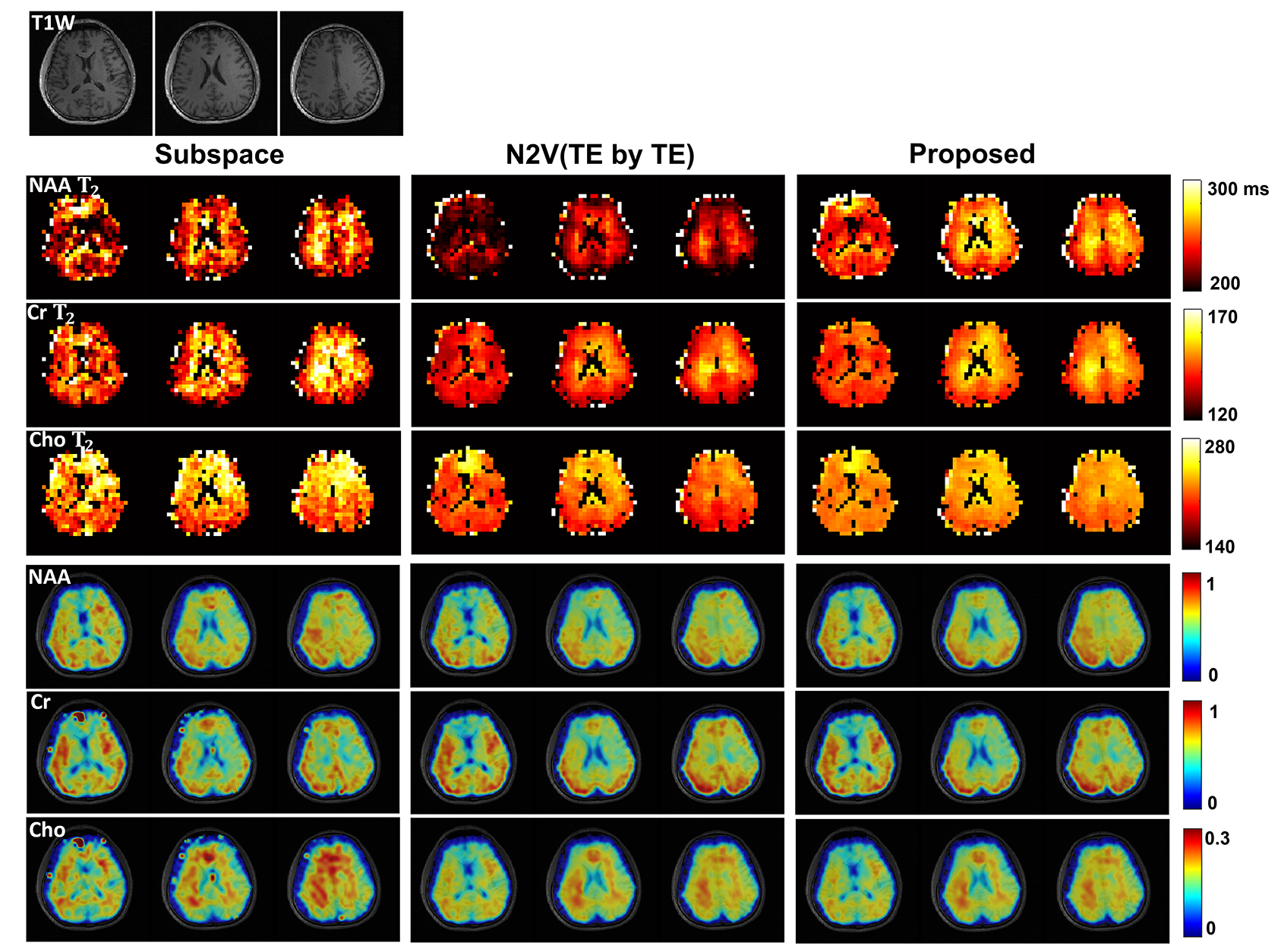
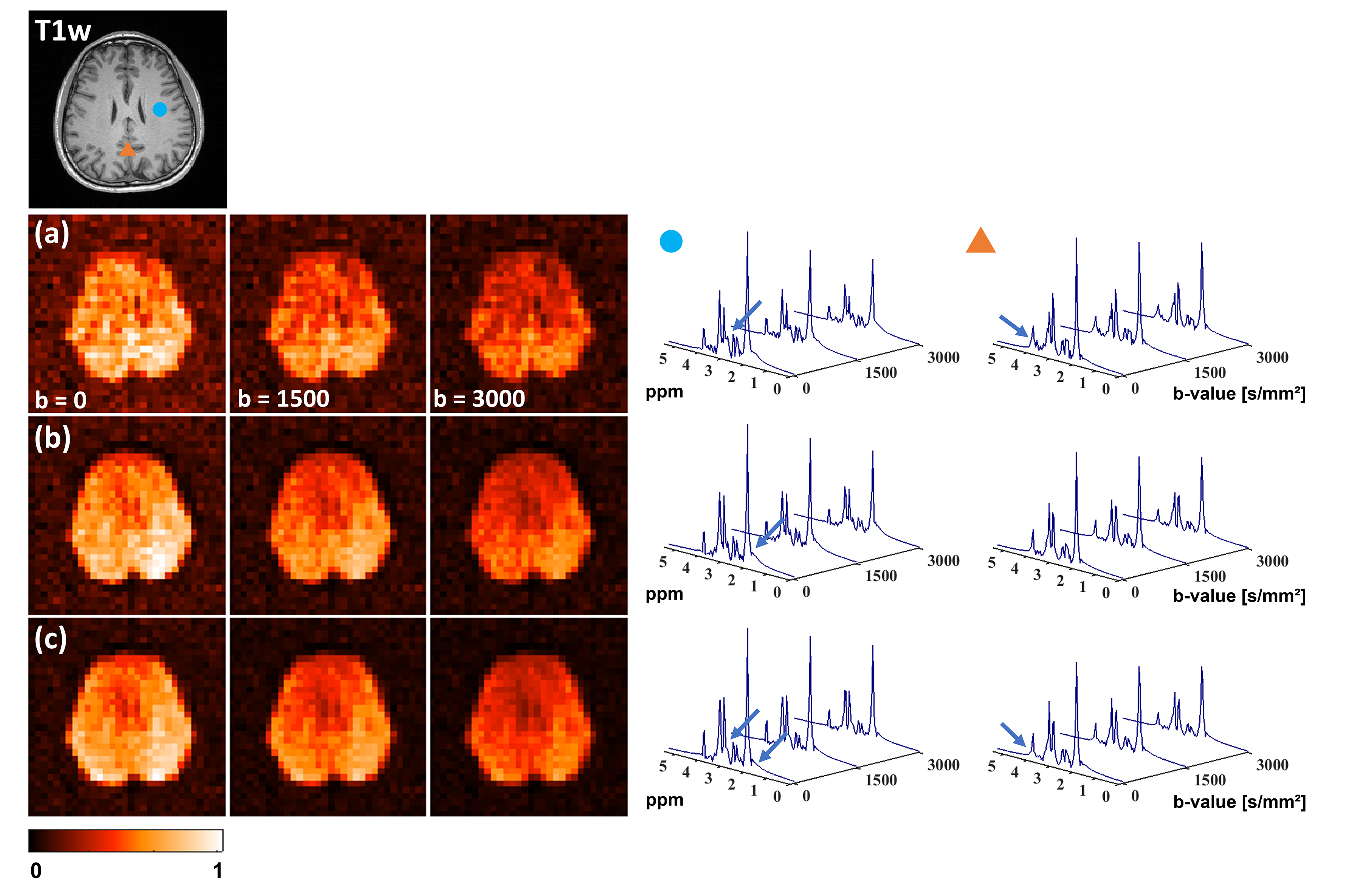
Numerical multi-TE 1H-MRSI phantoms with different spatiospectral variations were created (TE=[35,80,160] ms, matrix size=64×64 and 256 FID points) for validation. The network was trained with 6,300 patches from the simulated noisy data, with patches of 8×8×256×3 (TEs). As shown in Fig. 2, the proposed N2V-based joint-TE denoiser demonstrated superior SNR enhancement over the denoisers trained for each TE separately. Improved reconstruction was achieved when using the denoiser as a plug-in prior integrated with the subspace constraint, as shown in Fig. 3.Both in vivo multi-TE and diffusion-weighted 1H-MRSI data were acquired from healthy volunteers (IRB approved) to evaluate the utility of the proposed method, using sequence previously described in [15,16]. Quantified metabolite $$$T_2$$$ and concentration maps from the multi-TE data in Fig. 4 show apparent improvement for the proposed over competing methods (less noisy and artifact). Spatiospectral reconstructions from the DW-MRSI data were shown in Fig. 5. The proposed method again produced stronger SNR enhancement than competing methods.
Conclusion
We presented a novel multidimensional MRSI reconstruction method. Simulations and in vivo results from different MRSI acquisition scenarios demonstrated the effectiveness and potential wide applicability of our method.Acknowledgements
This work was supported in part by NSF-CBET 1944249 and NIH R35GM142969.References
1. Tang, Lihong, et al. "Accelerated J‐resolved 1H‐MRSI with limited and sparse sampling of (k, t1, t2)‐space." MRM. 2021; 85: 30-41.
2. Kirov, Ivan I., and Assaf Tal. "Potential clinical impact of multiparametric quantitative MR spectroscopy in neurological disorders: A review and analysis." MRM. 2020; 83:22-44.
3. Fotso, Kevin, et al. "Diffusion tensor spectroscopic imaging of the human brain in children and adults." MRM. 2017; 78: 1246-1256.
4. Lam, Fan, et al. "High-dimensional MR spatiospectral imaging by integrating physics-based modeling and data-driven machine learning: Current progress and future directions." IEEE SPM. 2023; 40:101-115.
5. Li, Yudu, et al. "Machine learning-enabled high-resolution dynamic deuterium MR spectroscopic imaging." IEEE TMI. 2021; 40:3879-3890.
6. Zhao, R., et al. "MR spatiospectral reconstruction using plug&play denoiser with self-supervised training." In Proc. of ISMRM. 2023, p.0955.
7. Venkatakrishnan, Singanallur V., et al. "Plug-and-play priors for model based reconstruction." In Proc. of IEEE GlobSIP. 2013: 945-948
8. Kamilov, Ulugbek S., et al. "Plug-and-play methods for integrating physical and learned models in computational imaging: Theory, algorithms, and applications." IEEE SPM. 2023; 40: 85-97.
9. Lecoq, Jérôme, et al. "Removing independent noise in systems neuroscience data using DeepInterpolation." Nature Methods. 2021;18:1401-1408.
10. Akçakaya, Mehmet, et al. "Unsupervised deep learning methods for biological image reconstruction and enhancement: An overview from a signal processing perspective." IEEE SPM. 2022; 39:28-44.
11. Krull, Alexander, et al. "Noise2void-learning denoising from single noisy images." In Proc. of Intl. IEEE CVPR. 2019.
12. Schuster, Mike, and Kuldip K. Paliwal. "Bidirectional recurrent neural networks." IEEE TSP. 1997; 45 : 2673-2681.
13. Lam, Fan, et al. "A subspace approach to high‐resolution spectroscopic imaging." MRM. 2014; 71:1349-1357.
14. Lam, Fan, et al. "Ultrafast magnetic resonance spectroscopic imaging using SPICE with learned subspaces." MRM. 2020; 83:377-390.
15. Wang, Zepeng, et al. "High-Resolution brain metabolite T2 mapping using optimized multi-TE MRSI." In Proc. of ISMRM. 2022, p.4998.
16. Wang, Zepeng, and Fan Lam. "High resolution volumetric diffusion-weighted MRSI using a subspace approach." In Proc. of ISMRM. 2021, p.0337
Figures