0803
Human Umbilical Cord Blood-Mononuclear Cell Transplantation Improves Glymphatic System Activity in Patients with Multiple System Atrophy1Department of radiology, Liaocheng People’s Hospital, Liaocheng, China, 2Department of neurology, Liaocheng People’s Hospital, Liaocheng, China, 3Philips Healthcare, Shanghai, China, 4Department of radiology, Jinan Central Hospital, Jinan, China
Synopsis
Keywords: Parkinson's Disease, Parkinson's Disease, Diffusion tensor image
Motivation: Glymhatic system as a therapeutic target for multiple system atrophy (MSA) lacks imaging markers.
Goal(s): Our goal was to determine changes in imaging parameters after human umbilical cord blood mononuclear cells (hUCB-MCs) transplantation.
Approach: Diffusion tensor image analysis along the perivascular space (DTI-ALPS) of MSA patients were compared with healthy controls and the ALPS indices of patients were compared before and after hUCB-MCs transplantation.
Results: We found that MSA patients had lower ALPS values than health controls and that ALPS values increased after treatment.
Impact: Our demonstration of a detectable decline in MSA patients and an uptick after treatment utilizing ALPS metrics provides an imaging marker to monitor the glymphatic system after hUCB-MCs transplantation.
Introduction
The glymphatic system plays a crucial role in maintaining neurological homeostasis and has emerged as a potential therapeutic target for neurodegenerative diseases. 1 Recently, diffusion tensor imaging analysis along the perivascular space (DTI-ALPS) parameters have been utilized to assess glymphatic activity in various studies. 2 However, the activity of the glymphatic system in patients with multiple system atrophy (MSA) remains unknown. Currently, the treatment options for MSA primarily focus on symptom management. Dianrong Gong et al. 3 demonstrated that transplantation of human umbilical cord blood mononuclear cells (hUCB-MCs) can slow disease progression over an extended period. Nevertheless, there is a dearth of suitable imaging markers to effectively demonstrate the efficacy of this therapy. In this study, we aimed to explore the feasibility of using the ALPS index as an imaging marker to detect changes in the glymphatic system before and after hUCB-MCs transplantation, thereby assessing treatment efficacy.Methods
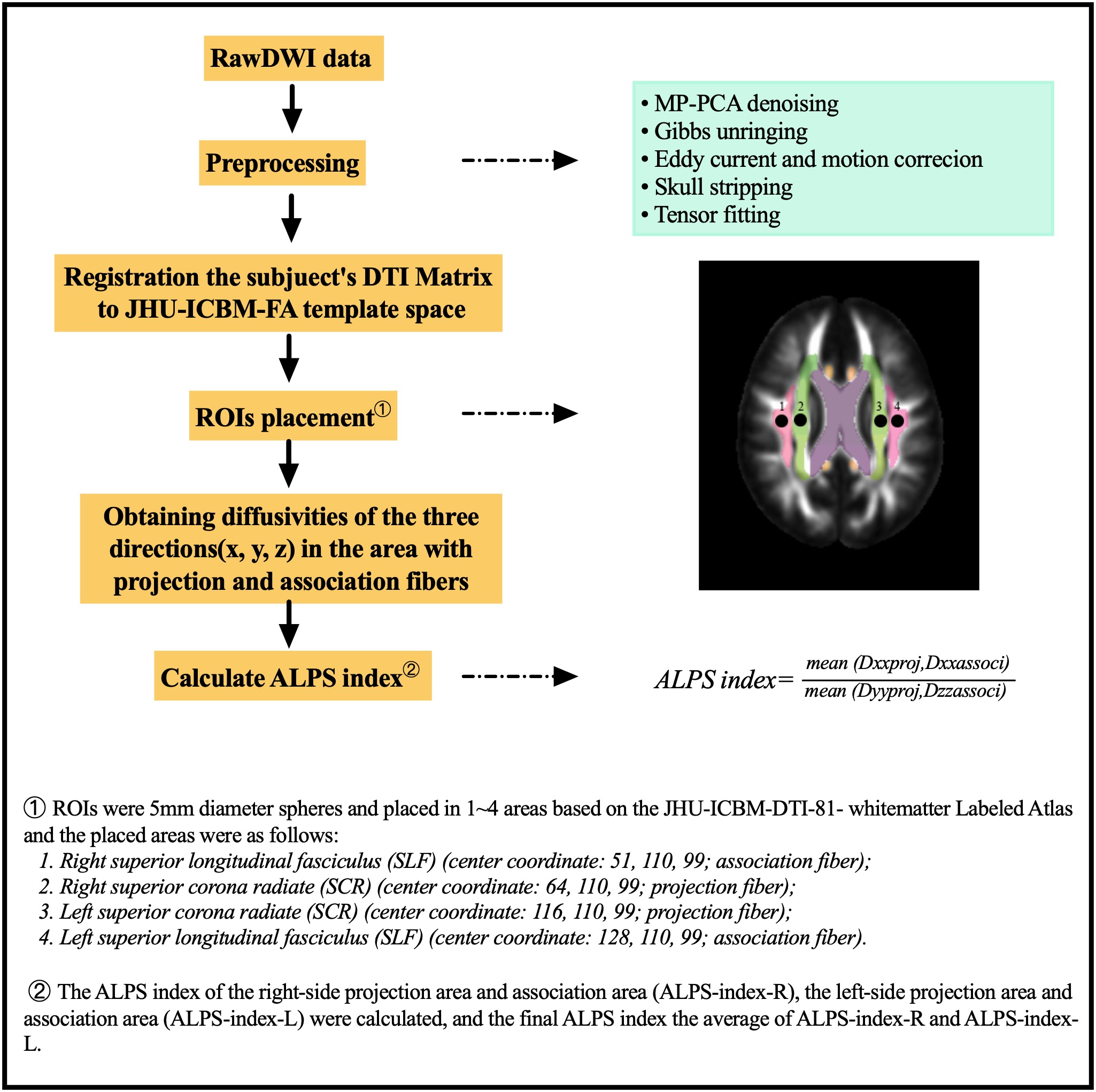
This study received approval from the institutional research ethics board of Liaocheng People's Hospital (ID: 2023024). From November 2021 to September 2023, a total of 30 patients diagnosed with multiple system atrophy (MSA) (57.4±5.6 years, female: male=15:15) and 30 healthy controls (HCs) (55.8±4.1 years, female: male=20:10) were recruited. Among the patients, 9 individuals underwent hUCB-MCs transplantation using the lateral atlanto-occipital space puncture technique (Gong's Puncture). 3 All participants underwent MRI scans, with the 9 treated patients requiring an additional scan 2 days after the surgery.MRI data were acquired using a 3.0 T scanner (Ingenia Elition X, Philips Healthcare, Best, the Netherlands) equipped with a 32-channel phased array head coil. Axially parallel to the anterior-posterior commissure (AC-PC) plane, q-space sampled diffusion MRI was performed with the following parameters: multi-shell acquisition, a total of 120 diffusion samplings, 10 different b-values ranging from 0 to 4000 s/mm². The imaging parameters were as follows: TR/TE = 3473/95 ms, FOV = 224*224 mm², voxel size = 2*2 mm², slice thickness = 2 mm, 69 slices, and a multiband factor of 3. The total acquisition time for the q-space diffusion MRI was 7 minutes and 8 seconds. The FMRIB Software Library version 6.0 (FSL; Oxford Centre for Functional MRI of the Brain, Oxford, UK; https://fsl.fmrib.ox.ac.uk/fsl/) was used to process the q-space diffusion MRI data, following the FSL pipeline described in a previous study by Liu et al. 4 (Fig 1). To compare the ALPS index between MSA patients and HCs, the Mann-Whitney test was employed. Paired t-tests were used to compare the changes in ALPS and Unified MSA Rating Scale (UMSARS) I + II score in MSA patients before and after treatment.
Results
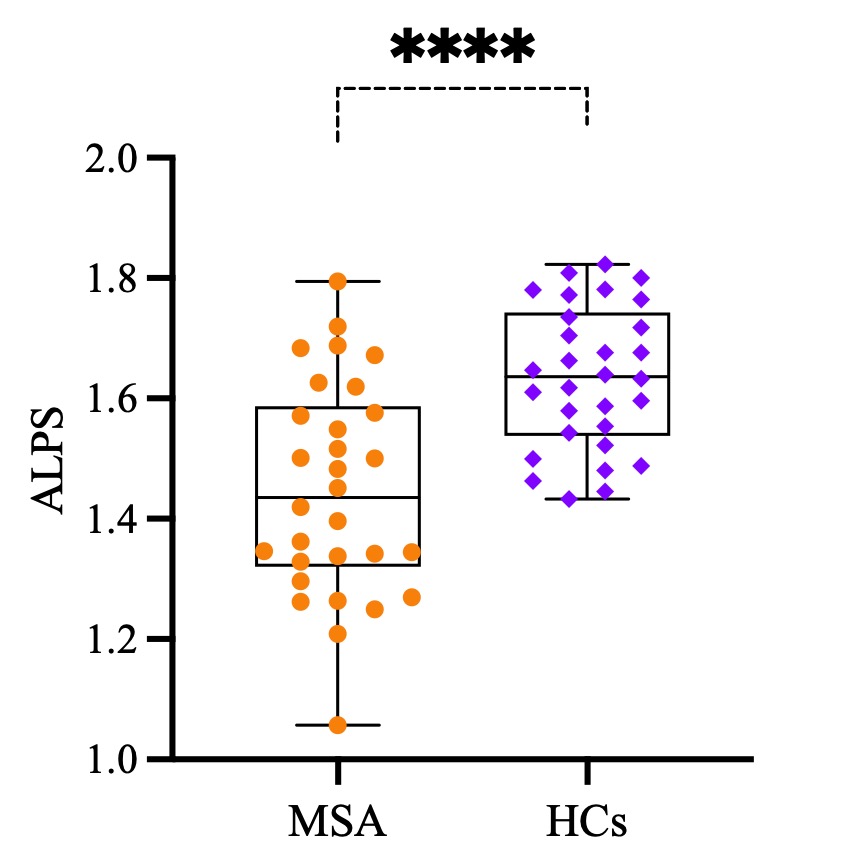
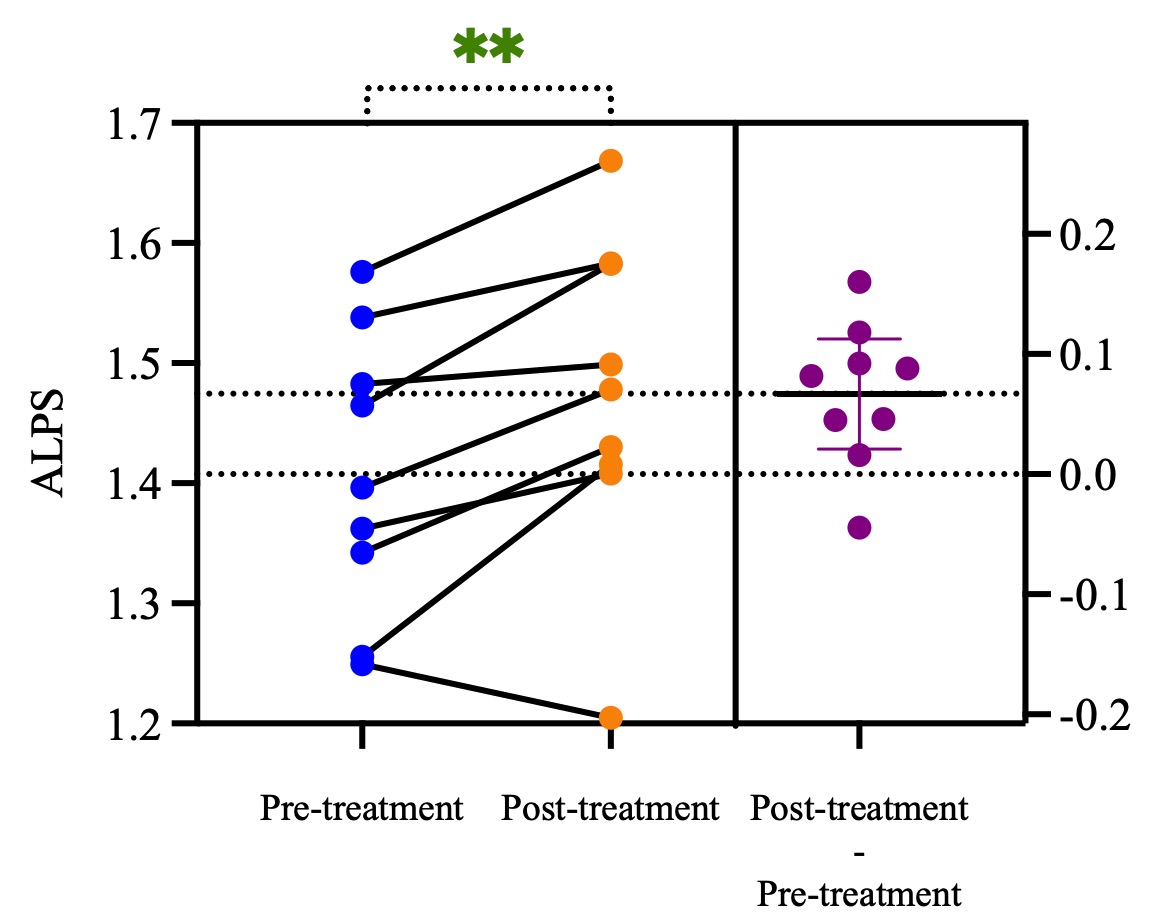
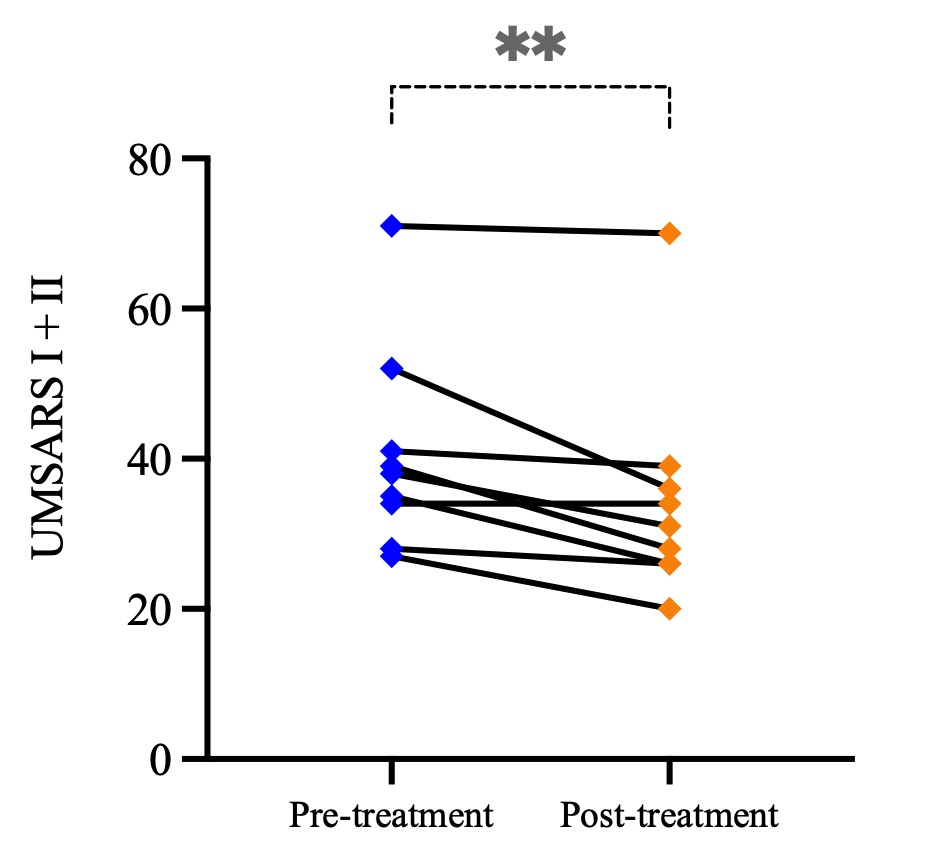
The results showed that the ALPS index was significantly lower in patients with MSA compared to healthy controls (1.448±0.1774 vs. 1.635±0.1179, p<0.0001, Fig. 2). After treatment, there was a significant improvement in the ALPS index compared to before treatment (1.475±0.1343 vs. 1.408±0.1167, p<0.01, Fig. 3). Additionally, the UMSARS I + II score (34.44 ± 14.54) was significantly lower than the score before treatment (40.56 ± 13.61, p<0.001, Fig. 4). These findings indicate that the treatment led to an increase in the ALPS index and a decrease in the UMSARS score, suggesting improved glymphatic system activity and reduced disease severity in MSA patients.Discussion
This study revealed dysfunction of the glymphatic system in MSA patients, as indicated by the ALPS index, when compared to healthy controls. The glymphatic system plays a crucial role in the exchange of cerebrospinal fluid (CSF) and interstitial fluid (ISF), facilitating the removal of waste proteins, and relies on aquaporin-4 (AQP4) channels. 1The impairment of the glymphatic system results in the aggregation of α-synuclein, 5 a common characteristic observed in MSA patients. The interaction between the glymphatic system and neurological disorders suggests a potential therapeutic target. 1 Previous studies have shown that the transplantation of human umbilical cord blood-derived mesenchymal stem cells (hUCB-MCs) could be an effective treatment for MSA. 3 In our study, we observed that this treatment improved glymphatic system activity, as evidenced by the ALPS index, suggesting enhanced excretion of waste proteins. Therefore, hUCB-MCs transplantation may be considered as a promising approach to improve glymphatic system activity. Furthermore, the ALPS index can serve as a valid and non-invasive biological marker to detect this alteration in glymphatic function.Conclusion
Patients with MSA exhibited dysfunctions in the glymphatic system. Transplantation of hUCB-MCs emerged as a potential therapeutic target to modulate the glymphatic system. Monitoring the changes in the glymphatic system activity can be achieved using the ALPS index, which shows promise as a potential biological markerAcknowledgements
Acknowledgement to Jixin Luan for his help in data processing.References
1. Xuan X, Zhou G, Chen C, et al. Glymphatic System: Emerging Therapeutic Target for Neurological Diseases. Oxid Med Cell Longev 2022;2022:6189170.
2. Taoka T, Masutani Y, Kawai H, et al. Evaluation of glymphatic system activity with the diffusion MR technique: diffusion tensor image analysis along the perivascular space (DTI-ALPS) in Alzheimer's disease cases. Jpn J Radiol 2017;35:172-178.
3. Gong D, Wang W, Yuan X, et al. Long-Term Clinical Efficacy of Human Umbilical Cord Blood Mononuclear Cell Transplantation by Lateral Atlanto-Occipital Space Puncture (Gong's Puncture) for the Treatment of Multiple System Atrophy. Cell Transplant 2022;31:9636897221136553.
4. Liu X, Barisano G, Shao X, et al. Cross-Vendor Test-Retest Validation of Diffusion Tensor Image Analysis along the Perivascular Space (DTI-ALPS) for Evaluating Glymphatic System Function. Aging Dis 2023.
5. Zhang Y, Zhang C, He XZ, et al. Interaction Between the Glymphatic System and alpha-Synuclein in Parkinson's Disease. Mol Neurobiol 2023.
Figures