0784
Repeatability of DTI and tractography biomarkers in healthy kidneys1The University of Sheffield, Sheffield, United Kingdom, 2Antaros Medical AB, Mölndal, Sweden, 3Department of Biomedical Imaging Sciences, University of Leeds, Leeds, United Kingdom, 4University of Exeter Medical School, Exeter, United Kingdom, 5Department of Clinical Sciences, Lund University Diabetes Centre, Malmö, Sweden
Synopsis
Keywords: Kidney, Kidney
Motivation: For clinical application uncertainty of DTI and tractography biomarkers is critical to avoid that management decisions are made based on changes that are due to measurement error.
Goal(s): Provide a comprehensive reference guide of estimated uncertainties for DTI and tractography renal biomarkers and use the data to screen these biomarkers based measurement precision.
Approach: Five healthy-volunteers were scanned 4 times on 3T MRI scanner using a diffusion free-breathing protocol. DTI and tractography parameters were calculated using DIPY.
Results: Tractography markers are less precise than DTI, sphericity is the most reliable of all DTI metrics, and histogram metrics kurtosis and skewness are inherently imprecise.
Impact: This study presents comprehensive reference values for error ranges in renal DTI that will help to identify real (patho)physiological changes in future clinical results
Introduction
Diffusion-weighted MR imaging (DWI) biomarkers allow renal microstructure characterization providing a non-invasive method for assessing (patho)physiological changes in the kidney. Initial evidence suggests that diffusion tensor imaging (DTI) and tractography offer early indicators of diabetic nephropathy, correlate with pathological measures of fibrosis [1-5], and can predict decline of kidney function in chronic kidney disease [6]. However, for clinical application knowledge of the uncertainty is critical to avoid that management decisions are made based on changes that are due to measurement error.The aim of this study was to provide a comprehensive reference guide of estimated uncertainties for 180 possible DTI and tractography renal (bio)makers and use the data to screen these biomarkers based on their estimated measurement precision.
Methods
Data acquisition: Five healthy volunteers were scanned 4 times on MAGNETOM Prisma 3T MRI (Siemens Healthcare GmbH, Germany) using the MRI protocol of the iBEAt study [6]: free-breathing single-shot EPI readout (TE=70ms, TR=5100ms, Grappa=2, slices=30) with a pulsed-gradient spin-echo (PGSE), consisting of two diffusion-weighting shells (number of directions) of b = 100 s/mm2 (24 directions), 600 s/mm2 (122 directions) with 3 non-diffusion-weighted volumes (~ 0 s/mm2). All volunteers arrived fasted (>8hrs) and were provided with standardized meal and fluid prior to the MRI scan (same hour/weekday per individual).Image processing: Images were processed using DIPY open-source python library, in two different ways: (1)Using reconst.dti function library from DIPY: mean diffusivity (MD), fraction anisotropy (FA), axial diffusivity (AD), radial diffusivity (RD), sphericity, planarity and linearity were calculated from the DWI images. (2)Tractography: fibres were reconstructed using a deterministic (deterministic maximum direction getter) and a probabilistic fibre tracking (probabilistic direction getter) algorithm from DIPY tracking function library. A minimum FA threshold of 0.10 and a maximum turning angle of 55° between two adjacent voxels. Fibre lengths were extracted from the two tracking methods.
Image analysis: Whole kidney ROIs were placed over the left and right kidney. For each of the 9 parameters 20 metrics were extracted: mean, standard-deviation, median, minimum, maximum, percentiles (2.5%,5%,10%,25%,75%,90%,95% and 97.5%), inter-quartile range, range, 90% range, coefficient-of-variation, heterogeneity, kurtosis, and skewness, leading to a total of 180 biomarkers to be evaluated. For each biomarker and for each volunteer, the repeatability error (RE) and relative repeatability error (RRE) were calculated as follows: RE=1.96 x (standard deviation), RRE=1.96 x (standard deviation/average). To determine the error of each parameter RE and RRE were averaged over all 5 volunteers and the 95%CI on the average was determined.
Results
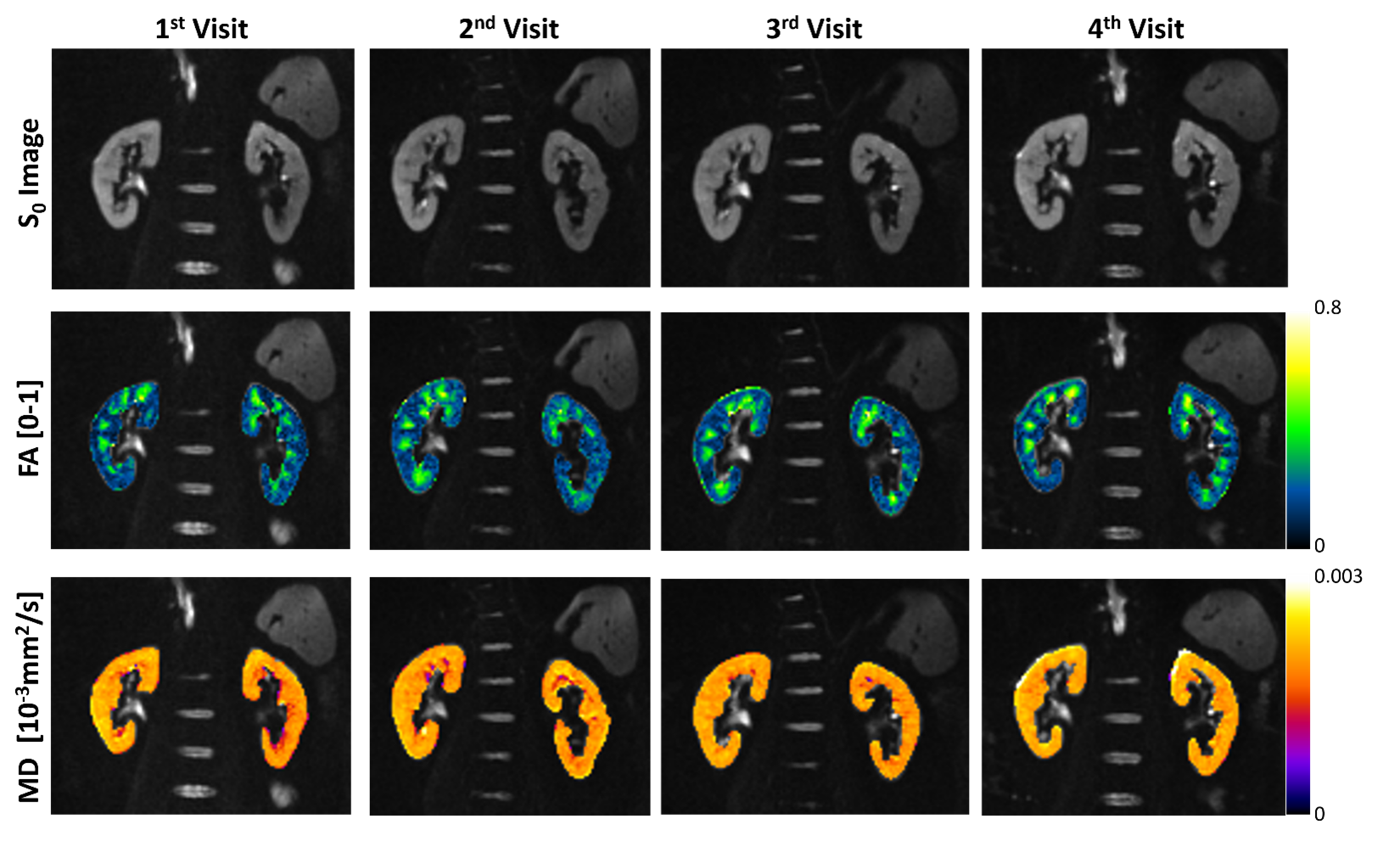
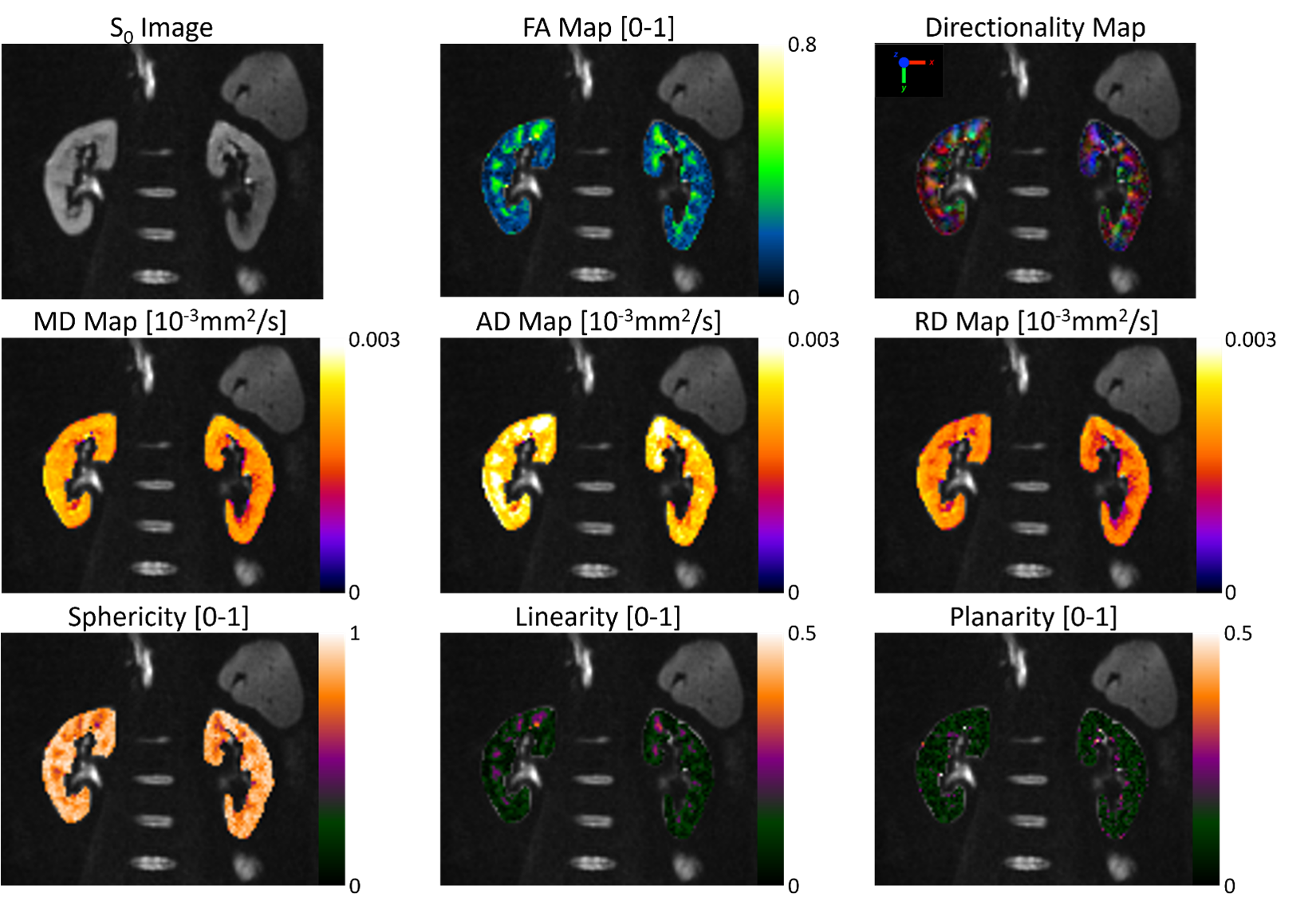
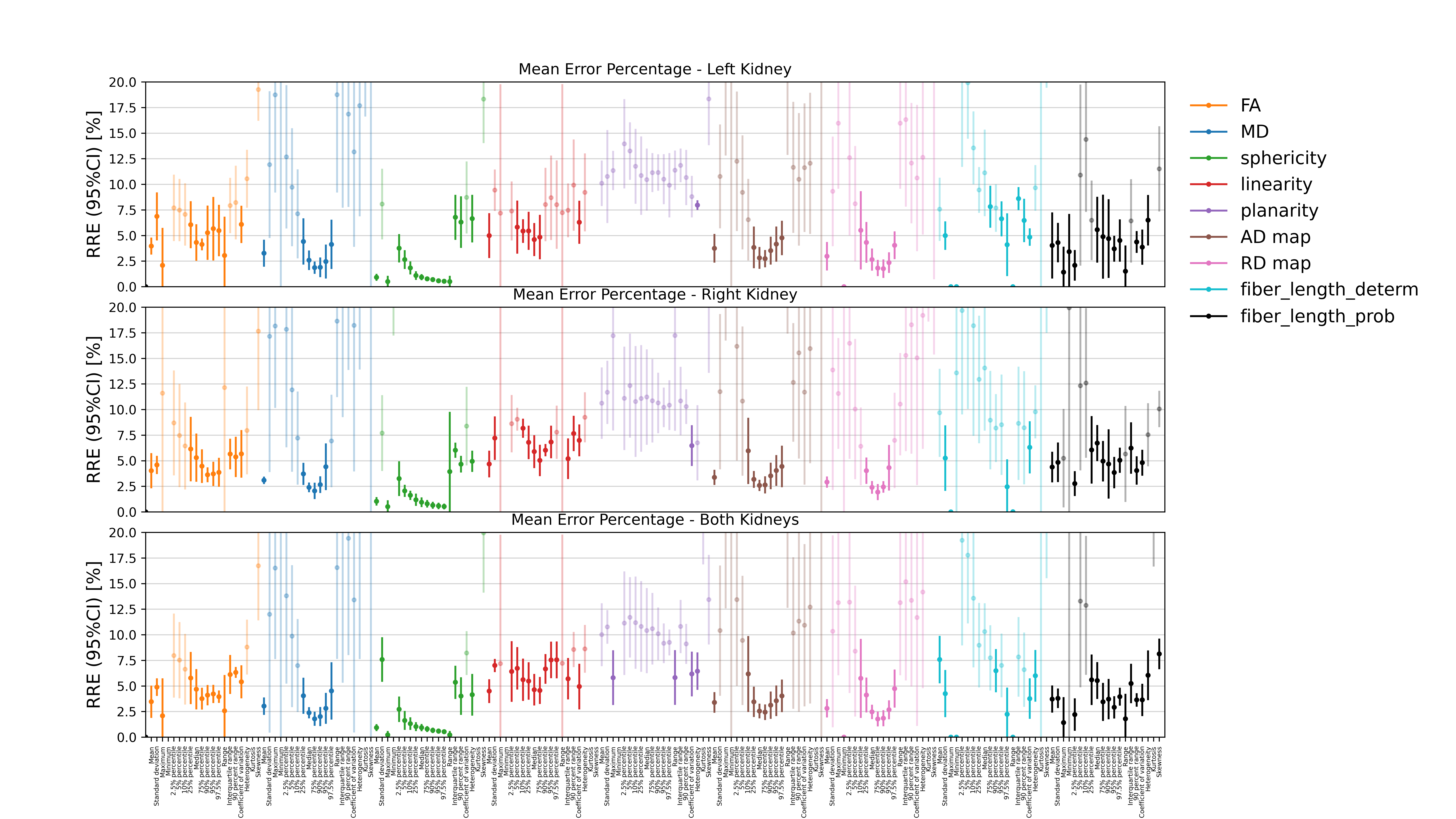
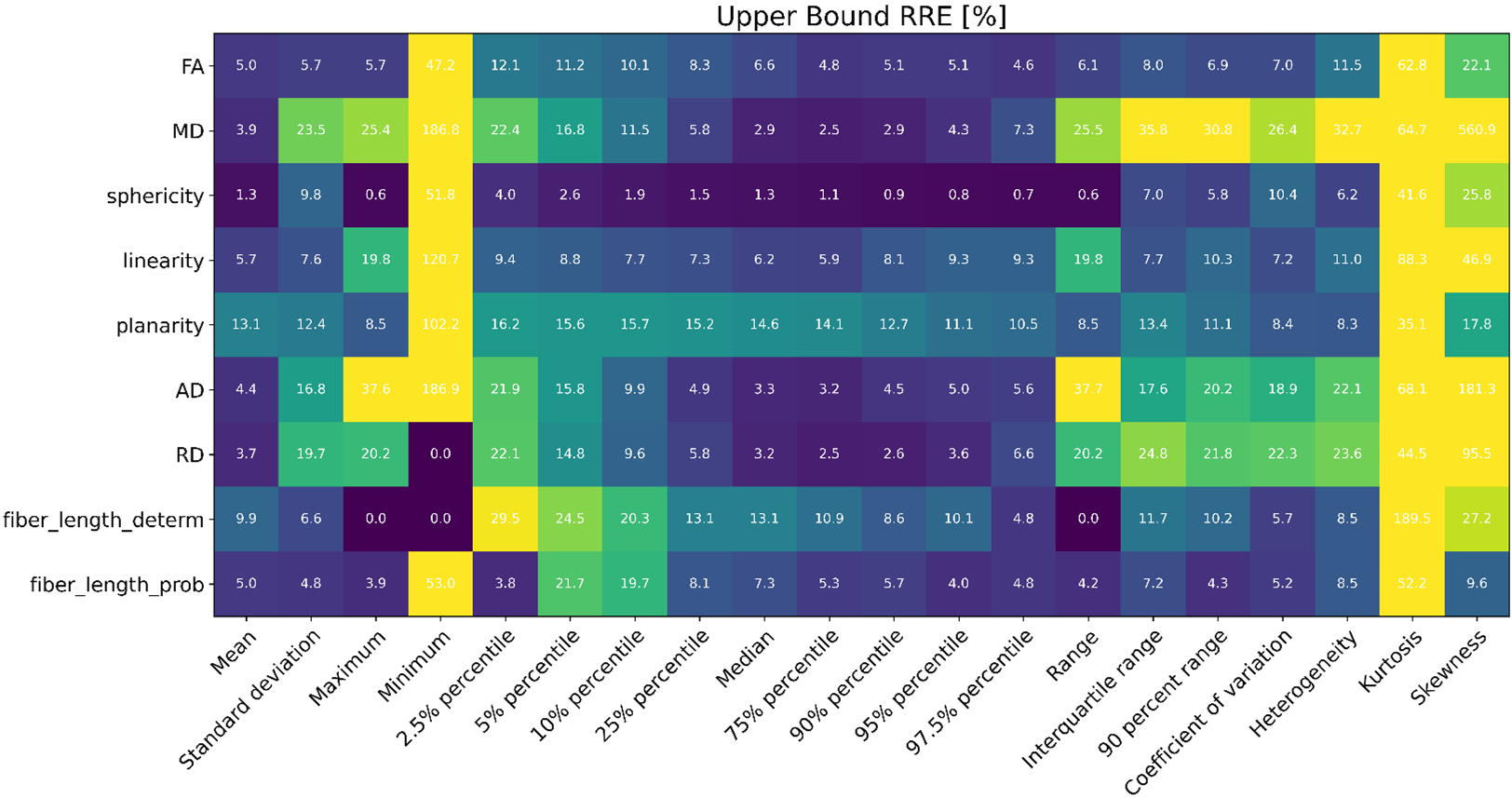
Figure 1 shows S0-image, MD, and FA maps from a volunteer across all visits. Figure 2 shows all the calculated maps in one individual at one time point: S0, FA, Directionality, MD, AD, RD, and tensor shape related maps: sphericity, linearity, and planarity. Figure 3 shows the mean RRE along with its 95%CI for the left kidney (top), right kidney (middle) and both kidneys (bottom) for all 120 extracted biomarkers. Biomarkers where RRE±error<10% are highlighted. Figure 4 shows the mean RRE values for both kidneys as heatmap to facilitate identification of most/least repeatable metrics.Discussion
DTI biomarkers related to FA and tensor shape like sphericity and linearity showed a high repeatability while metrics related to planarity were the least repeatable. While FA is generally the go-to measure of anisotropy in the kidney, the data show that sphericity is more repeatable and deserves more consideration in future studies. Metrics like kurtosis and skewness stand out as relatively poorly repeatable metrics, which implies that these may only be useful when they show large effects. Regarding tractography, fibre length provided by the probabilistic algorithm has a higher repeatability than the determinist method.Limitations:(1)while a good repeatability is a necessary characteristic of a reliable biomarker, it is not on itself sufficient and may in fact reflect a poor sensitivity to change. Closer inspection demonstrated that this was the case for metrics like minimum and maximum values, which were often determined by the fit boundaries rather than the data themselves. Hence biomarker screening may have to be refined by including metrics that reflect specificity, such as cortico-medullary differentiation in healthy kidneys.(2)These error metrics are determined in healthy volunteers, and while they may be seen as useful estimates, there is no guarantee that these apply exactly to diseased kidneys.
Conclusion
On the whole DTI metrics show good repeatability in the kidney, with multiple biomarkers showing errors that are confidently below 5%. DTI is more repeatable than tractography and sphericity in particular is a highly repeatable marker. The data presented here will serve as useful references for interpretation of future clinical data derived with the same protocol.Acknowledgements
This project has received funding from the Innovative Medicines Initiative 2 Joint Undertaking under grant agreement No 115974. The JU receives support from the European Union’s Horizon 2020 research and innovation programme and EFPIA and JDRF.Any dissemination of results reflects only the author's view; the JU is not responsible for any use that may be made of the information it contains.References
[1] - Caroli, Anna, et al. "Diffusion-weighted magnetic resonance imaging to assess diffuse renal pathology: a systematic review and statement paper." Nephrology Dialysis Transplantation 33.suppl_2 (2018): ii29-ii40.
[2] - Lu, Lan, et al. "Use of diffusion tensor MRI to identify early changes in diabetic nephropathy." American journal of nephrology 34.5 (2011): 476-482.
[3] - Inoue, Tsutomu, et al. "Noninvasive evaluation of kidney hypoxia and fibrosis using magnetic resonance imaging." Journal of the American Society of Nephrology: JASN 22.8 (2011): 1429.
[4] - Hueper, Katja et al. “Diffusion tensor imaging and tractography for assessment of renal allograft dysfunction-initial results.” European radiology vol. 21,11 (2011): 2427-33. doi:10.1007/s00330-011-2189-0
[5] - Delgado, Jorge, et al. "Pilot study on renal magnetic resonance diffusion tensor imaging: are quantitative diffusion tensor imaging values useful in the evaluation of children with ureteropelvic junction obstruction?." Pediatric Radiology 49 (2019): 175-186.
[6] - Berchtold, Lena, et al. "Diffusion-magnetic resonance imaging predicts decline of kidney function in chronic kidney disease and in patients with a kidney allograft." Kidney international 101.4 (2022): 804-813.
[7] - Gooding, Kim M et al. “Prognostic imaging biomarkers for diabetic kidney disease (iBEAt): study protocol.” BMC nephrology vol. 21,1 242. 29 Jun. 2020, doi:10.1186/s12882-020-01901-x
Figures