0781
Multiparametric Renal MRI Reveals Ethnic Disparities in Multiple Kidney Function Markers in Asian Preadolescents1Agency for Science, Technology and Research (A*STAR), Singapore Institute for Clinical Sciences (SICS), Singapore, Singapore, 2Khoo Teck Puat-National University Children's Medical Institute, National University Health System, Singapore, Singapore, 3Department of Paediatrics, Yong Loo Lin School of Medicine, National University of Singapore, Singapore, Singapore, 4Department of Diagnostic and Interventional Imaging, KK Women’s and Children’s Hospital, Singapore, Singapore, 5Siemens Healthcare GmbH, Erlangen, Germany, 6Saw Swee Hock School of Public Health, National University of Singapore and National University Health System,, Singapore, Singapore, 7Department of Maternal Fetal Medicine, KK Women's and Children's Hospital, Singapore, Singapore, 8Duke-NUS Medical School, Singapore, Singapore, 9Department of Pediatrics, KK Women's and Children's Hospital, Singapore, Singapore, 10Lee Kong Chian School of Medicine, Nanyang Technological University, Singapore, Singapore, 11Department of Obstetrics and Gynaecology and Human Potential Translational Research Programme, Yong Loo Lin School of Medicine, National University of Singapore, Singapore, Singapore, 12MRC Lifecourse Epidemiology Centre and NIHR Southampton Biomedical Research Centre, University of Southampton and University Hospital Southampton NHS Foundation Trust, Southampton, United Kingdom, 13Liggins Institute, University of Auckland, Auckland, New Zealand, 1414Department of General Practice and Primary Health Care, University of Helsinki, Helsinki, Finland, 15Folkhälsan Research Center, Helsinki, Finland, 16School of Biomedical Sciences, Faculty of Medicine, The University of Queensland, St Lucia, Australia, 17Obstetrics and Gynaecology, University of Melbourne, Parkville, Australia, 18School of Molecular Sciences, The University of Western Australia, Crawley, Australia
Synopsis
Keywords: Kidney, Kidney, Volumetry, Diffusion, Perfusion, Oxygenation
Motivation: Within Singapore's multiethnic population, Indians and Malays have a higher burden of chronic kidney disease than Chinese. While this has been attributed to higher prevalence of hypertension, diabetes and dyslipidemia, it is not clear if Indians and Malays already have preexisting subclinical renal alterations.
Goal(s): Assess ethnic differences in kidney function markers in healthy Asian preadolescents using multiparametric MRI and physiological assessments.
Approach: Identify adverse renal function using multiparametric MRI (volumetry, diffusion, perfusion, oxygenation) and physiological assessments (urine albumin, estimated glomerular filtration rate, blood pressure)
Results: Indian and Malay preadolescents showed multiple renal alterations which predate the development of diabetes, hypertension or dyslipidemia.
Impact: Detailed renal phenotyping of Asian preadolescents using multiparametric renal MRI and physiological assessments identified ethnic disparities in multiple renal function markers, which predate the development of diabetes, hypertension or dyslipidemia, and may help explain the predisposition for chronic kidney disease.
Background
Globally, chronic kidney disease (CKD) represents a major health burden with substantial ethnic disparities. Within Singapore’s multiethnic population, CKD is expected to affect a quarter of the population by 20351. Current CKD prevalence in Singapore is higher in Malays (18.6%) and Indians (17.6%) than in Chinese (11.4%)2. Malays have the highest burden of end-stage renal disease, with 3-fold and 2-fold higher age-standardized incidence rates for dialysis initiation compared to Chinese and Indians, respectively3. These ethnic disparities have been attributed to higher prevalence of diabetes, dyslipidemia and hypertension in Malays and Indians2,4. We investigated whether subclinical alterations in kidney function are already apparent in children of Malay and Indian ethnicity. Detailed phenotyping of kidney function was undertaken in a multi-ethnic cohort of apparently healthy Asian preadolescents using a combination of multiparametric renal MRI (Volumetry, Diffusion, Perfusion & Oxygenation) and physiological assessments.Methods
Multiparametric renal MRI was performed on a 3T MRI scanner (Magnetom Prisma, Siemens). 461 singleton preadolescents from the Growing Up in Singapore Towards healthy Outcomes (GUSTO) cohort underwent MR imaging at age 10.5y. Left and right renal parenchyma were segmented automatically from coronal HASTE images using a deep learning model developed in-house. Cortical and medullary oxygenation were assessed using the apparent transverse relaxation rate, R2*, obtained by blood oxygen level dependent (BOLD) MRI. Molecular water diffusion, D, in the cortex and medulla (corrected for effects of vascular and tubular water motion) were assessed using intravoxel incoherent imaging (IVIM). Cortical and medullary renal blood flow (RBF) were assessed using a research pulsed arterial spin labeling (PASL) sequence. Urine osmolarity, creatinine and albumin were assessed from first morning urine samples. The effect of water dilution on urine albumin was corrected using covariate-adjusted standardization, accounting for constitutional variation in urine creatinine due to ethnicity, lean body mass and sex5. As a proxy for sympathetic nervous system (SNS) activity, we measured α-amylase levels in morning and evening saliva samples6. Anthropometric assessments and clinical biochemistry were performed at a separate clinical visit at age 10y. The CKiD U25 equation was used to calculate estimated glomerular filtration rate (eGFR) from plasma creatinine7. Total daily fluid intake was estimated from self-reported dietary intake recorded in a 4-day web-based diary. Given the lack of standard cut-offs for risk-stratification using the above assessments in this age-group, we defined low parenchymal volume as total parenchymal volume (sum of the left and right renal parenchymal volumes) <10th centile, restricted diffusion as IVIM D <10th centile, low perfusion as PASL RBF <10th centile, low oxygenation as BOLD R2*>90th centile, high urine albumin as water-dilution corrected urine albumin >90th centile, and high SNS activity as either morning or evening salivary α-amylase >90th centile. Simplified pediatric systolic/diastolic blood pressure (SBP/DBP) cut-offs of 110/70 mmHg were used to identify children with elevated blood pressure8. An eGFR <90 mL/min/1.73 m2 was used to identify children with a mild reduction in GFR. We assessed the risk of belonging to the high-risk categories identified above, associated with Indian and Malay ethnicities (compared to Chinese ethnicity) using modified Poisson regression.Results
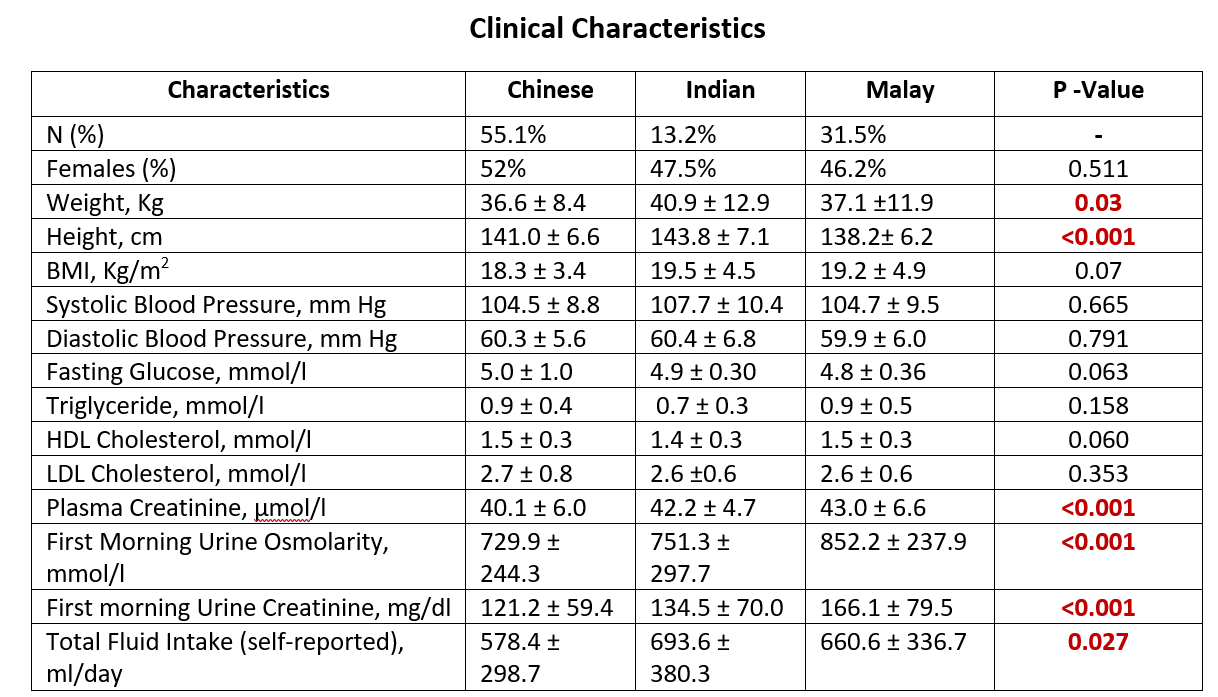
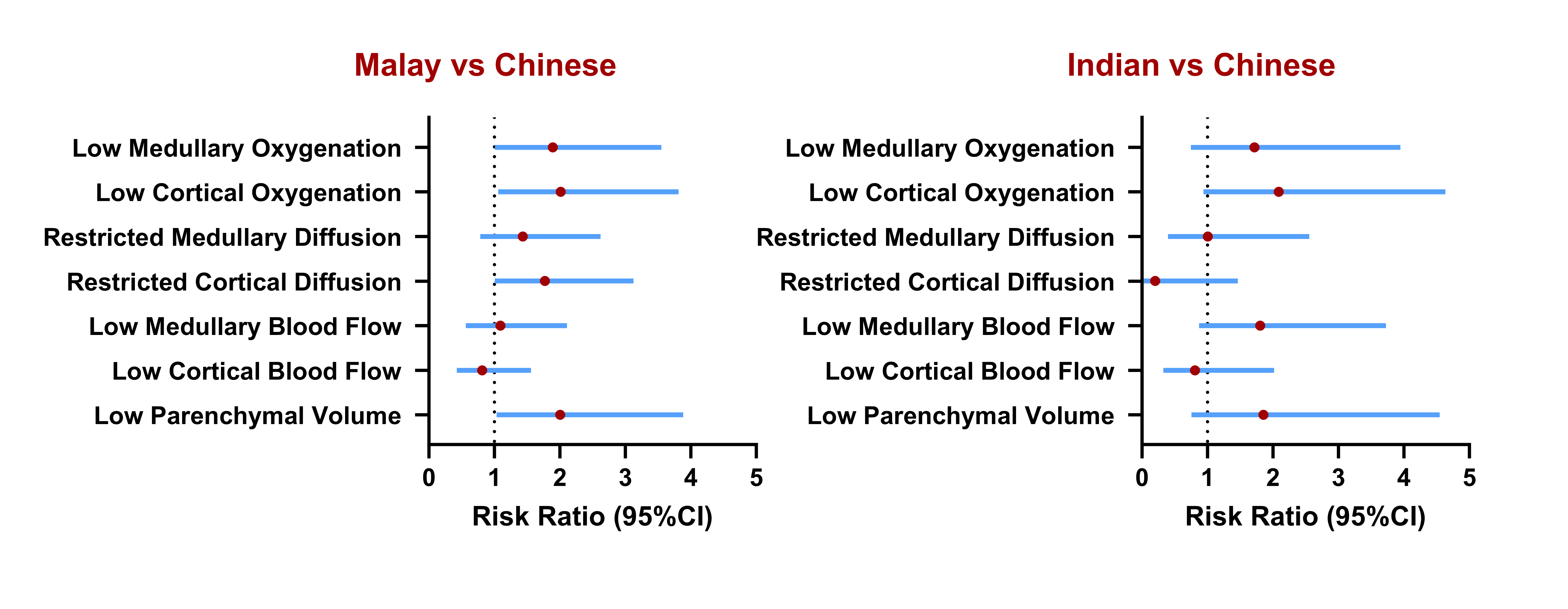
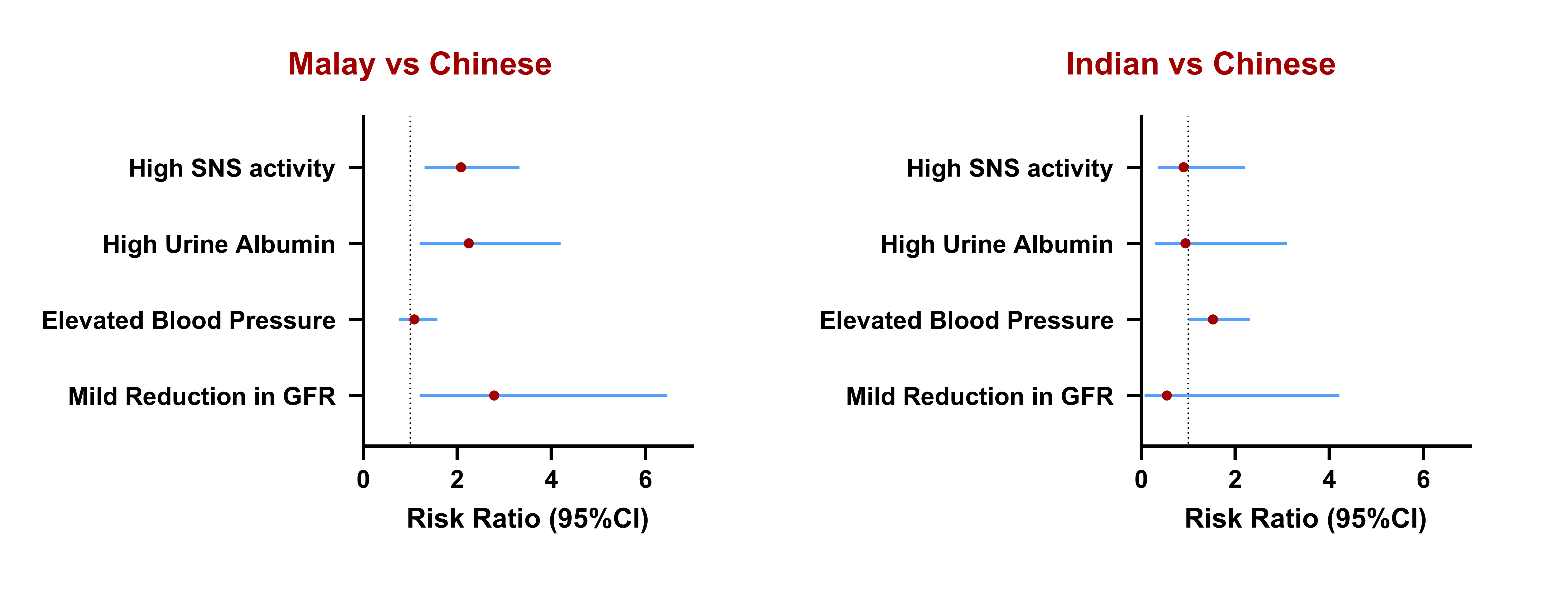
Clinical characteristics are shown in Fig.1. There were no ethnic differences in BMI, SBP, DBP, plasma lipids or fasting glucose. Both urine osmolarity and creatinine levels were highest in Malay children. They also had a nearly 2-fold higher risk of having low parenchymal volume, low cortical diffusion, low cortical and medullary oxygenation, high urine albumin and high SNS activity, and a nearly 3-fold higher risk of a mild reduction in GFR (Figs. 2&3). Indian children had a nearly 2-fold higher risk of low parenchymal volume, low cortical oxygenation and low medullary blood flow, and a 1.5-fold higher risk of having elevated blood pressure (Figs. 2&3).Conclusion
Malay and Indian preadolescents had higher risks of multiple renal functional alterations, including higher risks for low kidney volume and filtration rate (proxies for reduced function), restricted diffusion (proxy for inflammatory infiltrates and fibrosis), low oxygenation and blood flow (which increases risk for hypoxic injuries) and increased loss of albumin in urine (marker for reduced glomerular barrier selectivity and a trigger for tubular injury/inflammation). Malay children showed evidence for high SNS activity (which activates the renin-angiotensin-aldosterone system) and high urine concentrating function (not explained by low fluid intake, since self-reported fluid intake was highest in Malays). Our findings highlight the need to understand the etiology of these renal alterations which predate development of diabetes, dyslipidemia or hypertension in Malays and Indians, as these alterations may modify/amplify the effects of secondary insults overt the life-course, creating a predisposition for CKD.Acknowledgements
This study was supported by the NMRC-YIRG grant (OFYIRG18nov-0011) and the NUHS-SEED grant (NUHSRO/2020/024/T1/Seed-Aug/08). Additional funding was provided by Singapore Institute for Clinical Sciences, A*STAR. The GUSTO cohort is supported by National Medical Research Council, Singapore (NMRC) [NMRC/TCR/004-NUS/2008, NMRC/TCR/012-NUHS/2014, OFLCG19May-0033]. KMG is supported by UK Medical Research Council (UK MRC) (MC_UU_12011/4), National Institute for Health Research (NF-SI-0515-10042 & IS-BRC-1215-20004), European Union (Erasmus+ Programme ImpENSA 598488-EPP-1-2018-1-DE-EPPKA2-CBHE-JP), British Heart Foundation (RG/15/17/3174) and US National Institutes of Health’s National Institute On Aging (Award No. U24AG047867).
References
1. Wong, L. Y., et al. "Projecting the burden of chronic kidney disease in a developed country and its implications on public health." International journal of nephrology 2018 (2018).
2. Sabanayagam, Charumathi, et al. "Ethnic disparities in prevalence and impact of risk factors of chronic kidney disease." Nephrology Dialysis Transplantation 25.8 (2010): 2564-2570.
3. Singapore Renal Registry Annual Report 2020, National Registry of Diseases Office, Singapore
4. Sabanayagam, Charumathi, et al. "Hypertension, hypertension control, and chronic kidney disease in a Malay population in Singapore." Asia Pacific Journal of Public Health 23.6 (2011): 936-945.
5. O’Brien, Katie M., et al. "Environmental chemicals in urine and blood: improving methods for creatinine and lipid adjustment." Environmental health perspectives 124.2 (2016): 220-227.
6. Nater, Urs M., and N. Rohleder. "Salivary alpha-amylase as a non-invasive biomarker for the sympathetic nervous system: current state of research." Psychoneuroendocrinology 34.4 (2009): 486- 496.
7. Nyman, Ulf, et al. "The modified CKiD study estimated GFR equations for children and young adults under 25 years of age: performance in a European multicenter cohort." American Journal of Kidney Diseases 80.6 (2022): 807-810.
8. Xi, Bo, et al. "Can pediatric hypertension criteria be simplified? A prediction analysis of subclinical cardiovascular outcomes from the Bogalusa Heart Study." Hypertension 69.4 (2017): 691-696.Figures