0756
Motion Correction with Combination of Disentangled Cycle-GAN and k-space Subsampling for the gadoxetic acid-enhanced liver MRI1State Key Laboratory of Magnetic Resonance and Atomic and Molecular Physics, Innovation Academy for Precision Measurement Science and Technology, Chinese Academy of Sciences, Wuhan, China, 2University of Chinese Academy of Sciences, Beijing, China, 3Weizmann Institute of Science, Rehovot, Israel, 4Department of Radiology, Union Hospital, Tongji Medical College, Huazhong University of Science and Technology, Wuhan, China, 5Clinical & Technical Support, Philips Healthcare, Beijing, China, 6Optics Valley Laboratory, Hubei, China
Synopsis
Keywords: Motion Correction, Motion Correction
Motivation: The gadoxetic acid-enhanced liver MRI is often accompanied by significant motion artifacts due to drug side effects.
Goal(s): Motion correction by integrating Disentangled Cycle-GAN with the k-space Subsampling (DCGAN-kS) method.
Approach: Convert motion correction to the image domain transfer problem resolved by DCGAN with the aid of the k-space subsampling strategy for reducing features and simplifying the domain transfer problem.
Results: The method can effectively remove artifacts for the arterial phase imaging of the gadoxetic acid-enhanced liver MRI.
Impact: The proposed scheme outperforms the other state-of-the-art methods for motion correction in the gadoxetic acid-enhanced liver MRI, which could enhance the image quality and reduce failed scanning.
INTRODUCTION
Gadoxetic acid is an effective liver-specific MRI contrast agent. Numerous research findings have acknowledged the occurrence of side effects, such as acute transient dyspnea, following the administration of Gadoxetic acid [1]. These side effects can result in significant motion artifacts [1]. Although many strategies have been proposed to remove motion artifacts, nonrigid motion correction is still challenging, especially for the abdominal regions.With the rapid development of deep learning, many researchers have demonstrated potential for motion correction, especially for dramatically reducing computation time and improving the data-driven autofocusing motion correction convergence. Many motion correction techniques are based on supervised learning, in which the network is trained with pairs of motion-corrupted and motion-free images. Bao et al. [2] proposed a new end-to-end motion-correction method for the multishot sequence that incorporates a conditional generative adversarial network with minimum entropy (cGANME) of MR images. Although the supervised deep learning methods perform well by the metrics, the objective function has limited constraints on fine details. Thus, the supervised methods trained the models with a simulated data set yielded a relatively poor performance for the real motion correction. GANs-based unsupervised methods address the motion correction problem by considering it as a cross-domain translation problem, the images in the motion-corrupted domain are translated to the clean domain. Liu et al. [3] suggested a disentangled unsupervised cycle-consistent adversarial network (DUNCAN), which demonstrated that artifact-corrupted images can be disentangled into an anatomical content component and an artifact component.
Methods
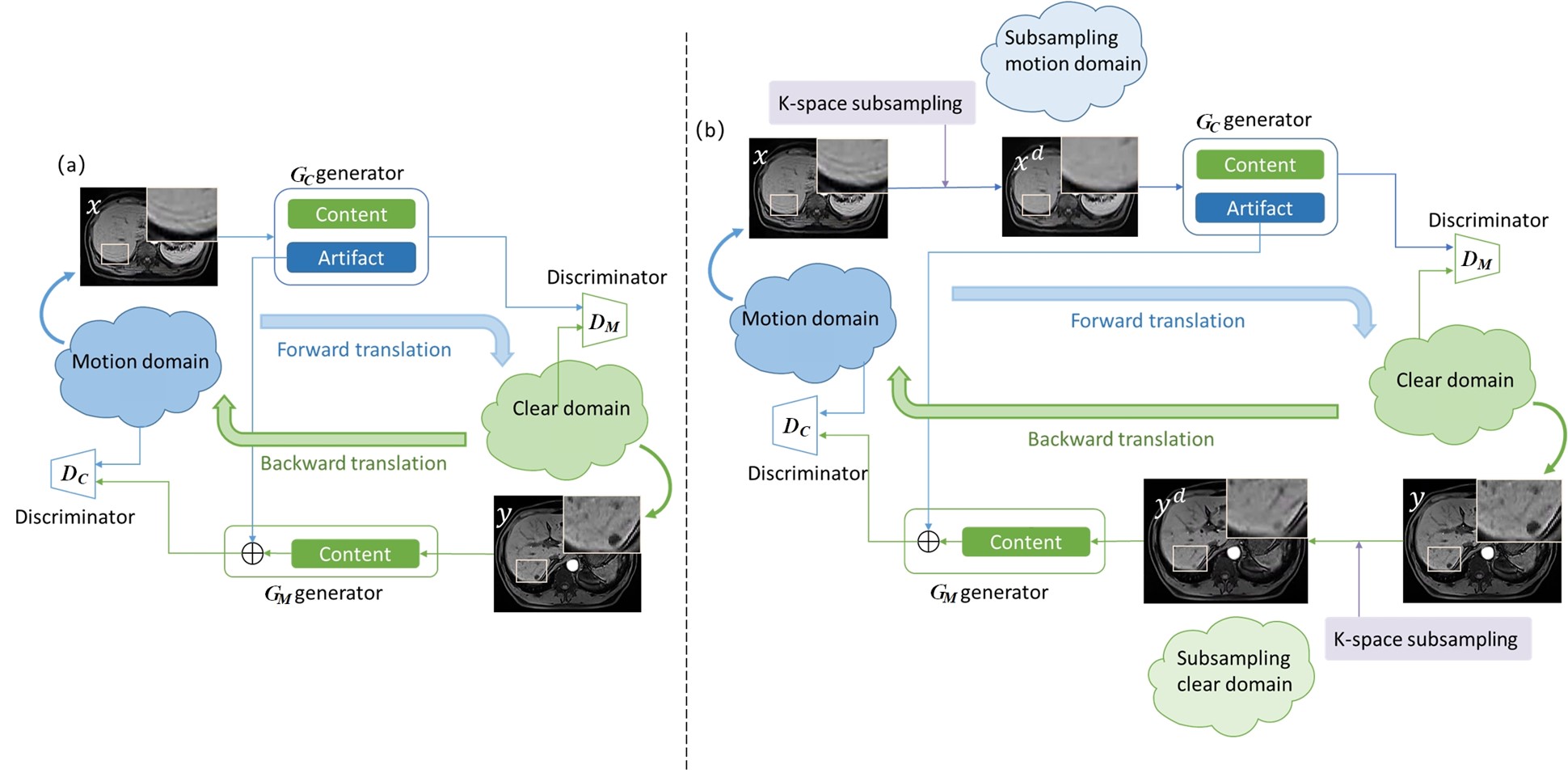
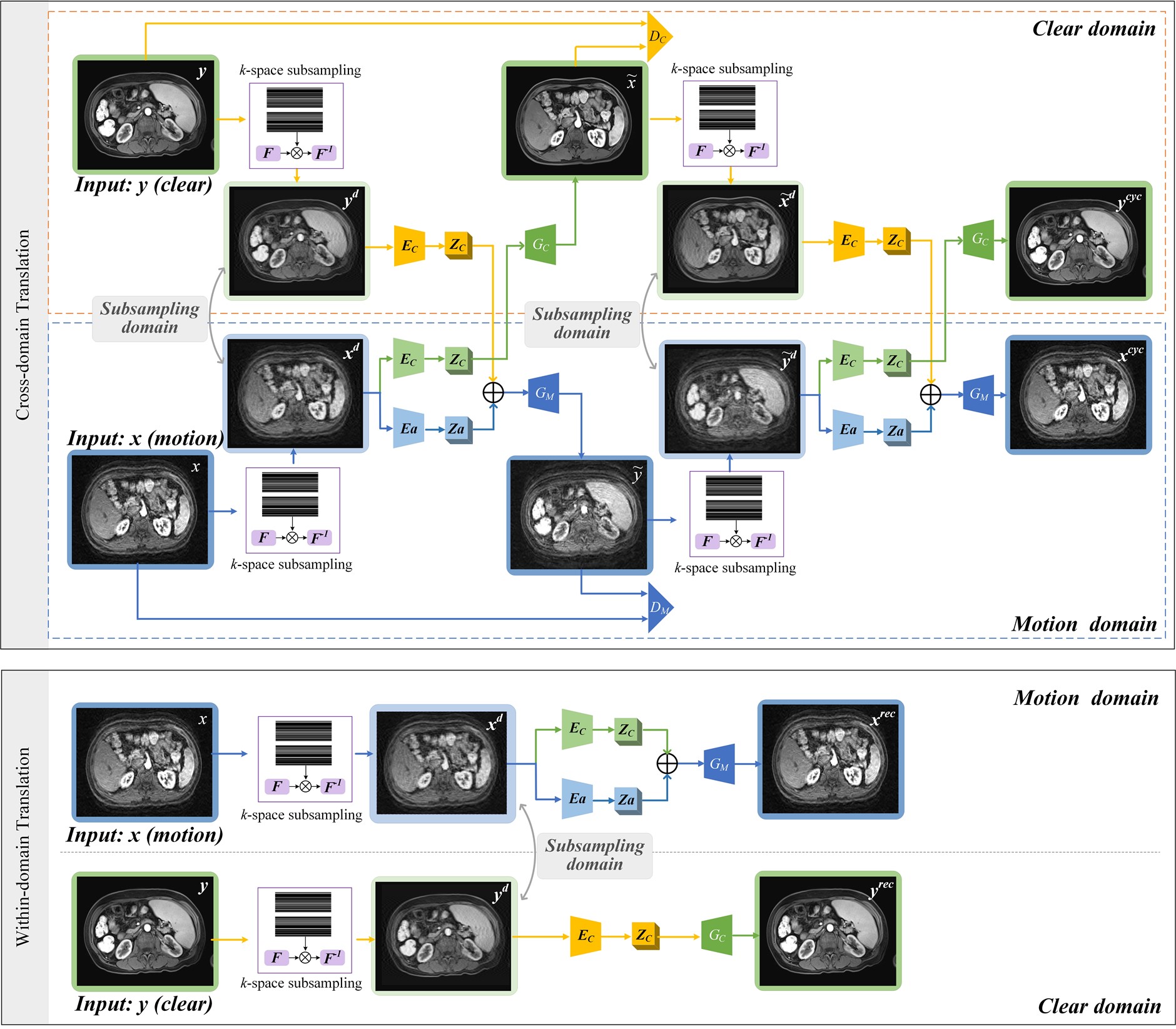
We propose a disentangled Cycle-GAN with -space Subsampling (DCGAN-kS) method for motion correction. First, we design the network based on disentangled presentation Cycle-GAN, to overcome limitation of training with paired ground truth data. Second, based on the prior knowledge of MRI that motion artifacts cause outliers along the k-space phase encoding direction, we use the k-space subsampling module to obtain a subsampling domain with fewer motion artifacts and reduce the distribution complexity. Thirdly, Fréchet Inception Distance (FID) which measures the similarity between the distribution of two sets of images is introduced to demonstrate the performance of the method.Fig. 1(a) shows the cross-domain translation with disentangled representation. The motion-corrupted image $$$x$$$ is disentangled into the content and artifact features, and the motion-clear image $$$y$$$ is encoded to the content components of $$$x$$$ . Then the content features of $$$x$$$ is decoded via $$$G_{c}$$$ generator to obtain motion-corrected images. The artifact features of $$$x$$$ are combined with the content component of $$$y$$$ to obtain the motion-corrupted images with the $$$G_{M}$$$ generator. Thus, with the cross-domain translation, the motion-corrupted image can be transferred to image $$$y$$$ , indicating the motion-corrupted image is corrected. Fig.1(b) shows the main idea of the combination of the k-space subsampling model the disentangled represented Cycle-GAN. A k-space random subsampling is applied to motion-corrupted image $$$x$$$ along the phase encoding direction, the sparse outliers can be removed in a probabilistic sense. The domains with k-space subsampling are denoted as the subsampling motion domain and subsampling clear domain, respectively. The complexity of artifact distribution in the subsampling motion domain is reduced, reducing learning complexity for the network. The detail of proposed network architecture shows in Fig. 2.
RESULTS & DISCUSSION
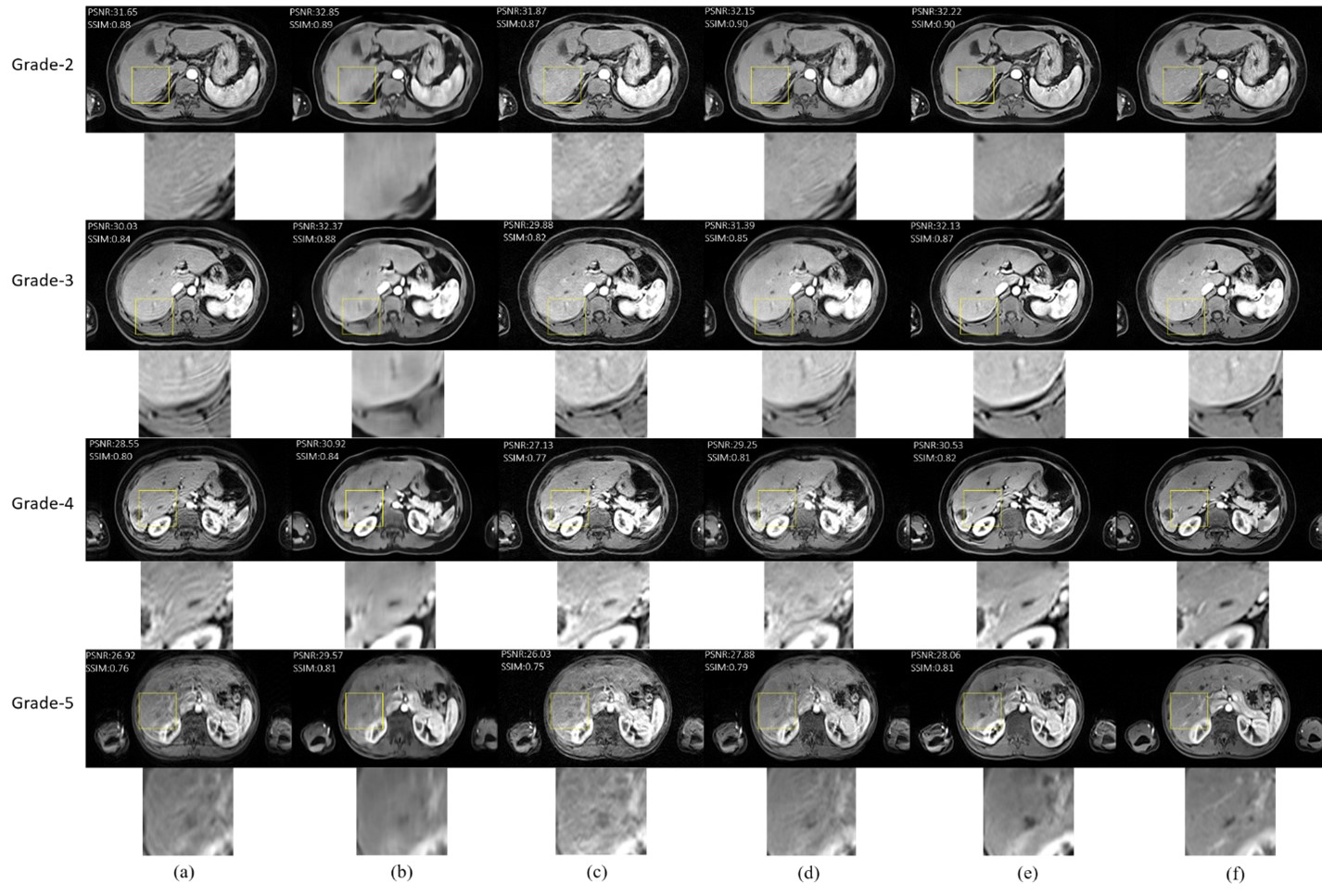
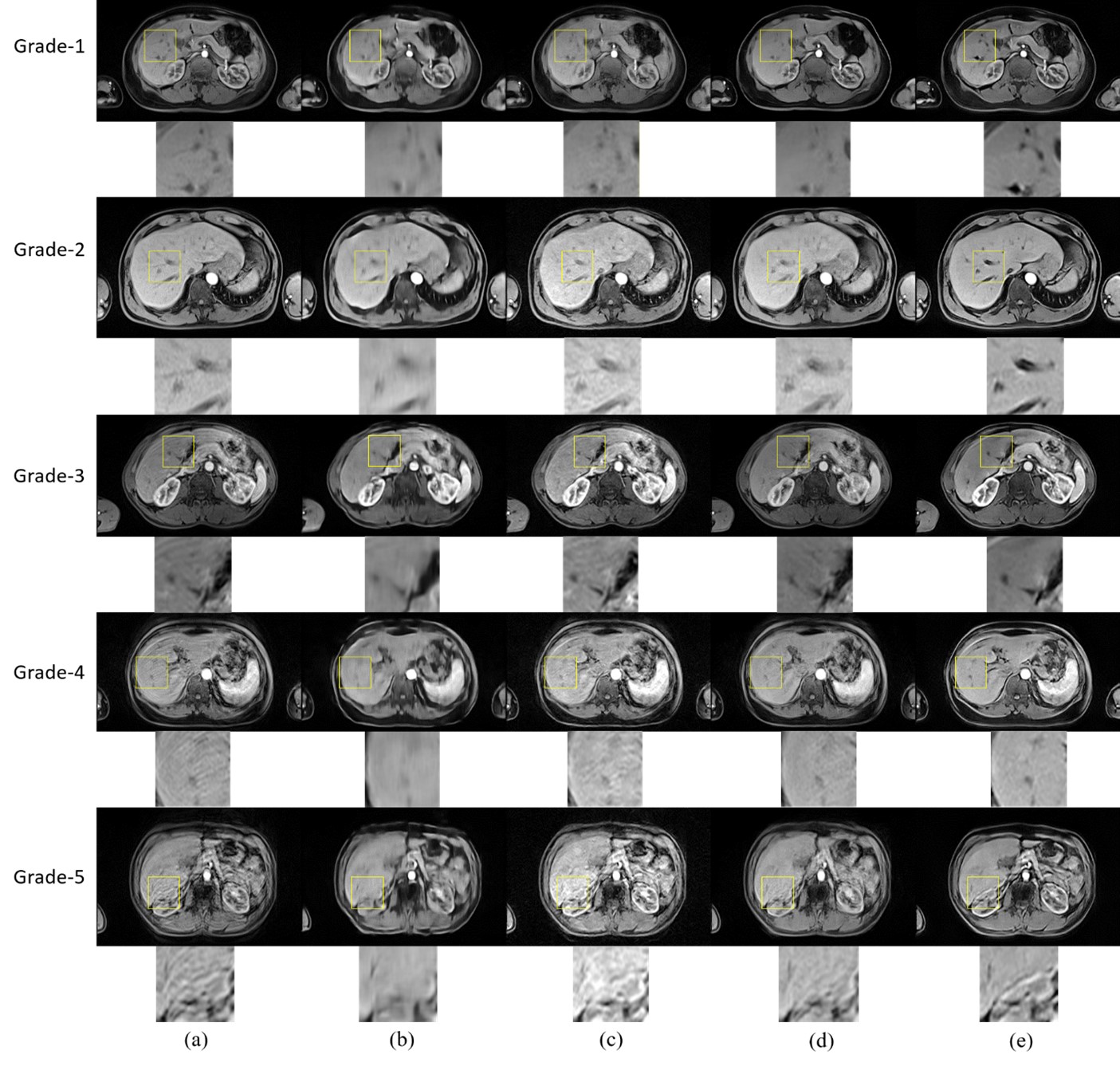
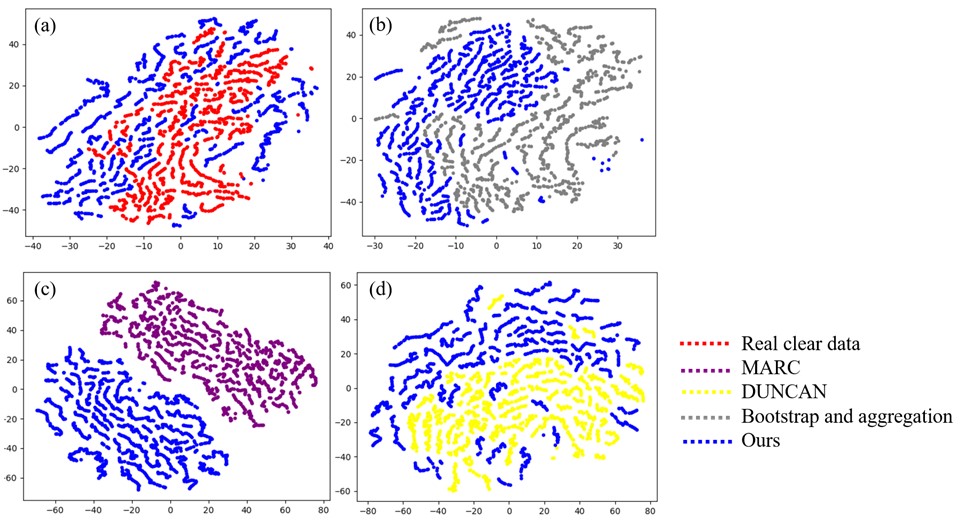
Fig. 3 shows the simulated 2D random motion artifact correction results for both quantitative and qualitative comparison. As shown in Fig. 3(a), simulated random motion artifacts appear in the input images. MARC [4] reduces the motion artifacts in MR images and improves the quantitative metric values. However, the output images of MARC (Fig. 3(b)) are blurred and lose the fine details. DUNCAN [3] (Fig. 3(c)) could remove the motion artifacts but the ability to recover the details is not sufficient. Compared with bootstrap and aggregation (Fig. 3(d)), our method (Fig. 3(e)) was able to correct the motion artifacts more efficiently.We also demonstrate our method with real motion artifact data in Fig. 4. To verify the quality of generation results of the proposed DCGAN-kS network, we evaluated the real test data with the Fréchet Inception Distance (FID) (Fig. 5), comparing the distribution of the data generated by different methods with the real motion-free data. The distribution of (a) our method, (b) MARC [4], (c) DUNCAN [3], and (d) bootstrap and aggregation [5] are compared with the distribution of the real motion-free data.
CONCLUSION
The proposed Disentangled Cycle-GAN with k-space Subsampling can correct motion artifacts for gadoxetic acid-enhanced MRI without paired datasets and outperforms the other state-of-the-art unsupervised methods. It incorporates the Cycle-GAN framework with an MRI physical prior model, k-space subsampling, to effectively reduce the motion artifacts.Acknowledgements
This work was supported by the National Major Scientific Research Equipment Development Project of China (81627901), the National key of R&D Program of China (Grant 2018YFC0115000, 2016YFC1304702), National Natural Science Foundation of China (11575287, 11705274), and the Chinese Academy of Sciences (YZ201677).References
1. Frydrychowicz A, Lubner M G, Brown J J, et al. Hepatobiliary MR imaging with gadolinium‐based contrast agents[J]. Journal of magnetic resonance imaging, 2012, 35(3): 492-511.
2. Bao Q, Chen Y, Bai C, et al. Retrospective motion correction for preclinical/clinical magnetic resonance imaging based on a conditional generative adversarial network with entropy loss[J]. NMR in Biomedicine, 2022, 35(12): e4809.
3. Liu S, Thung K H, Qu L, et al. Learning MRI artefact removal with unpaired data[J]. Nature Machine Intelligence, 2021, 3(1): 60-67.
4. Tamada D, Kromrey M L, Ichikawa S, et al. Motion artifact reduction using a convolutional neural network for dynamic contrast enhanced MR imaging of the liver[J]. Magnetic resonance in medical sciences, 2020, 19(1): 64-76.
5. Oh G, Lee J E, Ye J C. Unpaired MR motion artifact deep learning using outlier-rejecting bootstrap aggregation[J]. IEEE Transactions on Medical Imaging, 2021, 40(11): 3125-3139.
Figures