0724
Advanced Deep Learning Denoising for Accelerated 0.55T Prostate MRI1Bernard and Irene Schwartz Center for Biomedical Imaging, Department of Radiology, New York University Grossman School of Medicine, New York, NY, United States, 2Department of Electrical and Computer Engineering, NYU Tandon School of Engineering, Brooklyn, NY, United States, 3Center for Advanced Imaging Innovation and Research (CAI2R), Department of Radiology, New York University Grossman School of Medicine, New York, NY, United States
Synopsis
Keywords: Prostate, Prostate
Motivation: Low-Field MR offers a great platform for low-cost high-performance screening of prostate cancer, but it suffers from low SNR. Prolonged scan times are typically needed to achieve adequate SNR at low field.
Goal(s): In this work, we developed an advanced deep learning denoising method for rapid high spatial resolution prostate MRI at 0.55T.
Approach: The proposed approach was tested in T2-weighted prostate MRI. Supervised training was performed to denoise images acquired with different numbers of averages, corresponding to different scan times.
Results: Deep learning was able to denoise prostate images at high spatial resolution resulting acquisition time with 1-2 average.
Impact: The proposed denoising technique holds significant potential to promote the use of 0.55T MRI and other types of low-field MRI for prostate imaging and screening for prostate cancer, with reduced cost and greater accessibility.
Introduction
Prostate cancer (PCa) is the most common malignancy and is the 2nd leading cause of cancer-related mortality in males in the United States. Despite high incidence and tremendous human and economic impact of PCa, there is no good screening test for clinically significant PCa. Multi-parametric prostate MRI has been shown to have an increasingly important role in the detection and localization of clinically significant PCa. However, implementation of prostate MRI as a first-line screening tool is significantly restricted by the high cost of the scanner and the exam. Low-field MRI has emerged as an exciting area of research in recent years and has seen increasing clinical adoption in past years presenting great potential to enable low-cost high-performance MRI for PCa screening with greater accessibility. Nevertheless, low SNR is a major challenge associated with low-field MRI, thus necessitating longer acquisition times compared to high field imaging. In this study, we propose an advanced deep learning approach for denoising prostate MRI at 0.55T.Methods
The proposed denoising technique was trained on a total of 36 prostate datasets acquired on a ramped down 0.55T scanner (Area, Siemens). After network training, a total of 4 datasets (not included for training) with suspected prostate cancer were used for evaluation. Imaging protocol included: Matrix size=512x256, FOV=360x180mm2, interpolated resolution=0.7x0.7mm2, number of slices=30, GRAPPA factor=2. 8 averages were acquired in each dataset and the scan time was ~15min.Figure 1 shows the training scheme. The 8-average coil-combined prostate data are used as reference for supervised training. A convolutional dictionary learning network (CDLNet)[1] is then trained to denoise corresponding 1-average or 2-average coil-combined data from the same datasets. A wavelet-based noise-level estimation algorithm is used to obtain an estimated noise-level and adapt the denoiser to the characteristics input sample. The mean squared error (MSE) loss is computed between the output of the denoiser and the (noisy) 8-average reference to train the network via stochastic gradient descent.
CDLNet is a noise-adaptive convolutional denoising neural network derived from classical sparse-coding. Each layer consists of an analysis filter bank (1 channel to M latent channels), a synthesis filter bank (M latent channels to 1 channel), and soft-thresholding layer with (M) learnable thresholds. The thresholds are parameterized to increase with an increasing input noise-level. The explicit noise-adaptive parameterization of CDLNet has been shown to yield near-perfect generalization when presented with noise-levels outside the training distribution[2].
Results
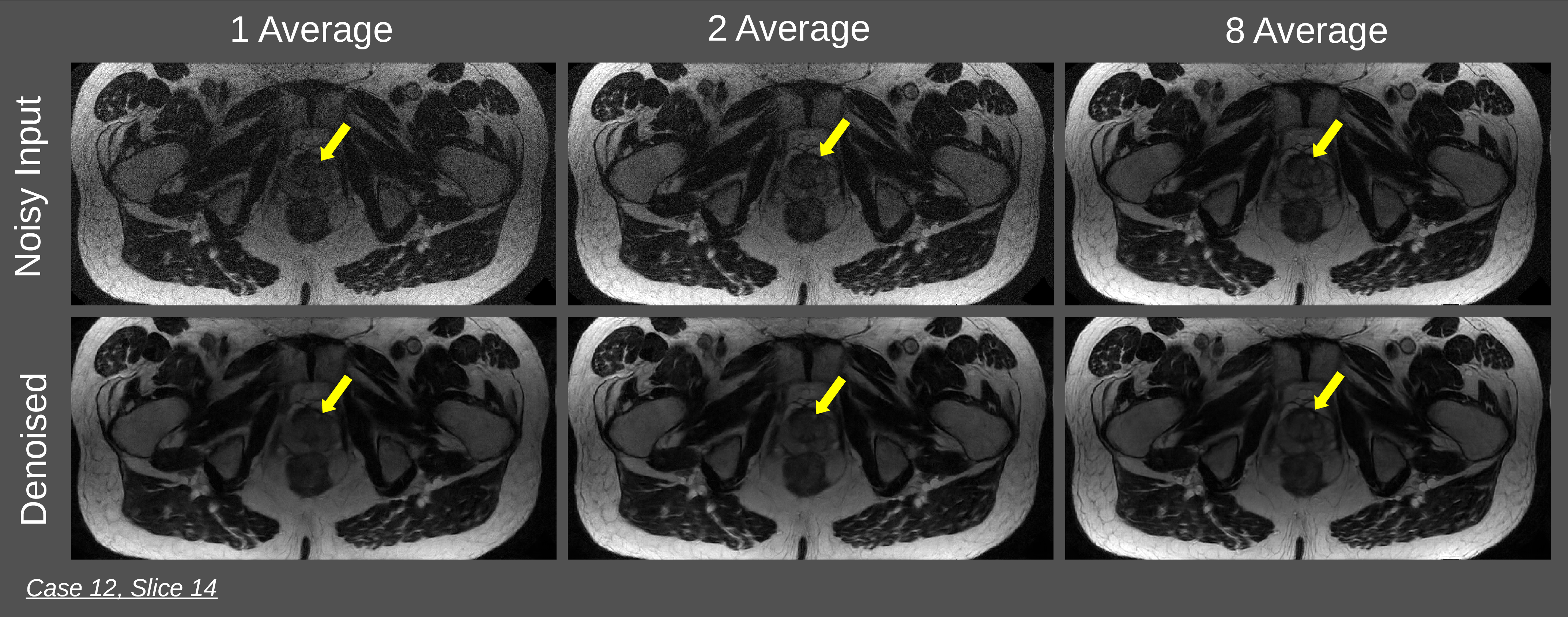
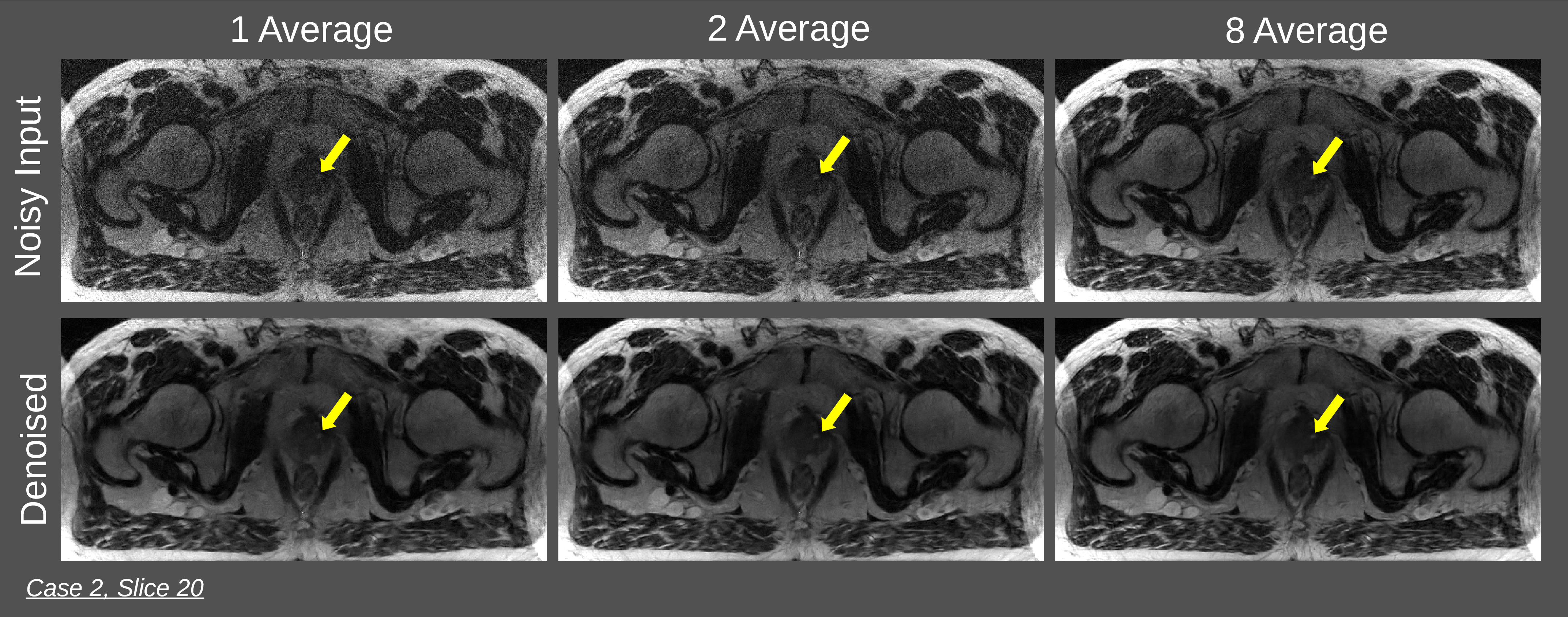
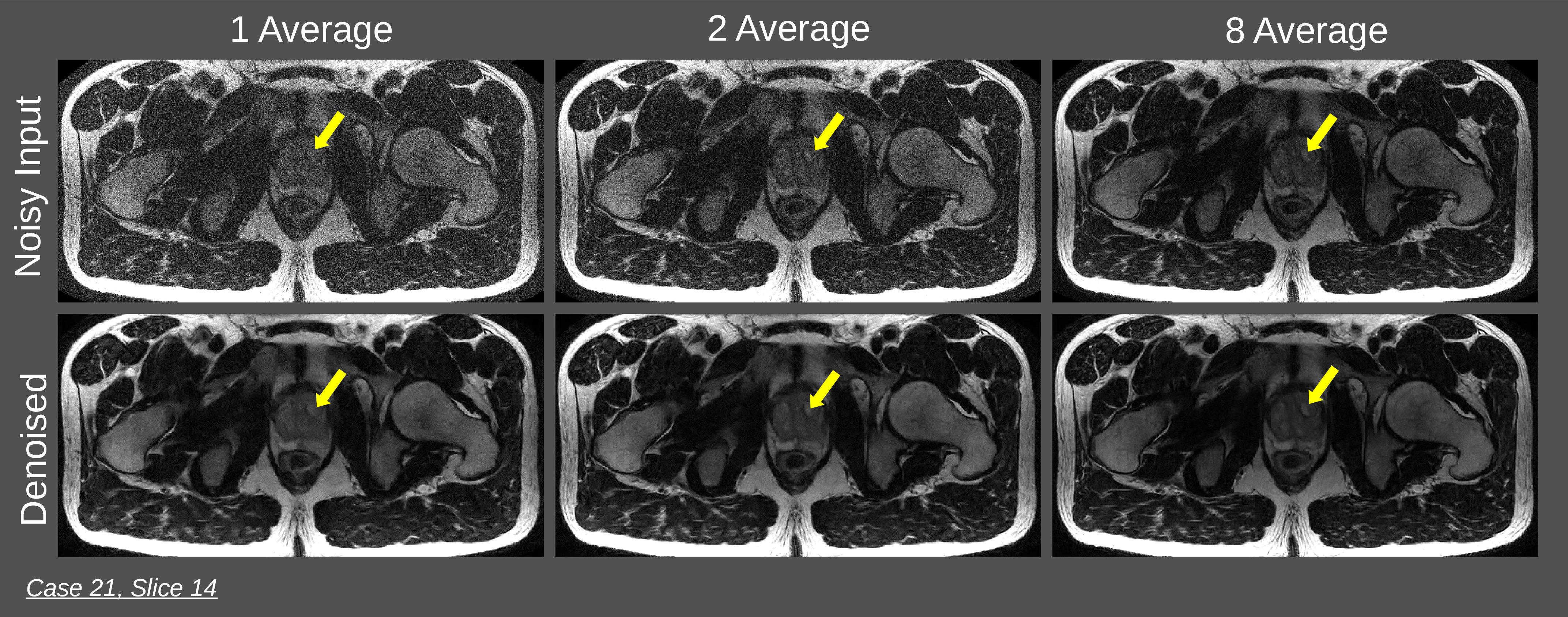
Figures 2-5 show [CH1] different evaluation datasets comparing images before and after denoising for different numbers of averages. 1-average and 2-average correspond to a scan time of 1min53sec and 3min45sec, respectively. In each case, we qualitatively observe that our technique was able to successfully removes noise content and enhances details available in the underlying images.Note that although our technique uses noisy 8-average data as a reference to update the network weights, we are still able to pass noisy 8-average data through the network. At the first glance, it may appear surprising that the technique is able to remove noise present in this “reference” data, as the network would ideally reproduce the level of noise present in 8-average data to minimize the training loss. We consider two possible explanations for this behavior. First, the CDLNet architecture possess an inductive bias towards producing noise-free signals, as noise is not sparsely represented with respect to a convolutional dictionary. As such, the network is not suited for reproducing the noise in the 8-average reference data. Second, the noise of the 8-average data is mostly uncorrelated with that the of 1-average or 2-average images, which helped remove noise in the 8-average images too.
Conclusion
This study proposes an advanced deep learning denoising to improve image quality of prostate MRI at 0.55T. Our technique closely resembles the Noise2Noise (N2N) training scheme[3], where paired noisy images are used as input and reference to train a denoising neural network. Although we only tested the performance of this technique for T2-weighted imaging, it is expected that it can also be applied to other imaging sequences, such as diffusion weighted imaging. The proposed denoising technique holds significant potential to promote the use of 0.55T MRI and other types of low-field MRI for prostate imaging and screening for prostate cancer, with reduced cost and greater accessibility.Acknowledgements
This work was supported by the NIH (R01EB031083, R01EB030549, R21CA256324 and P41EB017183) and was performed under the rubric of the Center for Advanced Imaging Innovation and Research (CAI2R), an NIBIB Biomedical Technology Resource Center.References
1. Janjušević N, Khalilian-Gourtani A, and Wang Y, "CDLNet: Noise-Adaptive Convolutional Dictionary Learning Network for Blind Denoising and Demosaicing," in IEEE Open Journal of Signal Processing, vol. 3, pp. 196-211, 2022, doi: 10.1109/OJSP.2022.3172842.
2. Janjušević N, Khalilian-Gourtani A, and Wang Y, "CDLNet: Noise-Adaptive Convolutional Dictionary Learning Network for Blind Denoising and Demosaicing," in IEEE Open Journal of Signal Processing, vol. 3, pp. 196-211, 2022, doi: 10.1109/OJSP.2022.3172842.
3. Lehtinen, J., Munkberg, J., Hasselgren, J., Laine, S., Karras, T., Aittala, M. & Aila, T.. (2018). Noise2Noise: Learning Image Restoration without Clean Data. Proceedings of the 35th International Conference on Machine Learning, in Proceedings of Machine Learning Research
Figures
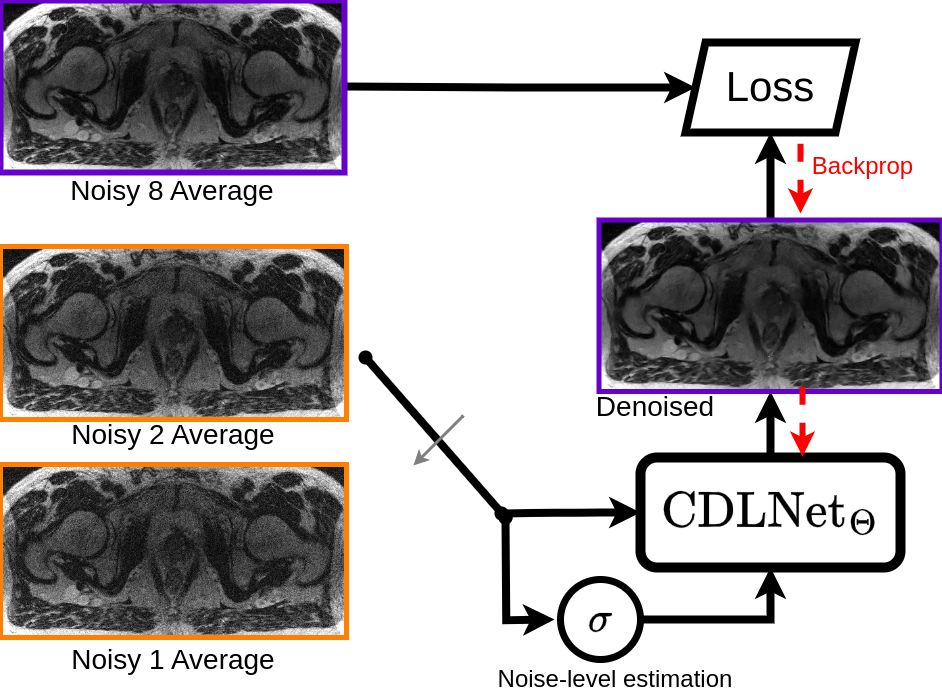
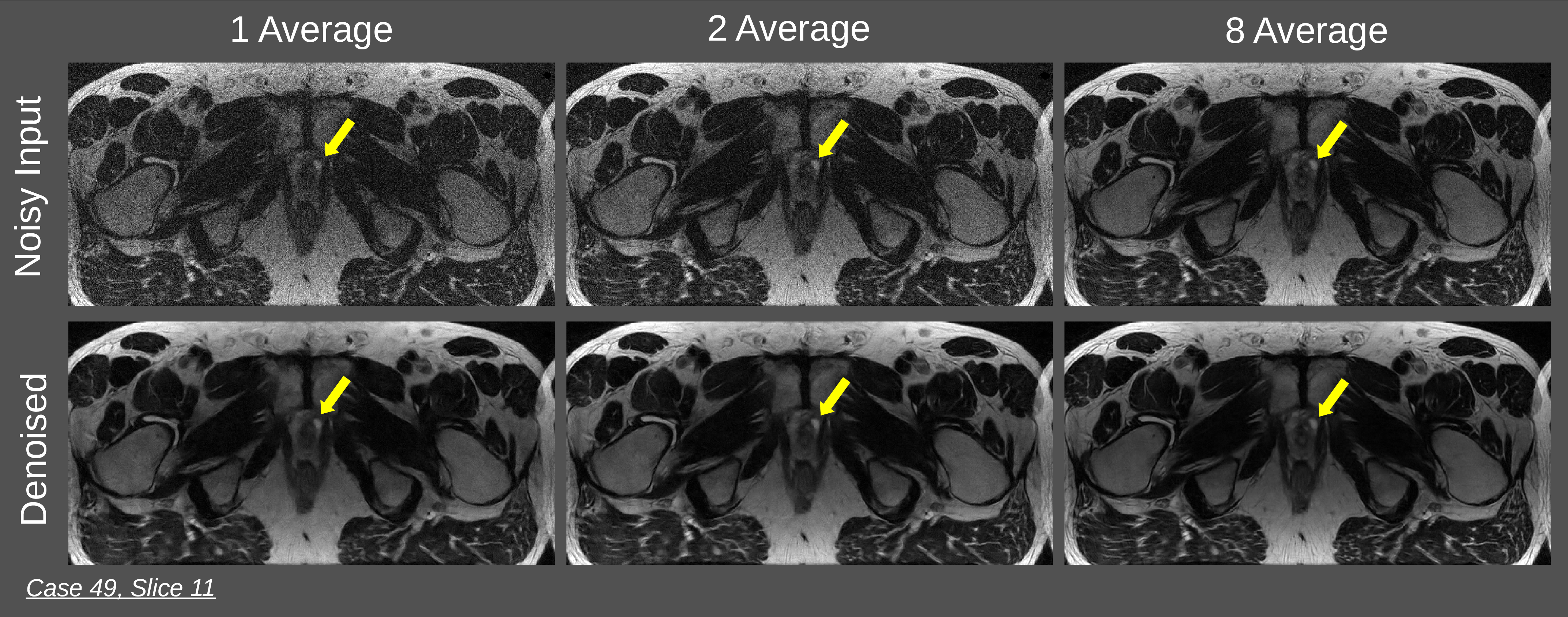
Figure 2. Visual comparison of denoising 1, 2, and 8-average data from the test set. Magnitude images are shown for display purposes. Arrows highlight potential anatomical anomaly in respective images.