0720
Deep Learning Based Reconstruction for Multi-shot DWI of the Breast: Comparison of Quantitative ADC and Distortion1Department of Medical Imaging, National Taiwan University Cancer Center and National Taiwan University College of Medicine, Taipei, Taiwan, 2Department of Medical Imaging, National Taiwan University Hospital and National Taiwan University College of Medicine, Taipei, Taiwan, 3GE Healthcare, Taipei, Taiwan, 4GE Healthcare, Menlo Park, CA, United States, 5GE Healthcare, Houston, TX, United States, 6GE Healthcare, Boston, MA, United States
Synopsis
Keywords: Breast, Machine Learning/Artificial Intelligence, Breast Imaging, Multiplexed Sensitivity Encoding (MUSE), Diffusion Weighted Imaging
Motivation: Diffusion-weighted imaging (DWI) in breast imaging is constrained by image distortion, which can be mitigated through the utilization of multi-shot DWI (MUSE).
Goal(s): We conducted a pilot study to investigate the impact of deep-learning reconstruction (DLRecon) on MUSE image quality.
Approach: Compared with the non-DL MUSE images, the MUSE DLRecon showed higher SNR without affecting the mean ADC value. Moreover, employing a higher shots in MUSE DL with reduced NEX could provide less-distortion DWI.
Results: Our preliminary results suggest the feasibility of MUSE-DWI in breast imaging with a higher number of shots.
Impact: Our results suggest that the DLRecon could be beneficial for the regions prone to distortion and requiring a high density of diffusion direction information, in the complex diffusion modeling, all while maintaining a feasible scan time in breast MUSE imaging.
Introduction
Diffusion-weighted imaging (DWI) is increasingly used as a non-contrast MRI technique for breast tumor detection and characterization. Compared with the single-shot EPI, multiplexed sensitivity encoding (MUSE), a multi-shot segmented technique, expands on existing sensitivity-encoding techniques by acquiring k-space with an interleaved trajectory with the aim of achieving better spatial resolution and reduced geometric distortion [1-3]. However, it is very challenging to apply higher number of shots in MUSE under clinically feasible scan time. Reducing the number of signal averages can proportionally reduce scan time of MUSE with increased shots, but at the cost of reduced SNR. In this preliminary study, we evaluated the deep learning-based (DL) noise reduction strategy [4] to: (1) achieve improved SNR of MUSE and (2) achieve higher shots MUSE with reduced distortion and comparable SNR under similar scan time for breast MUSE-DWI.Methods
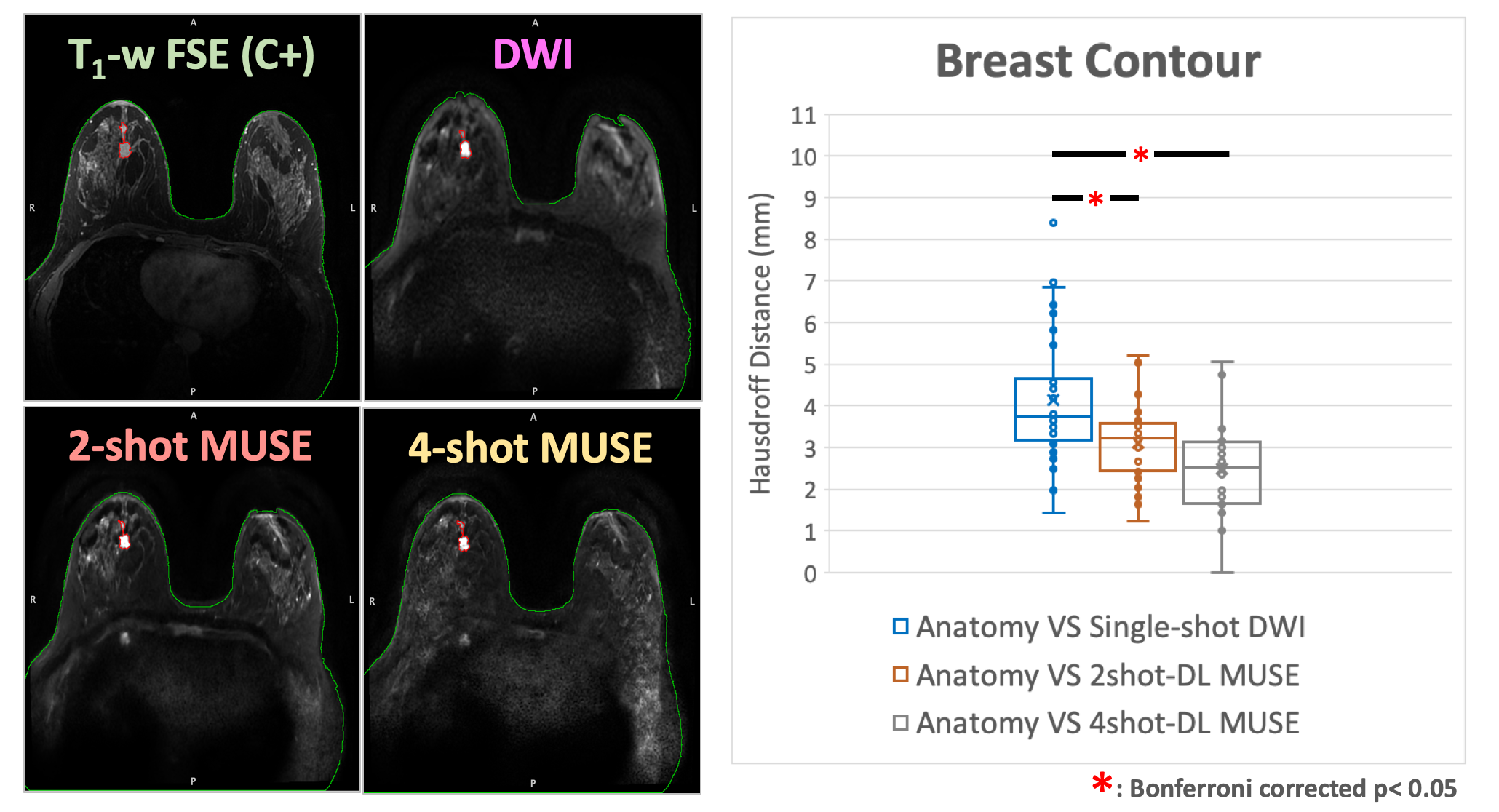
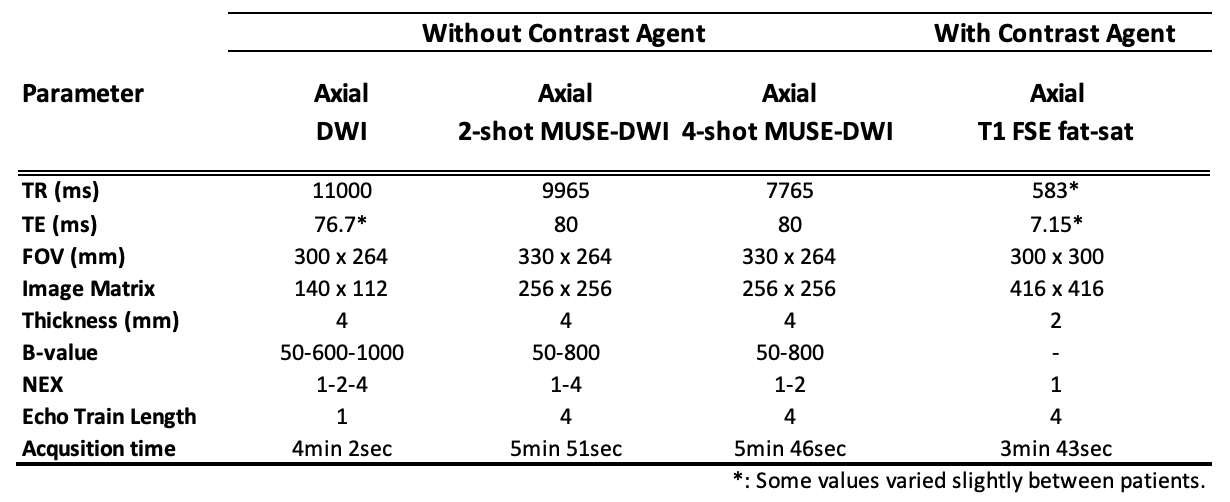
To investigate the improvement of image quality and the feasibility of deep learning reconstruction (DLRecon) in MUSE-DWI, we’ve collected breast images from 26 female participants regardless of diagnosis, and the parameters were listed in Table 1. All the data were performed in 3T MRI (SIGNA™ Architect, GE HealthCare, Waukesha, WI). The SNR was calculated by 3 ROIs (background, right, and left breast parenchymal regions), excluding notable tumors and the quantitative ADC maps with single-shot DWI were also compared. The Hausdroff distance (HD) was utilized as a distortion index to examine the alteration in distance between breast contours when comparing standard T1-weighted fast spin-echo imaging to single-shot DWI and multi-shot MUSE imaging.Results
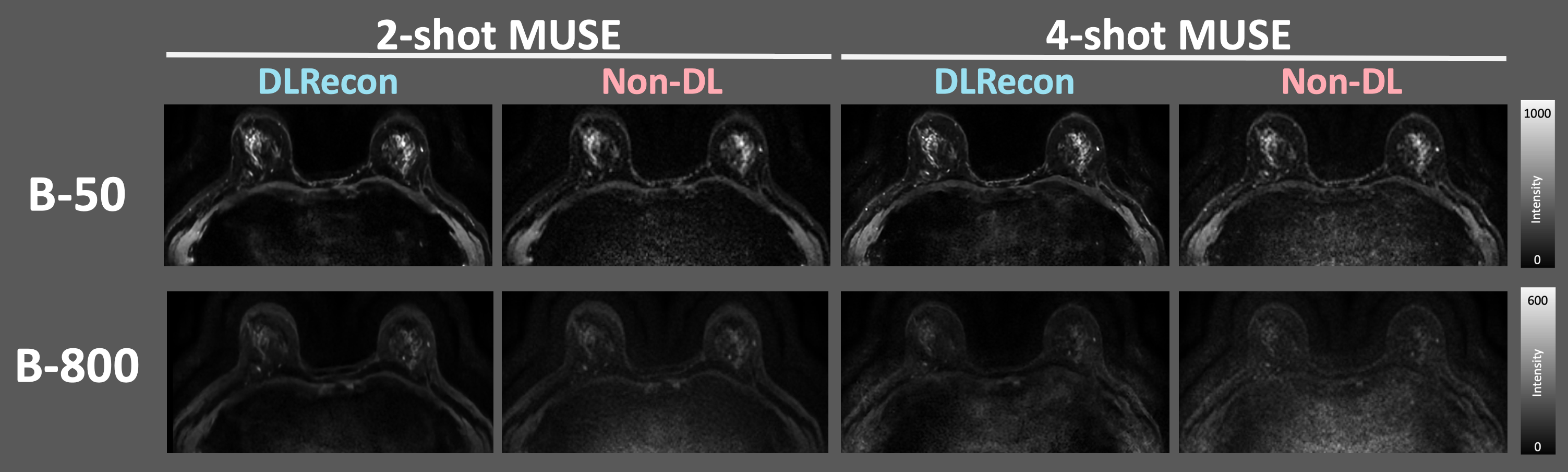
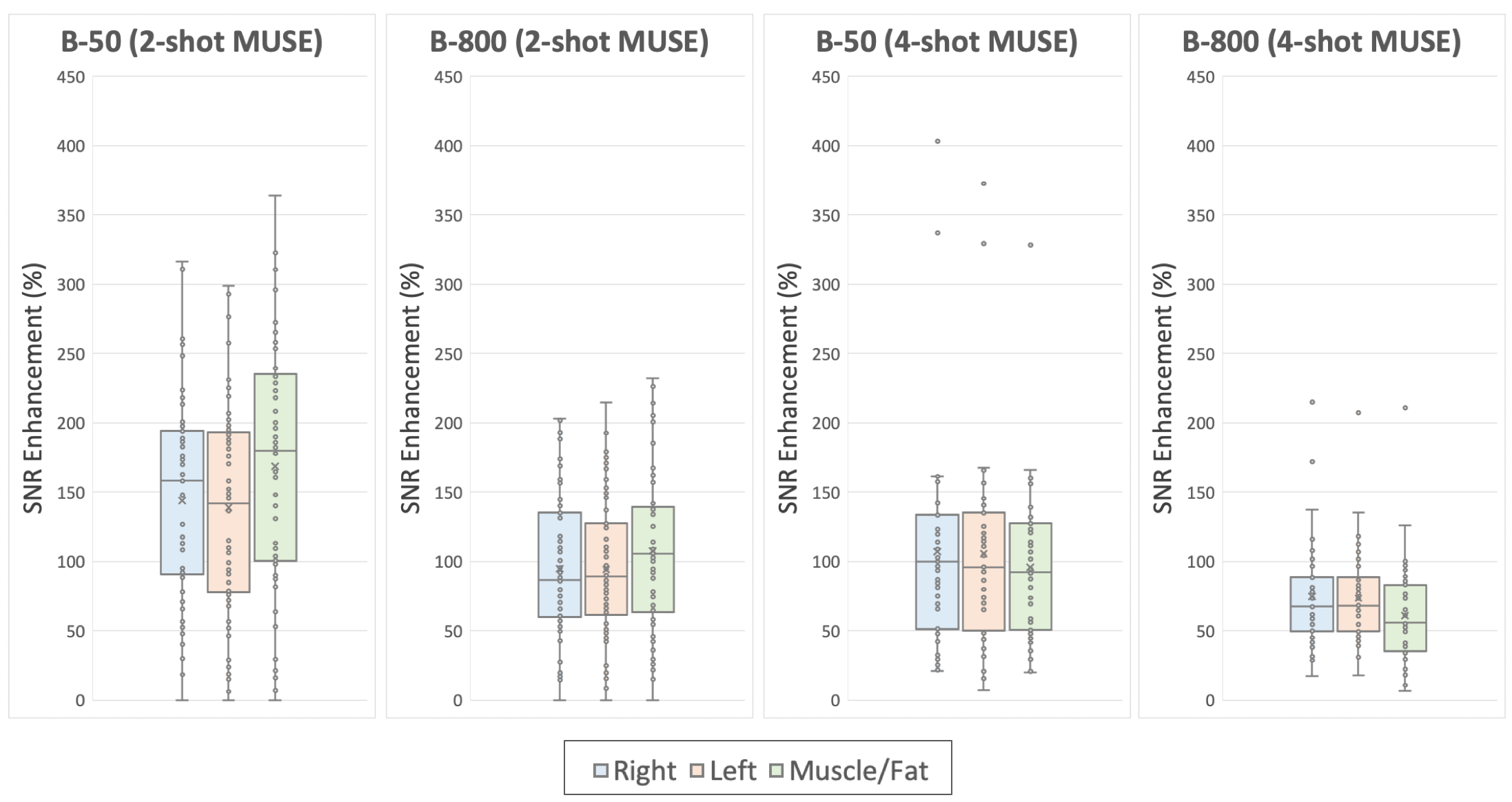
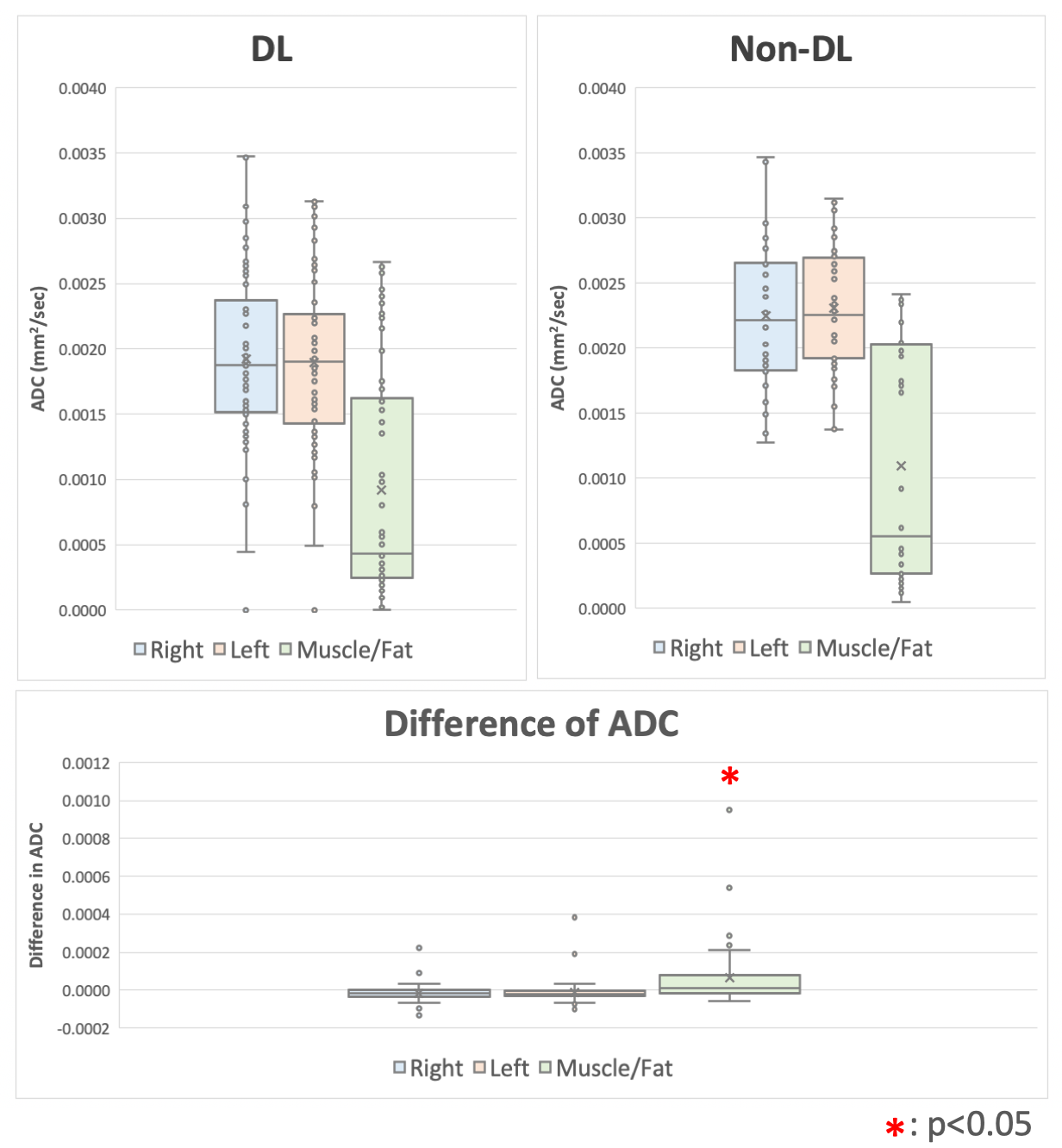
The MUSE DL images showed less noise in the background, compared with MUSE non-DLRecon (Figure 1). In the quantitative analysis, the MUSE DL images showed significant improvements in SNR (Figure 2). No significant difference was showed in the ADC between MUSE (with DLRecon and non-DL reconstruction) and single-shot DWI (Figure 3). Comparing with the T2-weighted FSE images (Figure 4), there was obviously less distortion on the 2- and 4-shot MUSE images (HD values of 2- and 4-shot MUSE are 3.11 mm and 2.58 mm, respectively) than the single-shot DWI images (HD value is 4.15 mm) .Discussion and Conclusion
Our results showed a notable increase in SNR in MUSE image when employing DLRecon, with no significant alteration in quantitative ADC values. Moreover, the use of 4-shot MUSE with DLRecon demonstrated less-distortion compared to both 2-shot MUSE and single-shot DWI. Our results suggest that the MUSE with DLRecon could be beneficial for the regions prone to distortion and requiring a high density of diffusion direction information, in the complex diffusion modelling, all while maintaining a feasible scan time in breast imaging.Acknowledgements
No acknowledgement found.References
- Baxter GC, Patterson AJ, Woitek R, Allajbeu I, Graves MJ, Gilbert F. Improving the image quality of DWI in breast cancer: comparison of multi-shot DWI using multiplexed sensitivity encoding to conventional single-shot echo-planar imaging DWI. Br J Radiol. 2021 Mar 1;94(1119):20200427.
- Hu Y, Ikeda DM, Pittman SM, Samarawickrama D, Guidon A, Rosenberg J, Chen ST, Okamoto S, Daniel BL, Hargreaves BA, Moran CJ. Multishot Diffusion-Weighted MRI of the Breast With Multiplexed Sensitivity Encoding (MUSE) and Shot Locally Low-Rank (Shot-LLR) Reconstructions. J Magn Reson Imaging. 2021 Mar;53(3):807-817.
- Daimiel Naranjo I, Lo Gullo R, Morris EA, Larowin T, Fung MM, Guidon A, Pinker K, Thakur SB. High-Spatial-Resolution Multishot Multiplexed Sensitivity-encoding Diffusion-weighted Imaging for Improved Quality of Breast Images and Differentiation of Breast Lesions: A Feasibility Study. Radiol Imaging Cancer. 2020 May 29;2(3):e190076.
- Matthew J. Middione, Alimohammad S. Moalem, Cheng William Hong, Arnaud Guidon, Daniel B. Ennis, and Ryan L. Brunsing (2022). Multishot EPI and a Deep Learning-Based Noise Reduction Strategy for High Resolution Pancreatic DWI. International Symposium of Magnetic Resonance in Medicine 2022 Conference.
Figures