0671
A Universal Bz Coil for Uniform Multiphoton Excitation in High-Field MRI1Dept. of Electrical Engineering and Computer Science, Massachusetts Institute of Technology, Cambridge, MA, United States, 2Harvard Medical School, Boston, MA, United States, 3Dept. of Radiology, Massachusetts General Hospital, A. A. Martinos Center for Biomedical Imaging, Boston, MA, United States, 4Dept. of Health Sciences and Technology, Massachusetts Institute of Technology, Cambridge, MA, United States
Synopsis
Keywords: RF Pulse Design & Fields, Brain
Motivation: Contrast in high-field MRI is obscured by the spatially non-uniform excitation flip angle profile of conventional birdcage transmit coils.
Goal(s): We demonstrate that a single $$$B_z$$$ coil operated in the kHz range can supplement a birdcage to create a spatially-uniform flip angle profile using multiphoton excitation.
Approach: We use a stream function boundary element method to optimize the $$$B_z$$$ coil windings to produce homogeneous nonselective multiphoton excitations across a universal pulse database and validate with Bloch simulations.
Results: The single $$$B_z$$$ channel achieved a mean flip angle NRMSE of 13.9% for a 90º target MP-pTx pulse in test subjects.
Impact: The design method provides a simplified hardware configuration and reduced local SAR concerns compared to either conventional pTx or our previous work using a full shim array in conjunction with multiphoton parallel transmission.
Introduction
The multiphoton excitation phenomenon1–5 uses off-resonant RF energy from a birdcage coil supplemented with low-frequency (kHz) z-directed fields at the frequency needed to complete transition between spin states. Multiphoton parallel transmission6 (MP-pTx) extends this excitation method to parallel channels of a multichannel shim array to create z-directed fields whose individual amplitudes and phases are chosen to create uniform excitations. MP-pTx provides an alternative to classical parallel transmission (pTx) to simplify local SAR concerns and reduce hardware costs, because low-frequency coils produce negligible SAR and use relatively inexpensive amplifiers. However, successful use of MP-pTx requires a multichannel shim, amplifier, and controller capable of producing non-constant waveforms.However, instead of generating the sinusoidal $$$B_z$$$ waveform via the superposition of fields from the multichannel shim array as described originally6, we design a “universal” single-channel $$$B_z$$$ coil that replaces the shim array producing the necessary field pattern for spatially-uniform multiphoton excitations. Since the $$$B_z$$$ coil must produce spatially-uniform excitations across a variety of subject $$$B_1^+$$$ and $$$\Delta B_0$$$ maps, we utilize an approach similar to “universal pulse” design7 to optimize the coil winding pattern over a database of subjects.
Methods
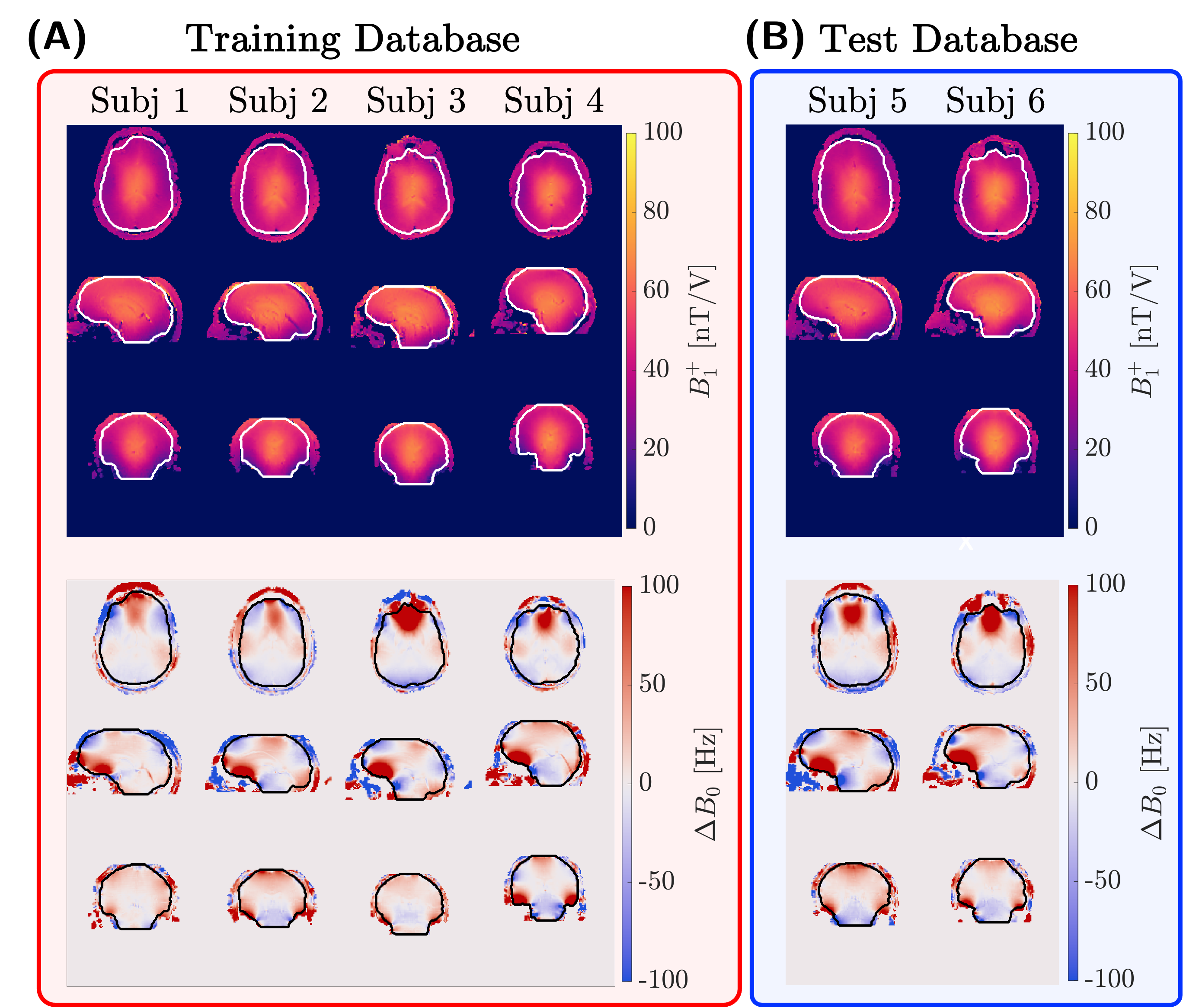
$$$B_1^+$$$ and $$$\Delta B_0$$$ Database:Six healthy subjects (5 males, 1 female, 25-56-years-old, height: 1.58-1.83 m, weight: 54.4-99.8 kg) were scanned on a 7 Tesla MAGNETOM Terra scanner (Siemens Healthcare, Erlangen, Germany) using a 1-Tx, 32-Rx coil (Nova Medical, Wilmington, MA, USA). $$$B_1^+$$$ maps were generated from a pre-saturation-based turbo-FLASH sequence8, and $$$\Delta B_0$$$ maps were acquired using a double-echo GRE unwrapped using PRELUDE9 (Figure 1). Four of the subjects were randomly assigned to the “training” dataset, and the remaining two to the “test” dataset.
Universal Bz Coil Target Field:
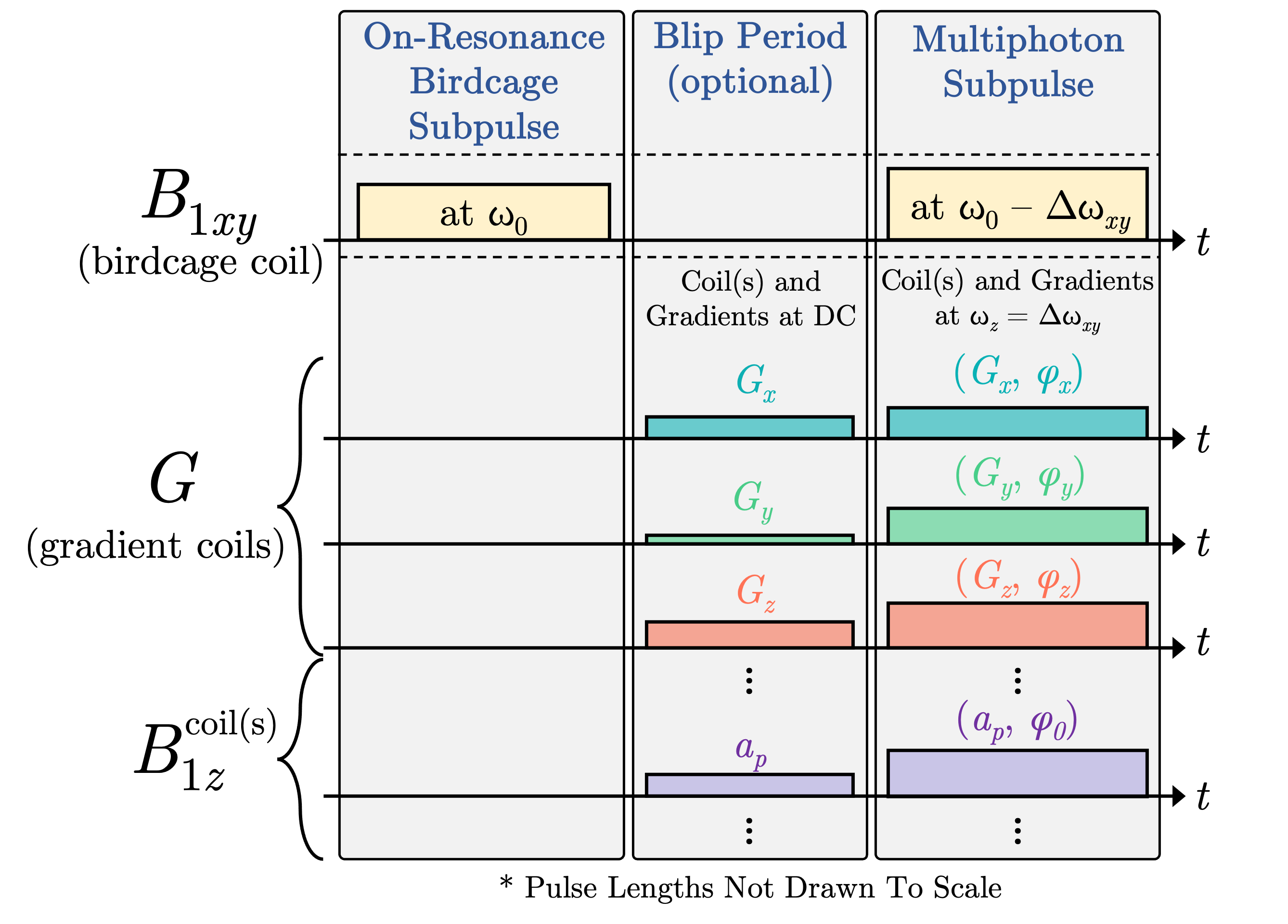
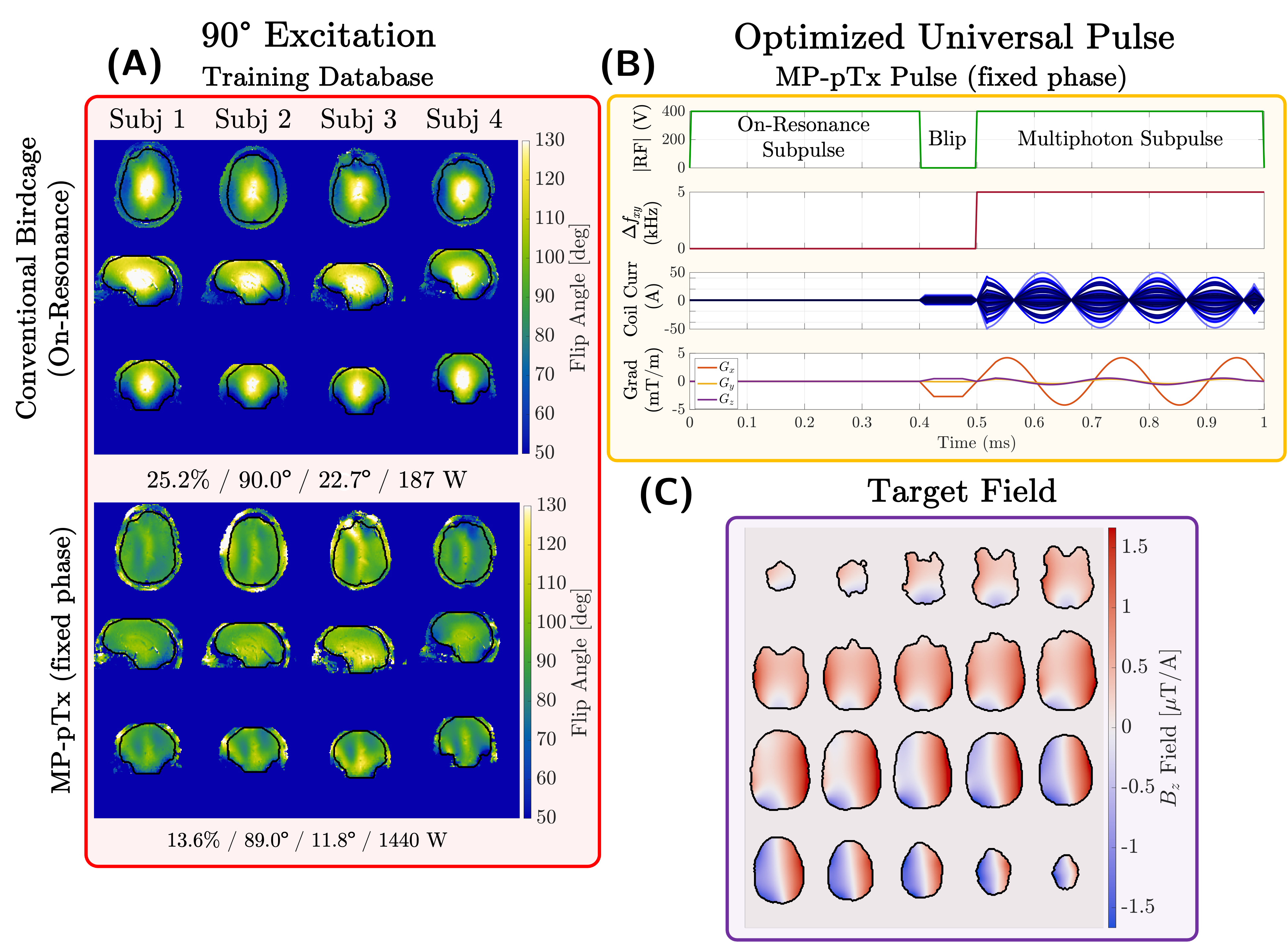
To design the $$$B_z$$$ field using a stream function optimization (detailed below), we first determined the target field needed by the MP-pTx pulse to achieve a uniform 90º excitation over the training dataset during universal pulse optimization7. This target field was derived from an optimized MP-pTx pulse with an on-resonant birdcage subpulse, a blip period, and a multiphoton subpulse, where the off-resonant RF birdcage pulse is supplemented with sinusoidal waveforms from the 64-channel shim array (Figure 2). We fix the relative phases of the Biot-Savart-simulated shim array because the single-channel “universal” coil does not support local phase shifts in the current. Additionally, the relative magnitudes of the shim array elements were held constant between the blip period and the multiphoton subpulse.
For the multiphoton subpulse, we set $$$\Delta\omega_{xy}=\omega_z=2\pi(5\,\,\text{kHz})$$$ to obtain two-photon resonance. MP-pTx pulses were optimized using a genetic algorithm (10 generations, population of 1000) followed by 200 iterations of gradient descent (SQP algorithm) on a 5-mm isotropic grid. After 20 optimizations, the three best-performing pulses over the training dataset became candidates to create a target $$$B_z$$$ fields for the universal coil winding. The target field was smoothed with a nine-pixel smoothing Gaussian kernel (SD: 2 pixels).
Universal Bz Coil Design: Stream Function – Boundary Element Method (SF-BEM):
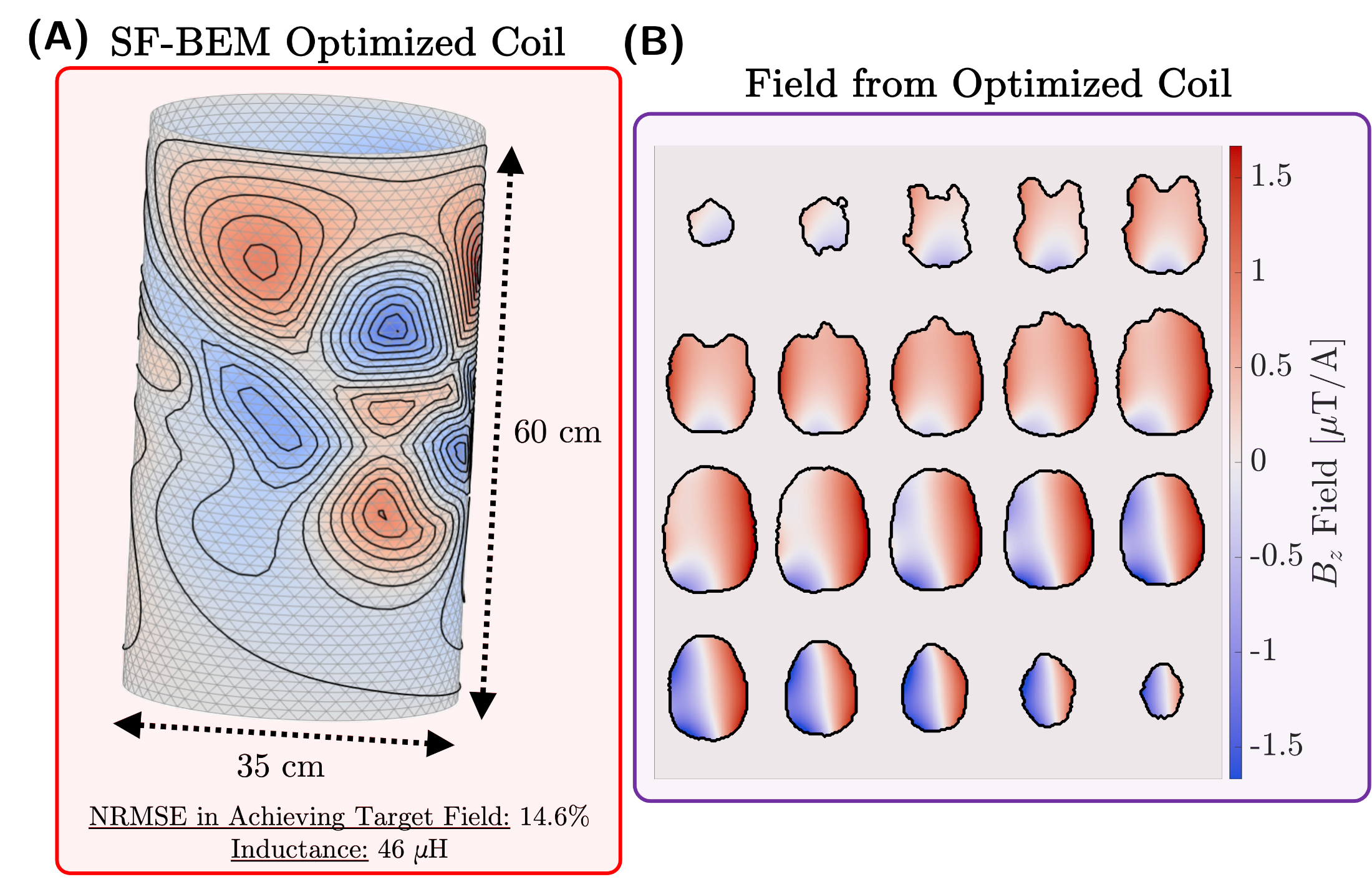
The single-channel $$$B_z$$$ coil was designed on a 35-cm diameter, 60-cm length cylinder meant to be placed outside the RF birdcage coil. The surface was meshed with 6720 triangular elements, comprising 3304 basis functions at the internal vertices. A vector of basis function weights determines the magnetic flux density map, inductance, force balance, and torque.10,11 A convex optimization problem determines the weight vector which best generates the target field, while satisfying torque, force balance, and wire density constraints.12 The optimal wire distribution is determined by contouring the node (stream function) weights. Finally, universal $$$B_z$$$ coil MP-pTx pulses are generated over the training dataset using the parameters mentioned previously, except with a 200 A current constraint.
Results
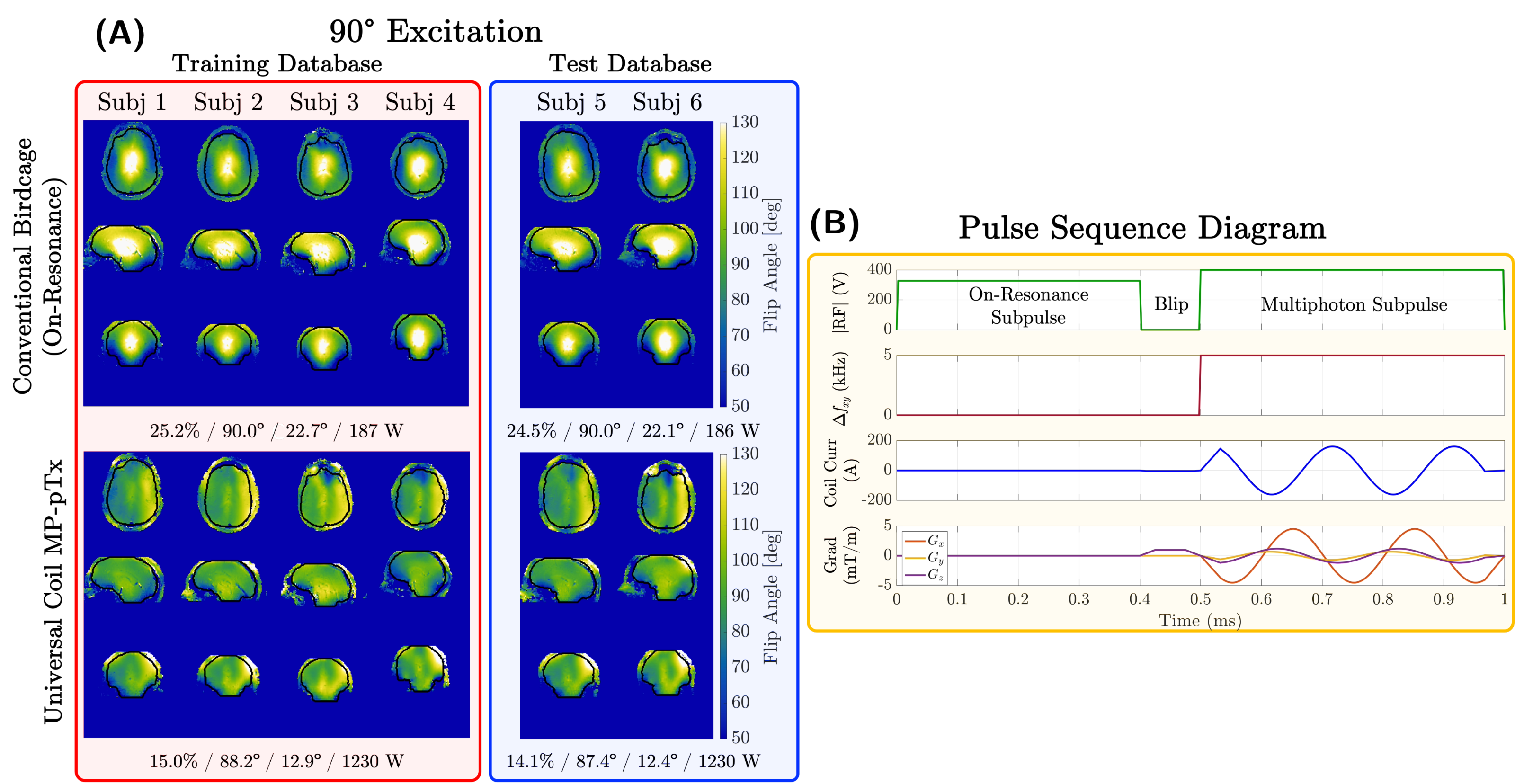
Figure 3 demonstrates the optimized 64-channel MP-pTx pulse performance on the training dataset and the resultant target field. Figure 4 shows the optimized coil winding on the cylindrical surface mesh and the obtained field. Figure 5 shows the performance of a universal MP-pTx pulse using the optimized single-channel universal coil. MP-pTx with a single-channel universal coil can obtain a ~43% FA-NRMSE reduction as compared to an on-resonance birdcage hard-pulse.Discussion
We demonstrate a method to generate a universal $$$B_z$$$ multiphoton coil design for MP-pTx pulses that mitigates flip angle inhomogeneity during nonselective excitations. To make the coil more broadly applicable, the optimization needs to be generalized to include excitation across multiple target flip angles.Acknowledgements
The authors thank Robert Barry, PhD for help obtaining the subject database. This work was supported by NIH grants R00EB021349, U24EB028984, S10OD023637, P41EB030006, F30MH129062, and T32GM144273.
References
1 A. Abragam, The Principles of Nuclear Magnetism. Oxford University Press, 1961.
2 D. G. Gold and E. L. Hahn, “Two-photon transient phenomena,” Phys. Rev. A, vol. 16, no. 1, pp. 324–326, 1977.
3 C. A. Michal, “Nuclear magnetic resonance noise spectroscopy using two-photon excitation,” J. Chem. Phys., vol. 118, no. 8, pp. 3451–3454, 2003.
4 P. T. Eles and C. A. Michal, “Two-photon excitation in nuclear magnetic and quadrupole resonance,” Prog. Nucl. Magn. Reson. Spectrosc., vol. 56, no. 3, pp. 232–246, 2010.
5 V. Han and C. Liu, “Multiphoton magnetic resonance in imaging: A classical description and implementation,” Magn. Reson. Med., vol. 84, no. 3, pp. 1184–1197, 2020.
6 J. M. Drago, B. Guerin, S. F. Cauley, and L. L. Wald, “Multiphoton Parallel Transmission (MP-pTx),” in Proceedings of the Annual Meeting of ISMRM, #4416, 2023.
7 V. Gras, A. Vignaud, A. Amadon, D. Le Bihan, and N. Boulant, “Universal pulses: A new concept for calibration-free parallel transmission,” Magn. Reson. Med., vol. 77, no. 2, pp. 635–643, 2017.
8 S. Chung, D. Kim, E. Breton, and L. Axel, “Rapid B1+ mapping using a preconditioning RF pulse with turboFLASH readout,” Magn. Reson. Med., vol. 64, no. 2, pp. 439–446, 2010.
9 M. Jenkinson, “Fast, automated, N-dimensional phase-unwrapping algorithm,” Magn. Reson. Med., vol. 49, no. 1, pp. 193–197, 2003.
10 R. A. Lemdiasov and R. Ludwig, “A stream function method for gradient coil design,” Concepts Magn. Reson. Part B Magn. Reson. Eng., vol. 26, no. 1, pp. 67–80, 2005.
11 M. Poole and R. Bowtell, “Novel gradient coils designed using a boundary element method,” Concepts Magn. Reson. Part B Magn. Reson. Eng., vol. 31B, no. 3, pp. 162–175, 2007.
12 M. S. Poole and N. Jon Shah, “Convex optimisation of gradient and shim coil winding patterns,” J. Magn. Reson., vol. 244, pp. 36–45, 2014.
Figures