0658
Continuous Spatio-Temporal Representation with Implicit Neural Representation and Neural Ordinary Differential Equation in DSC-MRI1Seoul National University College of Medicine, Seoul, Korea, Republic of, 2Department of Radiology, Seoul National University Hospital, Seuol, Korea, Republic of, 3Seoul Metropolitan GovernmentSeoul National University Boramae Medical Center, Seoul, Korea, Republic of
Synopsis
Keywords: Analysis/Processing, DSC & DCE Perfusion
Motivation: Dynamic Susceptibility Contrast MRI (DSC-MRI) aids in diagnosing cerebrovascular conditions, but simultaneously achieving high spatial and temporal resolutions is challenging, limiting the capture of detailed perfusion dynamics.
Goal(s): To develop a deep learning framework for spatio-temporal super-resolution in DSC-MRI to enhance the capture of perfusion dynamics.
Approach: Our proposed model utilizing bi-directional Neural ODE, feature extraction, and a local implicit image function to improve DSC-MRI images and address spatial and temporal resolution constraints.
Results: The reconstructed results outperform other methods, with enhanced NMSR, PSNR, and SSIM metrics, providing visual confirmation of accurate MR signal approximation and perfusion parameter calculation.
Impact: The spatiotemporal super-resolution of DSC-MRI with deep learning allows for more accurate assessment of perfused tissue dynamics and tumor habitat, as well as more freedom in choosing acquisition weights between spatial and temporal during MRI acquisition.
Introduction
Dynamic Susceptibility Contrast MRI (DSC-MRI) provides crucial insights into cerebrovascular hemodynamics, aiding in the diagnosis and monitoring of conditions like stroke, tumors1,2, and neurodegenerative diseases3,4 by quantifying cerebral blood flow and blood volume5. Nevertheless, achieving high spatial and temporal resolutions concurrently remains challenging, restricting the detailed capture of perfusion dynamics6.To overcome these limitations, we propose a novel deep learning framework that represents data within a continuous spatio-temporal domain, integrating implicit neural representation (INR) in the spatial domain and neural ordinary differential equations7 (Neural ODE) in the temporal domain.
Method
Problem StatementGiven a set of \(N\) sequences in low-resolution DSC-MRI, represented as \(I_{LR}\in\mathbb{R}^{N\times H\times W}\), the corresponding high spatio-temporal resolution image is represented as \(I_{HR}\in\mathbb{R}^{N\prime\times H\prime\times W\prime}\). Our objective is to reconstruct a high spatio-temporal resolution DSC-MRI, represented as \({\hat{I}}_{HR}\in\mathbb{R}^{N\prime\times H\prime\times W\prime}\). To achieve this, we generate an intermediate high-resolution MR image at time \(t\), denoted as \({\hat{I}}_{{HR}_t}\), using the low-resolution frames \(I_{{LR}_0}\) and \(I_{{LR}_1}\) as inputs, where \(0\le t\le1\).
Deep learning-based algorithm
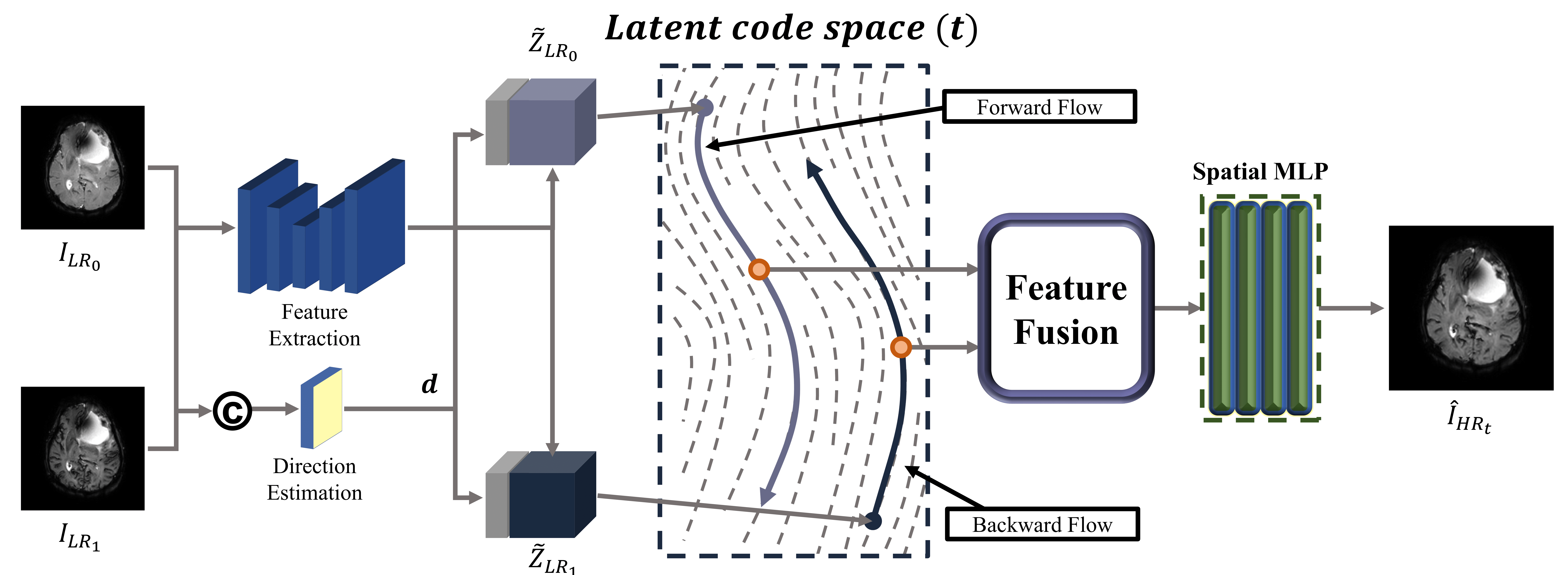
As depicted in Figure 1, our proposed architecture comprises three main stages: Oriented Latent Feature Embedding, Continuous Temporal Trajectory Calculation, and Implicit Spatial Representation. In the Oriented Latent Feature Embedding stage, initial latent feature and directional information are generated when low-resolution images corresponding to time 0 and 1 are provided as inputs. This initial feature is subsequently combined with the directional information as follows: \[{\widetilde{Z}}_{{LR}_{\widetilde{t}}}=\left[Z_{{LR}_{\widetilde{t}}};d\right],\] where, the semicolon ; denotes the concatenation operator, \(Z_{{LR}_{\widetilde{t}}}\in\mathbb{R}^{c\times h\times w}\) represents the initial latent feature of size \(h\times w\) with \(c\) channels at \(\widetilde{t}\), for \(\widetilde{t}\in{0,1}\), and \({\widetilde{Z}}_{{LR}_{\widetilde{t}}}\in\mathbb{R}^{c\prime\times h\times w} \)represents the oriented latent feature with \(c\prime\) channels obtained by concatenating the latent feature \(Z_{{LR}_{\widetilde{t}}}\) with an additional \(d\).
Within the trajectory of the Neural ODE, the oriented initial features are subsequently calculated at the time correspond target. The bi-directional Neural ODE is composed of a forward flow and a backward flow. This design is aimed at efficiently capturing representations from the features of the two input time points. Formally, the bi-directional Neural ODE is formulated as follows: \[Z_{{LR}_{0\rightarrow t}}=ODESolve\left(f_\theta,{\widetilde{Z}}_{{LR}_0},\left(0,t\right)\right)\simeq{\widetilde{Z}}_{{LR}_0}+\int_{0}^{t}{f_\theta\left({\widetilde{Z}}_{{LR}_\tau},\tau\right)d\tau},\] \[Z_{{LR}_{0\rightarrow t}}=ODESolve\left(f_\theta,{\widetilde{Z}}_{{LR}_0},\left(0,t\right)\right)\simeq{\widetilde{Z}}_{{LR}_0}+\int_{0}^{t}{f_\theta\left({\widetilde{Z}}_{{LR}_\tau},\tau\right)d\tau},\] where, \(Z_{{LR}_{0\rightarrow t}}\) and \(Z_{{LR}_{1\rightarrow t}}\) respectively represent latent features at time \(t\) obtained from both the forward and backward flows. The functions \(f_\theta\), \(f_\phi\) are convolutional neural networks used to approximate \(\frac{{\widetilde{Z}}_{{LR}_\tau}}{d\tau}\) within these flows. These features are then integrated through feature fusion, resulting in a new feature vector \(Z_{{LR}_t}\).
Finally, this feature vector is employed to decode the signal intensity correspond with the target MRI coordinates via Local Implicit Image Function8 (LIIF). \[{\hat{I}}_{{HR}_t}\left(x_q\right)=\sum_{\gamma\in00,01,10,11}\frac{S^\gamma}{S}\bullet g_\psi\left(z_{{LR}_t}^\gamma,x_q-v^\gamma,\left(\frac{1}{s},\frac{1}{s}\right)\right),\]
where implicit function \(g_\psi\) is parameterized as MLPs (with \(\psi\) as its parameter), \(v^\gamma\) is the coordinate of the nearest latent feature sub-spaces, surrounding \(x_q, z_{{LR}_t}^\gamma\) is the nearest latent feature at \(v^\gamma\) in \(Z_{{LR}_t}\), and \(S^\gamma\) is the opposite area of the rectangle between \(x_q\) and \(v^\gamma\). The weights are normalized by \(S=\sum_{\gamma} S^\gamma\).
Results
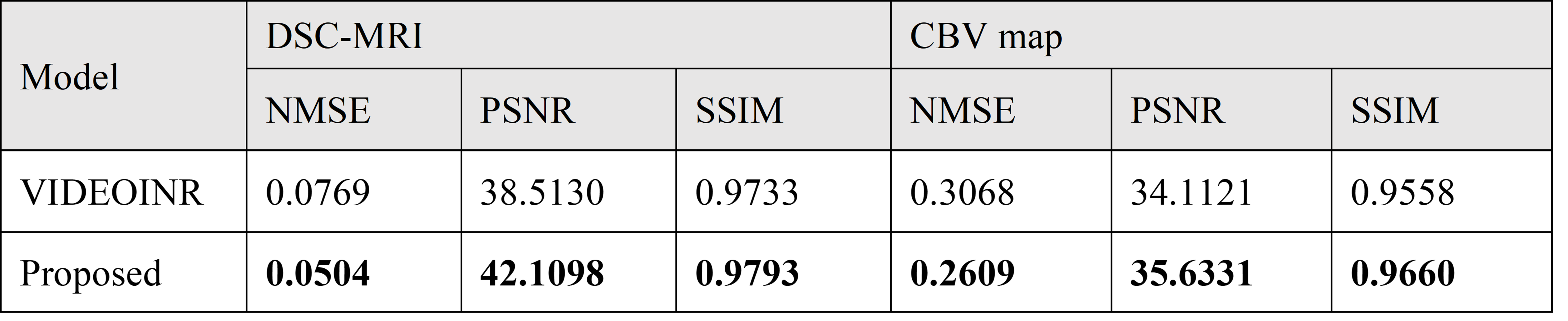
We utilized DSC-MRI data from 41 adult diffuse glioma patients, with 32 for training and 9 for validation. DSC-MRI was performed with specific parameters: TR/TE of 1500/30-40 ms, FA of 35-90°, a matrix of 256×256, and a section thickness of 5 mm. Each section produced 60 images at intervals. A gadobutrol bolus was injected at a dose of 0.1 mmol/kg of body weight and a rate of 4 mL/sec.We used the original DSC-MRI as ground truth and created low-resolution DSC images through 2×2 spatial and 4× temporal under-sampling for input. Our approach was compared to VIDEOINR9, a method employing INR for spatio-temporal super-resolution, using NMSE, PSNR, and SSIM metrics.
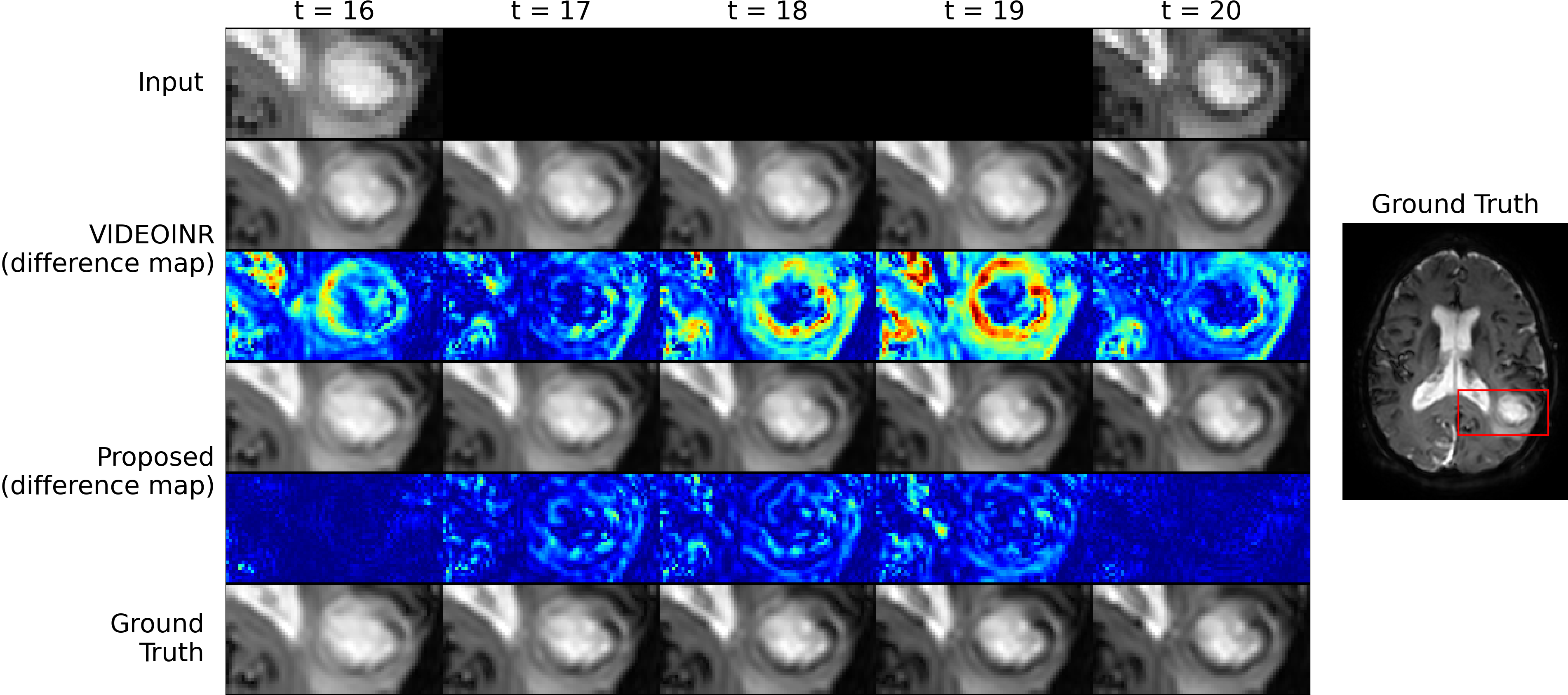
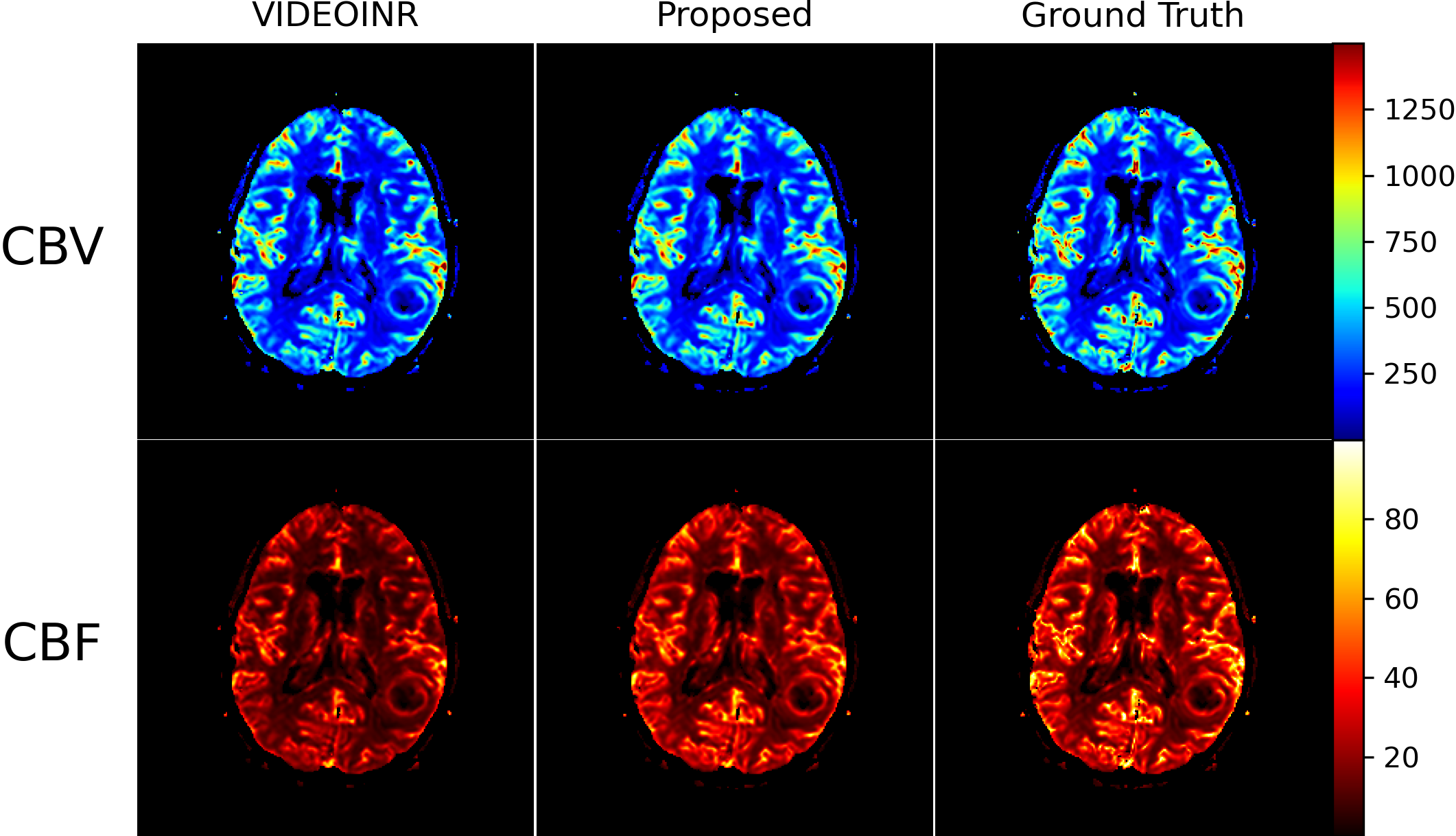
Figures 2 depicts reconstructed DSC-MRI examples, showing input and ground truth images. The proposed method is better than VIDEOINR in restoring spatiotemporal information, as shown in the difference map. In Figure 3, the cerebral blood volume (CBV) and cerebral blood flow (CBF) maps from our method closely matches the ground truth. Table 1 summarizes the metric results.
Conclusions
In this study, we proposed the novel deep learning architecture for spatio-temporal super-resolution in DSC-MRI, thereby addressing challenges associated with the inherent trade-off problem. Reconstructed results have shown better performance than comparative methods in terms of NMSR, PSNR, and SSIM, and provided visual support to robustly approximated MR signals but also accurately computed perfusion parameters. The spatiotemporal super-resolution of DSC-MRI with deep learning allows for more accurate assessment of perfused tissue dynamics and tumor habitat, as well as more freedom in choosing acquisition weights between spatial and temporal during MRI acquisition.Acknowledgements
This work was supported by the National Research Foundation of Korea(NRF) grant funded by the Korea government(MSIT) (No. RS-2023-00251022) (K.S.C); the Phase III (Postdoctoral fellowship) grant of the SPST (SNU-SNUH Physician Scientist Training) Program (K.S.C); the SNUH Research Fund (No. 04-2023-2050) (K.S.C.); the Bio & Medical Technology Development Program of National Research Foundation of Korea (NRF) grant funded by the Korean government (MSIT) (No. 2021M3E5D2A01022493) (I.H); and the Technology Innovation Program (20011878, Development of Diagnostic Medical Devices with Artificial Intelligence Based Image Analysis Technology) funded by the Ministry of Trade, Industry & Energy (MOTIE, Korea) (J.W.C).References
1. Cha S, Knopp EA, Johnson G, Wetzel SG, Litt AW, Zagzag D. Intracranial Mass Lesions: Dynamic Contrast-enhanced Susceptibility-weighted Echo-planar Perfusion MR Imaging1. Radiology. Published online April 1, 2002. doi:10.1148/radiol.2231010594
2. Law M, Yang S, Wang H, et al. Glioma Grading: Sensitivity, Specificity, and Predictive Values of Perfusion MR Imaging and Proton MR Spectroscopic Imaging Compared with Conventional MR Imaging. American Journal of Neuroradiology. 2003;24(10):1989-1998.
3. Renshaw PF, Levin JM, Kaufman MJ, Ross MH, Lewis RF, Harris GJ. Dynamic susceptibility contrast magnetic resonance imaging in neuropsychiatry: present utility and future promise. Eur Radiol. 1997;7(5):S216-S221. doi:10.1007/PL00006895
4. Schmainda KM, Rand SD, Joseph AM, et al. Characterization of a First-Pass Gradient-Echo Spin-Echo Method to Predict Brain Tumor Grade and Angiogenesis. AJNR Am J Neuroradiol. 2004;25(9):1524-1532.
5. Quarles CC, Bell LC, Stokes AM. Imaging vascular and hemodynamic features of the brain using dynamic susceptibility contrast and dynamic contrast enhanced MRI. NeuroImage. 2019;187:32-55. doi:10.1016/j.neuroimage.2018.04.069
6. Chakhoyan A, Leu K, Pope WB, Cloughesy TF, Ellingson BM. Improved Spatiotemporal Resolution of Dynamic Susceptibility Contrast Perfusion MRI in Brain Tumors Using Simultaneous Multi-Slice Echo-Planar Imaging. AJNR Am J Neuroradiol. 2018;39(1):43-45. doi:10.3174/ajnr.A5433
7. Chen RTQ, Rubanova Y, Bettencourt J, Duvenaud DK. Neural Ordinary Differential Equations. In: Advances in Neural Information Processing Systems. Vol 31. Curran Associates, Inc.; 2018. Accessed November 7, 2023. https://papers.nips.cc/paper_files/paper/2018/hash/69386f6bb1dfed68692a24c8686939b9-Abstract.html
8. Chen Y, Liu S, Wang X. Learning Continuous Image Representation With Local Implicit Image Function. In: ; 2021:8628-8638. Accessed November 7, 2023. https://openaccess.thecvf.com/content/CVPR2021/html/Chen_Learning_Continuous_Image_Representation_With_Local_Implicit_Image_Function_CVPR_2021_paper.html
9. Chen Z, Chen Y, Liu J, et al. VideoINR: Learning Video Implicit Neural Representation for Continuous Space-Time Super-Resolution. In: ; 2022:2047-2057. Accessed November 7, 2023. https://openaccess.thecvf.com/content/CVPR2022/html/Chen_VideoINR_Learning_Video_Implicit_Neural_Representation_for_Continuous_Space-Time_Super-Resolution_CVPR_2022_paper.html
Figures