0598
Tensor-Valued Diffusion MRI Identifies Brain Microstructural Alterations in Gene Knockdown Mouse1The Fifth Affiliated Hospital, Sun Yat-sen University, Zhuhai, China, 2Guangdong-Hong Kong-Macao University Joint Laboratory of Interventional Medicine, the Fifth Affiliated Hospital, Sun Yat-sen University, Zhuhai, China
Synopsis
Keywords: Microstructure, Brain Connectivity, Tensor-Valued Diffusion MRI, Microscopic anisotropy kurtosis (MKA) , Genetic diseases
Motivation: DEAD‐box helicase 24 (DDX24) gene mutations linked to abnormalities of major vessels1. However, the effect of the gene DDX24 on brain microstructure remains unclear.
Goal(s): Our goal was to demonstrate how advanced tensor-valued diffusion MRI can reveal microstructural alterations in a Ddx24 knockdown mouse model.
Approach: We performed advanced tensor-valued diffusion MRI to examine Ddx24 knockdown mouse brain and evaluated the performance of Ddx24 knockdown mice in the Morris water maze test.
Results: Ddx24 knockdown mouse revealed declining microscopic anisotropy kurtosis (MKA) in corpus callosum and hippocampus. Tensor-valued diffusion MRI is a sensitive neuroimaging tool to evaluate gene-edited mouse brain microstructural alterations.
Impact: Advanced tensor-valued diffusion MRI provided cylinders shapes sensitive MKA and spherical shapes sensitive MKI for detecting microstructural alterations in genetic diseases.
Introduction
Genetically engineered animals are widely used to explore genetic diseases and reveal the mechanisms of human diseases. However, genetic mutations caused slight and unpredictable microstructural changes, for which structural imaging and traditional diffusion imaging had low sensitive limitations. DEAD‐box helicase 24 (DDX24) gene mutations linked to abnormalities of major vessels1. Abnormal neural tube development in Ddx24 deficient embryos2 and cognitive dysfunction in adult Ddx24 knockdown mouse, but microstructural changes within the brain remain unclear. Here we performed tensor-valued diffusion MRI to image ex vivo 2mm thick brain slices of Ddx24 knockdown animal model and link brain function test with microstructural alterations reflected by µFA and MKA.Methods
Construction of Ddx24 knockdown mice: In performing conditional gene inactivation experiments, CAG-Cre+; Ddx24flox/flox male mice were crossed with Ddx24flox/flox female mice. This breeding strategy generated the homozygous CAG-Cre+; Ddx24flox/flox as experimental groups and CAG-Cre−; Ddx24 flox/flox, litter mates as control groups (Fig.1).Sample pretreatment: All 2mm thick brain slices were fixed by immersion in 4% paraformaldehyde in phosphate-buffered saline at 4°C, then shaked in PBS for 14 hours at 4°C.
Diffusion MRI (dMRI) images: All MR images were acquired on a 9.4 T scanner (Bruker Biospin) with a 10 mm inner diameter receive-only surface. A multi-shot spin-echo echo-planar imaging (EPI) sequence with a Linear Tensor Encoding (LTE) protocol and a Spherical Tensor Encoding (STE) protocol was used to acquire tensor-valued diffusion MR images. It included four b-values (200, 1500, 3000, and 4500 s/mm2) respectively with 6, 6, 21 and 21 directions and 4 b0 image. The acquisition parameters: TR= 4000 ms, TE= 58 ms, matrix = 96 × 96, FOV = 19.2 ×19.2 mm2, in-plane resolution = 0.2 × 0.2 mm2 and 11 slices with thicknesses of 0.2 mm. Total scan time is about 13 hours included tensor-valued diffusion MR images and T2 weight images. All data were processed and analyzed by FSL, MRtrix3, and Matlab.
Results
In the tensor-valued diffusion MRI metrics, Ddx24 knockdown mouse show weak µFA map and MKA map.1. Declining microscopic anisotropy kurtosis (MKA) in corpus callosum in DDX24 knockdown mouse brain. We noticed that the powder averaged signal of LTE and STE from the corpus callosum ROI of Ddx24 knockdown mouse brain decay slower than litter mates groups (Fig. 2 C). We drew a ROI in the thickest area of the corpus callosum to calculate(Fig. 3 A). We found Ddx24 knockdown mouse revealed declining microscopic anisotropy kurtosis (MKA) in corpus callosum (p < 0.05).
2. Weakened hippocampal nerve fibers associated with disrupted memory. We also found weakened microscopic fractional anisotropy (µFA) map in the dentate gyrus of hippocampus (Fig. 2 B). MKA and µFA were both decreased in this ROI (p < 0.05) (Fig. 4 B and C), suggesting the loss of neural connections in the hippocampus of KO mice. We implemented the hidden platform trial and spatial probe trail sessions in WT mice and Ddx24 KO mice. Comparing with the WT mice, Ddx24 KO mice behaved longer escape latency (p < 0.05) and showed learning impairment. (p < 0.05) . The disrupted nerve fibers connect could illustrate learning impairment in the Morris water maze test (Fig. 4 E and F ).
Discussion
Advanced tensor-valued diffusion MRI provided sensitivity readouts for detecting microstructural alterations in Ddx24 knockdown mouse. Microscopic fractional anisotropy (µFA) was not limited to describing straight fibers, but can also describe bending and crossing fibers. Microscopic anisotropy kurtosis (MKA) and isotropic kurtosis (MKI) respectively identified cylinders shapes (such as axons)and spherical shapes(such as versus the density of cell bodies)3. We will further verify the tensor parameters using pathological staining and tissue clearing4. It has higher clinical value in human genetic diseases.Conclusion
Tensor-valued diffusion MRI is a sensitive neuroimaging tool to evaluate gene-edited mouse brain microstructural changes. Our study demonstrated that declining corpus callosum fibrous connection in KO mouse brain. Moreover, we also found the impaired white matter connections in hippocampal associated with disrupted memory in Ddx24 knockdown mouse brain.Acknowledgements
We thank the Analysis of Functional NeuroImages (AFNI) and FMRIB Software Library (FSL) team for software support. This work was supported by grants from the National Natural Science Foundation of China (No. RLZY20231001-01, and No. 82201447), the Fundamental Research Funds for the Central Universities, Sun Yat-sen University (No. 23hytd009), the Hundred Talents Program of Sun Yat-sen University (The Fifth Affiliated Hospital, 202101), the Guangdong-Hong Kong-Macao University Joint Laboratory of Interventional Medicine Foundation of Guangdong Province (2023LSYS001).References
1. Pang P, Hu X, Zhou B, Mao J, Liang Y, Jiang Z, Huang M, Liu R, Zhang Y, Qian J, Liu J, Xu J, Zhang Y, Zu M, Wang Y, He H, Shan H. DDX24 Mutations Associated With Malformations of Major Vessels to the Viscera. Hepatology. 2019;69(2):803-816.
2. Ma Z, Moore R, Xu X, Barber GN. DDX24 negatively regulates cytosolic RNA-mediated innate immune signaling. PLoS Pathog. 2013;9(10):e1003721.
3. He Y, Aznar S, Siebner HR, Dyrby TB. In vivo tensor-valued diffusion MRI of focal demyelination in white and deep grey matter of rodents. Neuroimage Clin. 2021;30:102675.
4. Johnson GA, Tian Y, Ashbrook DG, Cofer GP, Cook JJ, Gee JC, Hall A, Hornburg K, Qi Y, Yeh FC, Wang N, White LE, Williams RW. Merged magnetic resonance and light sheet microscopy of the whole mouse brain. Proc Natl Acad Sci U S A. 2023;120(17):e2218617120.
Figures
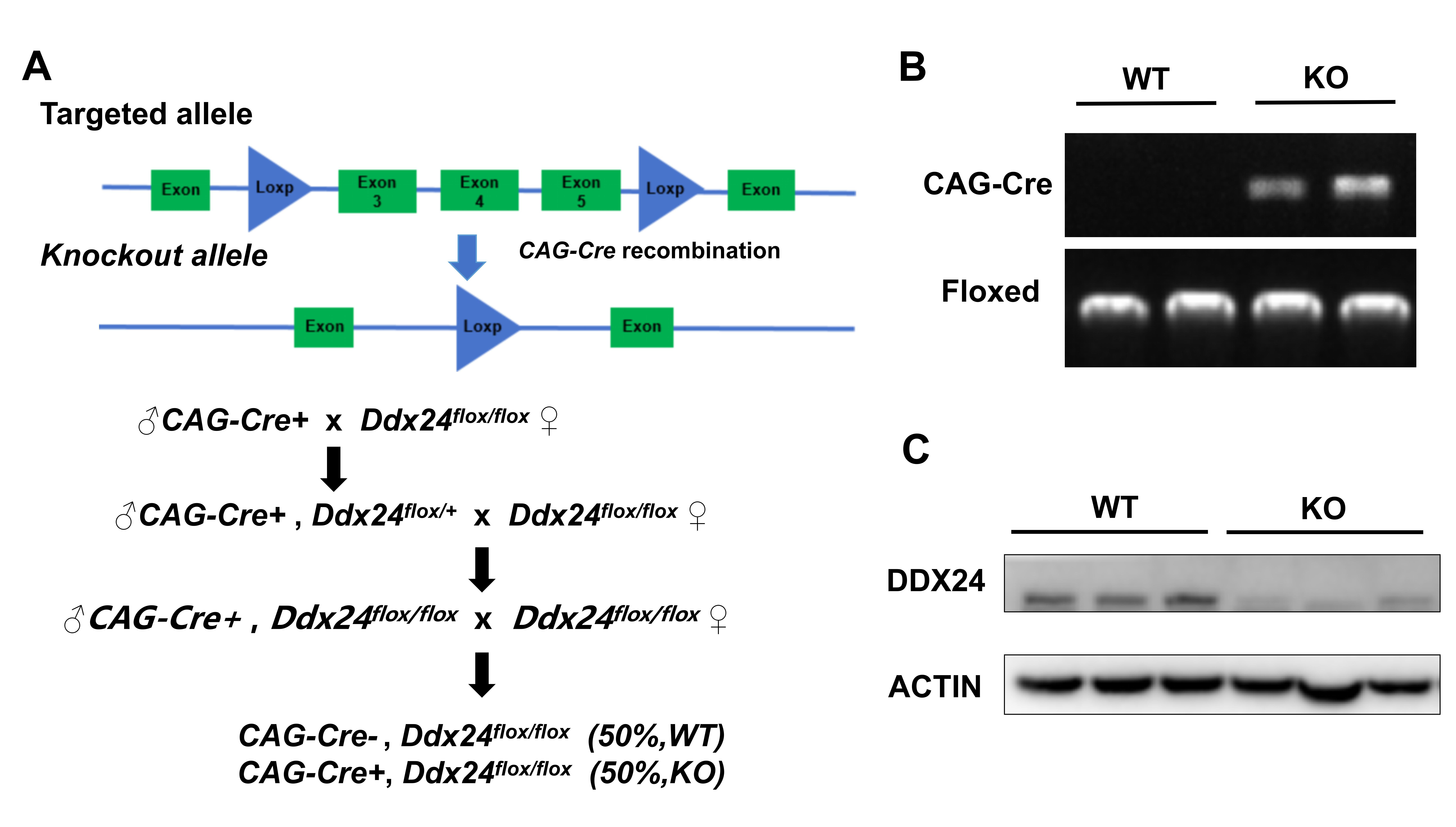
Figure 1. Construction and identification of Ddx24 knockdown mice.
(A) Transgenic construction pattern diagram of Ddx24 KO mice;
(B) Genotype PCR identification of Ddx24 KO mice ;
(C) Western-blot identification of Ddx24 KO mice.

Figure 2.Tensor-valued diffusion MRI metrics of Ddx24 knockdown mouse (KO) and its littermate controls (WT).
(A) The fitting model of tensor-valued diffusion MRI.
(B)Kurtosis sources map of KO and WT;
(C) Powder averaged signal of LTE and STE from the corpus callosum ROIs of Ddx24 knockdown mouse brain;
(D) Powder averaged signal of LTE and STE from the hippocampus ROIs of healthy control.
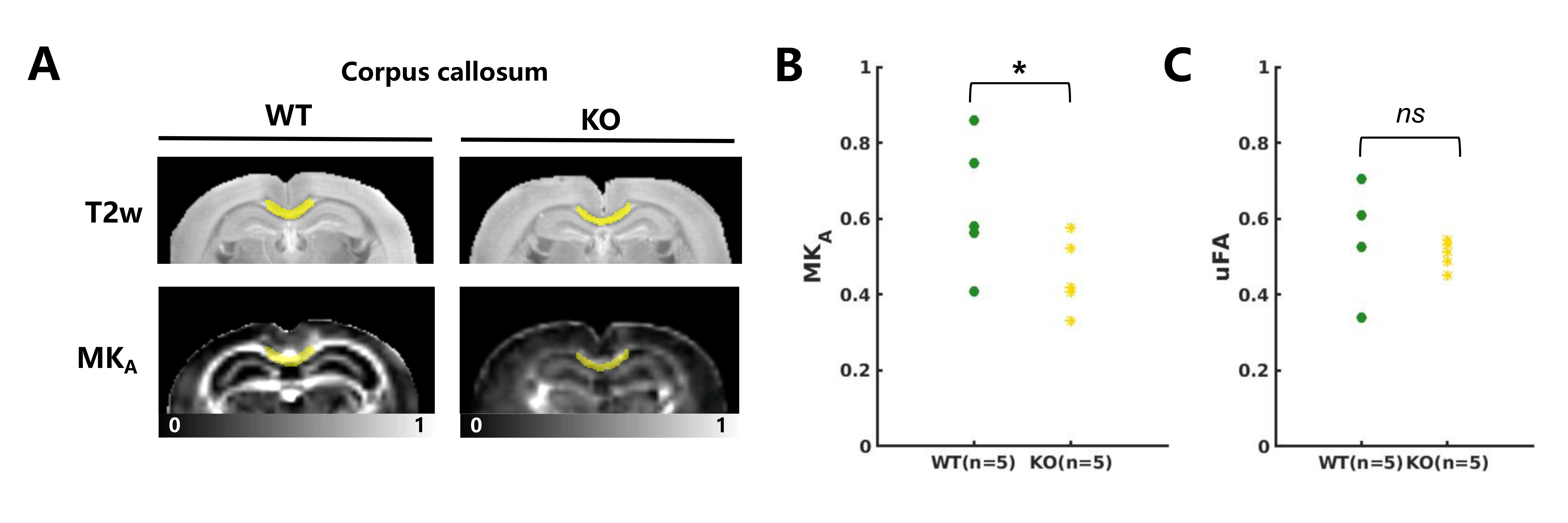
Figure 3. Declining microscopic anisotropy kurtosis (MKA) in corpus callosum in DDX24 knockdown mouse brain.
(A) The ROI of corpus callosum;
(B) A significant reduction of MKA in KO mouse in corpus callosum ROI (p < 0.05) ;
(C) No significant reduction of µFA in KO mouse in corpus callosum ROI.

Figure 4. Weakened hippocampal nerve fibers tructure associated with disrupted memory.
(A) The ROI of hippocampus;
(B and C) A significant reduction of MKA and µFA in KO mice in hippocampus ROI (p < 0.05) ;
(D) The Illustration of the Morris water maze and the timeline of Hidden platform trial and spatial probe trial sessions;
(E and F) Representative swimming paths of the WT mice and Ddx24 KO mice during the hidden platform trial and spatial probe trail sessions. Comparing with the WT mice, Ddx24 KO mice behaved longer escape latency (p < 0.05) and showed learning impairment. (p < 0.05) .