0566
Unbiased Neural Networks for Quantitative MRI Parameter Estimation1Bernard and Irene Schwartz Center for Biomedical Imaging, Department of Radiology, NYU Grossman School of Medicine, New York, NY, United States, 2Center for Advanced Imaging Innovation and Research (CAI2R), Department of Radiology, NYU Grossman School of Medicine, New York, NY, United States, 3Vilcek Institute of Graduate Biomedical Sciences, NYU Grossman School of Medicine, New York, NY, United States
Synopsis
Keywords: Quantitative Imaging, Precision & Accuracy, Parameter Estimation, Magnetization transfer, MR fingerprinting
Motivation: Neural-network (NN)-based estimators trained with the mean-squared error criterion have a non-negligible bias which impedes inter-method comparability and the clinical adoption of quantitative MRI methods.
Goal(s): To develop fast, accurate, precise, and reproducible quantitative MRI estimators that are reliable in the face of pathology.
Approach: We explicitly penalize the bias of the NN's estimates during training and study the resulting NN's bias and variance properties for a magnetization transfer model.
Results: The proposed method reduces the NN's variable bias throughout parameter space, achieves a variance close to the theoretical minimum, and shows excellent concordance with parameter maps estimated using non-linear least-squares in vivo.
Impact: NNs trained with the proposed strategy are approximately minimum variance unbiased estimators and are therefore well-suited for the development, validation, and translation of new quantitative biomarkers, particularly for multi-compartment biophysical models such as magnetization transfer or diffusion in white matter.
Introduction
Unbiased parameter estimators are critical for generating reproducible quantitative MRI biomarkers. We consider minimum variance unbiased estimators (MVUE) ideal, i.e. estimators with zero bias and a variance equal to the Cramér-Rao bound (CRB).1 Typical maximum-likelihood estimators, such as least-squares with white Gaussian noise, are asymptotically MVUEs, i.e. when the number of measurements is large.1 However, they are computationally inefficient, impeding the clinical adoption of many quantitative MRI methods.2,3,4 In this work, we train neural network (NN) estimators for a 2-pool quantitative magnetization transfer (qMT)5,6,7 technique to yield approximate MVUEs with improved computational efficiency and robustness compared to traditional estimators.Theory and Methods
We build upon our previous work where the NN's training loss is the mean-squared error (MSE) weighted by the individual parameter's CRB, which converges to a value of 1 for an MVUE.8 Here, we introduce an additional loss term to penalize the squared bias9 across $$$N_r$$$ noise realizations (additive white Gaussian noise $$$\sim \mathcal{N}(0,\sigma^2)$$$):$$\frac{1}{N_sN_pN_r}\sum_{i=1}^{N_s}\sum_{k=1}^{N_p}\frac{1}{\mathbf{b}_{ik}}\bigg(\sum_{j=1}^{N_r}\big( \hat{\mathbf{x}}_{k}(\mathbf{y}_{ij})-\mathbf{x}_{ik}\big)^2+\frac{\lambda}{N_r}\Big(\sum_{j=1}^{N_r}\hat{\mathbf{x}}_{k}(\mathbf{y}_{ij})-\mathbf{x}_{ik}\Big)^2\bigg),$$
where $$$N_s,N_p$$$ are the number of samples and parameters to be estimated respectively, $$$\mathbf{b}_i \in \mathcal{R}^{N_p}$$$ is the CRB vector for the measurement $$$\mathbf{y}_i, \mathbf{x} \in \mathcal{R}^{N_p}$$$ contains the ground-truth parameters, $$$\hat{\mathbf{x}} \in \mathcal{R}^{N_p}$$$ the parameter estimates, and $$$\lambda \geq 0$$$ is a non-negative tuning parameter that controls the bias' contribution to the overall cost.
We use a simple NN architecture where $$$\mathbf{y}$$$ is split into real and imaginary parts, upsampled to size 1024 before being downsampled again to $$$N_p=6$$$ over 11 fully connected layers with skip connections and batch normalization. We train NNs with the ``unbiased MSE-CRB'' strategy, defined by the above equation, for 500 epochs using the Rectified ADAM optimizer,10 a learning rate of $$$10^{-4},N_r=200$$$, and $$$N_s=1.84\cdot10^5$$$ (unique sets of randomly-sampled qMT parameters in a Gaussian distribution) for an empirically determined $$$\lambda=15$$$. All experiments are initialized with a NN trained with $$$\lambda=0,N_r=1$$$ for 2000 epochs (the ``MSE-CRB'' approach).
We scanned one healthy volunteer with a hybrid-state11 sequence optimized for sensitivity to the qMT parameters12 on a Siemens 3T Prisma system in agreement with our IRB's requirements. The subspace coefficient images13 reconstructed by solving the low-rank inverse problem14,15 with a locally low-rank penalty16,17 are fed, voxel-by-voxel, to the NN.
Results
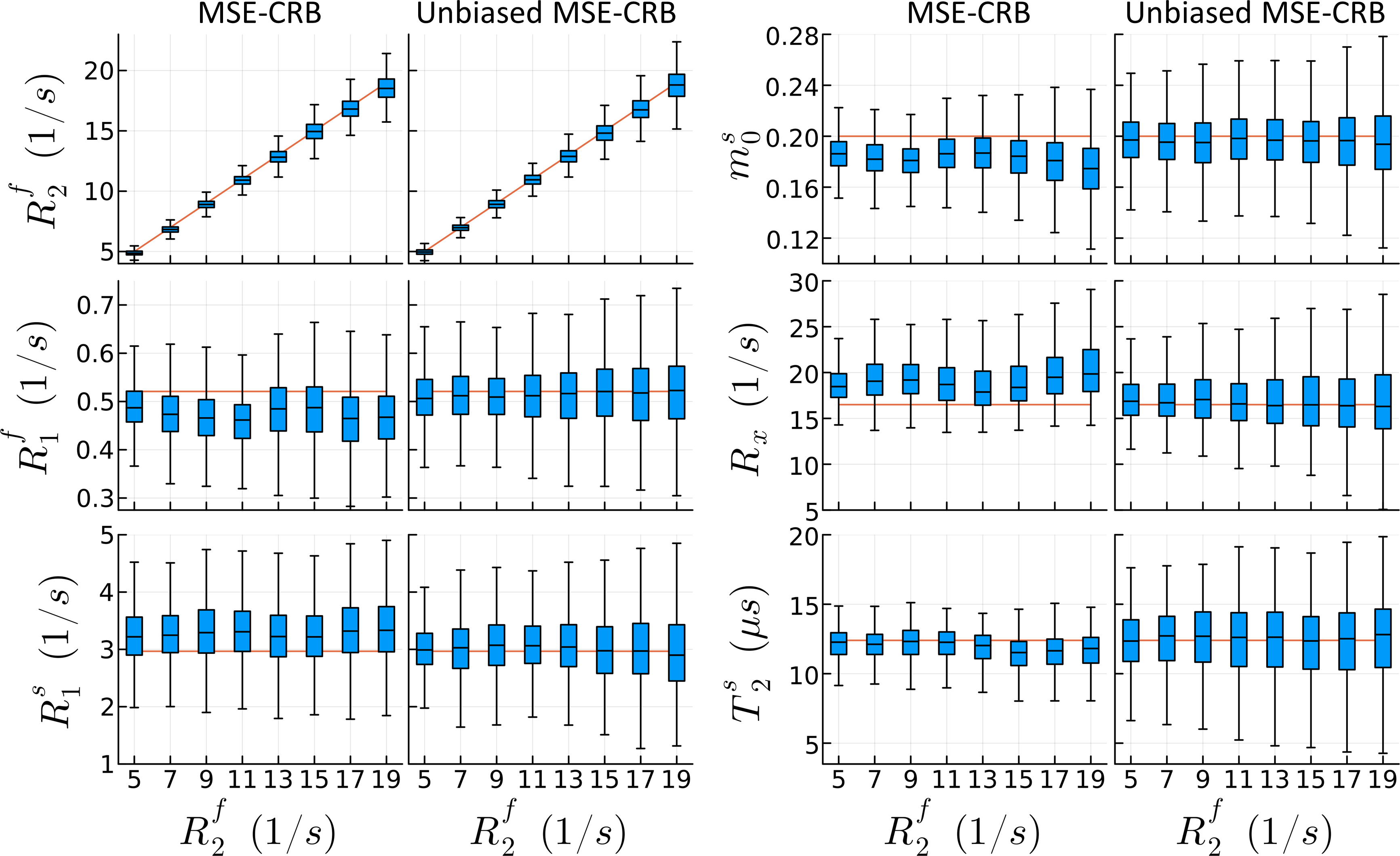
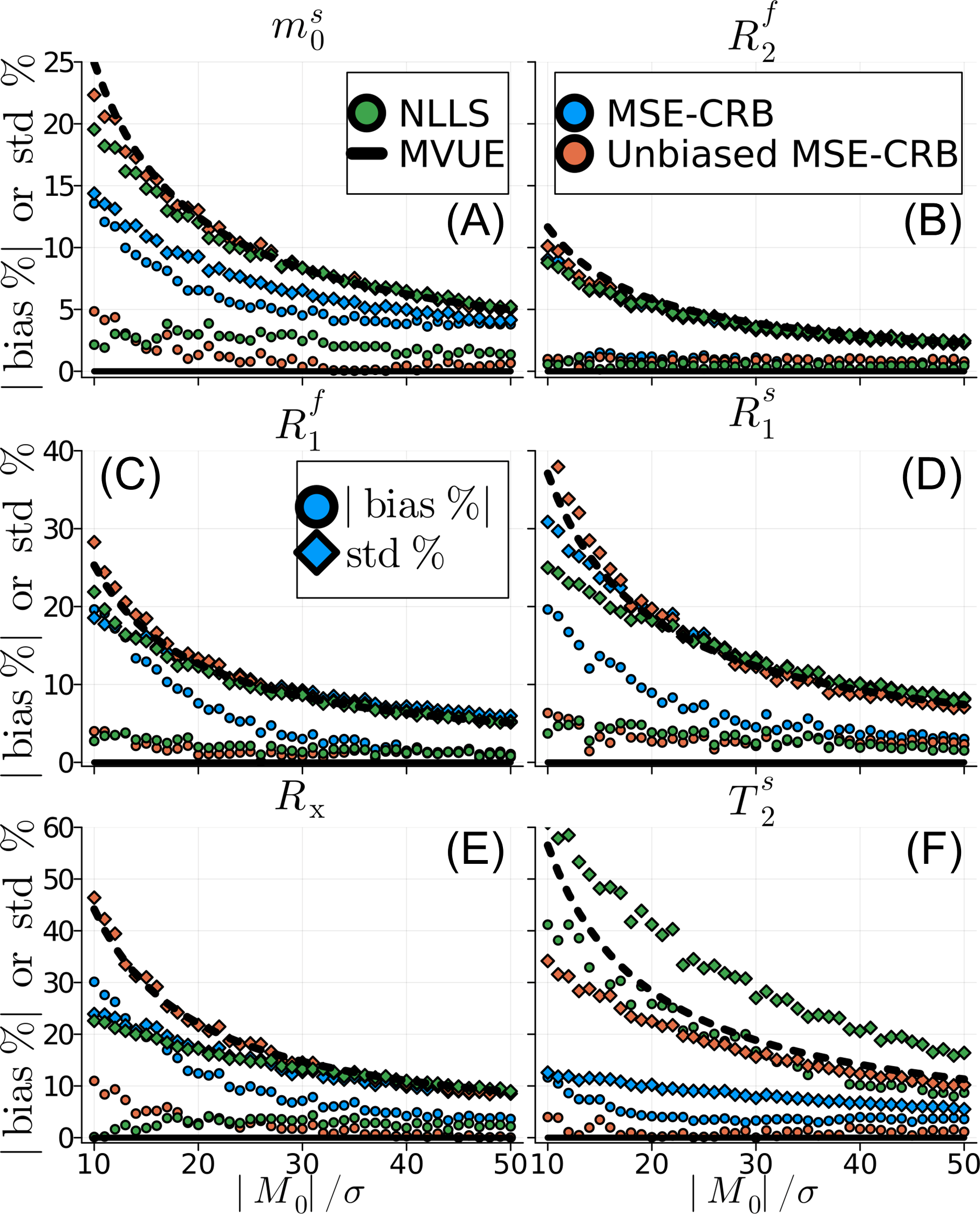
Fig. 1 demonstrates how the proposed unbiased MSE-CRB strategy leads to a reduction in the NN's bias. When training with the default MSE-CRB loss, the NN correctly estimates the parameter $$$R_2^f$$$, which is varied in this example. However, we observe a substantial and variable bias in all other parameters. By contrast, this bias is greatly reduced by the proposed training strategy and the only variability is an increase in the variance of all parameters' estimates with an increasing $$$R_2^f$$$, consistent with an increase in the CRB.Fig. 2 analyzes the simulated bias and variance, as a function of SNR (defined as the scaling $$$M_0$$$ over the noise level $$$\sigma$$$), for a fixed set of parameters corresponding to white matter ($$$m_0^s=0.2,R_1^f=0.52/s,R_2^f=12.9/s,R_x=16.5/s,R_1^s=2.97/s,T_2^s=12.4\mu s$$$ where $$$^s,^f$$$ denote the semi-solid and free spin pools, $$$m_0^s$$$ is the normalized semi-solid pool size and $$$R_x$$$ is the exchange rate).12 The MSE-CRB-trained NN achieves the lowest variance at all SNR values for several parameters at the cost of substantial bias. The proposed strategy significantly reduces the bias and more closely follows the CRB (black line) for all parameters and SNR levels.
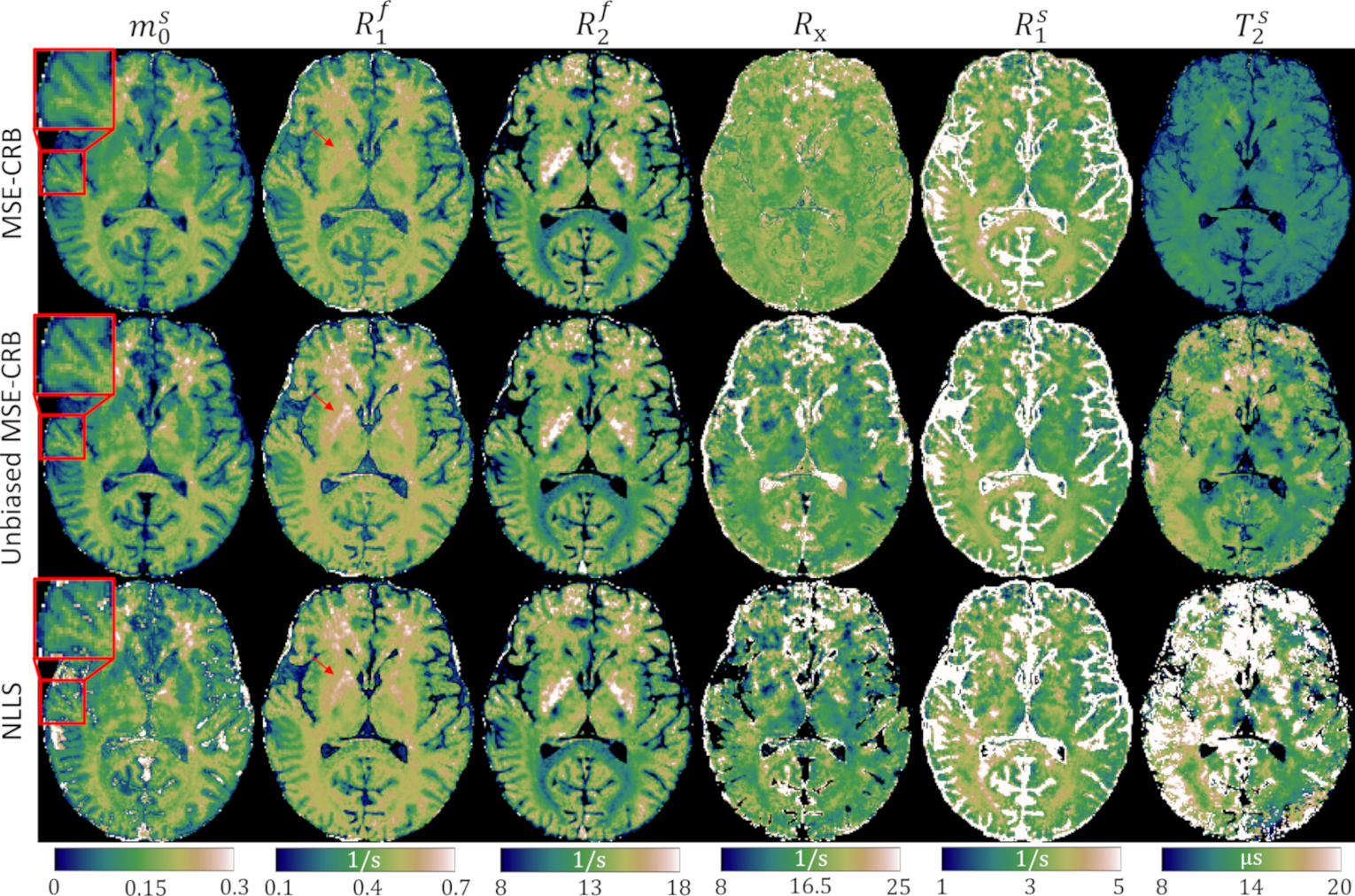
Fig. 3 shows that the unbiased MSE-CRB strategy significantly reduces bias in vivo for the harder-to-estimate qMT parameters (e.g., $$$R_x$$$) in comparison to the reference non-linear least-squares maps, except for $$$T_2^s$$$, which is consistent with simulation (Fig. 2F). Improved contrast-to-noise is observed for $$$m_0^s$$$, likely due to reduced bias towards the white matter prior in the training data.
Discussion and Conclusion
NNs trained with the standard MSE loss learn to reduce the variance at the cost of a bias toward the prior of the training data distribution. Here, we proposed a method to optimize NN estimators involving a single tuning parameter controlling an explicit penalty on the NN's bias. This penalty reduces the impact of the training data prior and yields NNs that are approximately MVUEs, i.e. with zero bias and variance matching the CRB. Since ground-truth parameters are often unknown in vivo, our approach, which focuses on ensuring the MVU property, helps reduce the uncertainty surrounding the quality of the NN's estimates. The proposed NNs are appropriate for developing and validating new quantitative MRI biomarkers, particularly for advanced biophysical models that move beyond the standard Bloch equations. They are also expected to be robust to pathology, where deviations from the training data prior are common.Acknowledgements
This work was supported by NIH grants F30 AG077794, T32 GM136573, and performed under the rubric of the Center for Advanced Imaging Innovation and Research (CAI2R), an NIBIB National Center for Biomedical Imaging and Bioengineering (NIH P41 EB017183).References
- Kay SM. Fundamentals of Statistical Signal Processing, Volume I: Estimation Theory. Philadelphia, PA: Prentice Hall, 1993.
- Liu H, Xiang QS, Tam R, Dvorak AV, MacKay AL, Kolind SH, et al. Myelin water imaging data analysis in less than one minute. NeuroImage 2020;210(January):116551. https://doi.org/10.1016/j.neuroimage.2020.116551.
- Lee J, Lee D, Choi JY, Shin D, Shin HG, Lee J. Artificial neural network for myelin water imaging. Magnetic Resonance in Medicine 2020;83(5):1875–1883.
- Cohen O, Zhu B, Rosen MS. MR fingerprinting Deep RecOnstruction NEtwork (DRONE). Magnetic Resonance in Medicine 2018 sep;80(3):885–894. http://doi.wiley.com/10.1002/mrm.27198.
- Henkelman RM, Huang X, Xiang Qtanisz GJ, Swanson SD, Bronskill MJ. Quantitative interpretation of magnetization transfer. Magnetic Resonance in Medicine 1993;29(6):759–766.
- Helms G, Hagberg GE. In vivo quantification of the bound pool T1 in human white matter using the binary spin-bath model of progressive magnetization transfer saturation. Physics in Medicine and Biology 2009;54(23).
- Assländer J, Gultekin C, Flassbeck S, Glaser SJ, Sodickson DK. Generalized Bloch model: A theory for pulsed magnetization transfer. Magnetic Resonance in Medicine 2021 nov;(July):1–15.
- Zhang X, Duchemin Q, Liu K, Gultekin C, Flassbeck S, Fernandez-Granda C, et al. Cramér–Rao bound-informed training of neural networks for quantitative MRI. Magnetic Resonance in Medicine 2022 mar;(Feb.):1–13.
- Diskin T, Eldar YC, Wiesel A. Learning to Estimate Without Bias. arXiv:2110.12403. http://arxiv.org/abs/2110.12403.
- Liu L, Jiang H, He P, Chen W, Liu X, Gao J, et al. On the Variance of the Adaptive Learning Rate and Beyond. arXiv:1908.03265.
- Assländer J, Novikov DS, Lattanzi R, Sodickson DK, Cloos MA. Hybrid-state free precession in nuclear magnetic resonance. Communications Physics 2019;2(1). http://dx.doi.org/10.1038/s42005-019-0174-0.
- Assländer J, Mao A, Beck ES, La Rosa F, Charlson RW, Shepherd TM, et al. On multi-path longitudinal spin relaxation in brain tissue. arXiv:2301.08394. http://arxiv.org/abs/2301.08394.
- Mao A, Flassbeck S, Gultekin C, Assländer J. Cramér-Rao Bound Optimized Temporal Subspace Reconstruction in Quantitative MRI. arXiv:2305.00326. http://arxiv.org/abs/2305.00326.
- Tamir JI, Uecker M, Chen W, Lai P, Alley MT, Vasanawala SS, et al. T2 shuffling: Sharp, multicontrast, volumetric fast spin-echo imaging. Magnetic Resonance in Medicine 2017 jan;77(1):180–195.
- Assländer J, Cloos MA, Knoll F, Sodickson DK, Hennig J, Lattanzi R. Low rank alternating direction method of multipliers reconstruction for MR fingerprinting. Magnetic Resonance in Medicine 2018 jan;79(1):83–96. http://doi.wiley.com/10.1002/mrm.26639.
- Trzasko J, Manduca A. Local versus Global Low-Rank Promotion in Dynamic MRI Series Reconstruction. Proc Intl Soc Mag Reson Med 2011;24(7):4371.
- Zhang T, Pauly JM, Levesque IR. Accelerating parameter mapping with a locally low rank constraint. Magnetic Resonance in Medicine 2015;73(2):655–661.
Figures