0563
3D MRE-based novel score predicts hepatocellular carcinoma development in patients with chronic hepatitis B1Radiology, Third Affiliated Hospital of Sun Yat-Sen University, Guangzhou, China, 2Mayo Clinic College of Medicine, Rochester, MN, United States
Synopsis
Keywords: fMRI Analysis, Elastography
Motivation: Identifying patients with chronic hepatitis B (CHB) who are at high risk of HCC development for close monitoring to improve prognosis is crucial.
Goal(s): We aimed to develop a 3D MRE-based risk score to predict HCC development in CHB patients.
Approach: The novel HCC risk score was developed using liver shear stiffness and LSS, age, platelet count, and albumin.
Results: Our results showed that the risk score has excellent performance for the identification of patients of HCC development, the cutoff value 55 of our risk score provided the high negative predictive value for HCC development at 3 and 5 years.
Impact: MRE- based HCC risk score may be a non-invasively accurate tool for predicting HCC, which may provide a useful reference for decision-making in HCC surveillance strategy for CHB patients.
Introduction
Hepatocellular carcinoma (HCC) is the fifth most common cancer and the second leading cause of cancer-related deaths worldwide [1]. The hepatitis B virus (HBV) is the major cause of liver cirrhosis and HCC [2]. Although the risk of HCC development can be reduced by using highly active antiviral agents [3], it cannot be eliminated [4], especially in patients with advanced fibrosis. Therefore, patients with chronic hepatitis B (CHB) who are at high risk of HCC development need to be promptly identified for early detection, and further optimize the use of healthcare resources and improve prognosis.Over the past few decades, several clinical risk scores have been developed and validated to predict HCC development [5-8]. Nevertheless, background of liver (such as liver fibrosis) has been proven to be as important risk factor affecting the outcome of liver diseases. Magnetic Resonance Elastography (MRE) emerged as the most accurate method to estimate liver fibrosis, including at earlier fibrosis stages [9]. Currently, several studies have been reported on the ability of 2D MRE to predict the development of HCC [8; 10]. By comparison, 3D-MRE provide even higher diagnostic performance for staging fibrosis [11; 12]. No study thus far has focused on the predictive value of 3D MR elastography in predicting HCC development for CHB patients. Therefore, the purpose of this study was to determine the utility of 3D MRE in predicting HCC development and further build the HCC risk score that combines 3D MRE and simple clinical markers to predict HCC development in CHB patients.Methods
We retrospectively enrolled 355 consecutive CHB patients (mean age, 48 years; range, 20-77 years; 283 men) who underwent MRI examination (including 3D MRE and CSE) between July 2015 and December 2018; 249 and 106 patients randomly assigned to training and validation cohorts, respectively. Baseline liver MR metrics and clinical biomarkers were collected, and then the patients received regular follow-up (median 4.4 (3.5-5.3) years) for the surveillance of HCC. A novel HCC risk score was developed based on multivariable Cox models and the score range for standardization. The prognostic performance was evaluated using C-index, time-dependent ROC, and calibration curves in the training and validation cohorts. For the risk score, we obtained the optimal cutoff value by X-tile software and separated all participants into high-risk and low-risk groups.Results
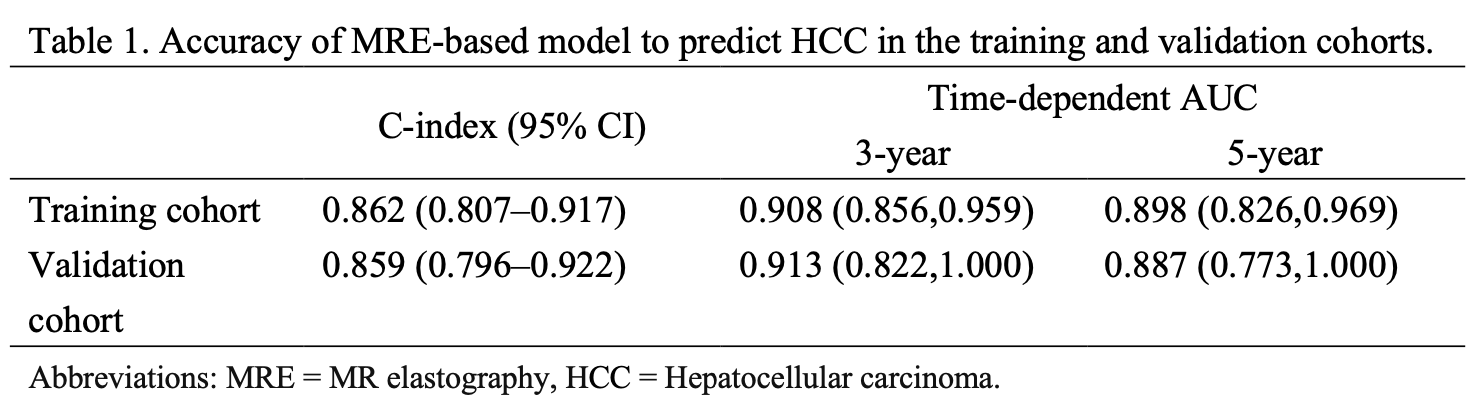
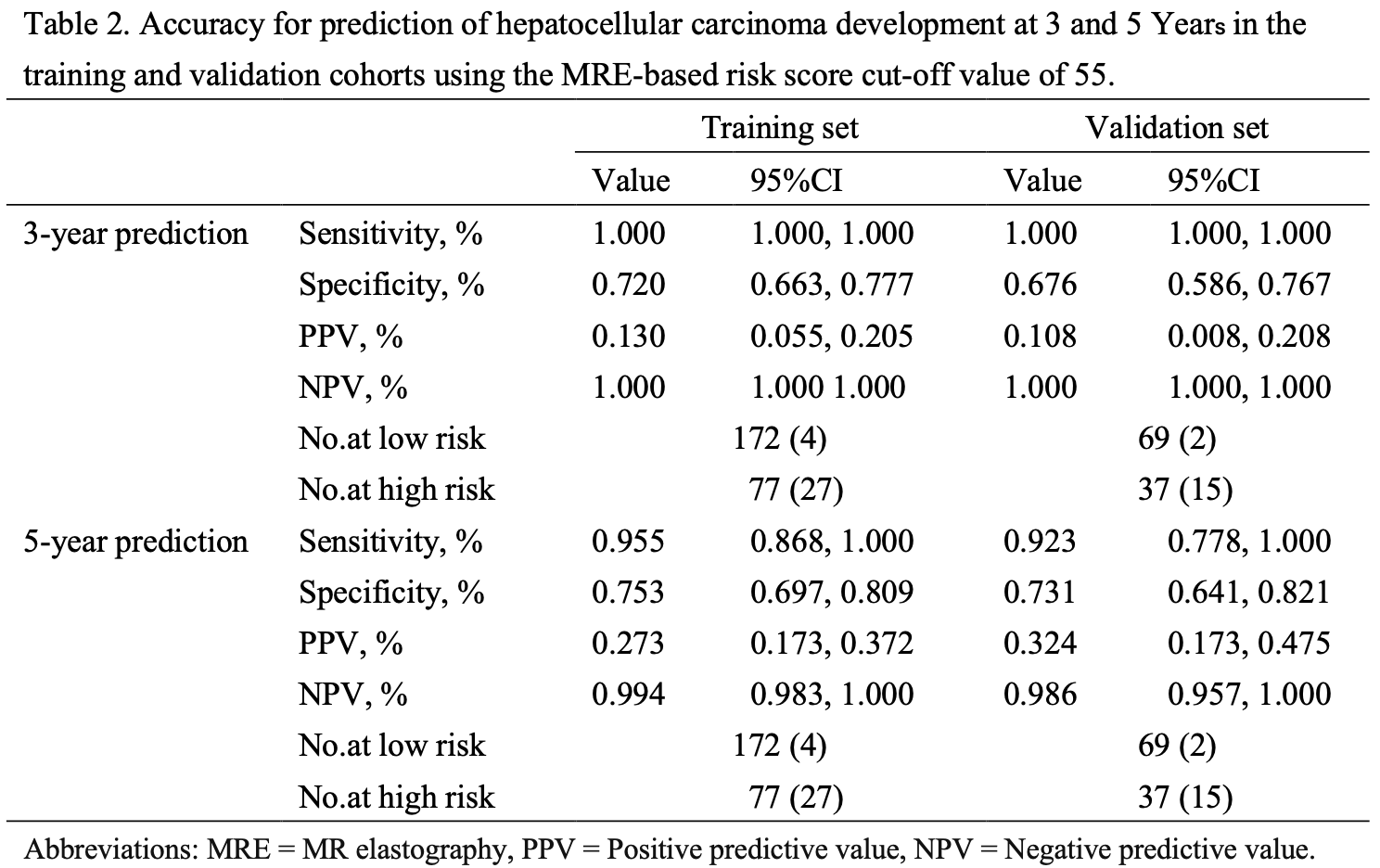
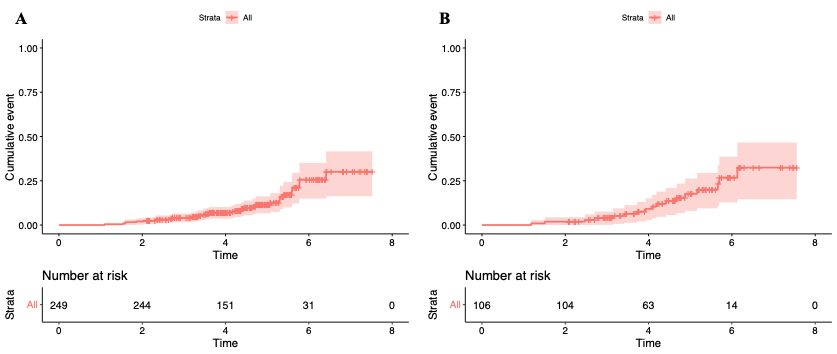
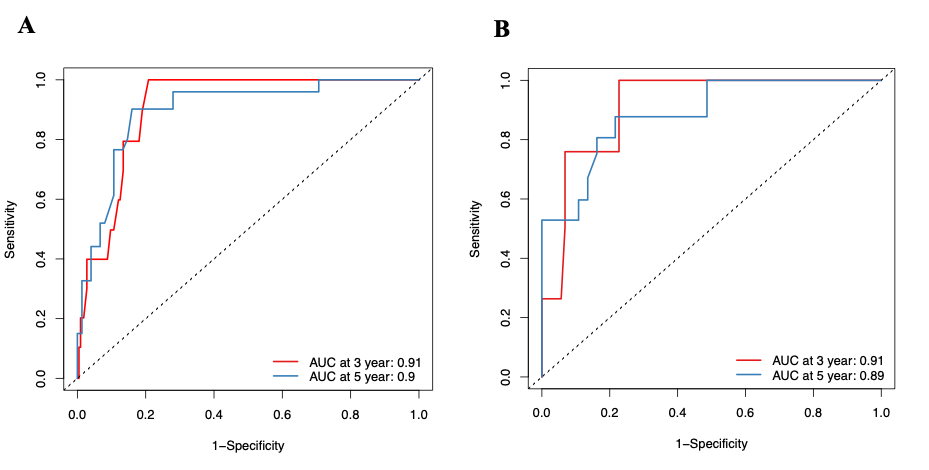
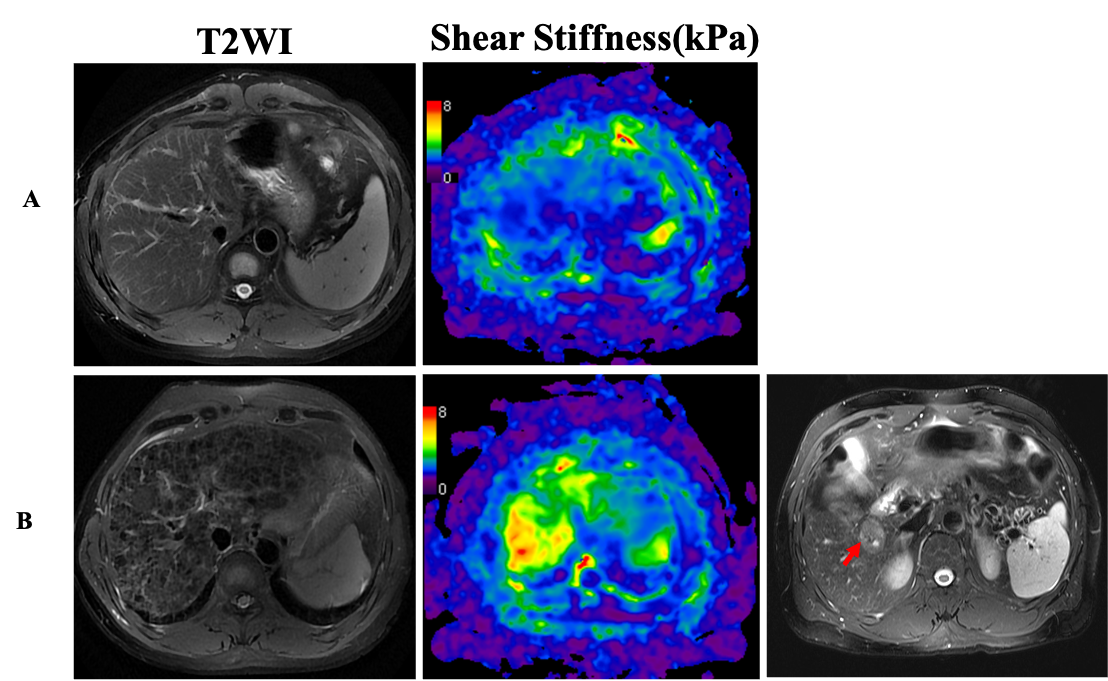
Patients in two cohorts had similar baseline characteristics (all P > 0.05). During a median follow-up of 4.4 (3.5-5.3) years, 31 patients (12.4%) and 17 patients (16.0%) patients in the training and validation cohorts developed HCC. The 3-, and 5-year cumulative incidences of HCC in the training cohort were 4.6% and 10.9%, respectively, which in the validation were 3.8%/and 9.3%, respectively (Figure 1). We developed an MRE-based HCC risk score (ranging from 0 to 100) that involves only age, platelet count <150×109/L, albumin ≤35 g/L, and liver shear stiffness (LSS) > 4.251kpa based on 3D MRE. This metric performed excellently in assessing HCC risk in both the training (C-index: 0.862, 95%CI 0.807–0.917) and validation (C-index: 0.859, 95%CI 0.796–0.922) cohorts (Table 1 & Figure 2). The time-dependent AUCs at 3 and 5 years also confirmed an excellent prognostic accuracy in the training and internal validation cohorts (Table 1 & Figure 2). The cut-off value of 55 was best discrimination for HCC risk for the novel risk score with high negative predictive values (3-year prediction: 100.0% and 100.0% in the training and validation cohorts, respectively; 5-year prediction: 95.5% and 92.3% in the training and validation cohorts, respectively; Table 2).Discussion
The results of this study showed that 3D LSS by MRE is an independent predictor for HCC development in patients with HBV; and we developed a novel risk score composed of available clinical-laboratory parameters and 3D LSS by MRE to predict the future risk of HCC in chronic HBV carriers. Our MRE-based risk score has excellent predictive performance for predicting HCC development at 3 and 5 years. This risk score could exclude future 3-years and 5-years HCC development with high negative predictive value in the training (100.0% and 95.5% respectively) and validation cohorts (100.0% and 92.3% respectively). Limitations of our study include its retrospective design, modest small number of cases, and a follow-up period that was relatively short.Conclusions
LSS is an independent predictor for HCC development, MRE- based HCC risk score with cutoff value 55 may be a non-invasively accurate tool for predicting HCC, which may provide a useful reference for decision-making in HCC surveillance strategy for CHB patients.Acknowledgements
National Natural Science Foundation of China grant (82271973 and 91959118, Jin Wang), The ‘Five Five’ Project of the Third Affiliated Hospital of Sun Yat-sen University (2023WW103, Jin Wang), Guangdong Basic and Applied Research Foundation (2021A1515010582, Jin Wang), Key Research and Development Program of Guangdong Province (2019B020235002, Jin Wang), China International Medical Foundation SKY Research Fund for Medical Imaging (Z-2014-07-2101 and Z-2014-07-1912-15, Jin Wang), Clinical Research Foundation of the 3rd Affiliated Hospital of Sun Yat-Sen University (YHJH201901, Jin Wang)References
1. Villanueva A (2019) Hepatocellular Carcinoma. N Engl J Med 380:1450-14622. Schweitzer A, Horn J, Mikolajczyk RT, Krause G, Ott JJ (2015) Estimations of worldwide prevalence of chronic hepatitis B virus infection: a systematic review of data published between 1965 and 2013. Lancet 386:1546-1555
3. Liaw YF, Sung JJ, Chow WC et al (2004) Lamivudine for patients with chronic hepatitis B and advanced liver disease. N Engl J Med 351:1521-1531
4. (2017) EASL 2017 Clinical Practice Guidelines on the management of hepatitis B virus infection. J Hepatol 67:370-398
5. Wong VW, Chan SL, Mo F et al (2010) Clinical scoring system to predict hepatocellular carcinoma in chronic hepatitis B carriers. J Clin Oncol 28:1660-1665
6. Papatheodoridis G, Dalekos G, Sypsa V et al (2016) PAGE-B predicts the risk of developing hepatocellular carcinoma in Caucasians with chronic hepatitis B on 5-year antiviral therapy. J Hepatol 64:800-806
7. Kim JH, Kim YD, Lee M et al (2018) Modified PAGE-B score predicts the risk of hepatocellular carcinoma in Asians with chronic hepatitis B on antiviral therapy. J Hepatol 69:1066-1073
8. Fan R, Papatheodoridis G, Sun J et al (2020) aMAP risk score predicts hepatocellular carcinoma development in patients with chronic hepatitis. J Hepatol 73:1368-1378
9. Loomba R, Wolfson T, Ang B et al (2014) Magnetic resonance elastography predicts advanced fibrosis in patients with nonalcoholic fatty liver disease: a prospective study. Hepatology 60:1920-1928
10. Motosugi U, Ichikawa T, Koshiishi T et al (2013) Liver stiffness measured by magnetic resonance elastography as a risk factor for hepatocellular carcinoma: a preliminary case-control study. Eur Radiol 23:156-162
11. Allen AM, Shah VH, Therneau TM et al (2020) The Role of Three-Dimensional Magnetic Resonance Elastography in the Diagnosis of Nonalcoholic Steatohepatitis in Obese Patients Undergoing Bariatric Surgery. Hepatology 71:510-521
12. Ronot M, Lambert S, Elkrief L et al (2014) Assessment of portal hypertension and high-risk oesophageal varices with liver and spleen three-dimensional multifrequency MR elastography in liver cirrhosis. Eur Radiol 24:1394-1402
Figures