0556
Gradient impulse response function-based phase compensation for wavelet MR elastography on a compact 3T scanner1Radiology, Mayo Clinic, Rochester, MN, United States
Synopsis
Keywords: Artifacts, System Imperfections: Measurement & Correction, gradient impulse response function
Motivation: High-performance asymmetric gradient systems have the potential to produce high-spatial-order eddy-current-induced magnetic fields that can impact phase-based applications such as wavelet MRE using large-magnitude motion-encoding bipolar gradient pulses.
Goal(s): Removal of the gradient-system-induced high-order phase deviation in the wavelet MRE phase map.
Approach: Gradient impulse response functions (GIRFs) can be used to characterize the gradient system. We introduce a GIRF-based phase compensation approach to alleviate the high-order phase deviations resulting from imperfections in the gradient system, along with practical recommendations, including the use of a tailored set of GIRFs.
Results: The phase inhomogeneity in wavelet-MRE phase map improved with the GIRF-based compensation.
Impact: The proposed GIRF-based phase compensation approach offers the potential to enhance phase image quality and accuracy, addressing imperfections in the gradient system, which is a challenge not fully resolved by alternative methods like concomitant field correction and pre-emphasis gradient modification.
Introduction
An asymmetric gradient system has been introduced to provide high gradient amplitude and slew rate, up to 80 mT/m and 700 T/m/s simultaneously in a Compact 3T technology demonstrator [1]. The high-performance gradient system may cause additional high-order eddy-current-induced magnetic field. In most of applications only reconstructing magnitude images, the effect is negligible. Recently, wavelet MRE has been introduced to use a large-area bipolar gradient pulses for encoding transient brain motions to investigate the mechanisms of traumatic brain injury (TBI) [2-4]. The phase images of the MRE technique could be vulnerable to the additional spatially high-order magnetic field.Gradient impulse response function (GIRF) has been proposed to characterize a gradient system as a linear system [5], which can be used for predicting field response to gradient input. In this work, we examined the phase deviation caused by large-area bipolar gradient pulses and attempted to compensate it with GIRF-based prediction.
Methods
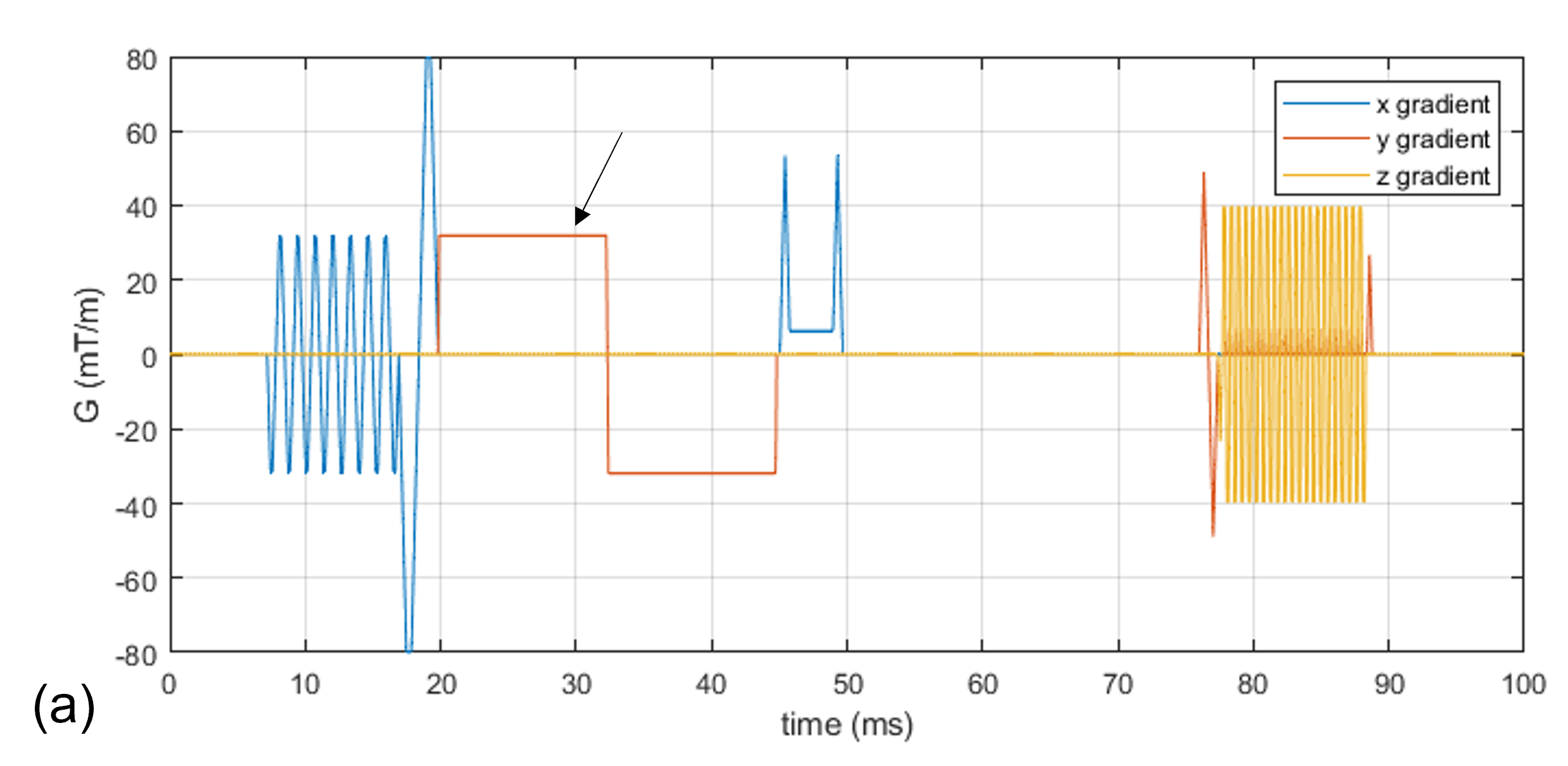
GIRFs were calculated for the Compact 3T MRI scanner. Triangle-shaped gradient pulses were generated on each gradient coil as input waveforms and the consequent field changes were measured by a third-order dynamic field camera (Skope, Zurich Switzerland) as outputs to calculate GIRFs [5]. 3×16 GIRFs with 25 ms duration were obtained, derived from x, y, or z-direction nominal inputs using 16 bases of real spherical harmonics.A wavelet MRE pulse sequence based on spin-echo EPI and a bipolar motion encoding gradient was used, as shown in Figure 1, which has 25 ms duration with magnitude of ±32 (or ±16 mT/m, not shown) on the physical y, x, or z-direction. To simulate the GIRF-based phase deviation caused by the bipolar gradient pulse, the following equation was implemented.
$$\theta\left(\bar{r}\right)=\gamma\sum_{j=1}^{16}\left[Y_j(\bar{r})\sum_{i=x,y,z}\int{G_i(t)\ast{GIRF}_{i,j}\left(t\right)dt}\right]=\gamma\sum_{j=1}^{16}{\beta_{GIRF,j}Y_j(\bar{r})}\;\;\;\;\;(1)$$
, where Gi is a nominal gradient waveform of x, y, or z and Yj is j-th basis of real spherical harmonics up to 3rd order [5]. γ is the gyromagnetic constant. The vector r denotes the voxel coordinate. ‘*’ indicates a linear convolution. The phase deviation was proportional to temporal accumulation of the GIRF-based field changes, which was summarized as β coefficients in Eq. (1).
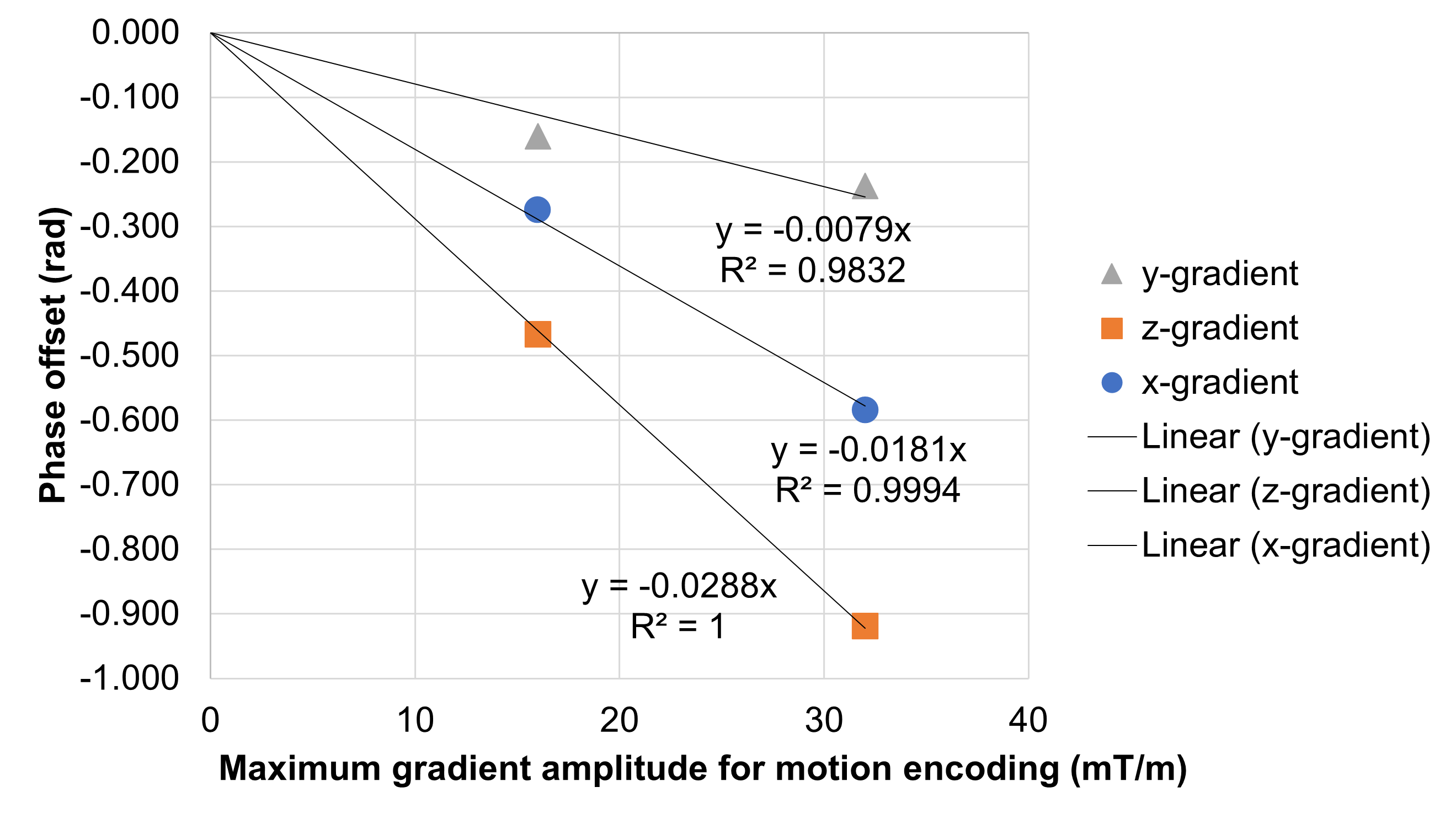
Based on level of contributions, only selected bases were used to minimize the standard deviation in GIRF-compensated phase map rather than using all, referred as 'tailored bases'. With the tailored bases, residual phase offsets were examined (Figure 2) and B0 adjustment was added to compensate for the offsets.
As a reference to compare GIRF-based prediction, other β coefficients were also calculated by fitting the unwrapped phase map with bases including $$$\bar{\mathbf{\beta}}_{{fit}}=\gamma^{-1}{(\mathbf{Y}^{-1}\mathbf{Y})}^{-1}\mathbf{Y}^{-1}{\mathbf{\Theta}}$$$, where $$${\mathbf{\Theta}}$$$ and $$$\mathbf{Y}$$$ denote vectors for unwrapped phase and the bases on coordinates of valid voxels, respectively.
A gel phantom was used for developing the method. For verification, healthy volunteer data was acquired under an IRB-approved protocol.
Results
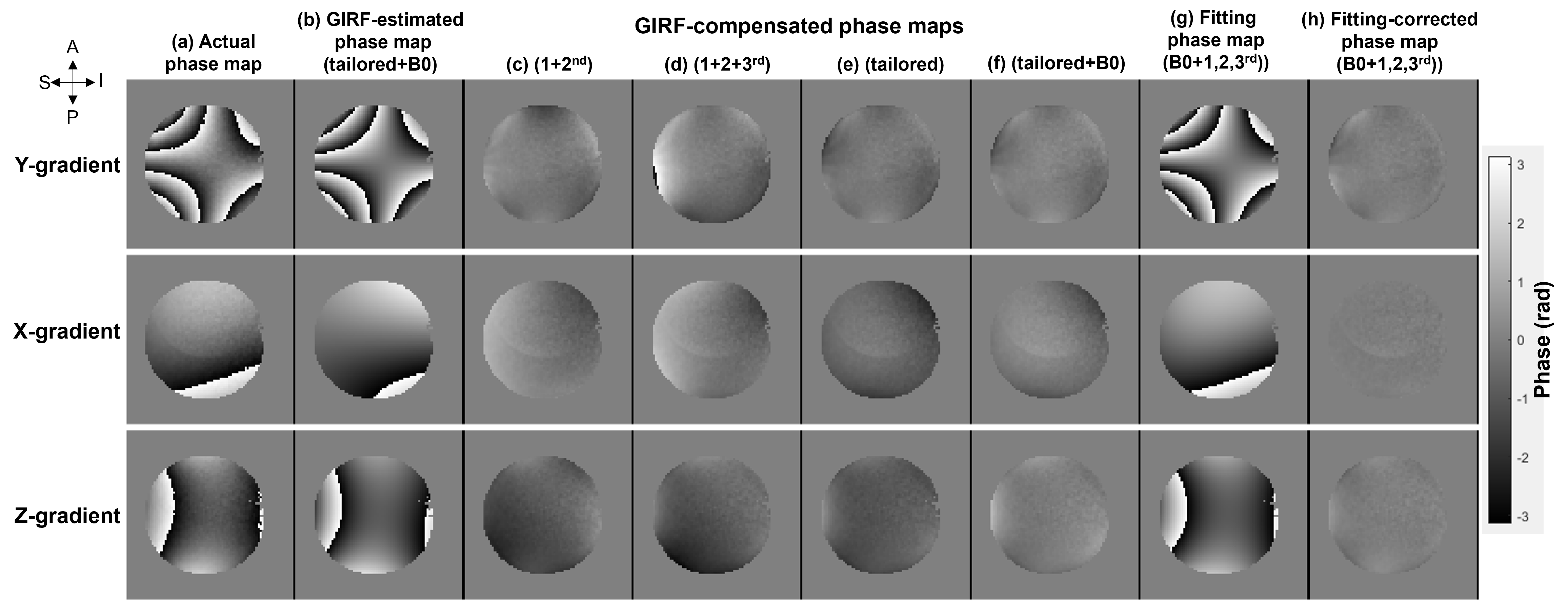
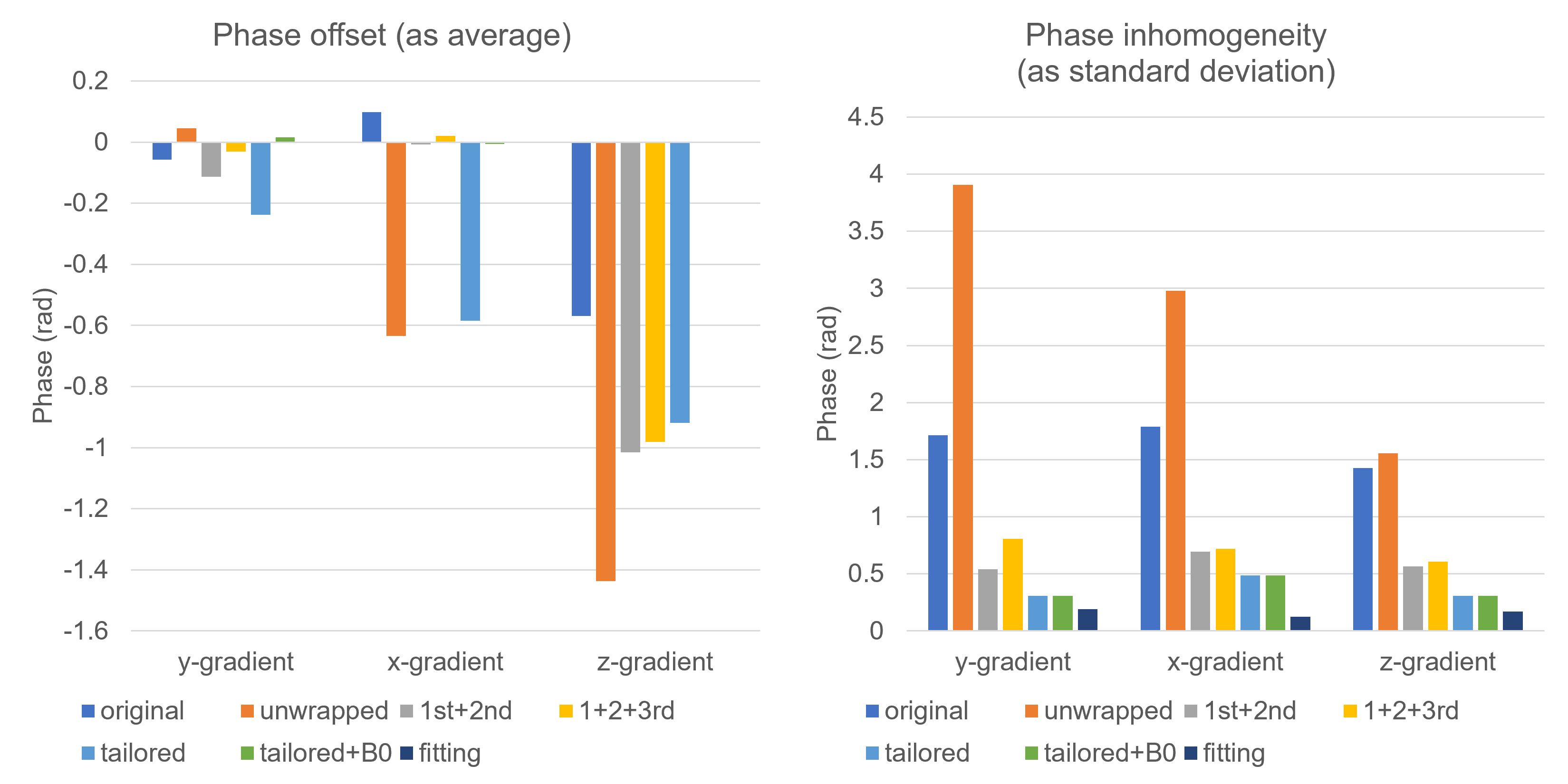
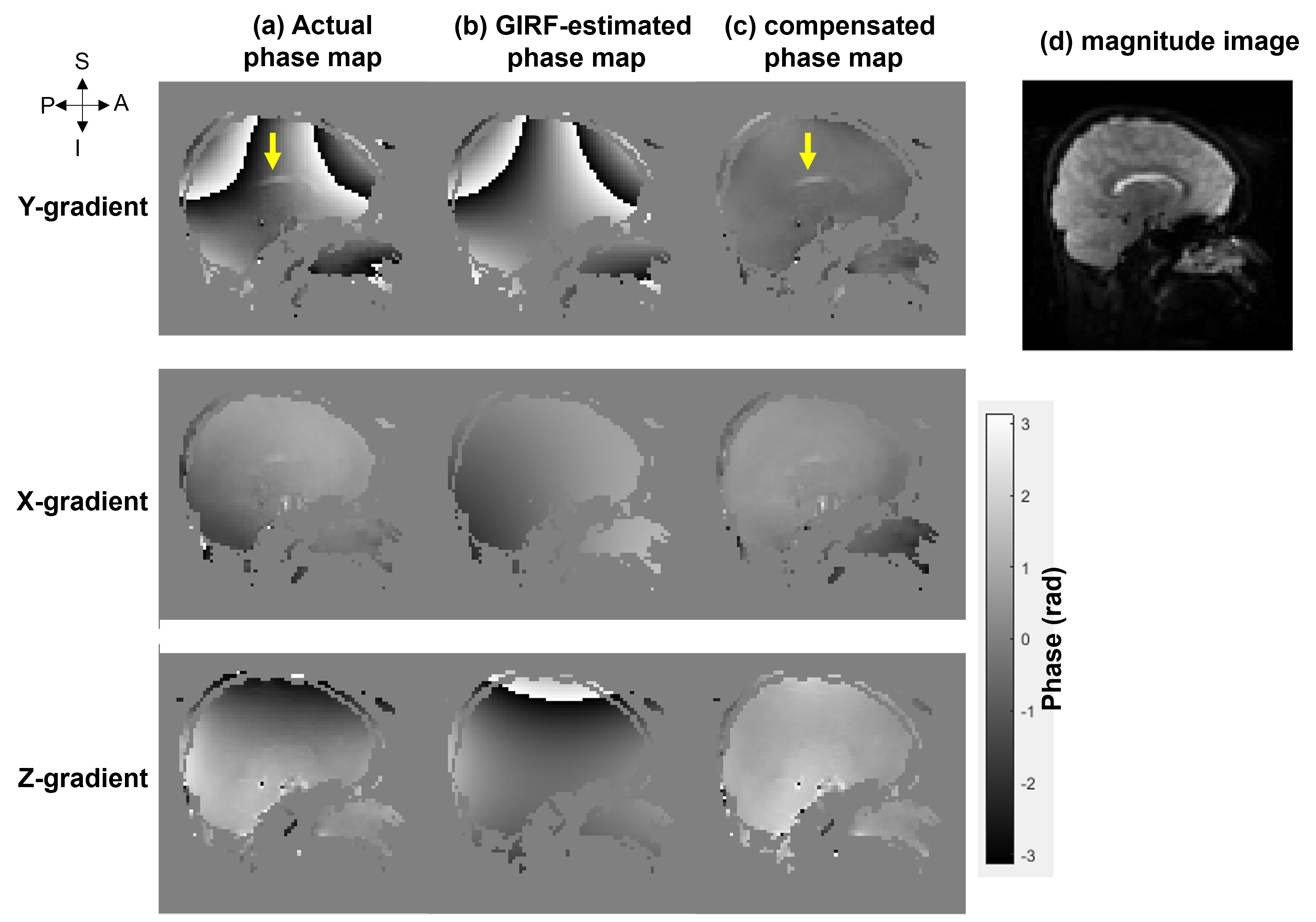
In Figure 3, y-direction bipolar gradient induced a spatially complicated phase deviation with wraps in the gel phantom phase images. GIRF-based prediction for the gradient pulses generated similar patterns and magnitudes in phase deviation with those of the actual acquired phase map. By compensating the phase errors, phase inhomogeneity was improved in the phantom. For x- and z-direction bipolar gradient pulses, phase compensations also led to reduced inhomogeneity. As shown in Figure 4, phase compensation using tailored bases minimized phase homogeneity further, compared to the use of all the spherical harmonic bases. In Figure 5, the proposed compensation was applied into a healthy volunteer subject data, where the system-induced phase deviation was mitigated while wave motion-specific phase variation was preserved as indicated.Discussion
In this work, we examined the GIRF-based phase compensation for the effect of motion-encoding gradient pulses performed with a high-performance Compact 3T. While the wavelet MRE employs bipolar gradient pulses of various durations, this preliminary work was limited to a bipolar gradient with fixed duration.The fitting approach tended to result in less phase inhomogeneity with more bases. In the GIRF-based approach, interestingly, some of GIRFs seemed to be ineffective for improving phase inhomogeneity, which were excluded in the tailored set of bases. This seemed plausible because some of the GIRFs could provide inaccurate estimation when the effective impulse response is below the noise level, and/or there is no actual relationship between a nominal gradient pulse and a certain basis.
Conclusion
Bipolar gradient pulses for motion encoding can induce phase inhomogeneity with high-order terms in high-performance gradient system of the compact 3T. GIRF-based prediction can provide a compensation for the system-derived phase deviation. This approach offers promising solutions for wavelet MRE challenges and could greatly advance transient motion detection in TBI research.Acknowledgements
The authors acknowledge the assistance of James G. Pipe, Ph.D. and Paul Weavers, Ph.D., in support and setup of dynamic field camera on the compact 3T, and the assistance of Nastaren Abad, Ph.D. and Thomas K. Foo, Ph.D., in support of pulse sequences used in GIRF estimation. This research was funded by the National Institutes of Health (NIH) (Grant/Award Nos. U01 EB024450, U01 EB026976 and R01 NS113760).
References
1. Foo, T.K.F., et al., Lightweight, compact, and high-performance 3T MR system for imaging the brain and extremities. Magn Reson Med, 2018. 80(5): p. 2232-2245.
2. Le, Y., et al. Assessment of dynamic shear strain in the brain caused by mechanical transients using multi-scale MR elastography. in Proc. Intl. Soc. Mag. Reson. Med. 2023.
3. Le, Y., et al. Imaging of Propagating Broadband Transient Waves with Multi-scale MR Elastography MotionEncoding: A Validation Study. in Proc. Intl. Soc. Mag. Reson. Med. 2023.
4. Le, Y., et al. Initial Study on Imaging Cyclic Tissue Motion with Motion Encoding Gradients in the Shape ofWavelet Basic Functions. in Proc. Intl. Soc. Mag. Reson. Med. 2022.
5. Vannesjo, S.J., et al., Gradient system characterization by impulse response measurements with a dynamic field camera. Magn Reson Med, 2013. 69(2): p. 583-93.
Figures