0552
A Newly Designed Hyperpolarized Aminopeptidase N Probe Sensitively Detects Early Therapeutic Responses Heterogeneously on Pancreatic Tumors1National Institutes of Health, Bethesda, MD, United States, 2The University of Tokyo, Tokyo, Japan, 3National Institutes for Quantum and Radiological Science and Technology, Chiba, Japan
Synopsis
Keywords: Probes & Targets, Hyperpolarized MR (Non-Gas)
Motivation: Molecular imaging is a promising methodology for diagnosing cancer and monitoring treatments by noninvasively visualizing the alternations of cancer metabolisms.
Goal(s): A framework for developing novel dissolution Dynamic Nuclear Polarization(dDNP) probes is needed to overcome their limited availabilities for in vivo and clinical applications.
Approach: dDNP-metabolic MRI successfully monitors therapeutic responses in spatiotemporal enzymatic activities particularly at earlier stages before the volumetric changes can be observed.
Results: In this presentation, we will demonstrate a model case for a rationally designed novel dDNP probe, aminopeptidase-N(CD13), which allows us to detect heterogenetic treatment responses with an anti-angiogenic/antitumor drug, sunitinib, at the earlier stages in tumors.
Impact: This work exhibits a framework that a rationally designed hyperpolarized MR probe targeted to a highly-selective enzymatic activity, aminopeptidase-N, leads to monitor early therapeutic responses on cancer tissues in vivo and to observe tumor heterogeneity in their treatment responses non-invasively.
Introduction
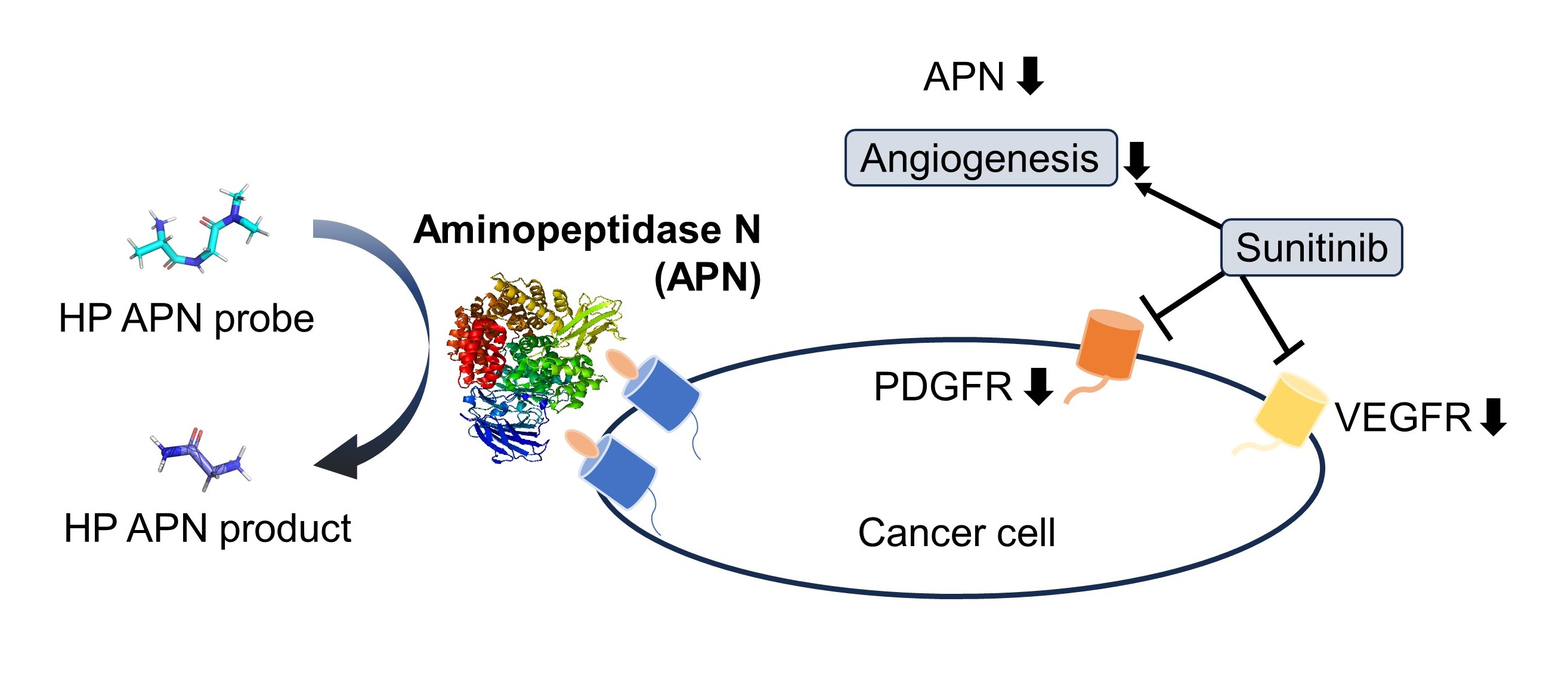
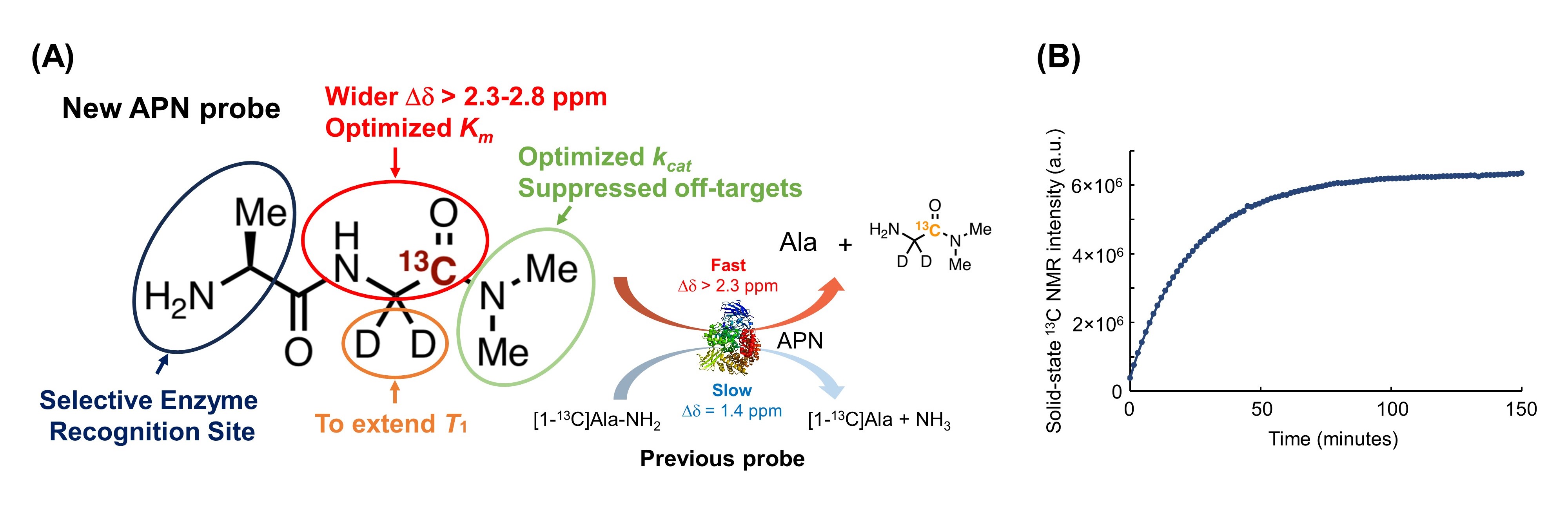
Cancer treatment responses in solid tumors is assessed by observing morphological/volumetric changes with MRI and CT after treatments conventionally. However, these treatment outcomes can be time consuming as morphological and volumetric changes can take several weeks/months to manifest(1). To monitor their therapeutic responses at the earlier stages, even before conventional volumetric changes are observed, modern molecular imaging approaches have been emerging. In recent years, we have been collaboratively tackling the discovery of new effective MRI-based probes(2-7). The development of new MRI-agents is particularly important for hyperpolarized Dynamic Nuclear Polarization(DNP) probes, which is considered as a promising molecular imaging approach, as the limited number of in vivo dissolution dynamic nuclear polarization(dDNP) probes is a critical bottleneck(8). Here, we rationally designed an aminopeptidase-N(APN) probe to detect enzyme specific activities in vivo based on a structure-guided molecular design utilizing structural biology, computations, quantum mechanics-based molecular dynamics, and enzymology(2). APN(CD13) plays a wide variety of important physiological roles and is highly expressed in various tumors associated with malignant tumor progression including angiogenesis. An anti-angiogenic cancer drug, sunitinib has been shown to inhibit the tyrosine kinase activity of vascular endothelial growth factor receptors. Here, this newly developed APN probe can potentially monitor therapeutic efficacy of sunitinib effectively even at an earlier stage before the morphological changes in tumors. In this presentation, we will demonstrate the framework of (i)a rational design of a novel hyperpolarized probe, (ii)its in vivo applications, and (iii)early assessment of an anticancer treatment utilizing hyperpolarized 13C metabolic MRI. We will plan to discuss the advantages and disadvantages of our approach in developing new MRI probes.Methods
Hyperpolarized 13C MRI: Hyperpolarized 13C MRI experiments were conducted on 3T MRI scanners(MR solutions Inc. and Bruker Biospin) using 17mm diameter home built 13C solenoid coils with saddle 1H coils.Results
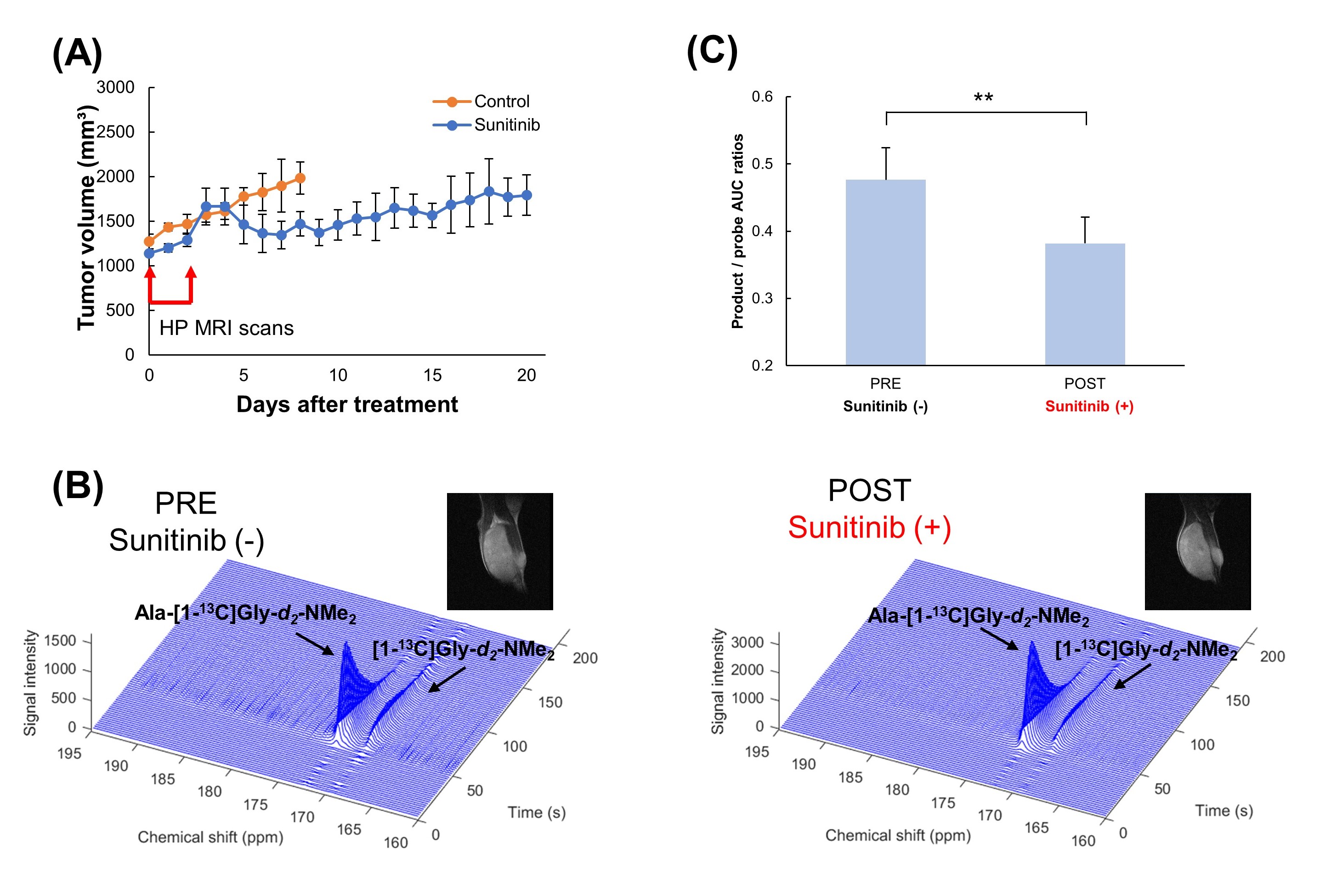
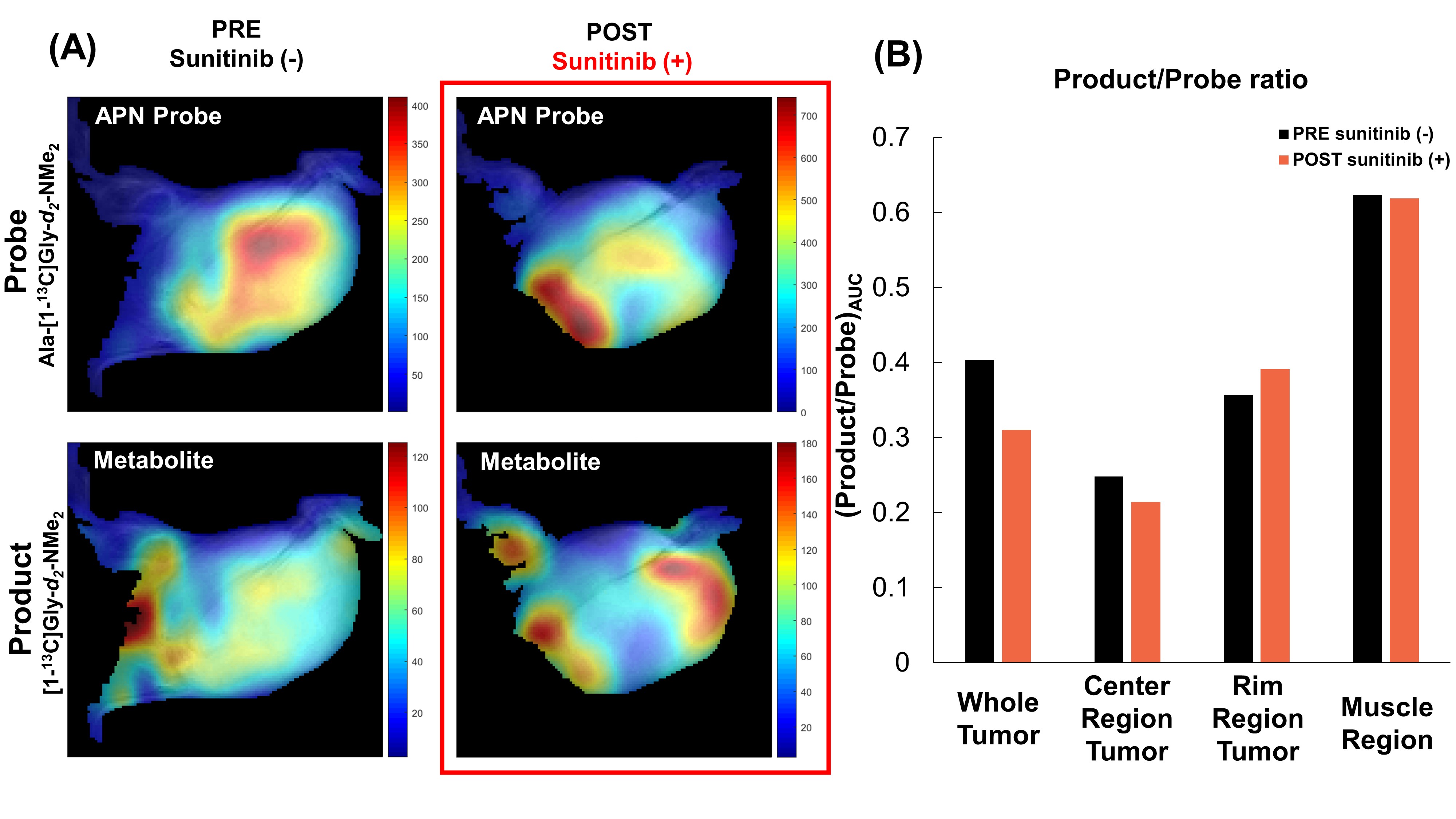
The growth kinetics of MIAPaCa-2 tumor xenografts with/without the treatment exhibited that the tumor volume of the control group was reached approximately 2000mm³ at day 8. The tumor volume of the treatment group did not reach 2000mm³ even at day 21 after treatments, which indicates the treatment with sunitinib(50mg/kg/day) suppressed the tumor growth significantly in MIAPaCa-2 tumors (5 days after beginning of treatment, p < 0.05)(Figure 3(A)). Hyperpolarized 13C APN MRI, Ala-[1-13C]Gly-d2-NMe2, was conducted to evaluate the therapeutic efficacies of sunitinib at the early stage of its treatments(Figure2(A,B)). Time-dependent 13C Magnetic Resonance Spectroscopy(MRS) exhibited highly sensitive and well-resolved spectra with sufficient hyperpolarization lifetime in vivo, which showed the APN probe at 172.6ppm and product ([1-13C]Gly-d2-NMe2) peaks at 170.0 ppm (Figure3(B)). The intensities of product peaks were significantly decreased after third day of treatments(Figure3(B,C)). Dynamic Chemical Shift Imaging(CSI) of hyperpolarized 13C APN on xenograft tumors indicated drastic changes in the distributions of APN metabolites/probe upon anti-cancer treatments(Figure4(A)) while tumor heterogeneities in their therapeutic responses were observed with/without sunitinib in site-specific manners(Figure4(B)).Discussion
Hyperpolarized 13C APN probe allowed us to visualize the treatment responses of sunitinib significantly earlier than the observable morphological changes, while successfully detecting alterations in APN enzymatic activities of APN before/after treatment with sunitinib. Sunitinib is a multi-target tyrosine kinase inhibitor which belongs to the class of anti-angiogenic therapies that target the VEGF-signaling pathway(9). Since its approval in 2006, sunitinib is a standard of care in the first line treatment of metastatic renal cell carcinoma led to improved prognostics(9). Here, CD13 is known as a key biomarker for angiogenesis, therefore, a hyperpolarized APN probe can be an effective surrogate for monitoring the efficacies upon anti-angiogenic cancer drugs(2,10) Our results suggest that hyperpolarized APN probe can be utilized for early therapeutic assessment of sunitinib for cancer cell types on which CD13 is highly expressed. The detailed investigations of these metabolic alterations also are in progress in our group utilizing the other perfusion-based imaging sequences and metabolomics approaches.Conclusion
The hyperpolarized 13C APN probe can monitor early therapeutic responses on pancreatic tumor xenografts treated with sunitinib. Their metabolic alternations induced by sunitinib can be observed much sensitive/earlier even before the morphological/volumetric changes upon their treatments can be observed. In particular, we observed that sunitinib can have heterogenetic impacts across the various tumor regions as observed by MRSI. To elucidate the mechanisms on this heterogenetic treatment effects, further imaging approaches as well as metabolic characterizations in various tumor cell lines including pancreatic and kidney tumors are in progress in our group. This study can be one of the effective model cases that demonstrate the framework of rational hyperpolarized 13C probe developments to its in vivo applications in cancer research.Acknowledgements
This study was supported by intramural research program at NCI/NIH.References
1. Kurhanewicz J, Vigneron DB, Ardenkjaer-Larsen JH, et al. Hyperpolarized (13)C MRI: Path to Clinical Translation in Oncology. Neoplasia 2019;21(1):1-16.2. Saito Y, Yatabe H, Tamura I, et al. Structure-guided design enables development of a hyperpolarized molecular probe for the detection of aminopeptidase N activity in vivo. Sci Adv 2022;8(13):eabj2667.
3. Yamamoto K, Opina A, Sail D, et al. Real-Time insight into in vivo redox status utilizing hyperpolarized [1-(13)C] N-acetyl cysteine. Sci Rep 2021;11(1):12155.
4. Adelabu I, Ettedgui J, Joshi SM, et al. Rapid (13)C Hyperpolarization of the TCA Cycle Intermediate α-Ketoglutarate via SABRE-SHEATH. Anal Chem 2022;94(39):13422-13431.
5. Miura N, Mushti C, Sail D, et al. Synthesis of [1-(13) C-5-(12) C]-alpha-ketoglutarate enables noninvasive detection of 2-hydroxyglutarate. NMR Biomed 2021;34(11):e4588.
6. AbuSalim JE, Yamamoto K, Miura N, et al. Simple Esterification of [1-(13)C]-Alpha-Ketoglutarate Enhances Membrane Permeability and Allows for Noninvasive Tracing of Glutamate and Glutamine Production. ACS Chem Biol 2021;16(11):2144-2150.
7. Saito K, Sail D, Yamamoto K, et al. Synthesis and evaluation of (13)C-labeled 5-5-dimethyl-1-pyrroline-N-oxide aimed at in vivo detection of reactive oxygen species using hyperpolarized (13)C-MRI. Free Radic Biol Med 2019;131:18-26.
8. Keshari KR, Wilson DM. Chemistry and biochemistry of 13C hyperpolarized magnetic resonance using dynamic nuclear polarization. Chem Soc Rev 2014;43(5):1627-1659.
9. Faivre S, Demetri G, Sargent W, Raymond E. Molecular basis for sunitinib efficacy and future clinical development. Nat Rev Drug Discov 2007;6(9):734-745.
10. Pasqualini R, Koivunen E, Kain R, et al. Aminopeptidase N is a receptor for tumor-homing peptides and a target for inhibiting angiogenesis. Cancer Res 2000;60(3):722-727.
Figures