0524
Universal Design of Multiphoton Parallel Transmission (MP-pTx) Pulses for Uniform, High-Flip Angle Excitations1Dept. of Electrical Engineering and Computer Science, Massachusetts Institute of Technology, Cambridge, MA, United States, 2Harvard Medical School, Boston, MA, United States, 3Dept. of Radiology, Massachusetts General Hospital, A. A. Martinos Center for Biomedical Imaging, Boston, MA, United States, 4Dept. of Health Sciences and Technology, Massachusetts Institute of Technology, Cambridge, MA, United States
Synopsis
Keywords: High-Field MRI, Brain
Motivation: Contrast in high-field MRI is complicated by the spatially non-uniform transmission profile of birdcage coils.
Goal(s): We create “universal” pulses for spatially-uniform excitations using multiphoton parallel transmission (MP-pTx).
Approach: MP-pTx operates a $$$B_z$$$ shim array in the kHz range to supplement birdcage excitation. We extend this framework to arbitrary flip angles and a universal design (a population of $$$B_1^+$$$ and $$$\Delta B_0$$$ maps) using spinor-domain, Bloch dynamics representation.
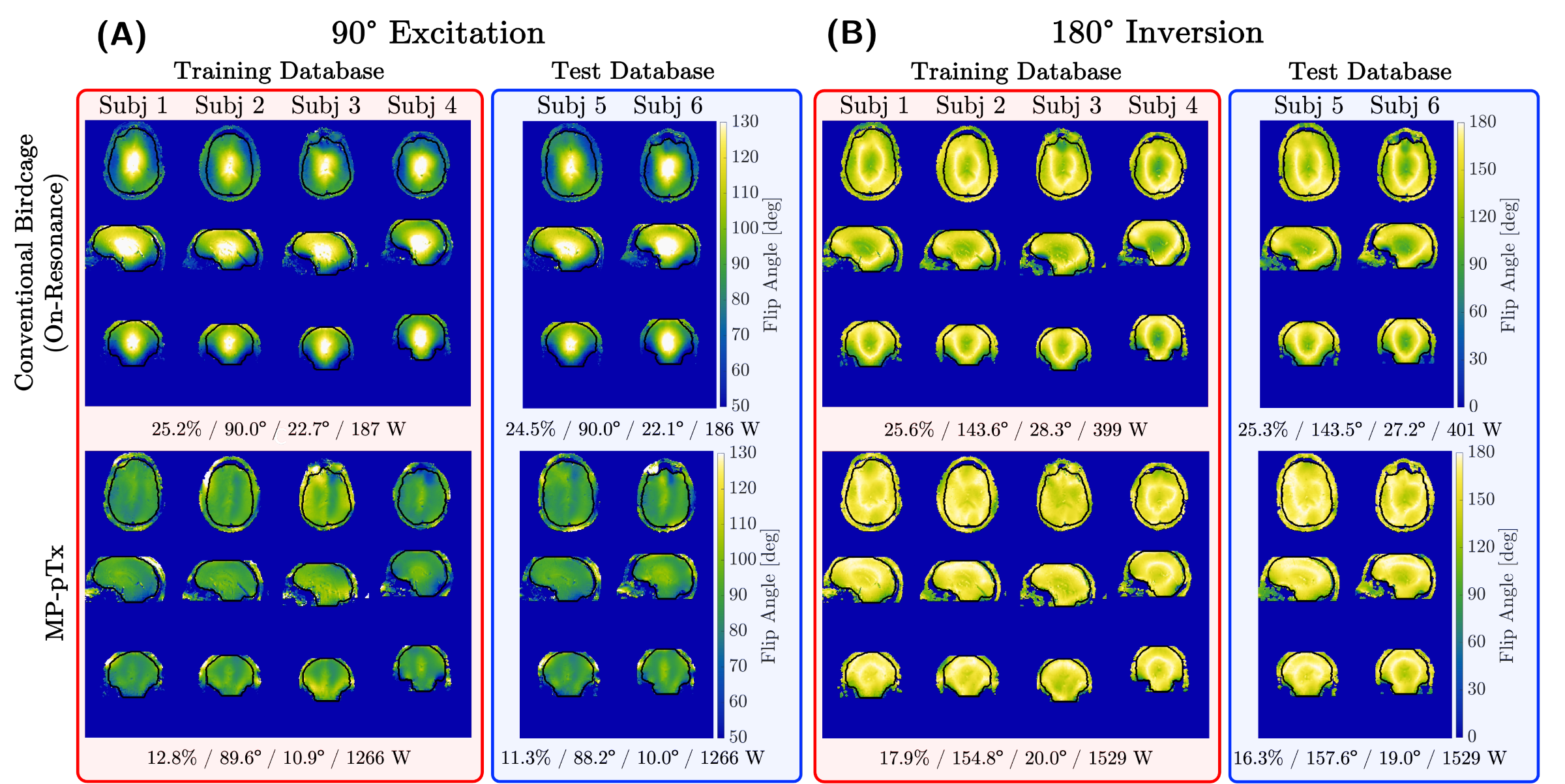
Results: Universal MP-pTx pulses have 11.3%, and 16.3% flip angle NRMSE for 90º and 180º pulses played on test subjects not used for training, compared to 24.5% and 25.3% with conventional birdcage.
Impact: Universal MP-pTx pulses will allow users to mitigate flip angle inhomogeneity present in the brain at 7 T using precomputed pulses without SAR concerns beyond that of a conventional birdcage transmit coil or subject-specific calculations.
Introduction
Multiphoton parallel transmission (MP-pTx)1 employs the multiphoton excitation phenomenon to mitigate flip angle inhomogeneities during non-selective, high-field imaging. Multiphoton excitations use off-resonant RF from a birdcage coil complemented by an oscillating $$$B_z$$$ field from a shim array and/or gradient channels at a frequency (~kHz) that satisfies the resonance condition for transition between spin states.2–6 Compared to conventional pTx, the low-frequency MP-pTx parallel channels reduce cost ($100s per channel vs. $100k per channel) and simplify SAR management, because the parallel shim array channels operating at kHz frequencies create negligible SAR. Thus, the SAR concern is reduced to that of a volumetric coil, avoiding the need for local SAR estimation. We previously have shown that optimizing the amplitude and phase of the shim array waveforms in MP-pTx allows uniform excitations with flip angle homogeneity similar to pTx.1,7However, our previous MP-pTx demonstration exclusively evaluated the small-tip regime and optimized over an individual subject’s $$$B_1^+$$$ and $$$\Delta B_0$$$ map (tailored excitation, similar to conventional pTx). Here, we extend the MP-pTx pulse optimizations to arbitrary flip angles using repeated application of spinor matrices in a Bloch simulation forward model8 and pursue a universal pulse design9 strategy, which optimizes pulses over a subject population of $$$B_1^+$$$ and $$$\Delta B_0$$$ maps generating robust “universal” pulses that preclude the need for obtaining subject-specific $$$B_1^+$$$ and $$$\Delta B_0$$$ maps.
Methods
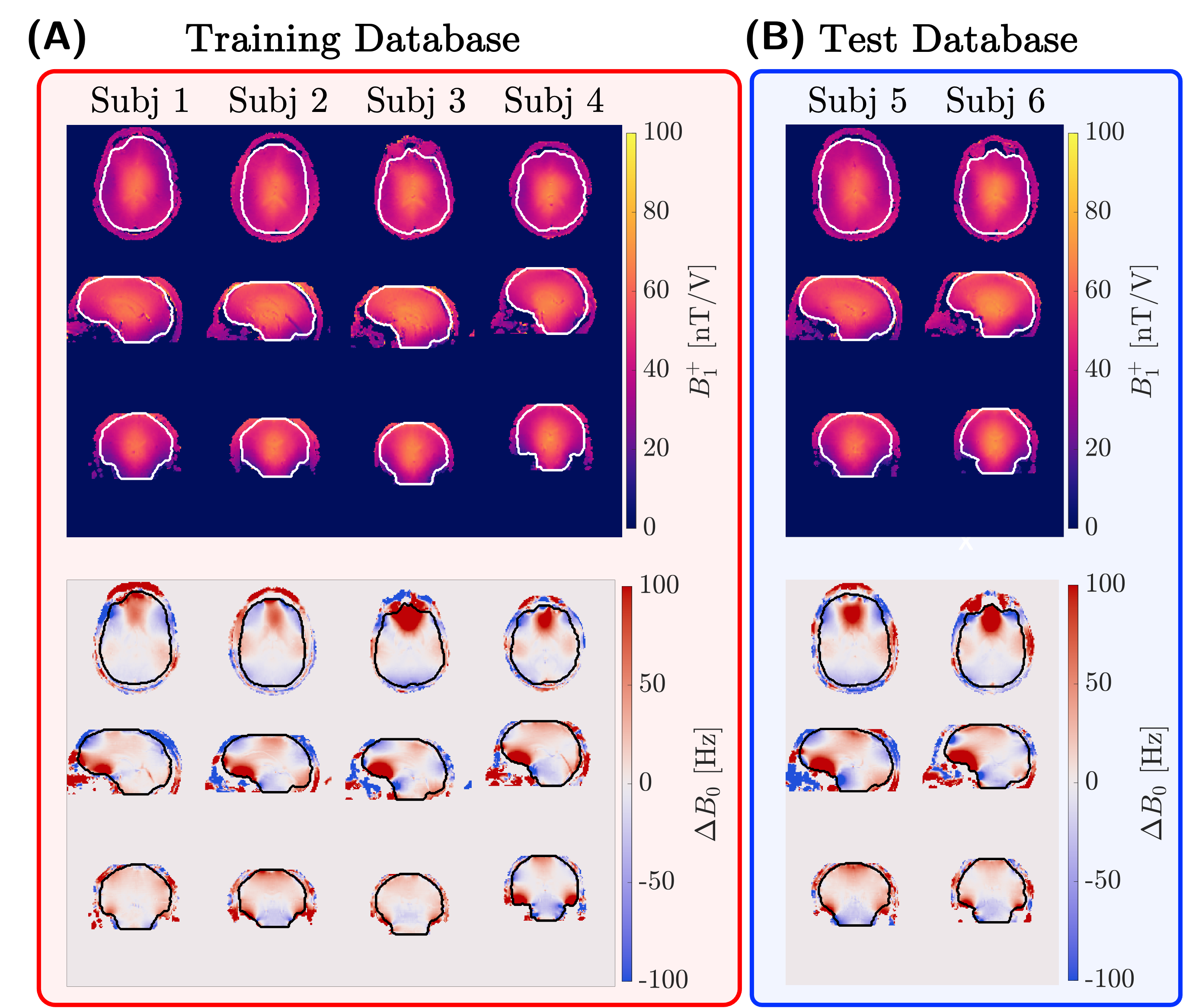
Universal Pulse Database:Six healthy subjects (5 males, 1 female, 25-56 years old, height: 1.58-1.83 m, weight: 54.4-99.8 kg) were scanned on a 7 Tesla MAGNETOM Terra scanner (Siemens Healthcare, Erlangen, Germany) using a 1-Tx, 32-Rx coil (Nova Medical, Wilmington, MA, USA). $$$B_1^+$$$ maps were acquired using a pre-saturation-based turbo-FLASH10 sequence, and $$$\Delta B_0$$$ maps were formed from a double-echo GRE unwrapped using PRELUDE11 (Figure 1). Four subjects were randomly assigned to the “training” dataset, and the remaining two were the “test” subjects.
Optimization Formulation:
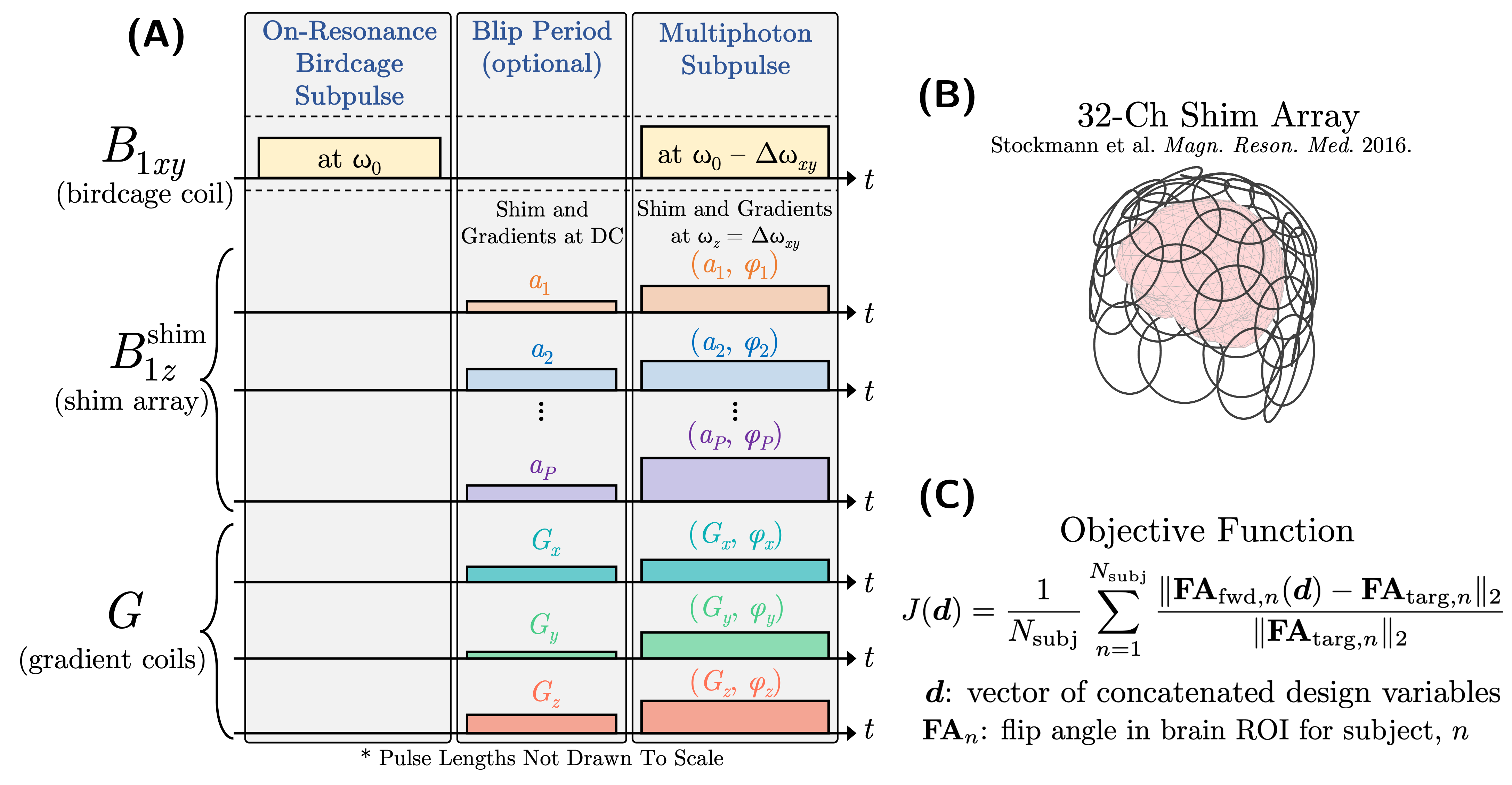
To design one optimized universal pulse, we attempt to minimize the flip angle normalized root-mean-square error (FA-NRMSE) between the forward model prediction and the desired target excitation averaged across members of the training dataset (objective function shown in Figure 2). The flip angle calculation ignores the transverse magnetization phase, effectively becoming a magnitude least-squares optimization.12 For the forward model, we employ Cayley-Klein-parameterized orthogonal matrices describing spinor dynamics for Bloch simulation8,13. The flip angle was obtained from the arccosine of the resultant z-axis magnetization. The parameterized MP-pTx pulse consists of an on-resonant subpulse, a blip period, and a multiphoton subpulse (Figure 2). Optimization variables include the complex-valued voltages and currents for the birdcage coil, gradient channels, and shim array during the three subpulses. To promote realizable pulses, peak RF, shim current amplitude, shim slew-rate, gradient amplitude, and gradient slew-rate were constrained. The optimizations are performed on a 5-mm isotropic grid using the Biot-Savart-simulated field maps of the multichannel shim array14, and the results shown are simulated on a 2-mm isotropic grid.
Pulse Optimization:
The optimization is nonconvex because Bloch simulation is nonconvex in the design parameters. To solve the design problem, we used a modified version of MATLAB’s genetic algorithm (10 generations, population of 1000) followed by 200 iterations of gradient descent (SQP algorithm) using finite differences for Jacobian/Hessian evaluation. Pulses for target flip angles of 90º and 180º inversion were optimized with respective total pulse lengths of 1 ms and 1.25 ms. All multiphoton subpulses used frequencies of $$$\Delta\omega_{xy}=\omega_z=2\pi(5\,\,\text{kHz})$$$ to obtain two-photon resonance.
Results
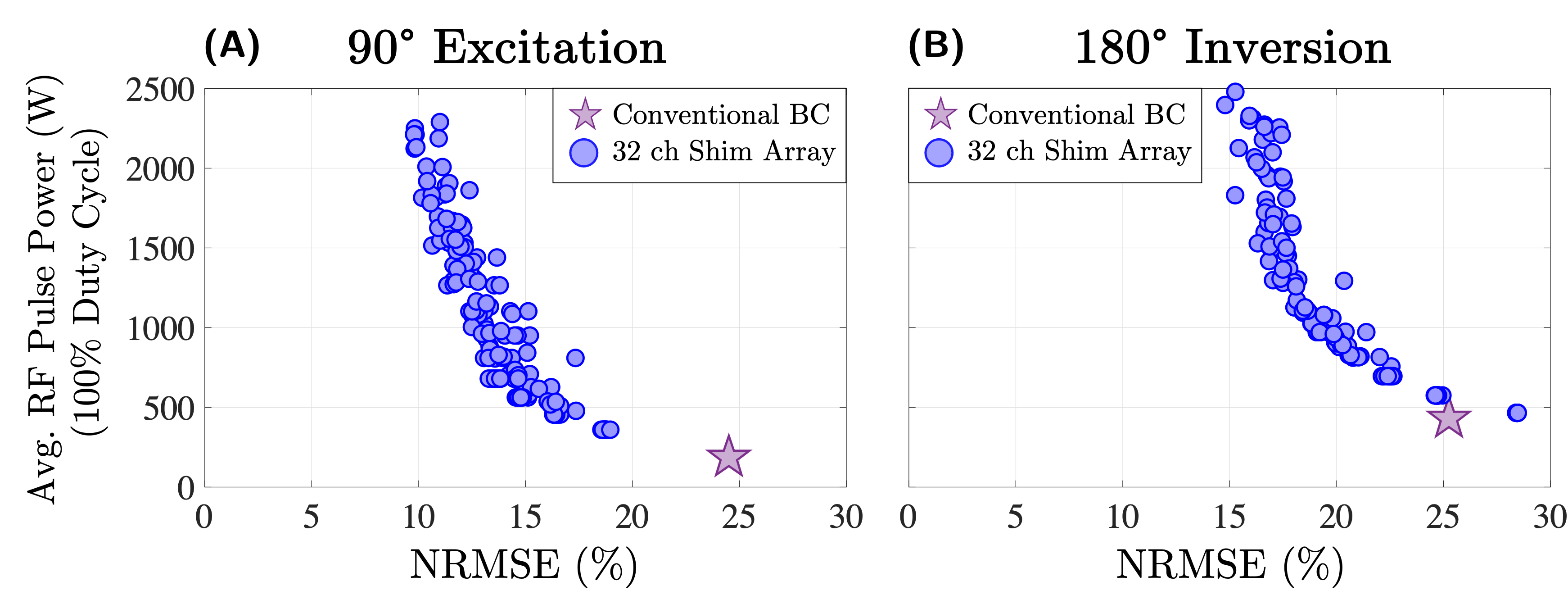
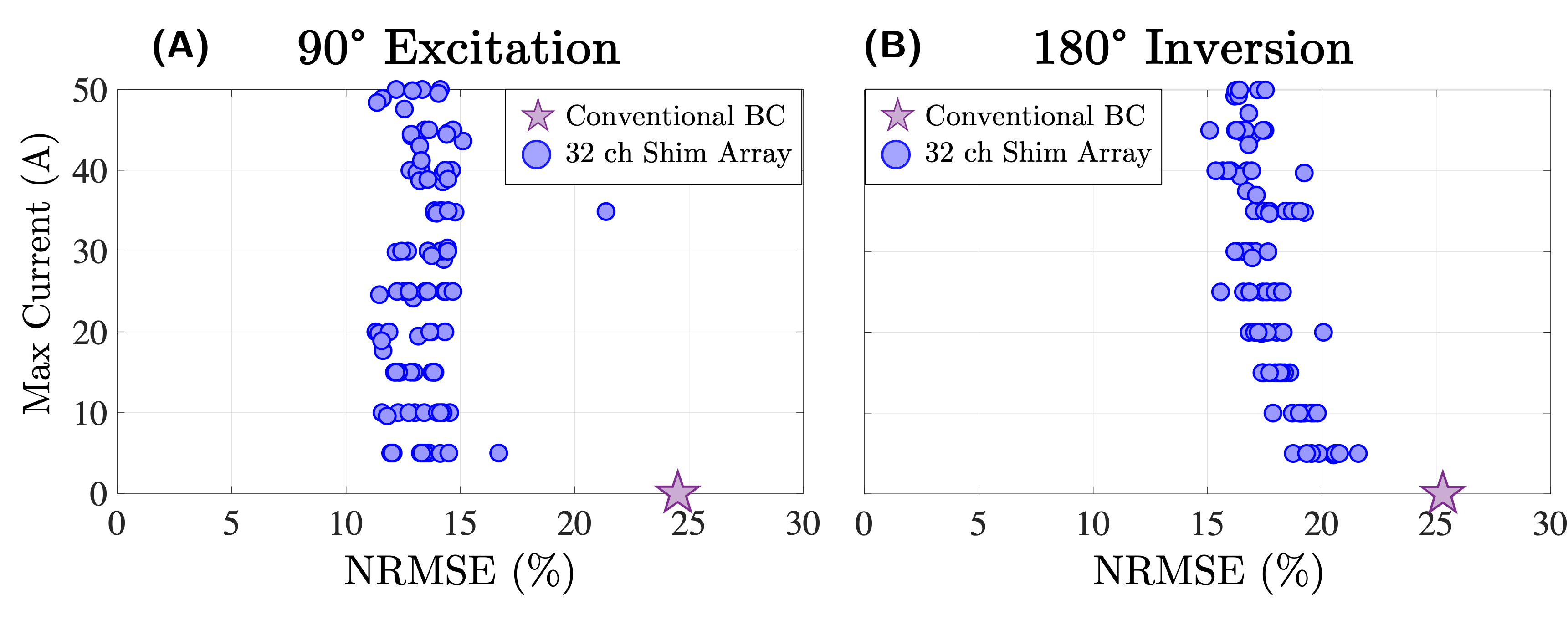
Figure 3 shows the performance of example universal pulses with different flip angle targets. Using universal MP-pTx pulses, we achieved FA-NRMSEs of 11.3% and 16.3% (corresponding to a ~54% and ~37% improvement over birdcage hard pulses) for 90º and 180º inversion excitation targets, respectively. In comparison, tailored pulses (not shown) had mean FA-NRMSE of 9.3% and 13.1% for 90º and 180º inversion excitation targets, respectively. Figure 4 shows a characteristic L-curve of MP-pTx pulse performance over the test dataset for different pulse powers. Figure 5 shows a characteristic L-curve of MP-pTx pulse performance over the test dataset for different maximum shim current constraints.Discussion
We demonstrate the ability of universal MP-pTx pulses to be optimized for arbitrary flip angles. The nonconvex nature of the problem makes optimization difficult and lengthy, but the universal pulse design is performed once and offline. Future work will include extending MP-pTx to slice-selective pulses.Acknowledgements
The authors thank Robert Barry, PhD for help obtaining the subject database. This work was supported by NIH grants P41EB030006, F30MH129062, and T32GM144273.References
1 J. M. Drago, B. Guerin, S. F. Cauley, and L. L. Wald, “Multiphoton Parallel Transmission (MP-pTx),” in Proceedings of the Annual Meeting of ISMRM, #4416, 2023.
2 A. Abragam, The Principles of Nuclear Magnetism. Oxford University Press, 1961.
3 D. G. Gold and E. L. Hahn, “Two-photon transient phenomena,” Phys. Rev. A, vol. 16, no. 1, pp. 324–326, 1977.
4 C. A. Michal, “Nuclear magnetic resonance noise spectroscopy using two-photon excitation,” J. Chem. Phys., vol. 118, no. 8, pp. 3451–3454, 2003.
5 P. T. Eles and C. A. Michal, “Two-photon excitation in nuclear magnetic and quadrupole resonance,” Prog. Nucl. Magn. Reson. Spectrosc., vol. 56, no. 3, pp. 232–246, 2010.
6 V. Han and C. Liu, “Multiphoton magnetic resonance in imaging: A classical description and implementation,” Magn. Reson. Med., vol. 84, no. 3, pp. 1184–1197, 2020.
7 M. A. Cloos et al., “KT-points: Short three-dimensional tailored RF pulses for flip-angle homogenization over an extended volume,” Magn. Reson. Med., vol. 67, no. 1, pp. 72–80, 2012.
8 J. Pauly, D. Nishimura, A. Macovski, and P. Le Roux, “Parameter Relations for the Shinnar-Le Roux Selective Excitation Pulse Design Algorithm,” IEEE Trans. Med. Imaging, vol. 10, no. 1, pp. 53–65, 1991.
9 V. Gras, A. Vignaud, A. Amadon, D. Le Bihan, and N. Boulant, “Universal pulses: A new concept for calibration-free parallel transmission,” Magn. Reson. Med., vol. 77, no. 2, pp. 635–643, 2017.
10 S. Chung, D. Kim, E. Breton, and L. Axel, “Rapid B1+ mapping using a preconditioning RF pulse with turboFLASH readout,” Magn. Reson. Med., vol. 64, no. 2, pp. 439–446, 2010.
11 M. Jenkinson, “Fast, automated, N-dimensional phase-unwrapping algorithm,” Magn. Reson. Med., vol. 49, no. 1, pp. 193–197, 2003.
12 K. Setsompop, L. L. Wald, V. Alagappan, B. A. Gagoski, and E. Adalsteinsson, “Magnitude least squares optimization for parallel radio frequency excitation design demonstrated at 7 tesla with eight channels,” Magn. Reson. Med., vol. 59, no. 4, pp. 908–915, 2008.
13 E.T.Jaynes, “Matrix Treatment of Nuclear Induction,” Phys. Rev., vol. 98, no. 4, 1955.
14 J. P. Stockmann et al., “A 32-channel combined RF and B0 shim array for 3T brain imaging,” Magn. Reson. Med., vol. 75, no. 1, pp. 441–451, 2016.
Figures