0508
Few-shot Learning Approach for Differentiation of Atypical Parkinsonian Syndromes Using Susceptibility Weighted Imaging1Department of Information Convergence Engineering, Pusan National University, Busan, Korea, Republic of, 2Department of Neurology, Pusan National University Yangsan Hospital, Yangsan, Korea, Republic of, 3School of Computer Science and Engineering, Pusan National University, Busan, Korea, Republic of
Synopsis
Keywords: Parkinson's Disease, Machine Learning/Artificial Intelligence, Few-shot learning
Motivation: Recent research indicates that various atypical Parkinsonian syndromes (APSs) exhibit distinct and subtle patterns of iron accumulation in the globus pallidus and putamen, typically detected through susceptibility-weighted imaging (SWI).
Goal(s): We propose a novel automated framework for distinguishing between APSs, specifically MSA-P and PSP, in SWI allowing the model to learn from a small amount of labeled data.
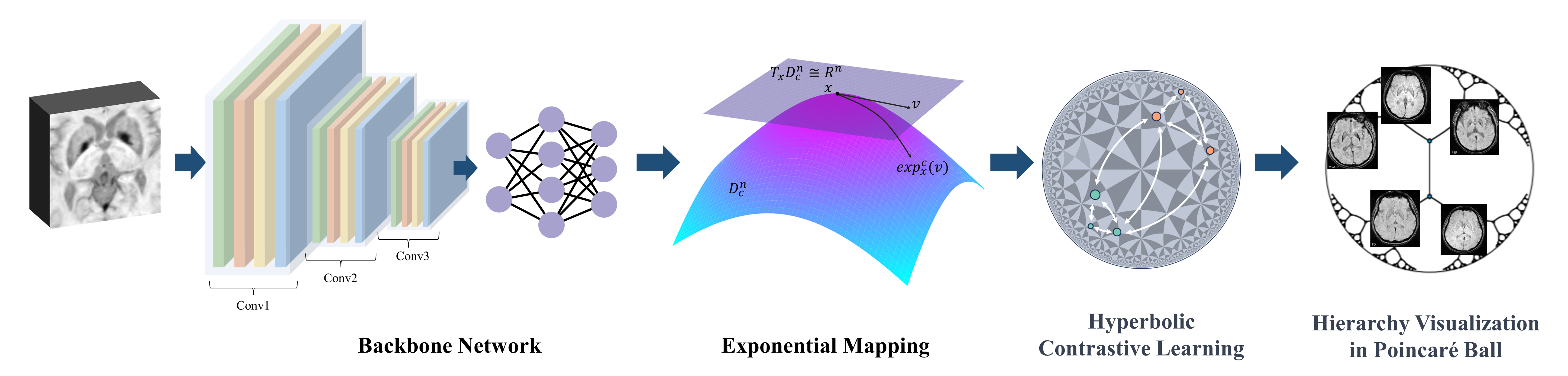
Approach: We combined T1-weighted and SWI to create a Hybrid Contrast Image, facilitating precise registration. Furthermore, we used Hyperbolic Few-shot contrastive learning for similarity-based.
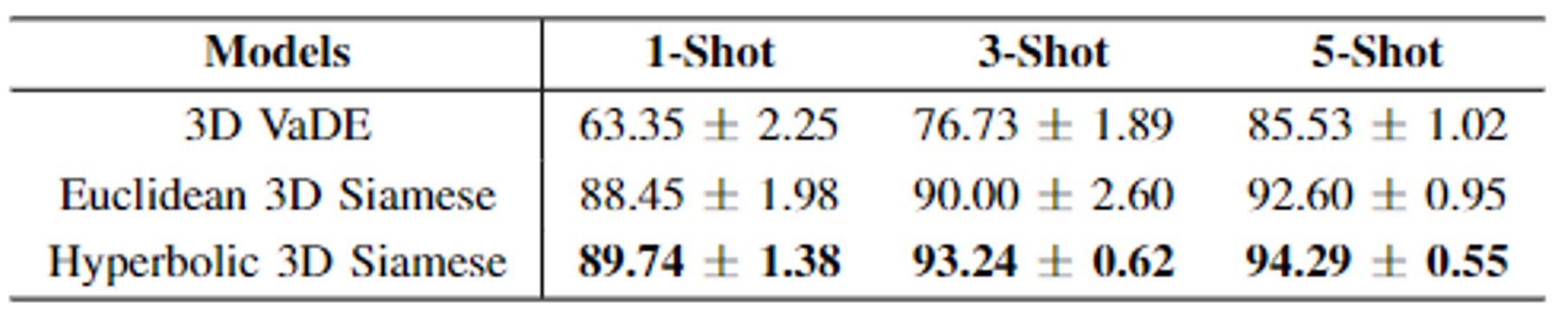
Results: The model achieved a balanced accuracy of approximately 94.29%, demonstrating its superior robustness compared to other models and distance metrics.
Impact: Our proposed approach demonstrated the potential to classify specific APS with high performance using a small amount of labeled data. Furthermore, it can be extended to apply not only to binary-classification of specific APS but also to the entire APS.
Introduction
Most reported deep learning-based supervised learning methods require a large number of labeled training data. Unfortunately, medical data is not only more difficult to collect than natural images due to the and limited collection with dedicated equipment, but also more time and costly because labeling the collected data must be done only by a specialist. Atypical Parkinsonian Syndromes (APSs) is different from the cause of the disease to the treatment method, the development of a method to distinguish it is clinical significance. Each Parkinson’s disease syndrome has a unique topographic pattern of iron distribution in the deep brain nuclei [1]. Susceptibility weighted imaging (SWI) is widely used to detect these specific patterns of localized iron concentration in the deep brain nuclei regions [2]. APSs is not easy to apply to deep learning-based classification models due to the small amount and the imbalance categories problems. So, we propose a novel few-shot learning framework to classify subtypes through three-dimensional iron accumulation patterns in a small number of APS data using SWI.Materials
We obtained T1-weighted (T1w) and SWI MRI scans of 53 normal control (NC), 27 cerebellar variant of multiple system atrophy (MSA-C), 52 parkinsonian variant of multiple system atrophy (MSA-P), and 41 progressive supranuclear palsy (PSP) patients from Pusan National University Yangsan Hospital.Methods
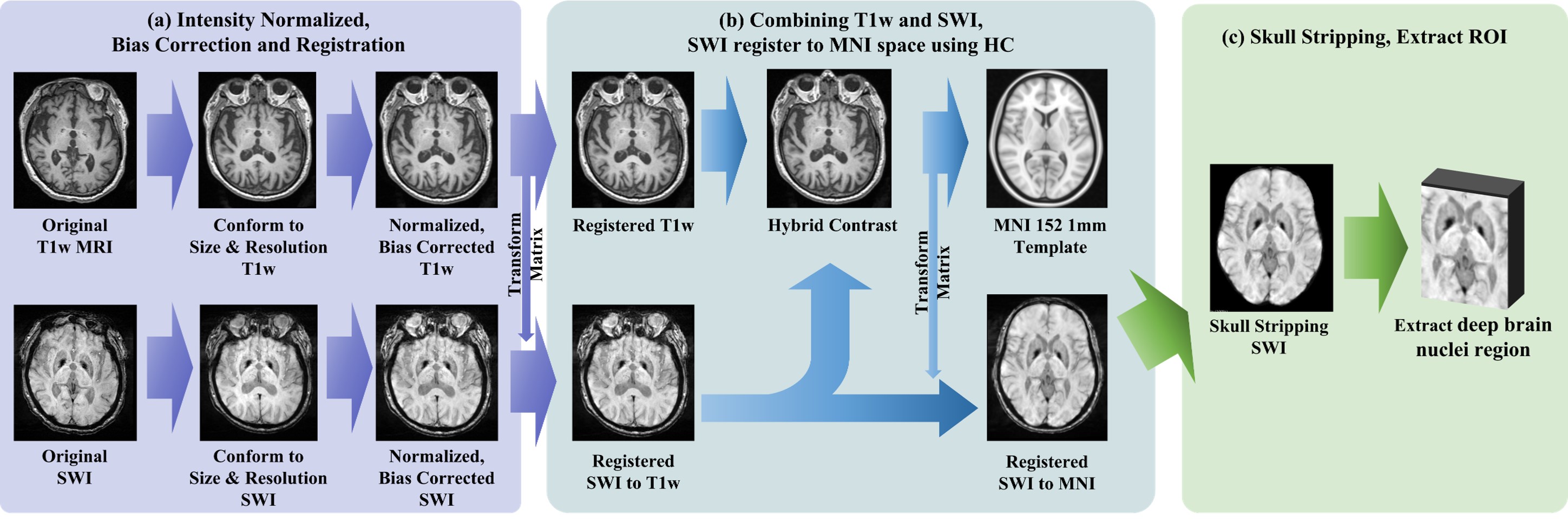
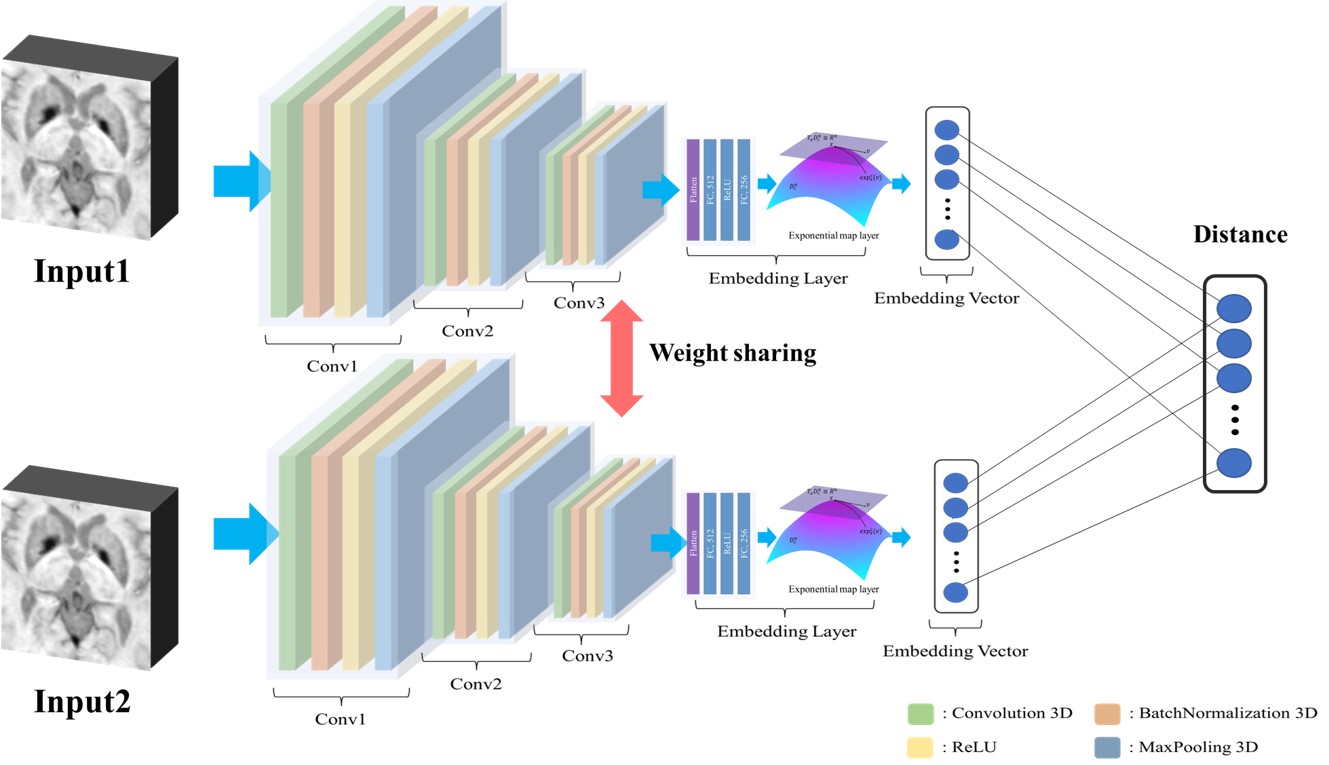
In the data we have, it is difficult to extract the deep brain nuclei region where iron is distributed because the actual brain size and direction are different for each patient. So, we performed preprocessing in the following order to improve deep brain nuclei region extraction [3]. Applying N4ITK bias-field correction and intensity normalization to all data. Register SWI to T1w and generate Hybrid Contrast (HC) image through linear combination of T1w and SWI to register SWI to MNI space. Then, patches of the deep brain nuclei are extracted. The entire process can be visualized in Figure 2.We constructed the model to measure the similarity between data using the difference in the distance between embedding vectors generated by embedding input data $$$(x)$$$ into the same latent space $$$(z)$$$ through a 3D Siamese network model [4]. And we added a layer that maps to the hyperbolic space [5] at the end of our model (see Figure 3). The model undergoes meta-training using data composed of MSA-C, PD, and NC through contrastive learning [6]. Subsequently, meta-testing is conducted using the MSA-P and PSP data with the prototypical network method, employing one of the hyperbolic models, the Poincaré ball model. The Poincaré ball model ($$$\mathbb{D}^n, g^\mathbb{D}$$$) is defined by the manifold $$$\mathbb{D}^n = \{ x \in \mathbb{R}^n : ||x|| < 1\}$$$ endowed with the Riemannian metric $$$g^\mathbb{D}(x) = \lambda_x^2g^E$$$, where $$$\lambda_x = \frac{2}{1-||x||^2}$$$ represents the conformal factor responsible for adjusting local distances, while $$$g^E = I_n$$$ signifies the Euclidean metric tensor.Results
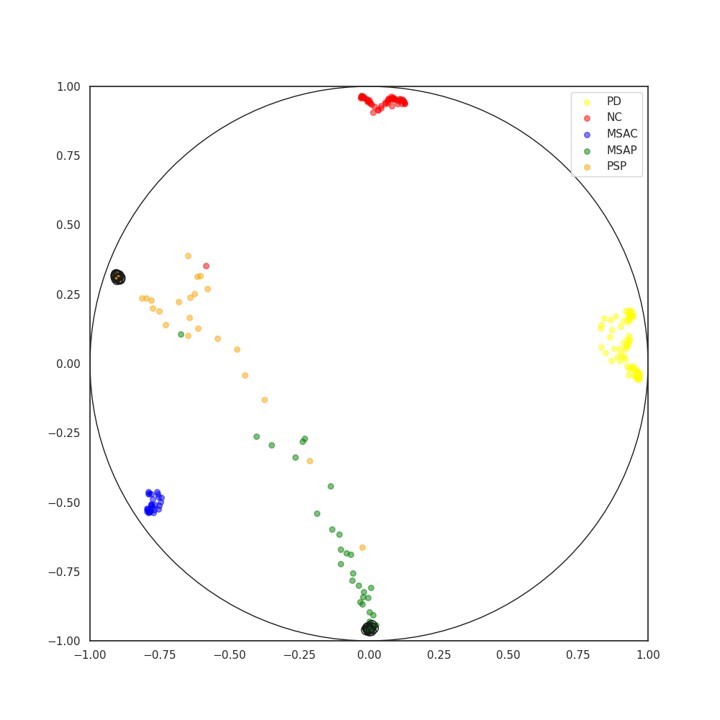
To compare the performance of our proposed model, we assessed the performance of a variational-based embedding model and an Euclidean-based model. And, We constructed prototypes using k support sets (k=1,3,5) and measured the performance of the model. Figure 4 presents the balanced accuracy measurements for the proposed models in MAS-P and PSP classification. It can be observed that, as the value of k increases, the performance improves across all models. In the case of the Siamese model, utilizing hyperbolic distance results in higher performance compared to Euclidean distance, and its performance in the hyperbolic space appears to be more stable than in other models.To visually inspect the embeddings, we employed the hyperbolic UMAP [7] algorithm to project the high-dimensional embeddings obtained from our proposed few-shot models. We can see that the classes trained on the meta-training set effectively separate and cluster near the circumference of the circle. Among the points in the meta-testing set, those with bold borders represent the support set. It is evident that these points serve as a reference for hierarchical clustering, effectively separating instances of the same class (see Figure 5).Conclusion
In this study, we developed a few-shot learning-based classification method to distinguish between MSA-P and PSP using various embedding techniques and distance metrics. The proposed approach demonstrated significantly superior classification performance compared with conventional methods, and visualizations confirmed the effective embeddings of different classes. Furthermore, the use of a hyperbolic space for embedding yielded more stable results than Euclidean space embeddings. This method currently focuses on classifying MSA-P and PSP. The high classification accuracy achieved by our hyperbolic-based few-shot model could potentially enhance the reliability of clinical differentiation for APSs.Acknowledgements
This work was supported by IITP grant (No. IITP-2023-RS-2023-00254177), and by NRF grant (No. NRF-2020R1C1C1008362) funded by the Korea government(MSIT).References
[1] HAN, Yong-Hee, and et al. Topographical differences of brain iron deposition between progressive supranuclear palsy and parkinsonian variant multiple system atrophy. Journal of the neurological sciences, 325.1-2:29–35, 2013.[2] Jae-Hyeok Lee and Seung-Kug Baik. Putaminal hypointensity in the parkinsonian variant of multiple system atrophy: simple visual assessment using susceptibility weighted imaging. Movement disorders, 4.2:60, 2011.[3] Feng, Xiang, and etal. Animprovedfsl-first pipelinefor subcorticalgray mattersegmentation to study abnormal brain anatomy using quantitative susceptibility mapping (qsm). Magnetic resonance imaging, 39:110–122, 2017.[4] Koch, Gregory, Richard Zemel, and Ruslan Salakhutdinov. Siamese neural networks for oneshot image recognition. ICML deep learning workshop, 2, 2015.[5] Khrulkov, Valentin, et al. "Hyperbolic image embeddings." Proceedings of the IEEE/CVF Conference on Computer Vision and Pattern Recognition. 2020.[6] Ermolov, Aleksandr, et al. Hyperbolic vision transformers: Combining improvements in metric learning. Proceedings of the IEEE/CVF Conference on Computer Vision and Pattern Recognition. 2022.[7] McInnes, L., J. Healy, and J. Melville. Uniform manifold approximationand projection for dimension reduction. Preprint at arXiv,(UMAP, 2020).Figures