0506
Classifiers for ADHD Based on Gray-White Matter Structural Connectivity Couplings and Corresponding Transcriptional Signatures1West China Hospital of Sichuan University, Chengdu, China
Synopsis
Keywords: White Matter, Brain Connectivity, Transcriptome
Motivation: The research aims to uncover intricate gray-white matter structural connectivity (GWSC) patterns and associated gene expression profiles in ADHD.
Goal(s): Develop machine-learning classifiers based on GWSC to distinguish ADHD from controls, bridging its gap with gene expression to unveil neurobiological mechanisms.
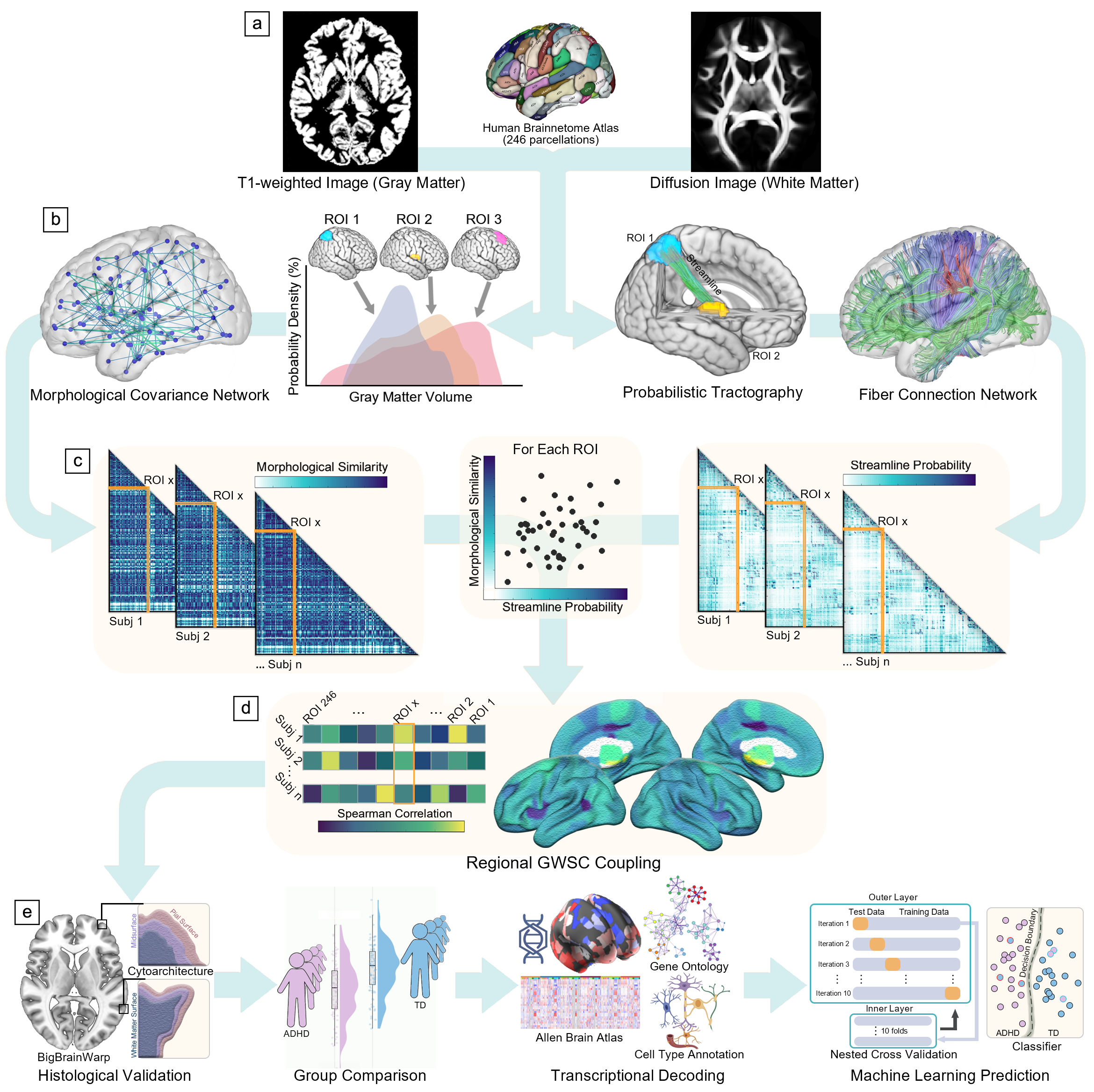
Approach: Utilize T1-weighted and diffusion-weighted MRI data to construct GWSC networks. Employed four machine-learning classifiers for classification. Analyzed transcriptomes from the Allen Human Brain Atlas to link with gene expression.
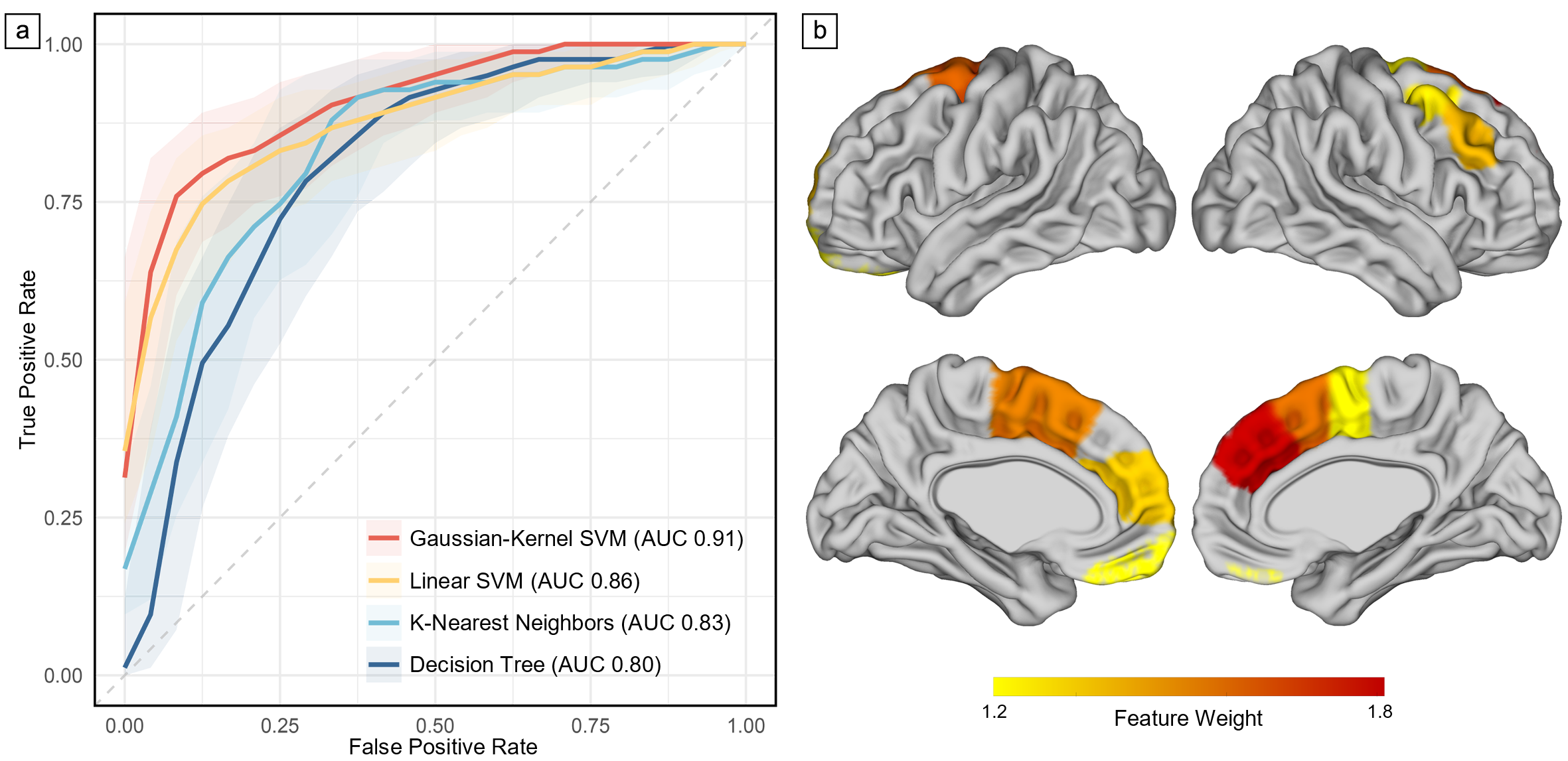
Results: Classifiers achieved over 75% accuracy, with Gaussian-kernel SVM leading at 82.6%. Ventromedial prefrontal cortex emerged as a key contributor. Transcriptome analysis identified enrichment in "neuron projection development."
Impact: These findings empower clinicians with accurate ADHD classifiers and pinpoint the ventromedial prefrontal cortex as a hub. The revelation of gene expression nuances in neuron projection development advances targeted interventions, fostering a shift towards more personalized and effective ADHD treatments.
Introduction
Attention-Deficit/Hyperactivity Disorder (ADHD) stands as a complex neurodevelopmental disorder, drawing considerable focus in the realm of neuroimaging psychiatry. While aberrations in the neural mechanisms of both brain gray matter and white matter have been extensively pinpointed, the intricate patterns of their structural connectivity coupling and the concurrent gene expression profiles continue to elude comprehensive understanding. Herein, we established machine-learning classifiers based on Gray-White Matter Structural Connectivity Coupling (GWSC) patterns, with a parallel exploration to unravel the underlying transcriptomes.Material and Methods
T1-weighted and diffusion-weighted MRI data were obtained from a cohort of children with ADHD (n = 83) and typically developing children (n = 89). Gray matter covariance networks and white matter connectivity networks were constructed using the Kullback-Leibler divergence similarity measure and probabilistic tractography respectively. We computed the strength of their regional coupling as we termed GWSC coupling. To individually classify ADHD children from typically developing controls, we established the machine-learning pipeline in pursuit of clinical applicability. Four configure learning algorithms, namely linear support vector machine (SVM), Gaussian-kernel SVM, k-nearest neighbors, and decision tree were employed to build up fitting models. Finally, we extracted gene expression data from the Allen Human Brain Atlas and performed partial least squares regression analysis to bridge the gap between abnormal GWSC coupling patterns and microarray-based transcriptomes, and gene enrichment analysis was conducted to interpret the inference of enriched gene ontology biological processes.Results
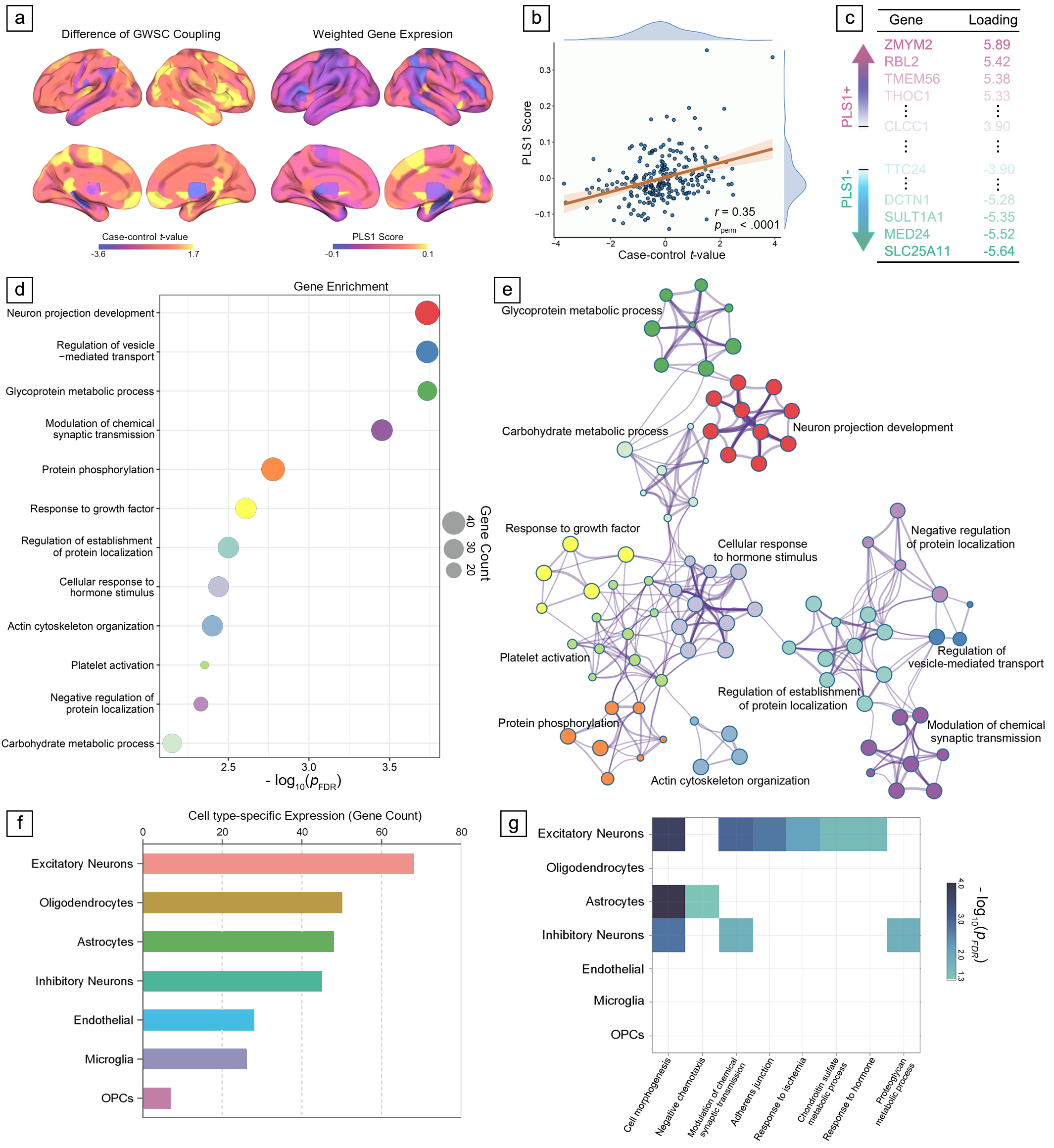
All four classifiers we employed distinguished children with ADHD with more than 75% accuracy, wherein the Gaussian-kernel SVM enables the highest accuracy of 82.6% (95%CI: 78.4%-86.8%). Sensitivity and specificity for the discrimination were 79.5% and 85.4% respectively. In this model, the GWSC couplings in the ventromedial prefrontal cortex provided the greatest contribution to the classifier. After correcting for enrichment terms (pFDR<.05) and discarding discrete enrichment clusters, the top significant gene ontology biological process is “neuron projection development”.Conclusions
By constructing GWSC coupling patterns in ADHD, we developed machine-learning classifiers with acceptable predictive performance, with the ventromedial prefrontal cortex severed as a central substrate. Our transcriptional findings reveal the involvement of neuron projection in the psychopathological processes of GWSC patterns in ADHD. We uncovered GWSC coupling phenotypes in ADHD and identified their transcriptional signatures, facilitating a more comprehensive understanding of ADHD.Acknowledgements
This work was supported by the National Natural Science Foundation of China (QG, grants 81621003 and 82027808).References
1. Gong G, (2012). Convergence and divergence of thickness correlations with diffusion connections across the human cerebral cortex. NeuroImage. 59,2:1239-48. 2. Gu Z, (2021). Heritability and interindividual variability of regional structure-function coupling. Nat Commun. 12:1–12. 3. Baum GL, (2020). Development of structure–function coupling in human brain networks during youth. Proc Natl Acad Sci USA. 117:771–778. 4. Koutsouleris N, (2018). Prediction Models of Functional Outcomes for Individuals in the Clinical High-Risk State for Psychosis or with Recent-Onset Depression: A Multimodal, Multisite Machine Learning Analysis. JAMA Psychiatry. 75:1156–1172. 5. Li J, (2021). Cortical structural differences in major depressive disorder correlate with cell type-specific transcriptional signatures. Nat Commun. 12Figures