0490
Denoising of 3D Fast Spin Echo Magnetic Resonance Imaging Using Multi-channel Three-dimensional Convolutional Neural Network1Department of Radiology, Ruijin Hospital Affiliated to Shanghai Jiao Tong University School of Medicine, Shanghai, China, 2College of Health Science and Technology, Shanghai Jiao Tong University School of Medicine, Shanghai, China, 3Department of Imaging and Interventional Radiology, the Chinese University of Hong Kong, Hong Kong SAR, China, 4CUHK Lab of AI in Radiology (CLAIR), Hong Kong SAR, China
Synopsis
Keywords: Skeletal, MSK
Motivation: Three-dimensional (3D) Fast Spin Echo (FSE) magnetic resonance imaging (MRI) can be acquired with high spatial resolution but at a cost of reduced signal-to-noise ratio (SNR). Deep-learning methods are promising for denoising in MRI.
Goal(s): The existing 3D denoising convolutional neural networks (CNNs) can be further improved with the sturcture to extract high dimensional features.
Approach: We developed a deep-learning approach based on multi-channel 3D CNN to utilize inherent noise information embedded in multiple number-of-excitation (NEX) acquisition.
Results: The proposed method achieves improved denoising performance compared to the current state-of-the-art denoising methods in both slice-by-slice 2D and 3D metrics of PSNR and SSIM.
Impact: The proposed network can realize a denoised effect with details well preserved for clinically achievable 2-NEX MR images. This shows great potential for 3D MRI, fast imaging, and low-feild MRI that demanding for noise suppression.
Introduction
Magnetic resonance imaging (MRI) is one of the most widely used noninvasive diagnostic modalities, providing superior soft tissue contrast. Signal-to-noise ratio (SNR) is often limited in MRI acquisitions, causing challenges to many MRI applications. Thus, denoising plays a major role in furthering the utility of MRI. Denoising of MRI is often performed through two-dimensional (2D) operations. Although proven efficient, these methods do not fully exploit the through-plane correlations inherent in three-dimensional (3D) MRI. In contrast, 3D denoising methods can naturally utilize the 3D features of MR volumes, providing a more comprehensive representation and better utilization of inter-slice redundancies. Therefore, it is recommended to employ 3D denoising algorithms for denoising tasks of 3D MR images. However, the existing 3D denoising convolutional neural networks (CNNs) rely on either a multi-channel two-dimensional (2D) network or a single-channel 3D network with limited ability to extract high dimensional features. To explore CNN's potential in tasks that require the extraction of high dimensional features, we aim to develop a deep learning approach based on multi-channel 3D convolution to utilize inherent noise information embedded in multiple number-of-excitation (NEX) acquisition for denoising of 3D FSE MRI.Method
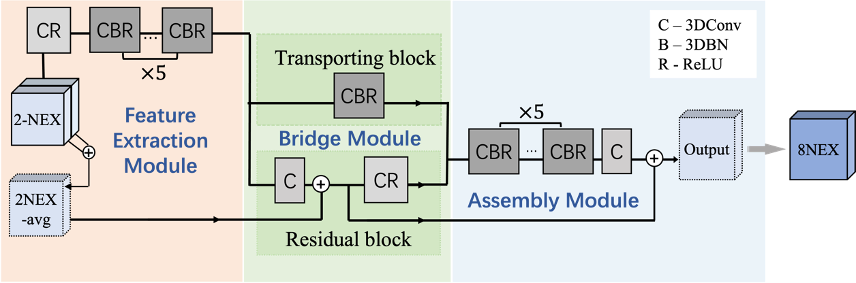
The proposed 3D CNN has 14 layers [1], consisting of 3D convolution, 3D batch normalization (BN), and ReLU. Each convolution has a filter size of 3×3×3, stride 1, and padding 1. As shown in Figure 1, the model comprises three modules: the feature extraction module, the bridge module, and the assembly module. To learn noise residuals, a two-step residual learning approach was employed over the parallel transporting and residual blocks. This structure enables the model to handle imbalanced input/output channels. In this experiment, we trained our network, denoted as 3D-Proposed-MultiCH, with an input channel of 4 to separately process the real and imaginary parts of each complex-valued NEX image. The whole network has about 1.3M trainable parameters.In this experiment, we compared the proposed approach to BM4D [2], the 3D extension of DnCNN [3] with a fourteen-layer architecture, and 3D-Parallel-RicianNet [4].We trained the networks with the Adam optimizer and the ReduceLROnPlateau monitor with an initial learning rate of 0.001, decaying by 0.2 when the loss stops decreasing for ten epochs. The model was optimized using the combination of L2 loss and 3D structural similarity index (SSIM) loss, as shown below:
$$argmin_{f}\left\|f(I_{2NEX})-I_{8NEX} \right\|_{2}^{2}*(1-3DSSIM(f(I_{2NEX}),I_{8NEX}))$$
Multi-NEX 3D-isotropic MR images were acquired using a 3D proton density-weighted VISTATM pulse sequence on a Philips Achieva TX 3.0T MRI (Philips Healthcare, Best, Netherlands) with an eight-channel receiver knee coil (Invivo, Gainesville, FL, USA). All MRI examinations were conducted under the approval of the Institutional Review Board. The MRI parameters were as follows: repetition time/echo time 900/33.6 ms; excitation flip angle 90; FOV 160x160x120 mm3; 150 slices with a 3D isotropic acquisition resolution 0.8x0.8x0.8 mm3; echo train length 42; SENSE acceleration factor 2; and spectral attenuated inversion recovery (SPAIR) for far suppression. Totally 8-NEX images were acquired for each subject with a total scan duration of 23.3min. All voxels are interpolated to the same resolution of 0.714x0.714x0.714 mm3 with 168 slices of each dataset. We used the cubic voxel of 64x64x64 with a sliding stride of 32x32x32 for input to cover more 3D information in the input images of the network. In total, 7200 patches from 50 datasets were used for training. The other 18 3D datasets were used for testing.
The peak signal-to-noise ratio (PSNR), SSIM [5], and multiscale SSIM (MS-SSIM) [6] were employed for evaluation.
Results and Discussion
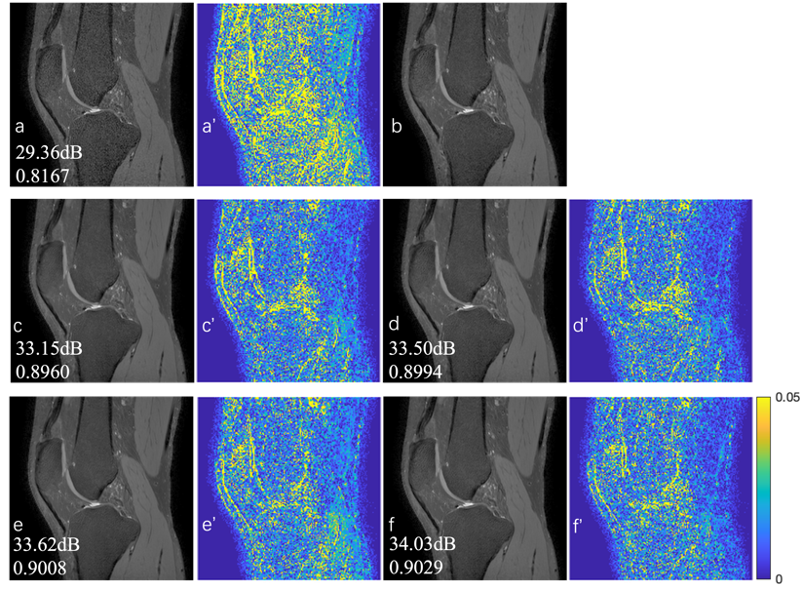
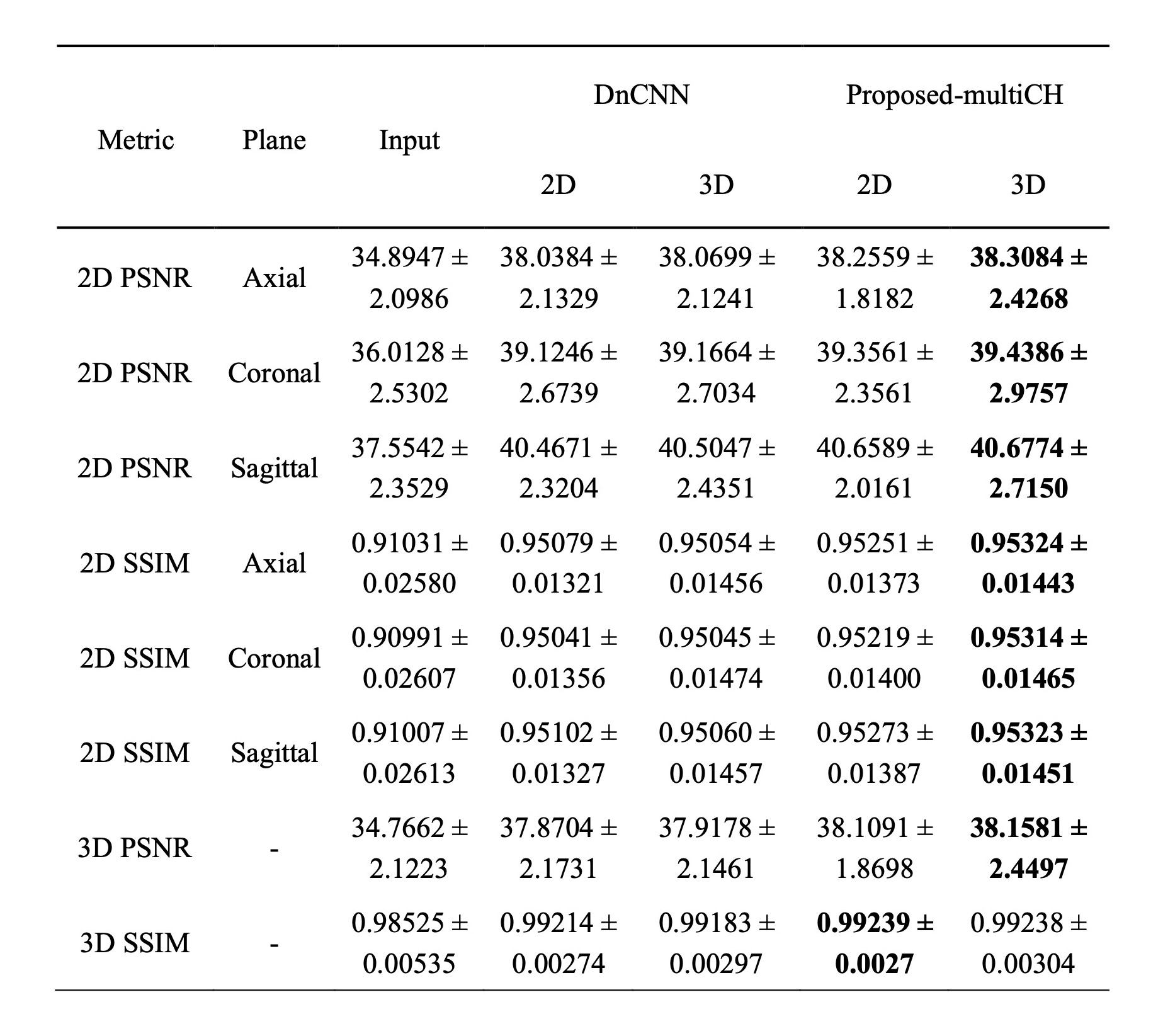
A typical slice in sagittal planes is shown in Figure 2. Figure 3 presents the models' performance using both 2D and 3D metrics. All four deep learning approaches improved the denoising effect in all metrics compared to the noisy input (p<0.05). The 3D network of both DnCNN and our proposed approach significantly outperformed their counterpart 2D network in 2D and 3D PSNR and achieved comparable results in 2D and 3D SSIM (p<0.05), indicating the benefits of utilizing 3D convolutions to leverage inter-slice correlations in deep learning network in denoising 3D MRI. Compared to 3D DnCNN, the proposed 3D network shows improved performance in all metrics measured in 2D and 3D.Conclusion
In this work, we proposed a multi-channel 3D CNN for denoising multi-NEX 3D FSE MR images and quantitatively measured its performance. Experiments on real data showed that our proposed multi-channel 3D CNN outperformed the state-of-the-art methods in denoising 3D FSE images. We demonstrated the proposed approach on knee MRI. Our work showed the potential of the proposed method and provided valuable guidance for its application in other anatomies.Acknowledgements
This study was supported by a grant from the Innovation and Technology Commission of the Hong Kong SAR (Project MRP/001/18X), and a grant from the Faculty Innovation Award, the Chinese University of Hong Kong.References
1. S. Zhao, Dόnal G. Cahill, S. Li, et al., Denoising of Three-Dimensional Fast Spin Echo Magnetic Resonance Images of Knee Joints using Spatial-Variant Noise-Relevant Residual Learning of Convolution Neural Network. Computers in Biology and Medicine (2022): 106295. http://dx.doi.org/10.1016/j.compbiomed.2022.106295
2. Phophalia, Ashish, Suman K. Mitra. 3D MR image denoising using rough set and kernel PCA method. Magnetic resonance imaging 36 (2017): 135-145, http://dx.doi.org/10.1016/j.mri.2016.10.010
3. K. Zhang, W. Zuo, Y. Chen, D. Meng, L. Zhang, Beyond a gaussian denoiser: Residual learning of deep cnn for image denoising. IEEE transactions on image processing, 26(7) (2017) 3142-3155, http://dx.doi.org/10.1109/TIP.2017.2662206
4.L. Wu, S. Hu, C. Liu, Denoising of 3D Brain MR Images with Parallel Residual Learning of Convolutional Neural Network Using Global and Local Feature Extraction. Computational Intelligence and Neuroscience, (2021), http://dx.doi.org/10.1155/2021/5577956
5. Z. Wang, A. C. Bovik, H. R. Sheikh, E. P. Simoncelli, Image quality assessment: from error visibility to structural similarity. IEEE transactions on image processing, 13(4) (2004) 600-612, http://dx.doi.org/10.1109/TIP.2003.8198612
6. Z. Wang, E. P. Simoncelli, A. C. Bovik,. Multiscale structural similarity for image quality assessment. In The Thrity-Seventh Asilomar Conference on Signals, Systems & Computers, 2 (2003) 1398-1402, IEEE, http://dx.doi.org/10.1109/ACSSC.2003.1292216
Figures