0472
A high permittivity and conformable gel pad fabricated by the PVA freeze-thaw method for dielectric shimming in ultra-high-field MRI1State Key Laboratory of Radiation Medicine and Protection, School of Radiation Medicine and Protection, Collaborative Innovation Center of Radiological Medicine of Jiangsu Higher Education Institutions, Soochow University, Suzhou 215123, China, Soochow University, suzhou, China, 2State Key Laboratory of Brain and Cognitive Science, Institute of Biophysics, Chinese Academy of Sciences, Beijing, China, 3Suzhou Medcoil Healthcare Co., Ltd., suzhou, China
Synopsis
Keywords: Shims, Shims, high-permittivity, sfaty, hydrogel pad
Motivation: Utilize new material to fabricate high-permittivity pads for addressing the B1 inhomogeneity and safety issues in ultra-high-field MRI scanning.
Goal(s): We aim to develop a new high permittivity pad with flexibility which can fit various body shapes. Different sizes and mass proportions of barium titanate powder were explored to achieve optimized mechanical properties and desired permittivity value.
Approach: The gel pad is fabricated using the PVA freeze-thaw method, resulting in a stable gel structure that incorporates barium titanate powder, thereby possessing excellent mechanical properties and high permittivity.
Results: Experimental results demonstrate of the gel pad's potential for clinical applications in ultra-high-field MRI scanning.
Impact: This abstract introduces a novel gel pad with high permittivity that can be conformed to different shapes of scanned objects. It highlights the potential of the gel pad in addressing safety issues in ultra-high-field MRI scanning.
Introduction
In ultra-high-field MRI scanning, the RF field distribution is severely degraded due to the interference effects1, which can be improved by active2 and passive shimming techniques3. Compared with the active shimming techniques, passive shimming usually applies the high-permittivity pad to alter the RF field by simply placing it around the scanned object, which is convenient and economical4. However, the currently used high-permittivity pads are usually made of barium titanate suspension which is unstable and non-uniform5, since the barium titanate powder will precipitate from the solution over time. More seriously, the barium titanate suspension is packaged in a plastic bag, so it cannot fit the different shapes of the scanned object. When the plastic bag is damaged, the leaked barium titanate suspension will be harmful to the scanned body and make the scanning bed in mess, which limits its clinical application. In this paper, a new kind of conformable gel pad with high permittivity fabricated through polyvinyl alcohol freeze-thaw method is proposed, which can fit different curves of the scanned body very well. The dielectric constant and mechanical properties of the pad can be controlled by adjusting the mass proportion between barium titanate powder and polyvinyl alcohol and utilizing different sizes of barium titanate powder6. The dielectric constant of the pad was measured by the coaxial cable method and the pad was applied for MRI scanning experiments to demonstrate its performance in enhancing the RF field.Methods
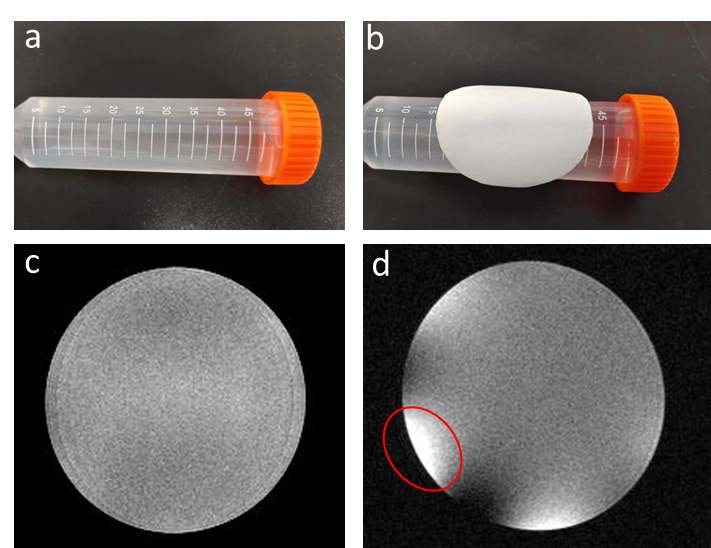
1) First, the PVA deuterium aqueous solution was prepared, and a certain amount of PVA powder and deuterium water was added to the flask, then the heating magnetic agitator was used for melting the powder. Reaction conditions were as follows: temperature:95 degrees Celsius, speed:600rpm, reaction time:30min, until the solution was cooled and poured into the petri dish, then barium titanate powder was evenly mixed into it. After that, the bubbles were dissolved and removed for 2h with ultrasonic assistance. Finally, melt the evenly mixed suspension in a -20° refrigerator. Repeat the above procedures three times to get a gel pad. 2)Measurement of EPs: The electrical properties (EPs) of the turbid liquid and gel pad were measured by the coaxial cable method. The measurements were conducted by the vector network analyzer E5063A-285 (Keysight) with the high-temperature probe (N15001A-101). 3) MRI experiments: The phantoms filled with ultrapure water were made to perform MRI scans in a 3.0T MRI system (MRS*DRYMAG 3.0T). The gel pad was placed on the surface of the phantoms and scanned for comparison. A quadrature birdcage coil was used for both transmission and receiving. Two FSE PDw images were acquired. The scanning parameters were TE/TR = 11/3000ms, the field of view (FOV) = 40×40mm, the resolution is 1.0mm isotropic.Results
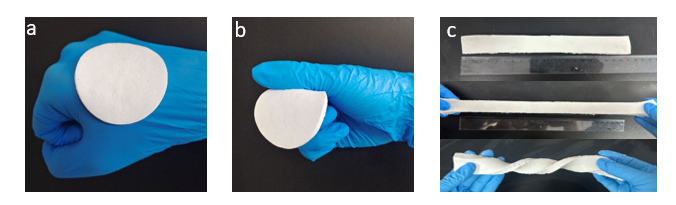
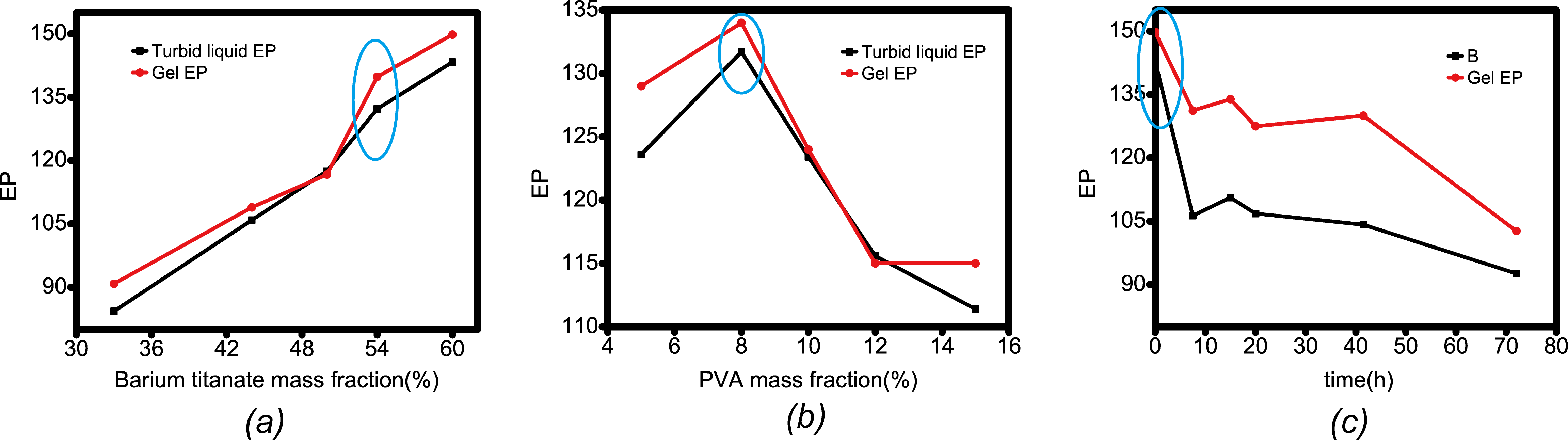
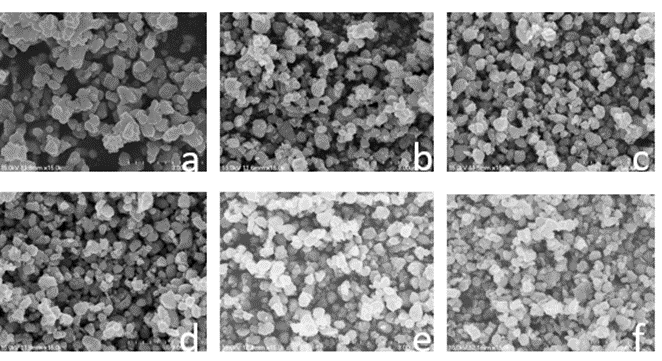
1) Flexibility performance: Figure 1 is a picture of the pad. It can fit perfectly to different body shapes. 2) Measurement of EPs: The effects of barium titanate mass proportion, PVA solution concentration and Barium titanate size on the dielectric constant and mechanical properties of the gel pad were explored respectively, and the results were shown in Figure 2. The optimized performance of the gel pad was obtained when the mass proportion of barium titanate was 55%, the concentration of PVA solution was 8% and the diameter of barium titanate powder was around 550nm. The measured relative permittivity and conductivity of the pad at 128MHz are 136 and 0.072S/m. 3) MRI experiments: The phantom was scanned with and without pad and the results are shown in Figure 4. An obvious enhancement of the RF field can be observed.Discussions and Conclusions
In conclusion, we have proposed a flexible gel pad with high permittivity fabricated through the PVA freeze-thaw method. The gel pad demonstrated high permittivity and potential for enhancing the RF field in ultra-high-field MRI scanning. Future studies should involve applying the proposed pad for in-vivo ultra-high-field experiments to explore its passive shimming abilities for human body scanning.Acknowledgements
No acknowledgement found.References
1. J.H.F. van Gemert, W.M. Brink, A.G. Webb, et al. Designing High-Permittivity Pads for Dielectric Shimming in MRI using Model Order Reduction and Gauss-Newton Optimization. 2017 International Conference on Electromagnetics in Advanced Applications (ICEAA), Verona, Italy, 2017:pp. 417-420.
2. Wyger M. Brink MJV,Johannes M. Peeters,Peter B€ornert, et al. Passive Radiofrequency Shimming in the Thighs at 3 Tesla Using High Permittivity Materials and Body Coil Receive Uniformity Correction. Magnetic Resonance in Medicine 2015;76:1951–1956.
3. Webb A, Shchelokova A, Slobozhanyuk A, et al. Novel Materials in Magnetic Resonance Imaging: High Permittivity Ceramics, Metamaterials, Metasurfaces and Artificial Dielectrics. MAGMA. 2022;35(6):875-894.
4. Hashemi S, Kandala SK, Agbo B, et al. Flexible, Stretchable, and MR-Invisible Dielectric Material for Magnetic Resonance Imaging. IEEE Journal of Electromagnetics, RF and Microwaves in Medicine and Biology. 2023:1-8.
5. Raolison Z, Dubois M, Luong M, et al. Evaluation of New MR Invisible Silicon Carbide Based Dielectric Pads for 7 T MRI. Magn Reson Imaging. 2022;90:37-43.
6. Wahab AHA, Saad APM, Harun MN, et al. Developing Functionally Graded PVA Hydrogel Using Simple Freeze-thaw Method for Artificial Glenoid Labrum. Journal of the Mechanical Behavior of Biomedical Materials. 2019;91:406-415.
Figures