0465
Eight-channel dual-tuned coaxial‐transmission‐line coils array for human head imaging at 10.5 Tesla1Department of Biomedical Engineering, State University of New York at Buffalo, Buffalo, NY, United States
Synopsis
Keywords: Parallel Transmit & Multiband, Hybrid & Novel Systems Technology, Dual-tuned, Hybrid & Novel Systems Technology, RF Array, Parallel Imaging
Motivation: The capability of coaxial-transmission-line (CTL) RF coils to exhibit multimode operating frequencies make them versatile for applications involving dual-nuclear coil resonators for Magnetic Resonance Imaging and Magnetic Resonance Spectroscopy studies.
Goal(s): Design eight-channel dual-tuned CTL coils array for human head imaging at 10.5 Tesla and address the electromagnetic coupling issue between elements of the array.
Approach: The high impedance feature of the high-frequency mode helps to achieve sufficient decoupling for 1H channels while the magnetic wall technique is used to decouple the low-frequency mode tuned to heteronuclear frequency.
Results: A well-decoupled array of dual-tuned CTL coils is feasible for head imaging at 10.5T.
Impact: The feasibility of advanced multichannel dual-tuned RF coil array can contribute to more informative imaging and spectroscopy, which is valuable in various medical and research applications.
Introduction
There is ongoing active research and development of Coaxial-Transmission-Line (CTL) RF coils for MRI applications due to their flexibility allowing them to adapt to different anatomical regions and body shapes 1-4. CTL RF coils exhibit multimode operating frequencies capable of acquiring image and spectroscopy at two distinct nuclear frequencies. However, the primary and secondary resonant frequencies of the conventional CTL RF coils 1-2 cannot be independently tuned to the target frequencies. This lack of independent tuning can limit the capability of the coil in accommodating specific imaging or spectroscopy needs. To address this issue, alternative design methods 5-6 involving modifications to the CTL RF coil geometry and the integration of tuning components have enabled the ability to tune these resonant frequencies independently. Despite the effectiveness of double-tuned volume RF coils 7-8 for Magnetic Resonance Spectroscopic Imaging (MRSI), there's a need for more advanced coil, including multichannel dual-tuned arrays, to improve the spectral resolution and signal-to-noise ratio (SNR) and to enable parallel imaging-based fast imaging techniques. An important challenge in the design of multichannel dual-tuned RF coil arrays is the ability to control the electromagnetic coupling between the individual elements of the array at both frequencies. Unwanted coupling can lead to interference and degrade the quality of the MRI images. In this work, we design height-channel dual-tuned CTL coil array for human head imaging at a high field strength of 10.5 Tesla and address the electromagnetic coupling issue.Method
A pair of dual-tuned (1H/2H) CTL 6 RF coil is designed for deuterium metabolic imaging (DMI) and tuned to operate at 10.5 T using a semi-flexible RG-405 .086" coaxial cable. We investigate the overlapping decoupling technique 9 and the magnetic wall decoupling 10 to ensure sufficient electromagnetic decoupling between the pair of dual-tuned (1H/2H) CTL at both operating frequencies. Furthermore, a well-decoupled height-channel dual-tuned CTL coils array is designed for human head imaging at 10.5 Tesla. The scattering matrix along with the normalized SNR (denoted SNR90 assuming 90-degree flip angle) map, and local SAR10g field distribution evaluated on the human head voxel model using full-wave electromagnetic field solver are obtained at both operating frequencies.Results
A pair of our proposed dual-tuned (1H/2H) CTL 6 RF coils is placed 0.5 cm on top of a tank phantom (Conclusion
We have designed and investigated a dedicated coaxial transmission line coil array for ultrahigh field human head imaging, which is capable of dual-tuned operation and effectively addresses electromagnetic coupling issues using overlapping decoupling or magnetic wall decoupling technique. The feasibility of this design is expected to lead to high-quality MRI images of the human head at 10.5 Tesla, able to provide detailed information about brain anatomy and function. It’s worth stating that different techniques may also be used to mitigate the electromagnetic coupling among the resonant elements of the proposed dual-tuned coaxial transmission line RF array.Acknowledgements
This work is supported in part by the NIH under a BRP grant U01 EB023829 and by State University of New York (SUNY) under SUNY Empire Innovation Professorship Award.References
1. B. Zhang, D. K. Sodickson, and M. A. Cloos, "A high-impedance detector-array glove for magnetic resonance imaging of the hand," Nat Biomed Eng, vol. 2, no. 8, pp. 570-577, Aug 2018, doi: 10.1038/s41551-018-0233-y
2. T. Ruytenberg, A. Webb, and I. Zivkovic, "Shielded-coaxial-cable coils for 7T human MRI," Magn Reson Med, vol. 83, no. 3, pp. 1135-1146, Mar 2020, doi: 10.1002/mrm.27964.
3. X. Zhang, L. DelaBarre, K. Payne, M. Waks, G. Adriany, and K. Ugurbil, "A Wrap-on Decoupled Coaxial Transmission Line (CTL) Transceive Array for Head MR Imaging at 10.5T," in Proc Intl Soc Mag Reson Med, 2023, p. 3904
4. X. Zhang , M. Waks, L. DelaBarre, K. Payne, K. Ugurbil, and G. Adriany, "Design and Test of a Flexible Two-row CTL Array and Its Detunable Resonant Elements for 10.5T MR Imaging," in Proc Intl Soc Mag Reson Med, 2023, p. 4593.
5. M. S. M. Mollaei, A. S. M. Mollaei, and C. R. Simovski, "Dual-Band Transceiver High Impedance Coil Array for Ultrahigh Field Magnetic Resonance Imaging," IEEE Transactions on Antennas and Propagation, vol. 70, no. 2, pp. 1033-1044, Feb. 2022. [Online]. Available: doi: 10.1109/TAP.2021.3111347.
6. K. Payne, et al "Design of dual-band Coaxial-transmission-line coils with independent tuning capabilities," in Proc Intl Soc Mag Reson Med, 2023, p. 4080.
7. X. Zhang, et al. “A circular-polarized double-tuned (31P and 1H) TEM coil for human head MRI/MRS at 7T”, Proc. Intl. Soc. Mag. Reson. Med 11: 423 (2003)
8. Y. Pang, et al, Common-mode differential mode (CMDM) method for double-nuclear MR signal excitation and reception at ultrahigh fields, IEEE Trans. Med. Imaging 30 (11) (2011) 1965–1973, https://doi.org/10.1109/TMI.2011.2160192.
9. P. B. Roemer, W. A. Edelstein, C. E. Hayes, S. P. Souza, and O. M. Mueller, "The NMR phased array," Magn Reson Med, vol. 16, no. 2, pp. 192-225, Nov 1990, doi: 10.1002/mrm.1910160203.
10. Y. Li, et al, "ICE decoupling technique for RF coil array designs," Med Phys, vol. 38, no. 7, pp. 4086-93, Jul 2011, doi: 10.1118/1.3598112.
Figures
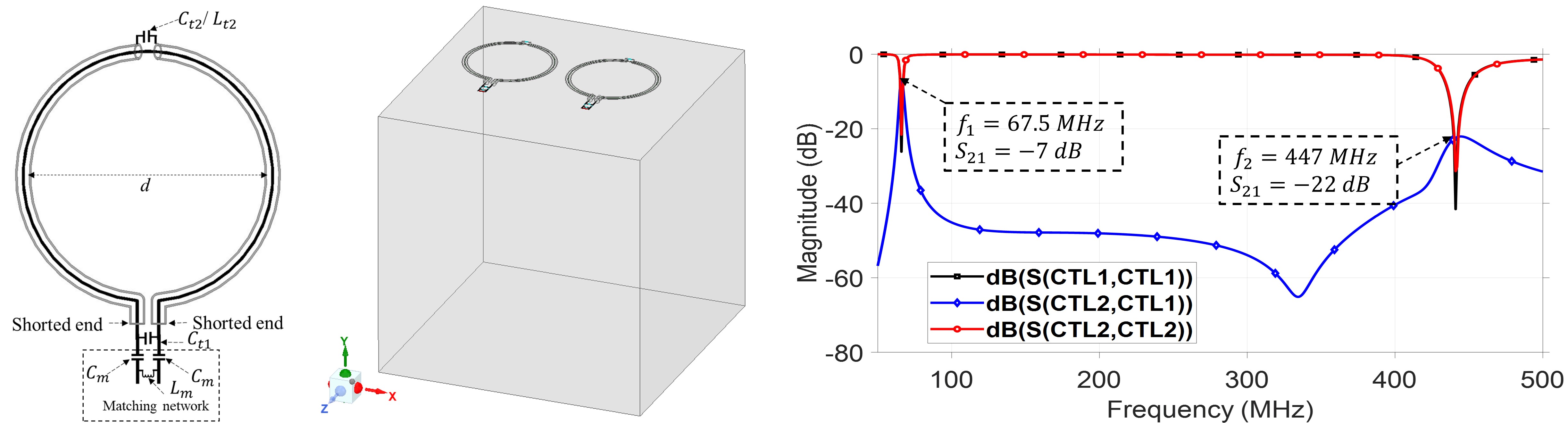
Fig. 1. Model of a pair of the dual-tuned 1H/2H RF coils with tuning capacitor and inductor, placed 1 cm coil-to-coil separation gap placed 0.5 cm on top of a tank phantom with dimension 20 x 20 x 20 cm3. Design parameters: d= 8 cm, Ct1 = 6.5 pF ; Cm = 24 pF, Lm = 71 nH, Lt2 = 67 nH.
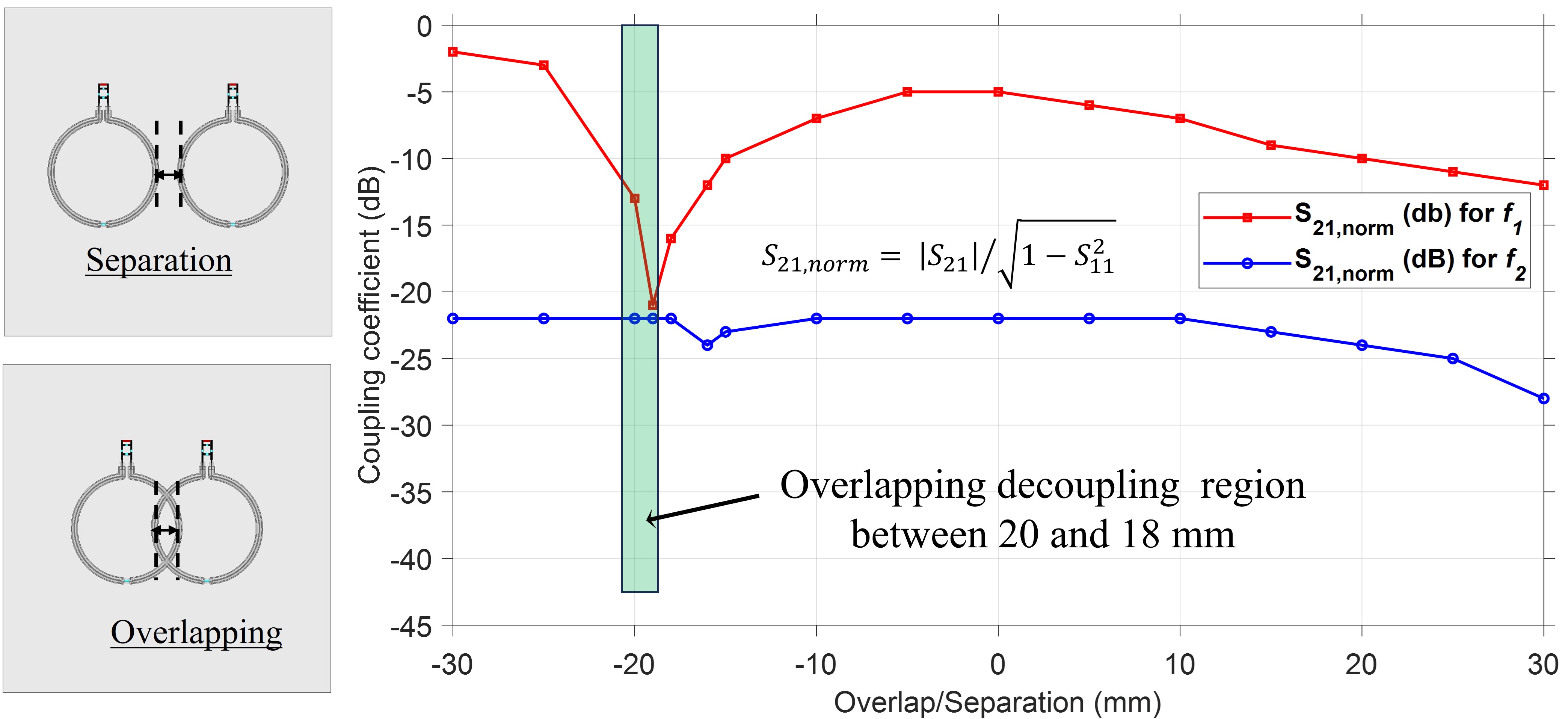
Fig. 2. Simulated scattering parameters of a pair of dual-tuned 1H/2H RF coils using the geometry overlapping decoupling technique with varying degrees of separation or overlapping.
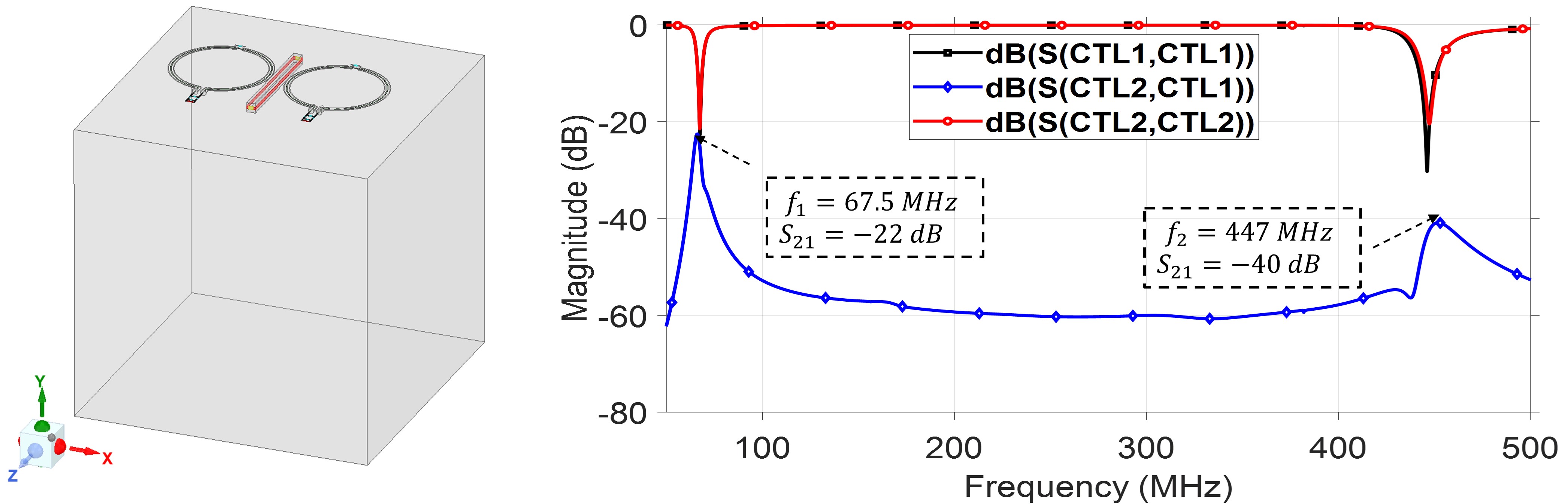
Fig. 3 Simulated scattering parameters of a pair of dual-tuned 1H/2H RF coils using a magnetic wall decoupling consisting of a tuning capacitive loop.
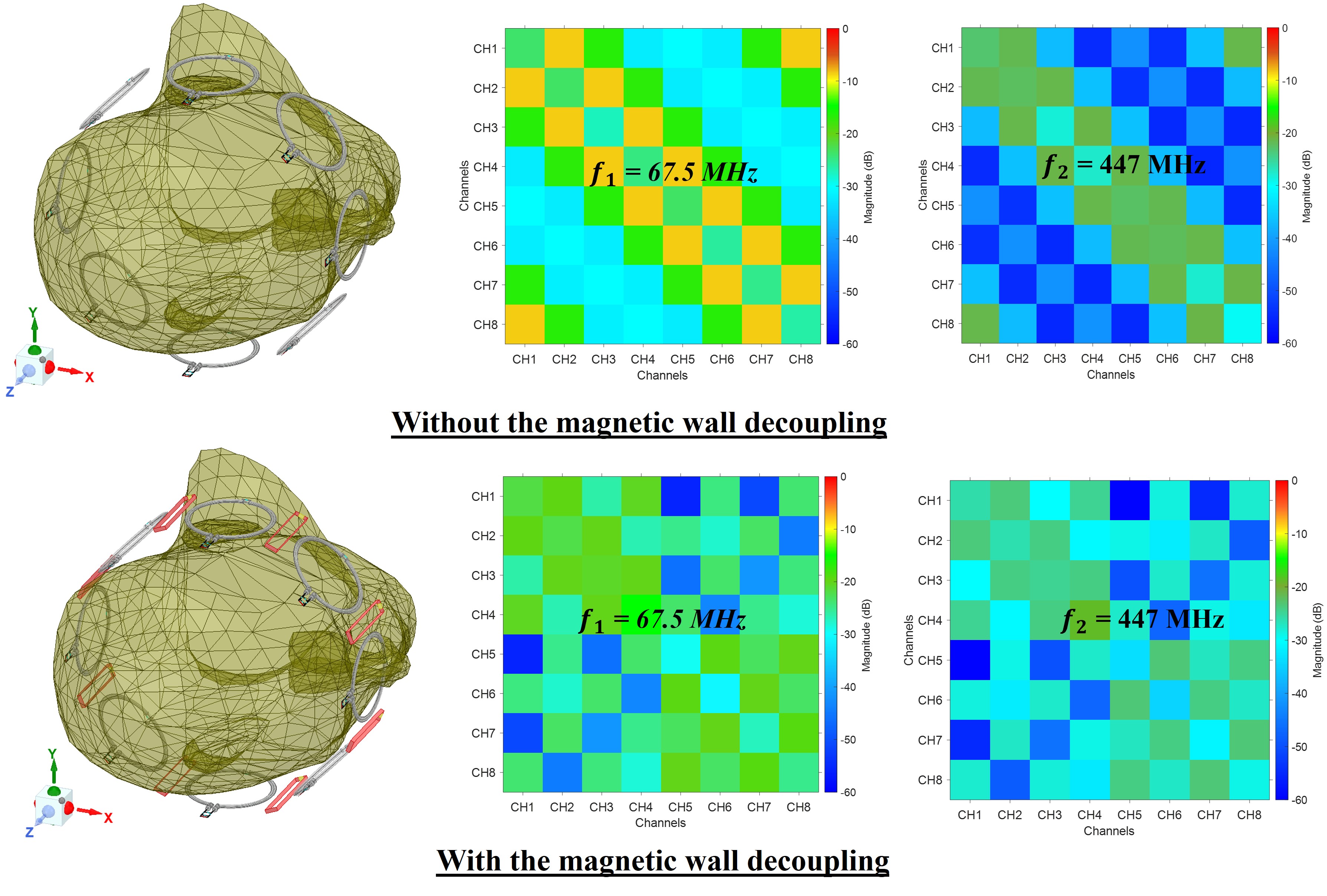
Fig. 4. Configuration of the 8-channel dual-tuned CTL coils array around the human head voxel model without / with the magnetic wall decoupling along with its scattering matrixes at both operating frequencies.
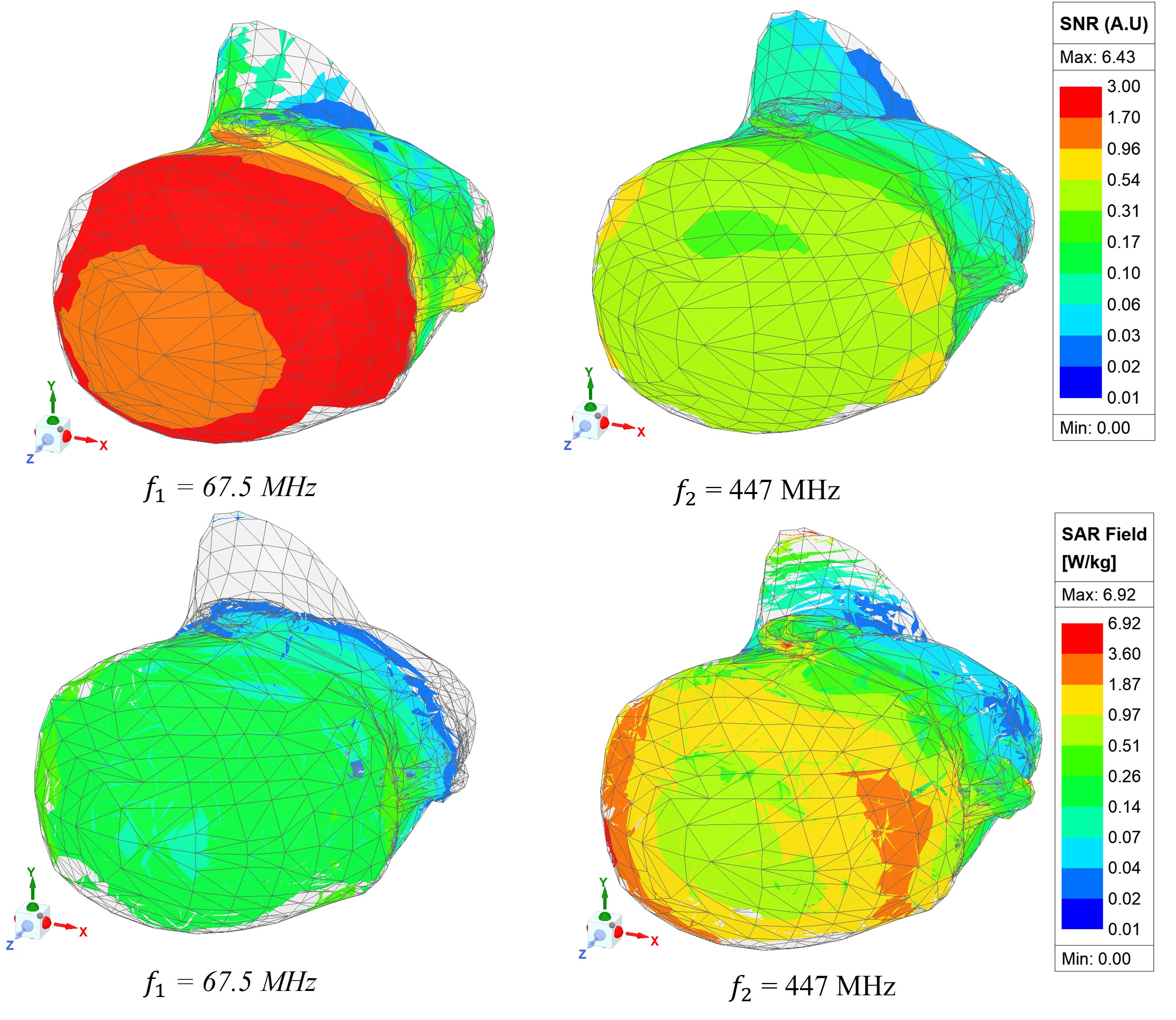
Fig. 5. Simulated 3D map of normalized SNR map, and local SAR10g field distribution evaluated on the human head voxel model obtained at both operating frequencies. The coils are excited with 1 W input and 45° linear phase progression.