0430
Efficacy of gadopiclenol in contrast-enhanced MRI of the liver: a post-hoc analysis1Seoul National University Hospital, Seoul, Korea, Republic of
Synopsis
Keywords: Liver, Liver
Motivation: Gadolinium dose reduction while maintaining MRI diagnostic efficacy is crucial.
Goal(s): Compare gadopiclenol (0.05 mmol/kg) and gadobutrol (0.1 mmol/kg) in liver MRI.
Approach: Post-hoc analysis on patients with liver lesions from the PROMISE phase III study (N=66).
Lesion visualization was qualitatively (border delineation, internal morphology, contrast enhancement) and quantitatively (enhancement percentage, lesion-to-background ratio) evaluated by three blinded readers. Three additional readers assessed diagnostic preference.
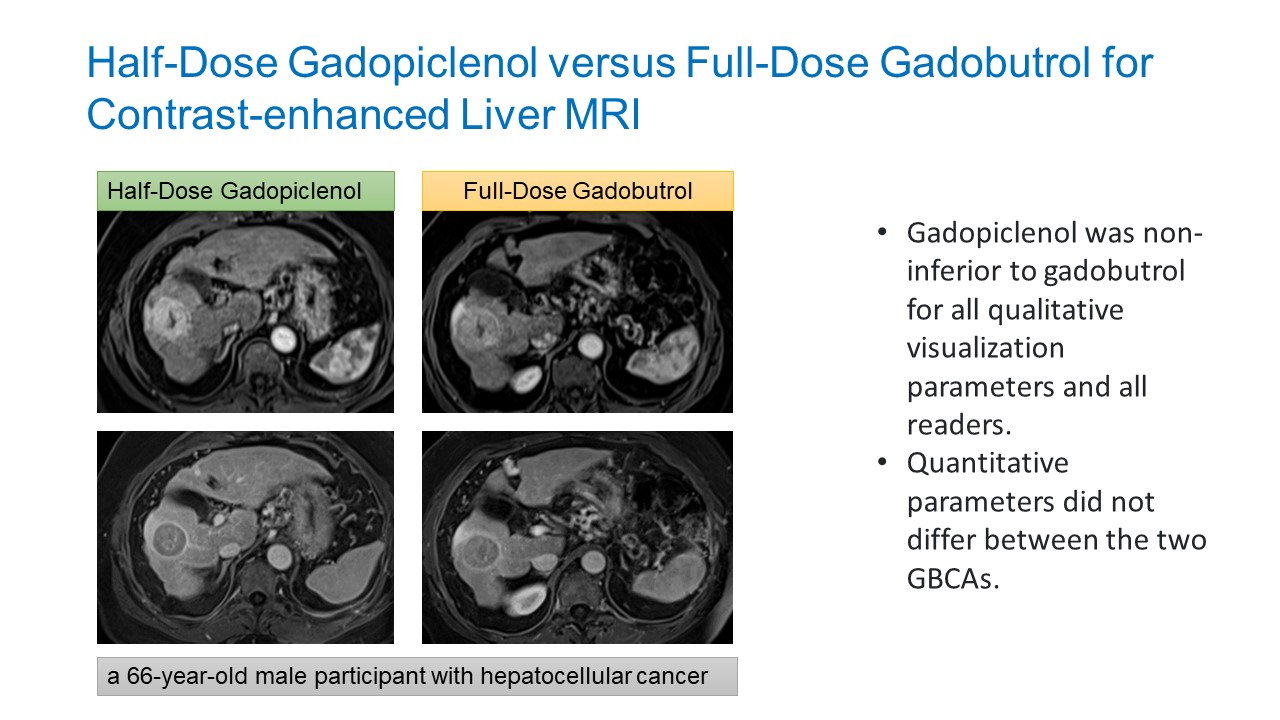
Results: Gadopiclenol was non-inferior to gadobutrol for all qualitative visualization parameters and all readers.
Quantitative parameters did not differ between the two GBCAs.
Readers had in most cases no preference between images with the two GBCAs.
Impact: The reduction in the injected gadolinium dose achieved with gadopiclenol may be particularly important in patients undergoing multiple contrast-enhanced MRI examinations. This will also reduce the amount of gadolinium released into wastewater systems, limiting any potential ecological impact.
Purpose
Gadopiclenol (Elucirem™, Guerbet) is a new high relaxivity macrocyclic gadolinium-based contrast agent (GBCA), recently approved by the FDA. Gadopiclenol at the approved dose of 0.05 mmol/kg was shown to be non-inferior to gadobutrol used at the standard dose of 0.1 mmol/kg, in terms of lesion visualization in contrast-enhanced MRI of the CNS and other body regions. (1,2) This analysis aims to specifically evaluate the efficacy of gadopiclenol (0.05 mmol/kg) in contrast-enhanced MRI of the liver.Materials and Methods
This is a post-hoc analysis of data from the subgroup of patients with liver lesions (N= 66) included in the PROMISE phase III study, (2) where 277 patients underwent two separate MRI examinations of different body regions, one with gadopiclenol (0.05 mmol/kg) and one with gadobutrol (0.1 mmol/kg) in a cross-over design. Lesion visualization parameters (border delineation, internal morphology and contrast enhancement) were assessed by 3 independent blinded readers, through a qualitative scoring (1 to 4) of up to 3 most representative lesions in each patient. Percentage of enhancement (E%) and lesion to background ratio (LBR) were measured. Overall diagnostic preference was assessed in a global matched-pairs fashion by 3 additional blinded readers.Results
For all readers, and all lesion visualization parameters, the difference in mean of scores showed the non-inferiority of gadopiclenol to gadobutrol for liver lesions (lower limit of 95%CI between -0.23 and -0.13, above the non-inferiority margin [-0.35]). Regarding quantitative measurements, there were no significant differences in LBR between the two GBCAs for all 3 readers (p≥0.1). E% was higher with gadopiclenol for 1 reader (p <0.0001) and no significantly different for the 2 others. The readers reported no preference between images with gadopiclenol and those with gadobutrol in the majority of cases (69.7% to 87.9% of the evaluations). Images with gadopiclenol were preferred in 7.6% to 18.2% of cases, while those with gadobutrol were preferred in 4.6% to 15.2% of cases.Conclusion
Gadopiclenol at 0.05 mmol/kg is non-inferior to gadobutrol at 0.1 mmol/kg for contrast-enhanced MRI of the liver. The reduction in gadolinium dose achieved with gadopiclenol at half the standard dose of other GBCAs may be particularly important in patients undergoing multiple contrast-enhanced MRI examinations. Furthermore, this will undoubtedly have a positive impact on the amount of gadolinium released into wastewater systems, limiting any potential ecological impact.Acknowledgements
No acknowledgement found.References
1. Loevner LA, Kolumban B, Hutoczki G, et al. Efficacy and Safety of Gadopiclenol for Contrast-Enhanced MRI of the Central Nervous System: The PICTURE Randomized Clinical Trial. Invest Radiol 2023;58(5):307-313.2. Kuhl C, Csoszi T, Piskorski W, Miszalski T, Lee JM, Otto PM. Efficacy and Safety of Half-Dose Gadopiclenol versus Full-Dose Gadobutrol for Contrast-enhanced Body MRI. Radiology 2023;308(1):e222612.Figures