0418
Medical physics mentoring through a RAD-AID International partnership with Intermed Hospital in Mongolia: Development and initial visit1Department of Radiation Oncology and Applied Sciences, Dartmouth-Hitchcock Medical Center, Lebanon, NH, United States, 2RAD-AID International, Chevy Chase, MD, United States, 3Department of Radiology, Intermed Hospital, Ulaanbaatar, Mongolia, 4Department of Medicine, Al-Zahraa Hospital University Medical Center, Cairo, Egypt, 5Department of Radiation Oncology, Moffitt Cancer Center, Tampa, FL, United States, 6Department of Diagnostic and Interventional Imaging, University of Texas Health Science Center at Houston McGovern Medical School, Houston, TX, United States, 7Department of Radiation Physics, MD Anderson Cancer Center, Houston, TX, United States, 8Department of Radiology, Bellevue Hospital, New York, NY, United States
Synopsis
Keywords: Safety, Health Care Economics, Global Health, Outreach
Motivation: Despite wide application in high-income countries, MRI is largely underutilized in low- and middle-income countries3 (LMIC’s). One reason is a lack of expertise in MRI physics in LMIC’s. RAD-AID International is an organization engaged in radiological outreach and is active in over twenty countries.
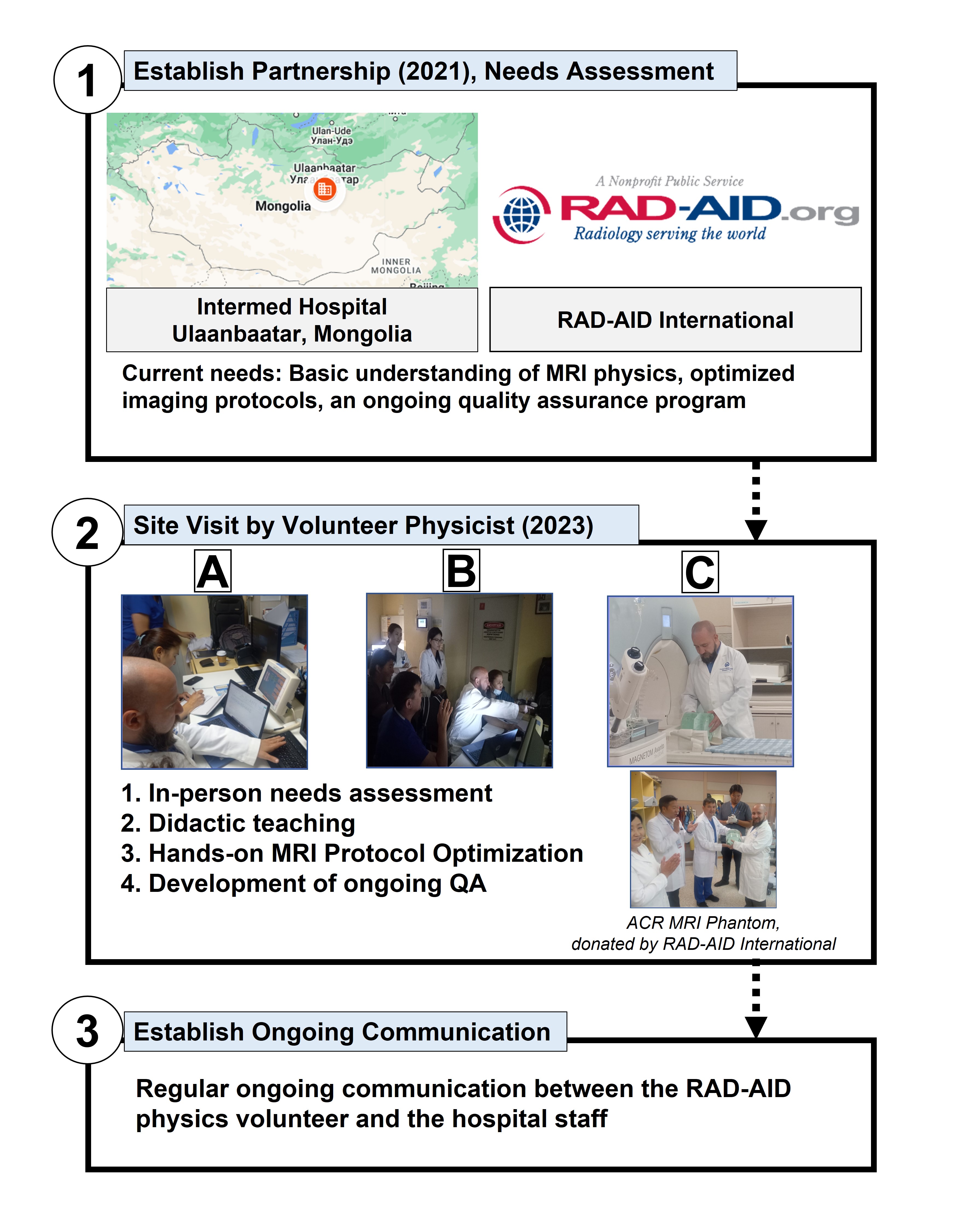
Goal(s): In this abstract, a roadmap for an MRI physics mentorship partnership is presented and illustrated at a private hospital in Northeast Asia.
Approach: A physicist volunteering for RAD-AID International visited Intermed Hospital in Mongolia.
Results: He taught the basics of MRI physics, optimized their imaging protocols, and established a quality assurance program. Collaboration will be ongoing.
Impact: MRI is underutilized in low-resource settings. One impediment to its utilization is lack of physics expertise. In this work, a roadmap is presented whereby a philanthropic organization partners with an Asian hospital to better incorporate physics concepts into clinic practice.
Introduction
Since Lauterbur’s initial development1 of magnetic resonance imaging (MRI) fifty years ago, MRI has become a widely utilized diagnostic tool in high-income countries, owing largely to its superior soft tissue contrast2 relative to other imaging modalities. In spite of its utility, MRI is underutilized in low- and middle-income countries3 (LMIC’s) due to a variety of factors4 such as cost, lack of trained personnel, and infrastructure requirements. In LMIC's that currently use MRI, imaging studies may be suboptimal due to a lack of expertise in MRI physics5. RAD-AID International is a nonprofit organization that was founded in 2008 and supports volunteer efforts in radiology clinics in over twenty LMIC’s. It aims to facilitate the application of diagnostic imaging in resource-limited settings and promote its appropriate use6. One such setting is Intermed Hospital, which is a private hospital in the city of Ulaanbaatar, Mongolia that lacks MRI physics support. To help support their needs, RAD-AID International conducted a week-long visit to Intermed Hospital to provide instruction in MRI physics for clinical personnel and to establish a recurring quality assurance (QA) program.Methods
A RAD-AID medical physicist visited Intermed Hospital in Mongolia in August of 2023 to accomplish three specific goals. First, a didactic course was conducted teaching the basics of MRI physics with a specific focus on how these concepts affect clinical care. This course was directed towards imaging technologists, radiologists, and a biomedical engineer. Second, their clinical protocols were optimized; specifically, they were instructed on how specific imaging parameters (i.e. repetition time, echo time, resolution, bandwidth) can be modified in order to mitigate imaging artifacts and improve image quality. This was done in real time in the clinic when artifacts or other image quality issues would arise so that the technologists gained hands-on experience in mitigating these issues. Finally, a QA program was established, and the first iteration of QA tests were performed while the RAD-AID volunteer was on site. In order to facilitate the adoption of the QA program, an MRI American College of Radiology (ACR) phantom was donated to Intermed Hospital for permanent use. All work was done on the hospital’s clinical Siemens Magnetom 1.5-T scanner (Siemens Healthineers). During the QA measurements, site protocols were utilized since standardized ACR protocols were unavailable.Results
The technologists at Intermed Hospital gained experience in modifying imaging parameters in real time to improve image quality and mitigate artifacts. For example, if geometric distortion was present, they learned that increasing the bandwidth would decrease the distortion but also decrease signal-to-noise ratio and alternatively that increasing the parallel imaging acceleration factor would decrease the distortion but could lead to aliasing artifacts. Moreover, a QA program based off ACR’s QA protocol7 was established. In the initial series of QA measurements, mean geometric distortion (horizontal, vertical, and diagonal measurements in two different image slices) of 0.77 mm across the phantom was measured. Spatial resolution in both directions on both imaging series was 1.0 mm. Compared to the nominal slice thickness of 5.0 mm, slice thicknesses of 4.2 mm and 4.6 mm were measured on the T1 and T2 series, respectively. Percent imaging uniformities and ghosting ratios of 96.9% and 0.068% (T1) and 95.8% and 0.19% (T2) were determined. 23 and 17 low contrast spokes were counted on the T1 and T2 series, respectively. Moreover, as a result of this initial visit, ongoing communication between the RAD-AID physicist and Intermed Hospital’s clinical staff was established.Discussion
MRI is a complex imaging modality that requires physics expertise for proper clinical implementation. Additionally, periodic QA is essential to ensure that scanner characteristics do not change appreciably over time and potentially affect clinical diagnostic readings. Efforts are currently being made to increase global access to MRI, specifically focusing on underserved LMIC’s8,9. However, in order to increase access in a safe and effective manner, physics involvement is critical. In this work, a roadmap for an MRI physics mentoring partnership is developed, presented, and illustrated at a private hospital in Northeast Asia. While in this example it was a philanthropic organization partnering with the LMIC hospital, the organizational backing may not be necessary. What is critical is the ongoing exchange of MRI physics knowledge and a collaboration between the experienced MRI physicist and the staff at the LMIC hospital.Conclusion
A roadmap for an MRI physics mentoring partnership between a philanthropic organization focusing on radiology outreach and a hospital in an LMIC was developed and is presented here. A periodic QA program was established. Collaboration between RAD-AID International’s volunteers and the LMIC hospital will be ongoing.Acknowledgements
The authors would like to acknowledge Ms. Anne-Marie Lugossy, Ms. Sara Rike, and Ms. Lauren Fuller Kulinski, on staff at RAD-AID International, who helped coordinate the site visit and the donation of the phantom.References
1. Lauterbur PC. Image formation by induced local interactions: Examples employing nuclear magnetic resonance. Nature. 1973; 242(5394): 190-191.
2. Weygand J, Fuller CD, Ibbott GS, et al. Spatial precision in magnetic resonance imaging–guided radiation therapy: The role of geometric distortion. International Journal of Radiation Oncology* Biology* Physics. 2016; 95(4): 1304-1316.
3. Jalloul M, Miranda-Schaeubinger M, Noor AM, et al. MRI scarcity in low- and middle-income countries. NMR in Biomedicine. 2023: e5022.
4. Murali S, Ding H, Adedeji F, et al. Bringing MRI to low- and middle-income countries: Directions, challenges and potential solutions. NMR in Biomedicine. 2023: e4992.
5. Hilabi BS, Alghamdi SA, Almanaa M. Impact of magnetic resonance imaging on healthcare in low- and middle-income countries. Cureus. 2023; 15(4): e37698.
6. Consul N, Culp M, Desperito E, et al. RAD-AID, an organization bringing radiology to resource-limited regions of the world. Medical Physics International. 2017; 5(1): 82-84.
7. Chen CC, Wan YL, Wai YY, et al. Quality assurance of clinical MRI scanners using ACR MRI phantom: Preliminary results. Journal of Digital Imaging. 2004; 17(4): 279-284.
8. Frija G, Blažić I, Frush DP, et al. How to improve access to medical imaging in low-and middle-income countries? EClinicalMedicine. 2021; 38: 101034.
9. Hricak H, Ward ZJ, Atun R, et al. Increasing access to imaging for addressing the global cancer epidemic. Radiology. 2021; 301(3): 543-546.
Figures