0416
MRI advancement and research in Africa: Report on the Inaugural ISMRM African Chapter conference1Mbarara University of Science and Technology, Mbarara, Uganda, Mbarara, Uganda, 2Department of Radiology, College of Medicine, University of Ibadan, Ibadan, Nigeria, 3Biomedical Engineering Research Centre, Division of Biomedical Engineering, University of Cape Town, South Africa, Cape Town, South Africa, 4Department of Human Biology, Faculty of Health Sciences, University of Cape Town, South Africa, CapeTown, South Africa, 5Rivers State University Teaching Hospital, Port Harcourt, Nigeria, 6Department of Radiology, University College Hospital, Ibadan, Nigeria, 7Department of Radiology, Muhimbili National Hospital-Mloganzila, Dar-es-salaam, Tanzania, 8Department of Radiology, Korle Bu Teaching Hospital, Accra, Ghana, 9Department of Radiology, University of Calabar teaching Hospital, Calabar, Nigeria, 10Montreal Neurological Institute, McGill University, Montreal, QC, Canada, 11Hyperfine Inc, St. Guilford, CT, United States, 12Perelman School of Medicine, University of Pennsylvania, Philadelphia, PA, United States, 13C. J. Gorter MRI Center, Department of Radiology, Leiden University Medical Center, Leiden, Netherlands, 14Clinical Imaging Science Centre, University of Sussex,, Sussex, United Kingdom, 15Department of Biomedical Engineering, Rochester Institute of Technology, Rochester, NY, United States, 16Cape Universities Body Imaging Centre, University of Cape Town, CapeTown, South Africa
Synopsis
Keywords: Low-Field MRI, Low-Field MRI, Networking, Innovation
Motivation: Due to rising non-communicable diseases, limited MRI accessibility, and Africa's underrepresentation in ISMRM, the African Chapter (AC) was founded in 2023. An inaugural conference in Ghana focused on emerging MRI technology for improved accessibility.
Goal(s): To provide the inaugural conference report of AC-ISMRM, with the identification of challenges and barriers to MRI access and propose solutions toward democratization of MRI across Africa.
Approach: A white paper approach was adopted
Results: Over 100 scientists from 12 African countries met to identify challenges and propose solutions for advancing MRI access and value in Africa. Low-field MRI was identified as a breakthrough innovation toward this goal.
Impact: The AC-ISMRM conference marks a pioneer event, convening African scientists and clinicians, aimed at establishing a network dedicated to rectify Africa's underrepresentation in MRI research, seeking solutions to challenges on the continent and promoting collaboration and MRI advancements
Introduction
The International Society for Magnetic Resonance in Medicine (ISMRM) was founded nearly three decades ago with the overarching mission of promoting worldwide communication, research, and the application of MR in medicine, biology, and related domains. The organization is committed to ensuring that scientists and clinicians from all corners of the globe have equal opportunities to engage in and contribute to this scientific realm. While ISMRM's influence has been steadily growing on a global scale, Africa's representation, both in terms of membership and research contributions, has been notably limited. Up until 2018, Africa represented a meager 0.05% of ISMRM's overall membership, and only a small fraction of those members held active status. Out of a community comprising over 9,000 professionals from a wide array of disciplines, just 4 individuals from Africa met the criteria to participate in ISMRM committees. However, a pivotal moment transpired at the 2023 ISMRM meeting in Toronto when over 40 African members gathered to create a landmark initiative, officially founding the African Chapter (AC) of ISMRM, aimed at rectifying this imbalance. A little over three months after, from September 27 to 30, 2023, the AC ISMRM successfully organized a workshop and hosted its inaugural annual meeting in Accra, Ghana. These events were dedicated to the exploration of emerging MRI technologies, encompassing both hardware and software, with the potential to address the specific needs of African countries where MRI accessibility has been historically limited1-3. Here, we present the key outcomes of the conference, illuminate the distinct challenges and opportunities in the advancement of MRI within the continent, and delineate practical goals aimed at closing the existing gaps in MRI education and research throughout AfricaDemographics
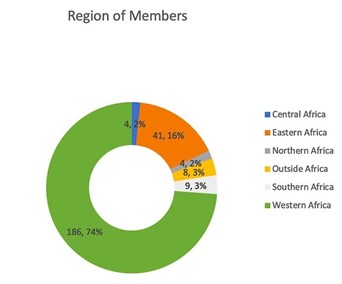
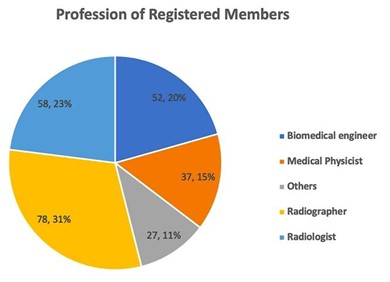
As of October 9, 2023, approximately four months since its establishment, the AC ISMRM boasts 252 registered members, comprising 190 full members and 62 associates, representing 25 countries. Membership spans across all regions of Africa, with a small diaspora representation of 8 members (3%), Figure-1a. Radiographers (78 members, 31%) and Radiologists (58 members, 23%) form the most prominent professional groups, followed by Biomedical Engineers (52 members, 20%), Figure-1bPre-conference Workshop
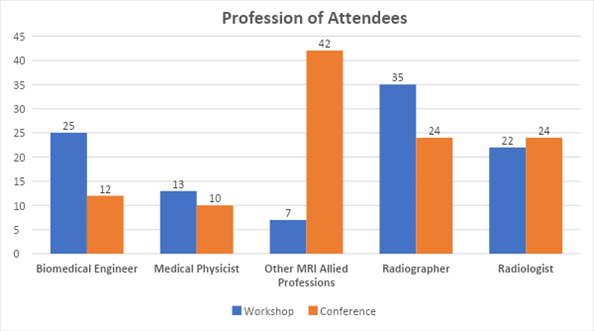
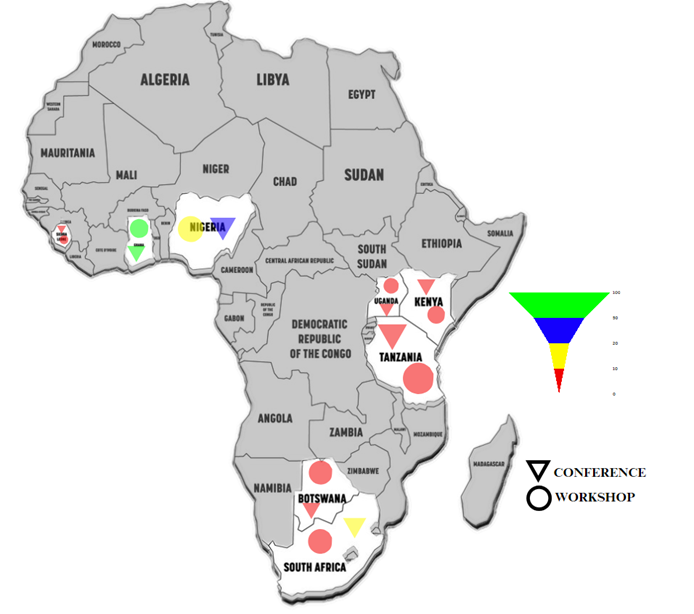
The two-day workshop drew 102 participants from the 215 individuals who registered through the AC ISMRM website. Attendees represented 14 countries, with Ghana leading (59%), followed by Nigeria (17%), Figure-2. By profession, Radiographers comprised the largest group (34%), followed by Biomedical Engineers (24%), Figure-2The Inaugural AC ISMRM Conference
The two-day conference attracted 112 attendees, with 45 registering onsite and the rest via the AC ISMRM website. Participants hailed from 12 countries, both within and outside Africa, Figure 3. Notably, the professional composition of the conference attendees differed from that of the workshop, Figure 3. The largest group consisted of "MRI allied professions" (38%), while Radiologists and Radiographers each comprised 22% of the attendees.Conference program
The conference's theme centred on advancing MRI technology and fostering innovation in Africa. Keynote speakers included Prof. Derek Jones, current president of ISMRM, who discussed advanced MRI techniques, and Prof. James Gee, who explored the potential of AI in enhancing MRI diagnostics. The conference featured five scientific sessions covering various aspects of MRI technology, education, neuroimaging, clinical applications, and imaging in low-resource settings. Moreover, 8 students from 4 different African countries showcased their research through Pitch talks and Scientific poster presentations.Barriers and Challenges
Limited access to MRI was identified as the primary impediment to MRI advancement in Africa. For example, in Sub-Saharan Africa, the number of MRI scanners per million people was <1, and a concerning 39% of those systems were obsolete yet still in use to meet clinical demands2. This is exacerbated by the crucial need for improvements to the maintenance and servicing of these systems. Computational constraints, which hinder the adoption of AI tools, remain a challenge. Education and "brain drain" were also recognized as obstacles to MRI research and utility in Africa.Turning obstacles into unique opportunities
Developing low-field MRI emerged as a major opportunity for advancement of MRI through reduced costs and portability. Participants emphasized the importance of open-source software and appropriate sequence selection to leverage MRI's unique capabilities. Training opportunities within the continent were identified as a way to increase participation and cross-discipline/cross-country collaborations4. Networking was seen as vital for securing funding, mentoring, and research output. Collaboration with other scientific societies in the continent was recognized as an opportunity for strengthening AC ISMRM. Bolstering ties with manufacturers was suggested to develop sustainable MRI in the continent.Conclusions
Building upon the success of the inaugural AC ISMRM Conference, the chapter aims to expand its membership and enhance the engagement of French-speaking countries. Working together will synergize the advancement of MRI in Africa.Acknowledgements
We express our deep appreciation to all the sponsors, partners, speakers, volunteers, and attendees for their invaluable contributions to the conference's resounding success. Our heartfelt thanks go to the dedicated Accra Conference LOC team. We are also indebted to the ISMRM leadership and the ISMRM African Chapter Inaugural Governance Committee for their pivotal roles in making this conference a reality. Special recognition is extended to the following sponsors: Chan Zuckerberg Initiative (CZI); CZI_SMART Africa; Bill and Melinda Gates Foundation (BMGF); RAD-AID International; African Stroke Organization; College of Medicine, University of Ibadan, Nigeria; EURACARE Ghana; WAM Pharma-GE; Consortium for Advancement of MRI Education and Research in Africa (CAMERA); HYPERFINE INC.; EASE Nigeria.References
1. Webb A, Obungoloch J. Five steps to make MRI scanners more affordable to the world. Nature. 2023 Mar;615(7952):391-393. doi: 10.1038/d41586-023-00759-x. PMID: 36918678.
2. Ogbole, G.I., A.O. Adeyomoye, A. Badu-Peprah, Y. Mensah and D.A. Nzeh, Survey of magnetic resonance imaging availability in West Africa. The Pan African Medical Journal, 30, 2018.
3. Anazodo, U.C., J.J. Ng, B. Ehiogu, J. Obungoloch, A. Fatade, H. Mutsaerts, M.F. Secca, M. Diop, A. Opadele, D.C. Alexander, M.O. Dada, Ogbole, G.I., R. Nunes, P. Figueiredo, M. Figini, B. Aribisala, B.O. Awojoyogbe, H. Aduluwa, C. Sprenger, R. Wagner, A. Olakunle, D. Romeo, Y. Sun, F. Fezeu, A.T. Orunmuyi, S. Geethanath, V. Gulani, E.C. Nganga, S. Adeleke, N. Ntobeuko, F.J. Minja, A.G. Webb, I. Asllani and F. Dako, A framework for advancing sustainable magnetic resonance imaging access in Africa. NMR Biomed. 36(3): p. e4846. (2023).
4. Ogbole G.I , Adepoju A.E, Ibrahim A., Togunwa T.O, Nkeakam F.A, MRI training in Africa. 2023 Annals of Ibadan Postgraduate (Accepted: in press )
Figures