0387
Best of both MoCo worlds: combining fast pilot tone motion sensing with retrospective SAMER correction1Siemens Shenzhen Magnetic Resonance Ltd., Shenzhen, China, 2Siemens Healthcare GmbH, Erlangen, Germany, 3Siemens Healthineers International AG, Lausanne, Switzerland, 4Lausanne University Hospital and University of Lausanne, Lausanne, Switzerland, 5École Polytechnique Fédérale de Lausanne (EPFL), Lausanne, Switzerland
Synopsis
Keywords: Motion Correction, Motion Correction, pilot tone
Motivation: Model-based retrospective motion correction has shown good results but sometimes lacks enough information to accurately derive motion parameters.
Goal(s): To use the pilot tone to address the drawbacks of retrospective methods by providing them with high-frequency motion information for more robust and efficient motion correction.
Approach: We use pilot tone to refine and increase the temporal resolution of motion parameters for the Scout Accelerated Motion Estimation and Reduction (SAMER) method.
Results: Motion phantom and volunteer tests show improved image quality of pilot tone + SAMER compared to SAMER-only while the reconstruction takes clinically acceptable 20s.
Impact: Our results demonstrate that pilot tone can be used to improve the precision and temporal resolution of a model-based retrospective motion correction method, while being robust and fast. This will help to further mitigate motion artifacts in clinical routine.
Introduction
Due to minimal hardware requirements, the pilot tone (PT) is attractive as a cost-effective method. While originally conceived for respiration and cardiac sensing, it can also be used to improve motion parameter (MP) calculation1,2 and to increase the temporal resolution of calculated MPs2,3. In related work, a NUFFT was used to speed up the reconstructing of the final motion-corrected image4. However, combining PT and model-based motion correction is still not clinically practical, especially due to the high computational demands2. SAMER (Scout Accelerated Motion Estimation and Reduction)5,6 was introduced to address the computational demands of these techniques. To render high temporal resolution (HTR) model-based motion correction clinically practical, we propose HTR-PT-SAMER which uses the pilot tone to refine SAMER MPs to a millisecond level in conjunction with an efficient NUFFT reconstruction. The effectiveness and robustness of HTR-PT-SAMER are evaluated in volunteers and a motion phantom.Methods
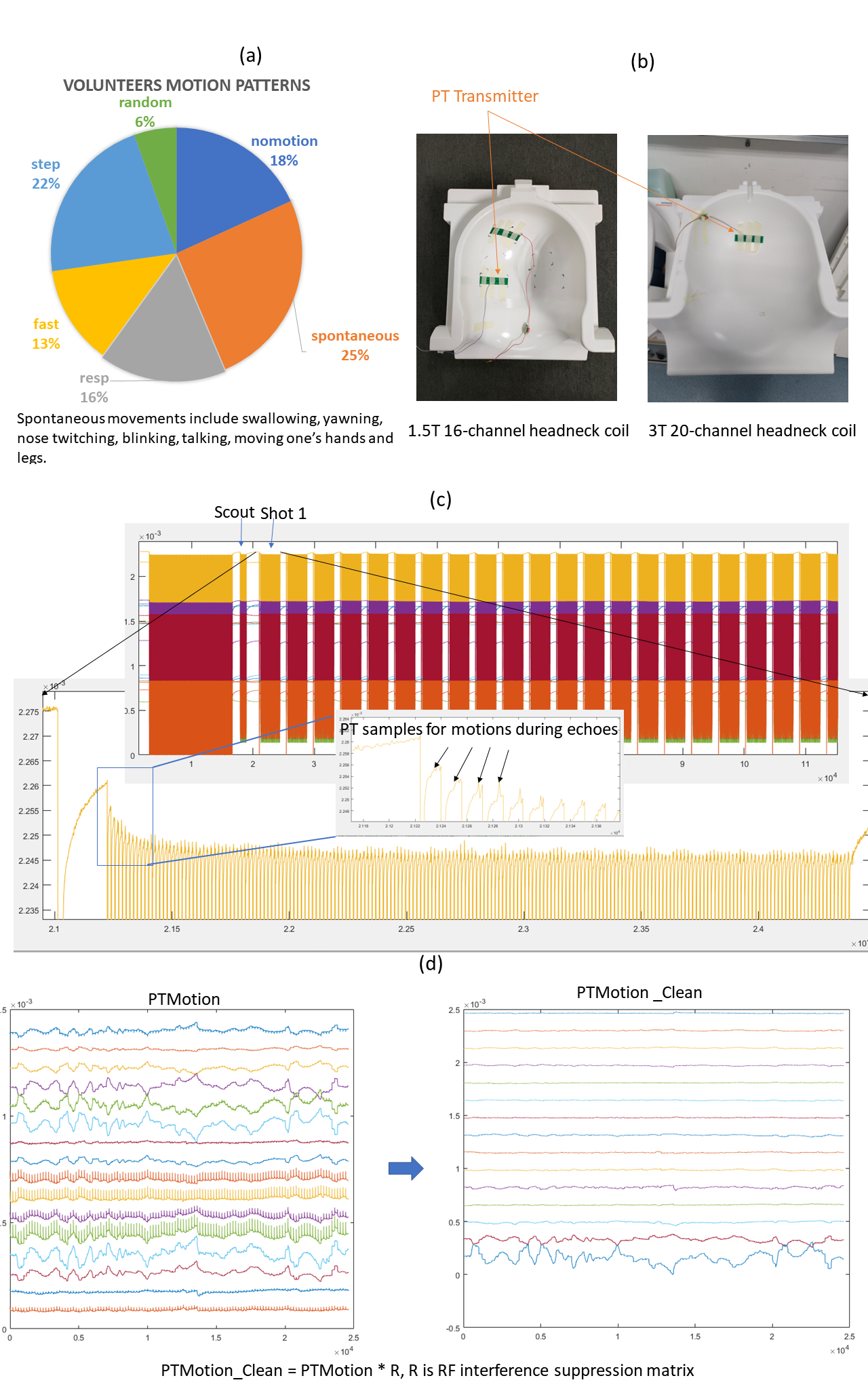
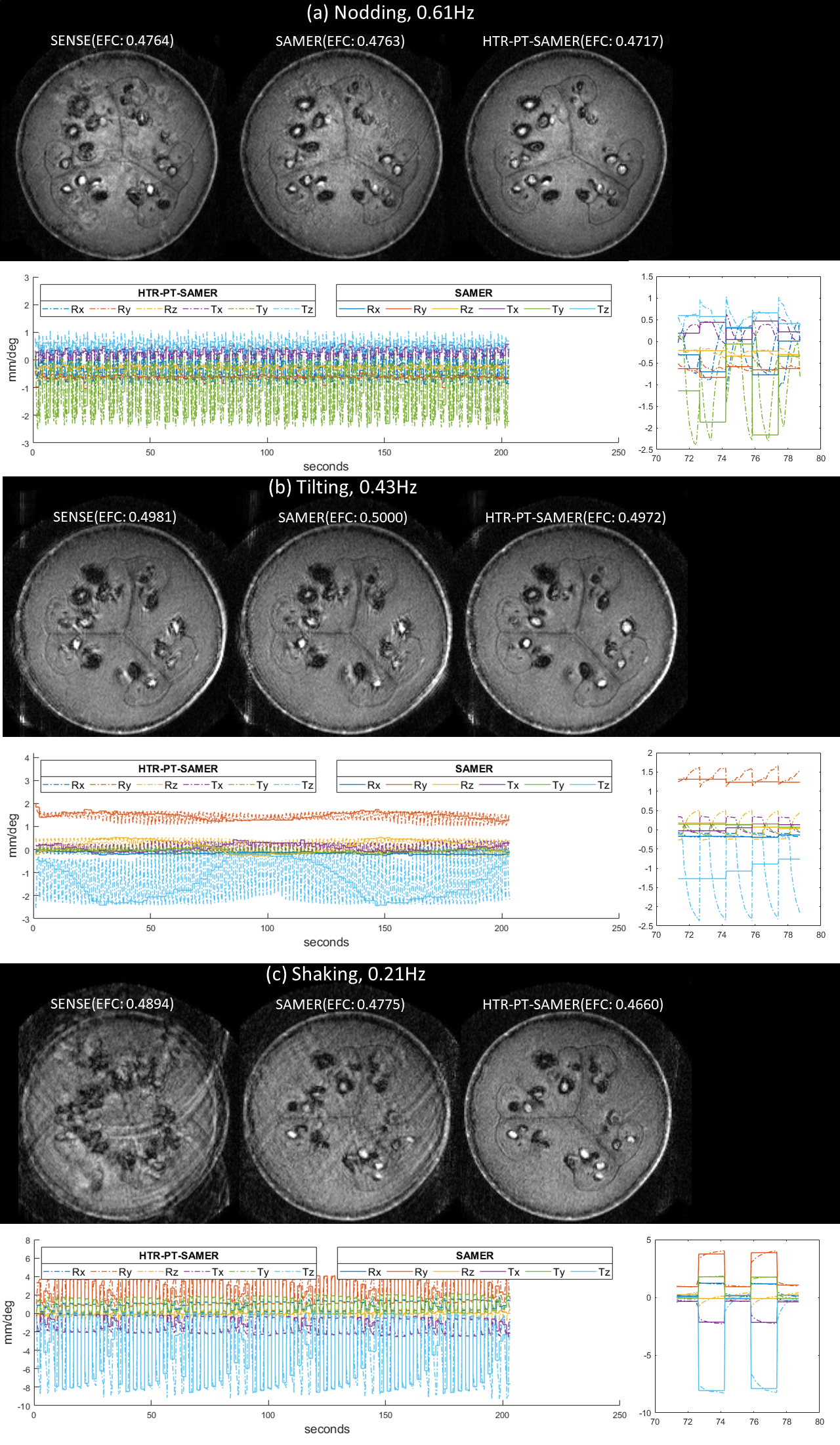
Volunteer experiments were performed at 1.5T (MAGNETOM Sola, Siemens Healthcare, Erlangen, Germany) with a 16-channel head/neck coil. Fifty-five measurements were performed on nine volunteers, who were instructed to keep still, intermittently perform various head motion patterns as well as “spontaneous movements ” (Fig.1 (a)). Additional experiments with a motion phantom (home-made device to periodically move a watermelon) were performed at 3T (MAGNETOM Cima.X, Siemens Healthcare, Erlangen, Germany) with a 20-channel head/neck coil. the watermelon was moved to mimic nodding, head tilting, and shaking with motion frequencies of ~0.6Hz to ~0.2Hz. PT transmitters were attached to the lower parts of the coils (Fig.1 (b)), most importantly to reduce the SNR loss for imaging and to render the PT signal more sensitive to rigid head motion, but less sensitive to spontaneous movements. A SAMER MP-RAGE research sequence with scout and guidance lines was used (R=2, 1mm3 isotropic resolution). The PT signal sampled at 2 kHz was separated from the imaging signal within the receive chain. A per-echo temporal resolution of ~8ms was used (limited by the echo spacing). The extraction of the PT signal and the suppressed RF interference7 are illustrated in Fig.1 (c) and (d).SAMER derives MP αs from the guidance lines. PT samples after RF interference suppression P, averaged over the acquisition of the guidance lines Pg can be used to calibrate a linear model QPg = αs . HTR MP for each k-space line α can then be estimated by using the linear model: Q = αsPg+, α = QP.
To correct the image, translations are first addressed by applying line-by-line phase ramps in k-space. Then, the trajectory of each line is rotated according to the MPs. The resulting non-Cartesian k-space data is transformed to a motion-corrected image using a NUFFT.
To study the benefits of PT, we also explored PT-SAMER, where we only corrected the SAMER MPs using the PT without increasing the temporal resolution. SAMER and HTR-PT-SAMER results were then compared by visually inspecting image quality differences to evaluate the effectiveness and robustness of the different methods; observations were subsequently ranked by an MR physicist for all acquisitions (better/similar/worse quality). For an objective quantitative assessment, the entropy focus criterion (EFC) metric from MRIQC8 was used in addition to evaluate the overall image quality.
Results and Discussion
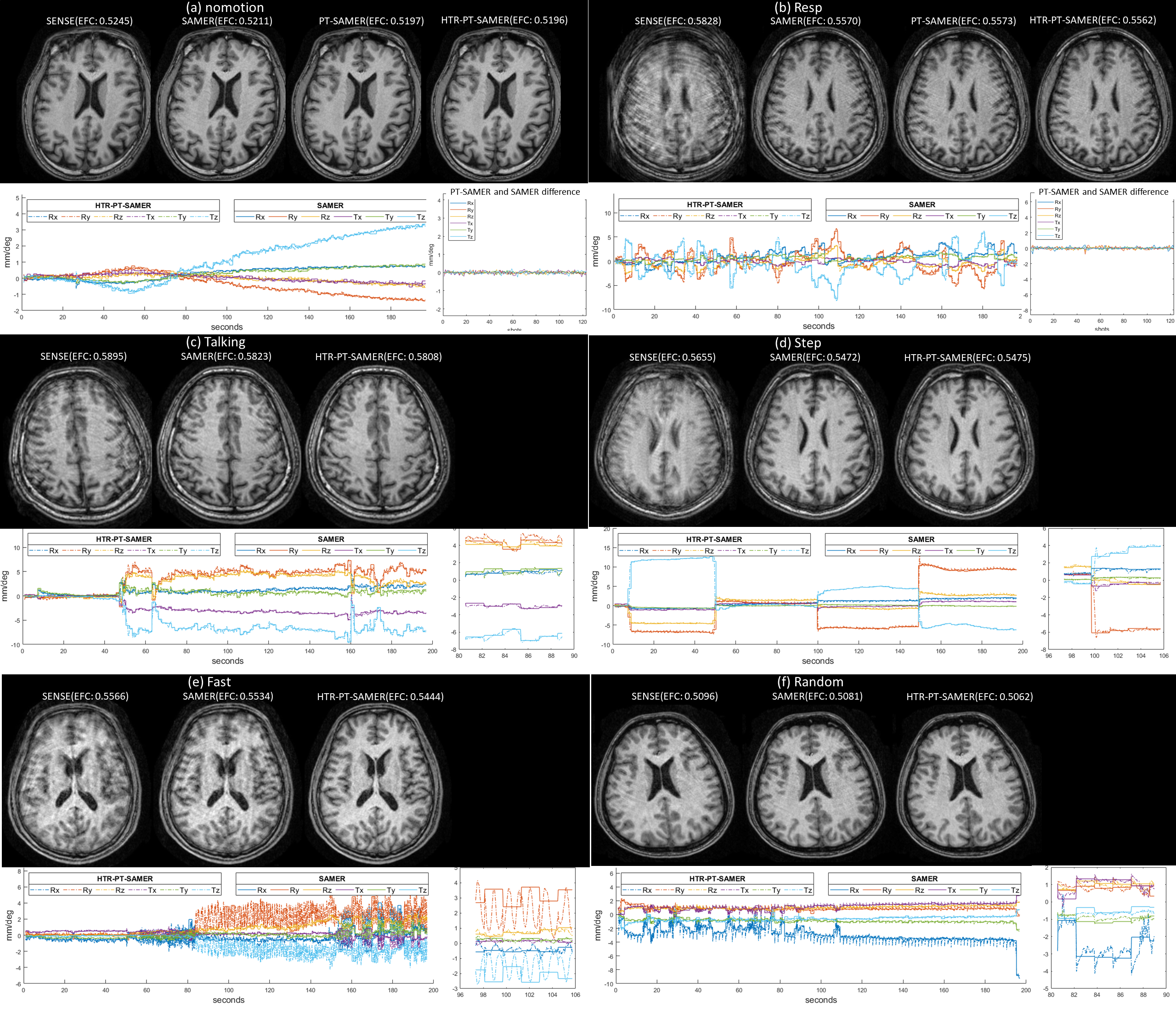
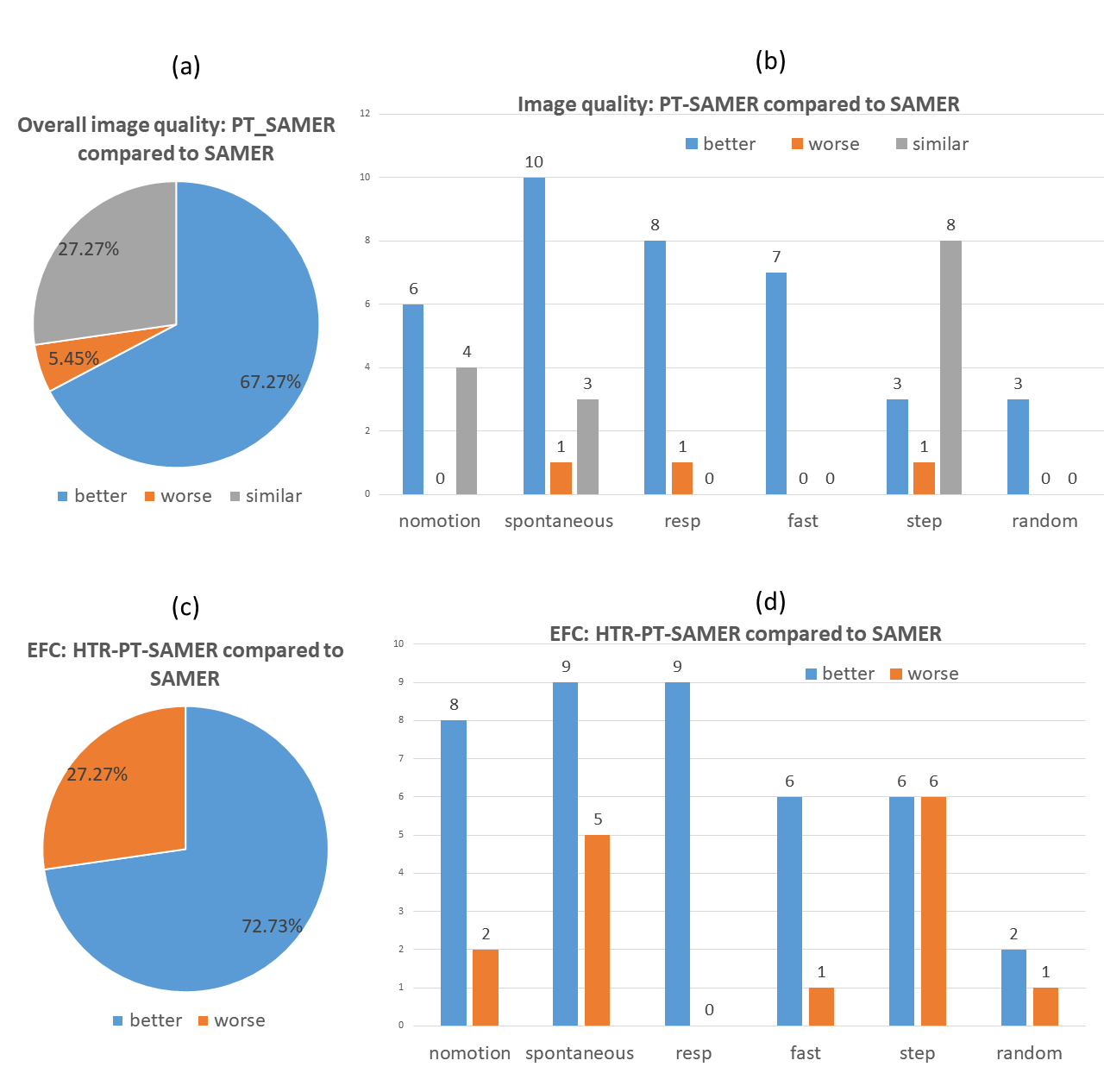
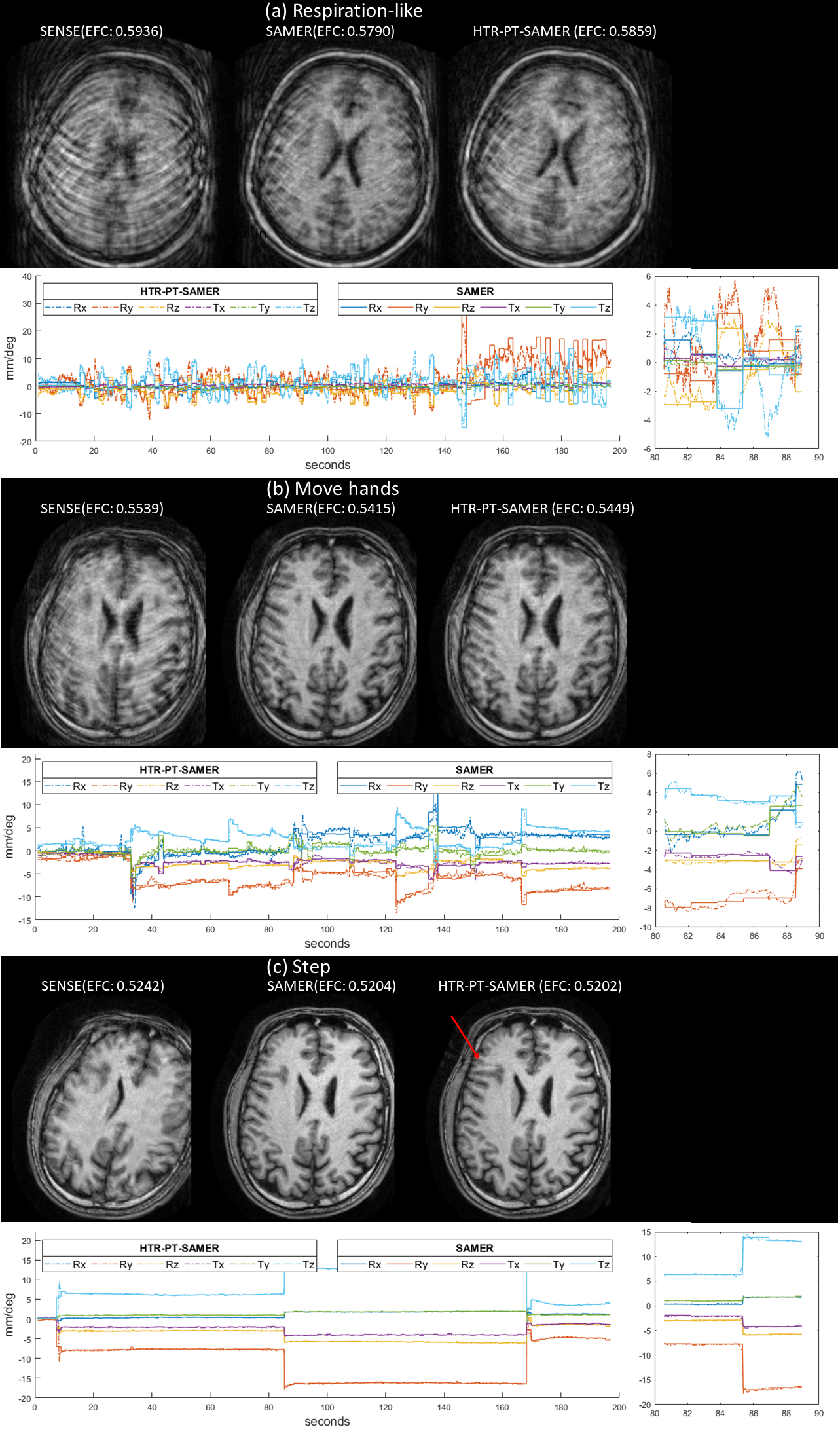
The consistently observed improved image quality exhibited in Fig.2 (a) suggests that PT helps to obtain more accurate MPs. For the rather small and slow movements occurring there, HTR does not yield further image improvement. In contrast, for larger and faster movements as shown in Fig.2 (b), the intra-shot correction by HTR-PT-SAMER yields considerably better image quality. This is consistent with the results obtained from the other motion patterns with representative examples shown in Fig.2 (c)-(f).The ranking results presented in Fig.3 (a) show that HTR-PT-SAMER improves image quality in most of the measurements. Fig.3 (b) shows image quality rankings with respect to different motion patterns. Overall, the results demonstrate the effectiveness and robustness of HTR-PT-SAMER, especially for cases of spontaneous motion. In Fig.3 (c) and (d), EFC confirms the results. Cases where HTR-PT-SAMER yielded worse results are shown in Fig.4.
In Fig.5, we observed better correction performance of HTR-PT-SAMER in motion phantom compared to the volunteer. This hints to a residual source of error in human brain scans using our method, but also shows that HTR-PT-SAMER can also handle continuous motion. The NUFFT-based final reconstruction was computed in 20s on a low-performance 4GB GPU.
Conclusion
The obtained image quality improvement together with the clinically feasible reconstruction times demonstrate that HTR-PT-SAMER meets the requirements of clinical practice. In a next step, its performance in a real-world setting should be validated.Acknowledgements
No acknowledgement found.References
1. HUANG Y, Speier P, Hilbert T, et al. Motion correction using Pilot Tone: a general model-based approach. In: Proc. Intl. Soc. Mag. Reson. Med. (2022).
2. Brackenier Y, Wilkinson T, Cordero-Grande L, et al. Pilot Tone meets DISORDER: Improved data-driven motion-corrected brain MRI by leveraging Pilot Tone signal variations. In: Proc. Intl. Soc. Mag. Reson. Med. (2022).
3. Wallace TE, Ariyurek C, Calakli F, et al. High Temporal Resolution Head Motion Tracking using Pilot Tone and 3D Radials. In: Proc. Intl. Soc. Mag. Reson. Med. (2023).
4. Huttinga NRF, Anand S, van den Berg CAT, et al. Three-dimensional rigid head motion correction using the Beat Pilot Tone and Gaussian Processes. In: Proc. Intl. Soc. Mag. Reson. Med. (2023).
5. Polak D, Splitthoff DN, Clifford B, et al. Linear+: An optimized sequence reordering for robust scout accelerated retrospective motion estimation and correction. In: Proc. Intl. Soc. Mag. Reson. Med. (2022).
6. HUANG Y, Splitthoff DN, Clifford B, et al. Linear SAMER: linear motion optimization for scout accelerated retrospective motion estimation and reduction with linear+ reordering in MPRAGE. In: Proc. Intl. Soc. Mag. Reson. Med. (2023).
7. Speier P, Huang Y, Hayes C, et al. Enabling Pilot Tone cardiac triggering for complete cardiac examinations using an RF calibration procedure. In: Proc. Intl. Soc. Mag. Reson. Med. (2022).
8. Esteban O, Birman D, Schaer M, et al. MRIQC: Advancing the automatic prediction of image quality in MRI from unseen sites. PloS one. 2017 Sep 25;12(9):e0184661.
Figures