0367
Functional dynamic patterns of executive networks predict postoperative attentive outcome in glioma patients1Department of Medical and Surgical Specialties, Radiological Sciences and Public Health, University of Brescia, Brescia, Italy, 2CIMeC, Center for Mind/Brain Sciences, University of Trento, Rovereto, Italy, 3Department of Neuroscience, Division of Neurosurgery, S.Chiara Hospital, APSS Trento, Trento, Italy, 4Structural and Functional Connectivity Lab, S.Chiara Hospital, APSS Trento, Trento, Italy
Synopsis
Keywords: Tumors (Post-Treatment), Brain Connectivity, Neuroscience, Tumors
Motivation: Brain surgery glioma patients frequently exhibit attentional deficit, however the prediction of its appearance is largely unknown.
Goal(s): Investigate longitudinal temporal properties of executive function to gain insights about its relationship with cognitive attentive performance in gliomas.
Approach: We used longitudinal dynamic functional connectivity analysis of executive networking to associate it with neuropsychological attentive and executive performance.
Results: Post-surgical attentive performance is strictly related to functional temporal properties of executive networks, regardless of gliomas' features. Underlying substrates of impairment in the executive domain could be explained by looking at changes in temporal persistence of highly co-activated fronto-parietal networking.
Impact: Co-activation patterns framework enables the prediction of post-operative attentional deficits by looking at pre-surgical temporal features of executive networking. We demonstrate how the dynamic nature of the brain contains crucial features to develop clinically relevant imaging markers for gliomas recovery.
Introduction
Postoperative attentional and executive dysfunctions are common following brain tumor resection, affecting both patients’ quality of life and functional recovery. Here, we investigate whether functional dynamic properties of executive networking could predict neuropsychological attentive functioning after surgery.Methods
The study included longitudinal resting-state functional magnetic resonance (rs-fMRI) scans from 22 patients with gliomas before brain surgery and at 3 months follow-up. Structural T1-weighted and rs-fMRI images were acquired on a 1.5T GE Healthcare MRI system as previously described1. Furthermore, every patient underwent a longitudinal neuropsychological assessment2-6 of attentional and executive functions, tested using attentional matrices and Trial Making Test (A, B, B-A scores). Neuropsychological assessment was performed before surgery, 1 week after surgery (before hospital discharge), and subsequently after 3 months before or after MRI scanning to be associated with neuroimaging measures. Pathological scores, to be later associated with dynamism of functional networks, were then calculated using a dichotomous classification based on the presence or absence of a cognitive deficit at the evaluation before hospital discharge in at least one of the neuropsychological scores.After standard rs-fMRI preprocessing (slice timing, motion and distortion corrections, normalization and spatial smoothing), we employed co-activation patterns analysis (CAPs)7 to reconstruct longitudinal functional dynamism of executive networking such as the Fronto-parietal (FPN). Temporal properties of networks (i.e. occurrences, resilience, betweenness centrality, in and out degree) were further extracted to gain insights about longitudinal networks stability, integration and centrality over timepoints. Partial least square (PLS) analyses and linear mixed models were used to respectively investigate the association between temporal network fluctuations and attentive/executive functioning and predict the longitudinal cognitive performance.Results
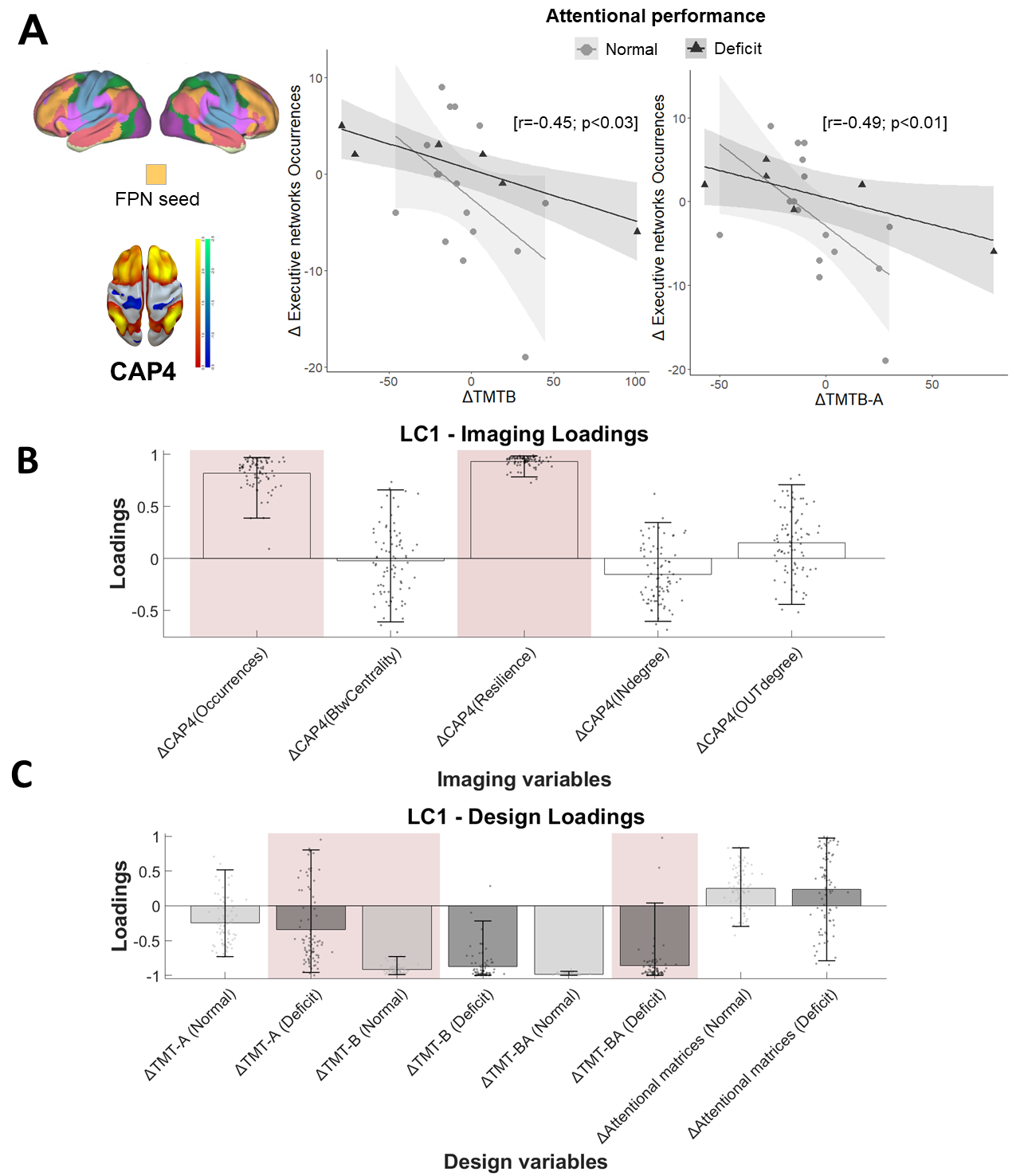
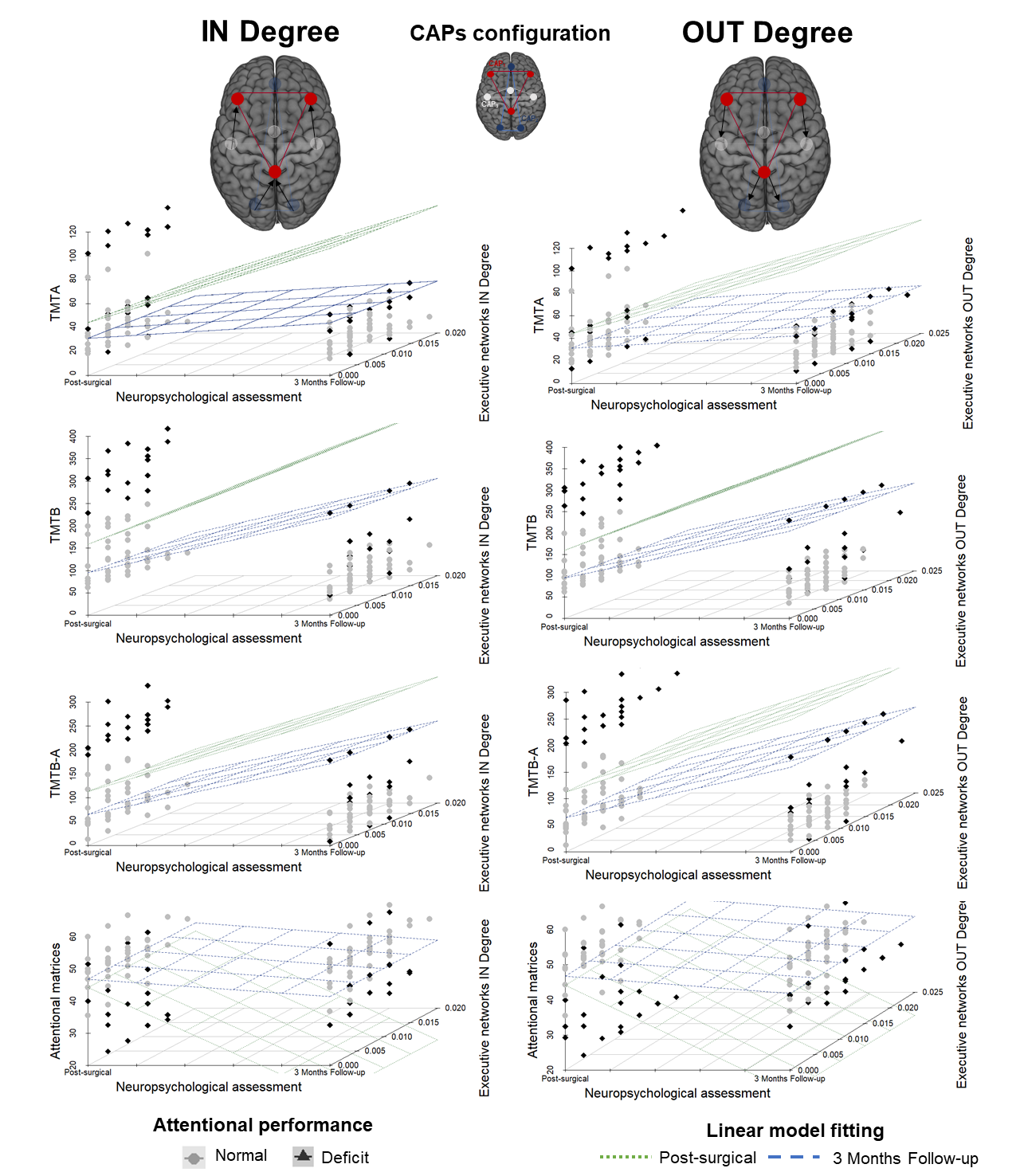
No significant longitudinal changes were found in temporal properties across glioma features and neuropsychological profile. Only one state related to the FPN (CAP4) resulted to be strictly correlated with the cognitive profile (Figure 1A). Indeed, longitudinal variation in executive control components of the TMT test (ΔTMTB and ΔTMTB-A) were found to be negatively associated with longitudinal changes in temporal duration of the state CAP4. Functional signatures of post-surgical attentional deficits confirmed an involvement of FPN properties: PLS with CAP4 revealed one significant latent component (LC; p-value<0.01; Figure 1B and 1C) explaining a strong correlation between behavioral and imaging score of r-value=0.80. Furthermore, linear mixed models (p-value<0.05; Figure 2) showed that not only post-surgical attentive deficits can be predicted by longitudinal dynamic networks properties of FPN such as stability and transition to other states; but also that pre-surgical FPN temporal properties per se allow the projection of post-operative attentive deficits.Discussion
Previous studies showed how preserving the integrity of functional networks is crucial for the recovery of several cognitive systems and abilities after brain surgery6,8. However, prognostic attentive outcomes after surgery have been scarcely investigated. Recently, negative evidence in favor of an anatomo-functional pre-surgical predictor of executive dysfunction was reported9,10. Therefore, by aiming at a better understanding of the topography of executive function performance, we looked at plastic reorganization of temporal network properties. We probe how favorable postoperative attentive performance can be predicted, regardless of the typology of glioma, from presurgical resting-state dynamic properties of FPN. Specifically, presurgical high levels of transitions between FPN states (i.e. in and out degree) are negative predictors of attentive performance. Whereas, the longitudinal functional signatures of attentive profile are better explained by changes in temporal persistence of highly co-activated CAP4 (i.e. occurrences and resilience). The results indicate that potentially acting on temporal perturbations of this functional networking aimed at re-establishing the resilient occurrence of the state, even with other neuroimaging techniques such as brain stimulation, could pave the way for preventing attentional deficits resulting from surgery in glioma patients. Furthermore, these results strengthen the need to better investigate, even during awake surgery, time-related properties of complex networks interacting with higher cognitive performance to improve patients prognosis.Conclusions
Using pre-surgical rs-fMRI co-activation patterns for dynamic executive networking analysis, we uncovered patterns of brain network activation and properties associated with diverse attentive post-surgical performance. For the first time, we showed that the neuropsychological attentive outcome can be predicted by presurgical dynamic properties of executive functional networks alone, making temporal functional connectivity properties highly informative and relevant in the clinical field.Acknowledgements
This project was supported by the Autonomous Province of Trento, Italy (Project: “NeuSurPlan and integrated approach to neurosurgery planning based on multimodal data") and the Dipartimento di Eccellenza project 2018-2022 (Italian Ministry of Education, University and Research).References
- Zacà D, Jovicich J, Corsini F, Rozzanigo U, Chioffi F, Sarubbo S (2018) ReStNeuMap: a tool for automatic extraction of resting-state functional MRI networks in neurosurgical practice. J Neurosurg.
- Dallabona M, Sarubbo S, Merler S, Corsini F, Pulcrano G, Rozzanigo U, Chioffi F (2017) Impact of mass effect, tumor location, age, and surgery on the cognitive outcome of patients with high-grade gliomas: A longitudinal study. Neuro Oncol Pract 4(4):229–240.
- Papagno C, Gallucci M, Casarotti A, Castellano A, Falini A, Fava E, Caramazza A (2011a) Connectivity constraints on cortical reorganization of neural circuits involved in object naming. Neuroimage 55(3):1306–1313.
- Papagno C, Miracapillo C, Casarotti A, Romero Lauro LJ, Castellano A, Falini A, Bello L (2011b) What is the role of the uncinate fasciculus? Surgical removal and proper name retrieval. Brain 134(2):405–414.
- Zigiotto L, Annicchiarico L, Corsini F, Vitali L, Falchi R, Dalpiaz C (2020a) Effects of supra-total resection in neurocognitive and oncological outcome of high-grade gliomas comparing asleep and awake surgery. J Neurooncol 148(1):97–108.
- Saviola, F., Zigiotto, L., Novello, L., Zacà, D., Annicchiarico, L., Corsini, F., ... & Sarubbo, S. (2022). The role of the default mode network in longitudinal functional brain reorganization of brain gliomas. Brain Structure and Function, 227(9), 2923-2937.
- Bolton, T. A., Tuleasca, C., Wotruba, D., Rey, G., Dhanis, H., Gauthier, B., ... & Van De Ville, D. (2020). TbCAPs: A toolbox for co-activation pattern analysis. Neuroimage, 211, 116621.
- Romero-Garcia, R., Mandal, A. S., Bethlehem, R. A., Crespo-Facorro, B., Hart, M. G., & Suckling, J. (2023). Transcriptomic and connectomic correlates of differential spatial patterning among gliomas. Brain, 146(3), 1200-1211.
- Landers, M. J., Smolders, L., Rutten, G. J. M., Sitskoorn, M. M., Mandonnet, E., & De Baene, W. (2023). Presurgical executive functioning in low-grade glioma patients cannot be topographically mapped. Cancers, 15(3), 807.
- van Lingen, M. R., Breedt, L. C., Geurts, J. J., Hillebrand, A., Klein, M., Kouwenhoven, M. C., ... & Douw, L. (2023). The longitudinal relation between executive functioning and multilayer network topology in glioma patients. Brain Imaging and Behavior, 1-11.
Figures