0358
In vivo metabolism of glucose and acetate in human meningiomas: A 13C NMR-based metabolic flux analysis1Neurosurgery, Houston Methodist Hospital and Research Institute, Houston, TX, United States, 2Pathology and Genomic Medicine, Houston Methodist Hospital and Research Institute, Houston, TX, United States
Synopsis
Keywords: Tumors (Pre-Treatment), Metabolism, 13C NMR, stable isotopomer analysis, metabolic imaging
Motivation: Metabolism plays a key role in the growth and proliferation of brain tumors including aggressive meningiomas. We previously reported that meningiomas preferentially utilize acetate as a bioenergetic substrate. However, the metabolism of acetate in the presence of glucose is not well understood.
Goal(s): To investigate the simultaneous in vivo metabolism of acetate and glucose in meningiomas.
Approach: We infused [2-13C]acetate and [U-13C]glucose as metabolic tracers in meningioma patients to determine the relative utilization of both nutrients by meningiomas.
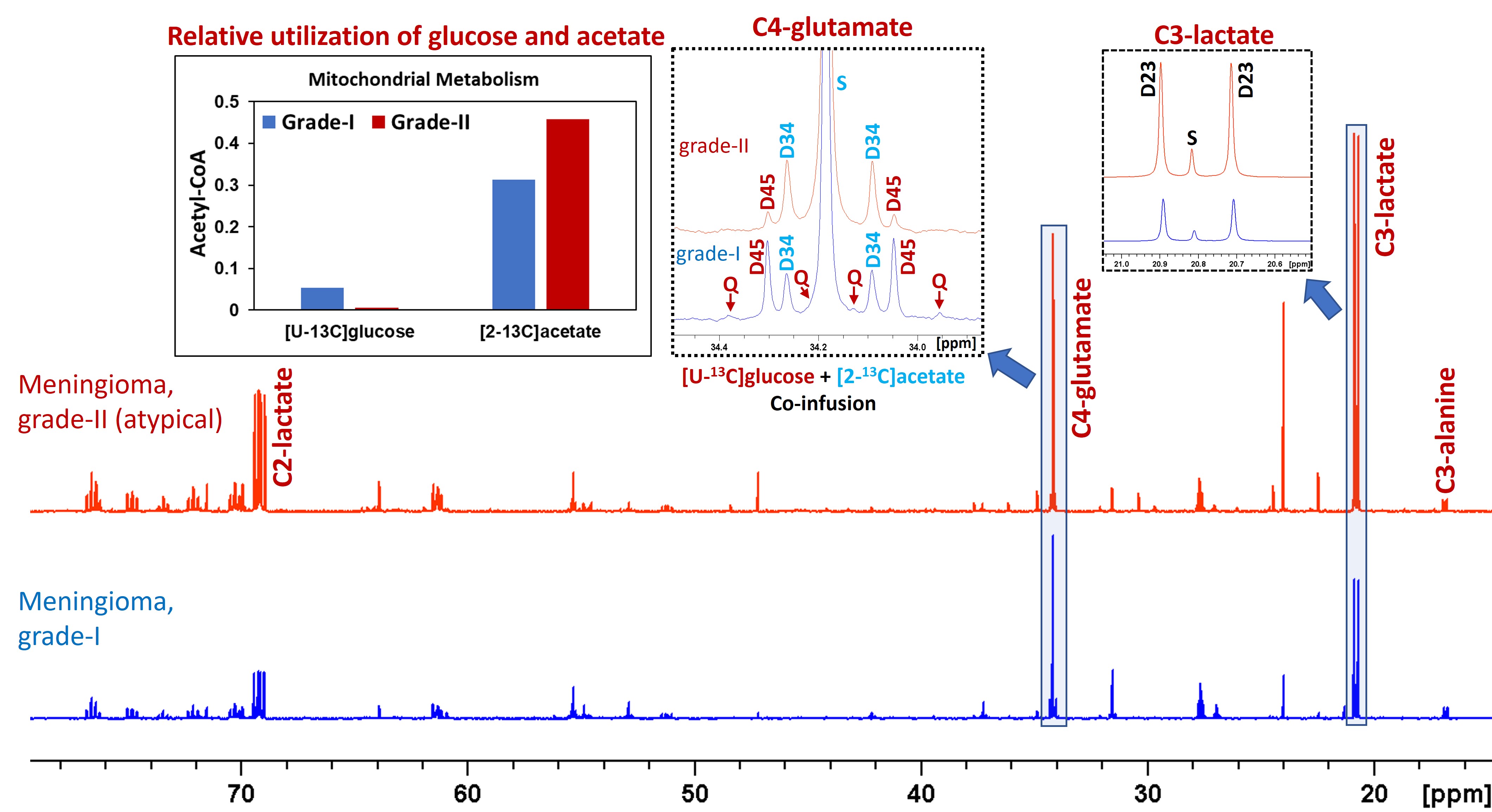
Results: Grade-II meningiomas utilize relatively less amount of glucose (grade-II: 0.6% vs. grade-I: ~5.4%) and more acetate than grade-I meningiomas (grade-II: 45.8% vs. grade-I: ~31.24%).
Impact: No chemotherapy is available for the treatment of meningiomas. The findings from this study will be helpful in designing targeted metabolic therapy for aggressive meningiomas using small molecule inhibitors (e.g., ACSS2 inhibitor) involved in acetate metabolism.
Introduction
Although the majority of meningiomas (~80%) are benign brain tumors, a subtype of these tumors called atypical meningiomas (WHO grade-II, ~18%) show aggressive behavior and present high risk of recurrence. Grade-II meningiomas show increased risk of recurrence. Currently, no chemotherapy is available for the treatment of meningiomas, and surgery followed by radiotherapy is the standard of care for the treatment of meningiomas1,2. Metabolism plays a key role in the growth and proliferation of meningiomas and metabolic phenotyping of histological subtypes of meningiomas will identify new targets for the metabolic therapy of these tumors2. We previously reported that meningiomas preferentially utilize acetate as a bioenergetic substrate3. However, the metabolism of acetate in the presence of glucose was not well understood. Here, we investigated the simultaneous in vivo metabolism of acetate and glucose in meningioma tumors by infusing [2-13C]acetate and [U-13C]glucose as metabolic tracers in meningioma patients and determined the relative utilization of both nutrients by meningiomas by 13C-NMR based isotopomer analysis4.Methods
Meningioma patients (grade-I = 2 and grade-II = 1) were enrolled at Houston Methodist Hospital, following the IRB protocol approved by Houston Methodist Hospital Institutional Review Board. 20% stock solutions of [U-13C]glucose and [2-13C]acetate were infused simultaneously (~2 hours prior to the surgical resection of the tumor) in meningioma patients undergoing brain surgery3,4. Blood and tumor tissue specimens were collected on dry-ice and were extracted in 5% perchloric acid, supernatants were vacuum dried and reconstituted in 180 µL D2O containing 1.0 mM DSS-d6 (pH = 7.4). 1H and 1H-decoupled 13C NMR data were collected on the reconstituted solutions using a Bruker 800 MHz spectrometer equipped with a cryo-probe.Results
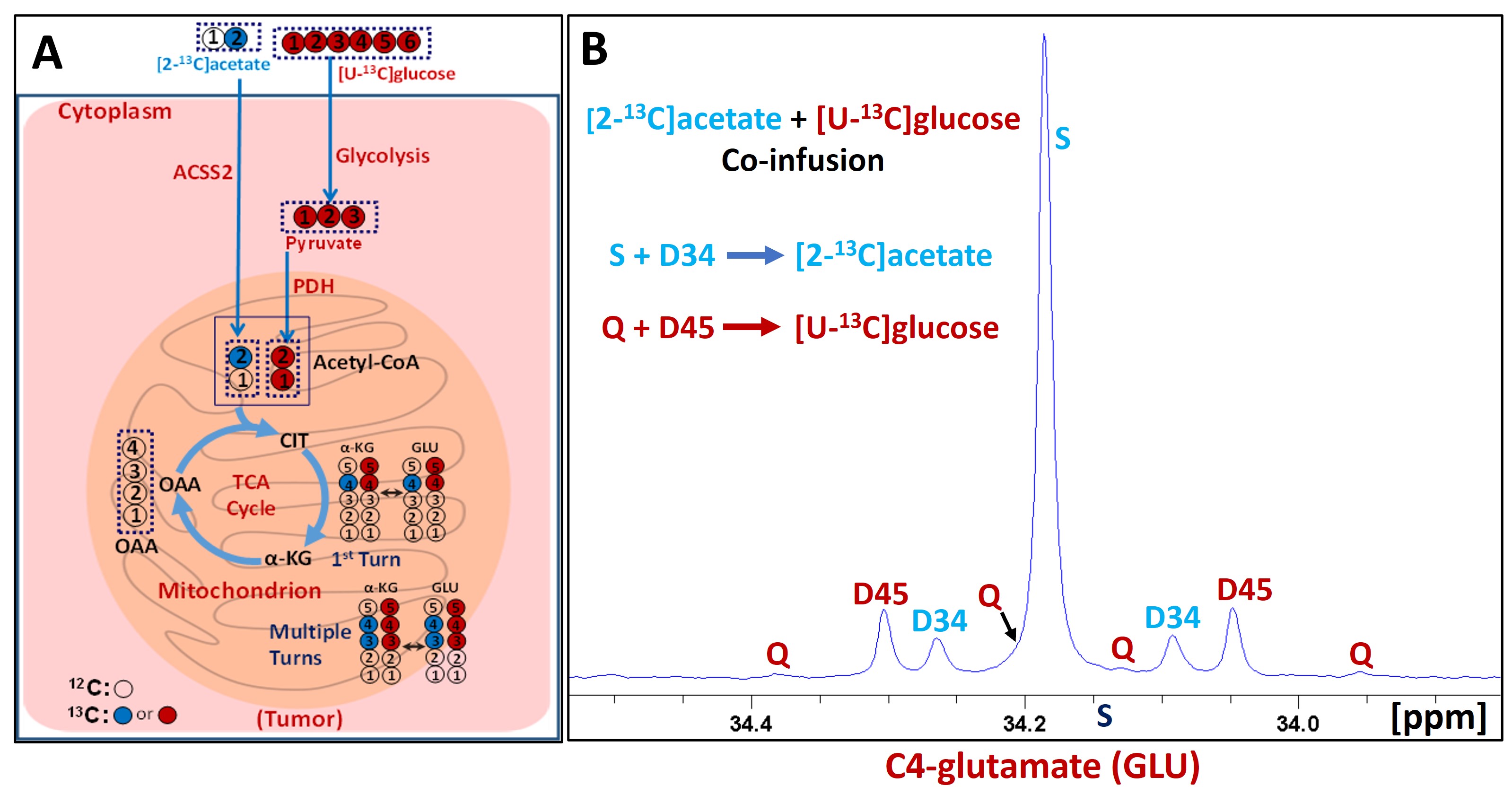
Figure 1(A) is a schematic showing metabolism of [2-13C]acetate and [U-13C]glucose in a tumor cell. [2-13C]acetate is converted to 2-13C]acetyl-CoA by the enzyme ACSS2. On the other hand, [U-13C]glucose is converted to [U-13C]pyruvate via glycolysis which generates [1,2-13C]acetyl-CoA through pyruvate dehydrogenase (PDH). [2-13C]acetyl-CoA enters the TCA cycle, condenses with unlabeled oxaloacetate (OAA) to form [4-13C] labeled α-ketoglutarate (α-KG) and glutamate (GLU) in the first turn of the cycle. After multiple turns of the cycle, carbons 3- and 4- of α-KG and glutamate get 13C-labeled. On the other hand, [U-13C]glucose-derived [1,2-13C]acetyl-CoA is converted to 4- and 5- 13C-labeled α-KG and glutamate (GLU) in the first turn of the TCA cycle. After multiple turns of the cycle, 3, 4, and 5 carbons of α-KG and glutamate are 13C-labeled to produce [3,4,5-13C] α-KG and glutamate (GLU). Figure 1(B) shows the portion of the 13C NMR spectrum of C4 signal of glutamate from the simultaneous infusion of [2-13C]acetate and [U-13C]glucose. The singlet (S) and the doublet (D34) are due to [4-13C]glutamate and [3,4-13C]glutamate respectively, which are derived from the metabolism of [2-13C]acetate. Doublet (D45) and the quartet (Q) are due [4,5-13C]glutamate, and [3,4,5-13C]glutamate respectively, which are derived from [U-13C]glucose metabolism.Figure 2 shows the 1H-decoupled 13C NMR spectra from the perchloric acid extracts of tumor tissues obtained from a grade-I and grade-II meningioma patients who were infused simultaneously with [U-13C]glucose and [2-13C]acetate during the surgical resection of tumor mass. Both tumors showed 13C-13C spin-coupled multiplets in various carbons of glycolytic and TCA cycle metabolites (e.g., C3-lactate refers to C3 carbon of lactate and C4-glutamate refers to glutamate C4 carbon). Levels of C3-lactate derived from [U-13C]glucose were relatively more in grade-II meningioma than in grade-I tumor. When comparing the mitochondrial metabolism, [2-13C]acetate derived C4-glutamate (the readout of the levels of acetyl-CoA) was higher in grade-II than in grade-I meningiomas (grade-II: 45.8% vs. grade-I: ~31.24%). On the other hand, [U-13C]glucose derived acetyl-CoA was relatively less in grade-II meningioma compared to the grade-I tumors (grade-II: 0.6% vs. grade-I: ~5.4%) (the bar chart in the inset).
Discussion
In our preliminary study, we found that grade-I meningiomas produced 4.20 ± 2.17% of acetyl-CoA from [U-13C]glucose only and 43.83 ± 2.17% acetyl-CoA from [1,2-13C]acetate only infusions. While grade-II tumors produced 10.1% acetyl-CoA from [U-13C]glucose only infusions3. In this study, we wanted to determine the relative utilization of glucose and acetate in meningioma tumors, by infusing [2-13C]acetate and [U-13C]glucose simultaneously. The study revealed that grade-II tumor produced only ~0.6% acetyl-CoA from glucose and 45.8% acetyl-CoA from acetate. On the other hand, grade-I tumors produced ~5.4% acetyl-CoA from glucose and 31.24% acetyl-CoA from acetate. These results suggests that more aggressive tumors such as grade-II meningiomas prefer acetate as a nutrient compared to more abundant glucose.Conclusion
We are enrolling more patients for this study and increasing the sample size will provide a better justification on the nutrient preference in meningioma tumors.Acknowledgements
We thank all the patients who participated in this study. This study is supported by the Donna and Kenneth R. Peak Foundation, The Kenneth R. Peak Brain and Pituitary Tumor Treatment Center at Houston Methodist Hospital, The Houston Methodist Foundation, The Taub Foundation, The Pauline Sterne Wolff Foundation, The Veralan Foundation, The Marilee A. and Gary M. Schwarz Foundation, The John S. Dunn Foundation, Contributions in honor of Will McKone. We also thank NMR and Drug Metabolism Core (Baylor College of Medicine, Houston, TX) for providing access to 800 MHz NMR spectrometer.References
1. Ostrom QT, Price M, Neff C, Cioffi G, Waite KA, Kruchko C, Barnholtz-Sloan JS. CBTRUS Statistical Report: Primary Brain and Other Central Nervous System Tumors Diagnosed in the United States in 2016-2020. Neuro Oncol. 2023 Oct 4;25(Supplement_4):iv1-iv99.
2. Ijare OB, Hambarde S, Brasil da Costa FH, Lopez S, Sharpe MA, Helekar SA, Hangel G, Bogner W, Widhalm G, Bachoo RM, Baskin DS, Pichumani K. Glutamine anaplerosis is required for amino acid biosynthesis in human meningiomas. Neuro Oncol. 2022 Apr 1;24(4):556-568.
3. Ijare OB, Powell S, Baskin DS, Pichumani K. Preferential utilization of acetate in human meningiomas. Proc. Intl. Soc. Mag. Reson. Med. 30 (2022)2655.
4. Mashimo T, Pichumani K, Vemireddy V, Hatanpaa KJ, Singh DK, Sirasanagandla S, Nannepaga S, Piccirillo SG, Kovacs Z, Foong C, Huang Z, Barnett S, Mickey BE, DeBerardinis RJ, Tu BP, Maher EA, Bachoo RM. Acetate is a bioenergetic substrate for human glioblastoma and brain metastases. Cell. 2014 Dec 18;159(7):1603-14.
Figures