0353
Zero-shot EPI Nyquist ghost correction with diffusion-based generative models and magnitude consistency regularization1Shenzhen Technology University, Shenzhen, China, 2Guangdong-Hongkong-Macau Institute of CNS Regeneration, Jinan University, Guangzhou, China, 3GE HealthCare MR Research, Beijing, China, 4Department of Radiology, The First Hospital of Tsinghua University, Beijing, China, 5Center for Biomedical Imaging Research, Department of Biomedical Engineering, School of Medicine, Tsinghua University, Beijing, China, 6Laboratory of Biomedical Imaging and Signal Processing, The University of Hong Kong, Hong Kong, China
Synopsis
Keywords: AI Diffusion Models, Data Processing, Phase error correct, Diffusion models.
Motivation: To address EPI phase error correction caused by the problem of inconsistent positive and negative phases.
Goal(s): We introduce an image prior-based method termed Phase Error Correction Diffusion-based Reconstruction with Echo Apart Magnitude-Consistency(PEC-DREAM).
Approach: The method was trained on structural imaging data, and it performs robustly the inference on EPI phase error correction task without specific model finetune. Here, we introduce novel data consistency including k-space and magnitude consistency to enhance the performance of the SGM during reverse diffusion.
Results: Experiments demonstrate the versatility of our approach across various scenarios, including human and rodent EPI, accelerated and non-accelerated imaging and SMS sampling.
Impact: The method we have proposed effectively addresses EPI phase error correction. Prospective experiments demonstrate the versatility of our innovative approach across various scenarios, and our method holds promise as a potent tool.
Introduction
Echo planar imaging (EPI) is important for medical diagnostics and research, but inconsistency between the positive and negative readout polarities can lead to Nyquist ghosting artifacts1,2,3. Recently, score-based generative models (SGMs) have shown promise for unsupervised image reconstruction by learning the distribution of high-quality images4,5,6. We propose a novel method, Phase Error Correction Diffusion-based Reconstruction with Echo Apart Magnitude-Consistency (PEC-DREAM), which uses SGMs to reconstruct images from uncorrected positive and negative echo k-space data and generates ghost-free images. Our method introduces k-space data and image magnitude consistency constraints during SGM reconstruction to maintain structural accuracy and prevent information loss, enhancing the reliability of the reconstruction process.Methods
1. The forward diffusion processWe establish a continuous score-base generative process denoted as x(t) over a specific time span, and t ranging from 0 to T, representing the time progression index. Initially, x(0) is configured to represent the distribution of high-quality images. Deliberately introducing various levels of noise to x(0) serves to disrupt distribution, resulting in a sequence of x(t). Notably, x(T) represents a pure Gaussian noisy distribution, indicating that the original image has been entirely distorted due to the significant addition of noise. Our method can be described by an equation, where noise is generated randomly, and sigma serves as a hyperparameter.
$$x(t) = x(0)+sigma×noise×t^2$$
2. Learning the reverse process at phase correct task
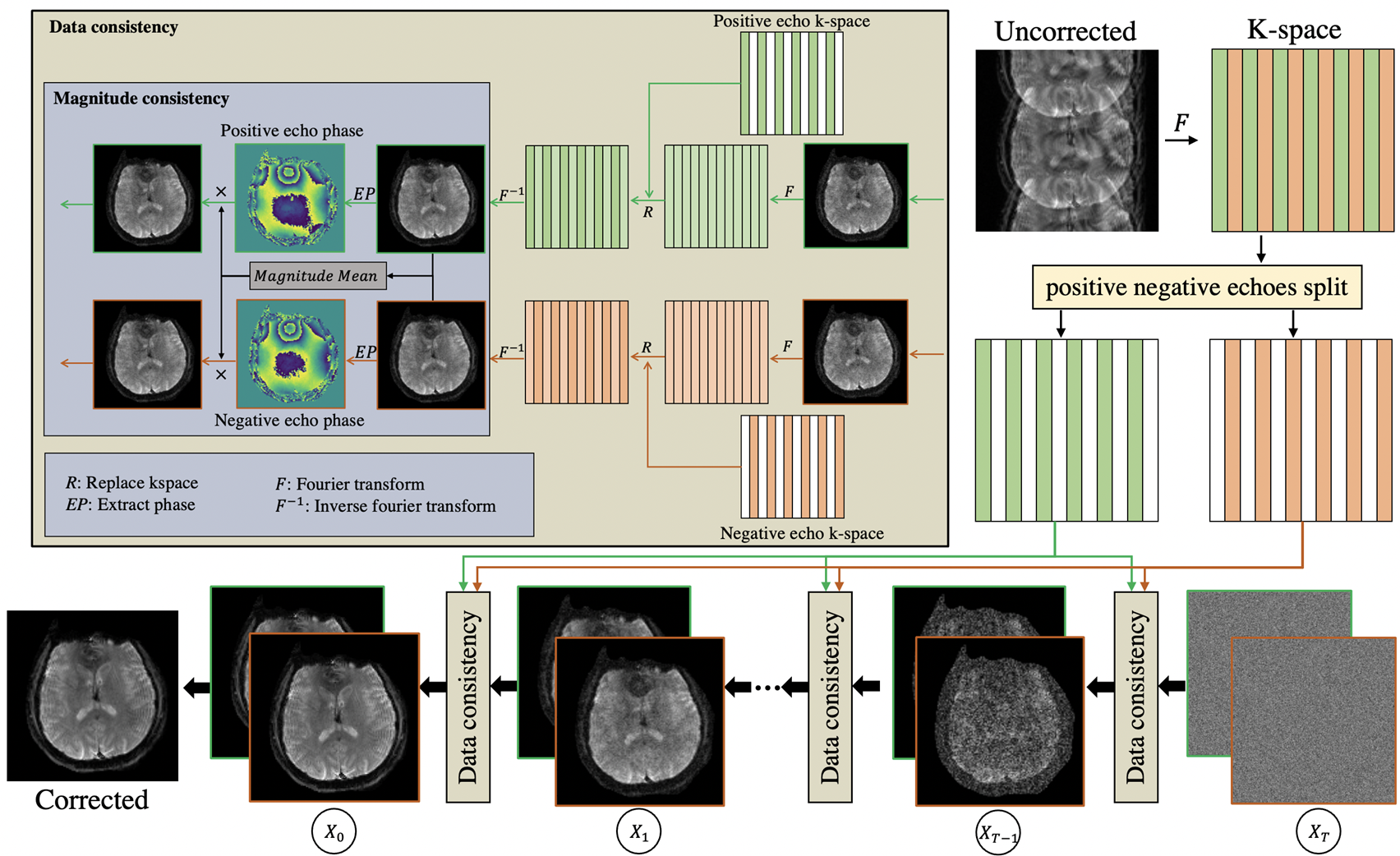
As shown in Fig. 1, during the inference process, given x(T), the Score-based Generative Model (SGM) and operations (ops) will denoise the noisy images to produce x(T-1). ops represent data consistency combined with both k-space and image magnitude consistency:
$$x(T-1)=ops(SGM(x(T),T))$$
As shown in Fig.1, the first step partitions the uncorrected image into positive and negative echo k-space components. Then, two noise images x(T) are randomly generated for each k-space and undergo k-space data consistency. Image magnitude consistency is then applied for these noise images. These enforced images are input into a U-Net model with temporal conditions for noise score computation. These scores are used to denoise the images iteratively over T times to recover the correct images of the positive and negative echoes.
K-space data consistency
Given two noisy images, we convert each into k-space using Fourier transform after expanding coil channels using the Coil Sensitivity Map (CSM). We replace the data points with the corresponding real k-space data where real data is acquired. The data is then channel combined by demodulating the CSM in image domain.
Image magnitude consistency (between positive and negative echo images)
As shown in Fig.1, for the noisy positive and negative echo images, we extract phase images from both of them. Then, we calculate the mean magnitude of the two images. Finally, we multiply the original phase images by the mean magnitude image to obtain the magnitude-consistency enforced images.
3. Model Implementation
We employed the diffusion model pretrained by Luo et.al7. on human MPRAGE images from ABIDE8,9.
4. Robustness test
We conducted an investigation into the robustness of PEC-DREAM using real EPI data, including both prospectively accelerated and unaccelerated scenarios. Additionally, we evaluated it on out-of-distribution data, which was a set of simultaneously multislice (SMS) accelerated rat brain EPI data.
Results
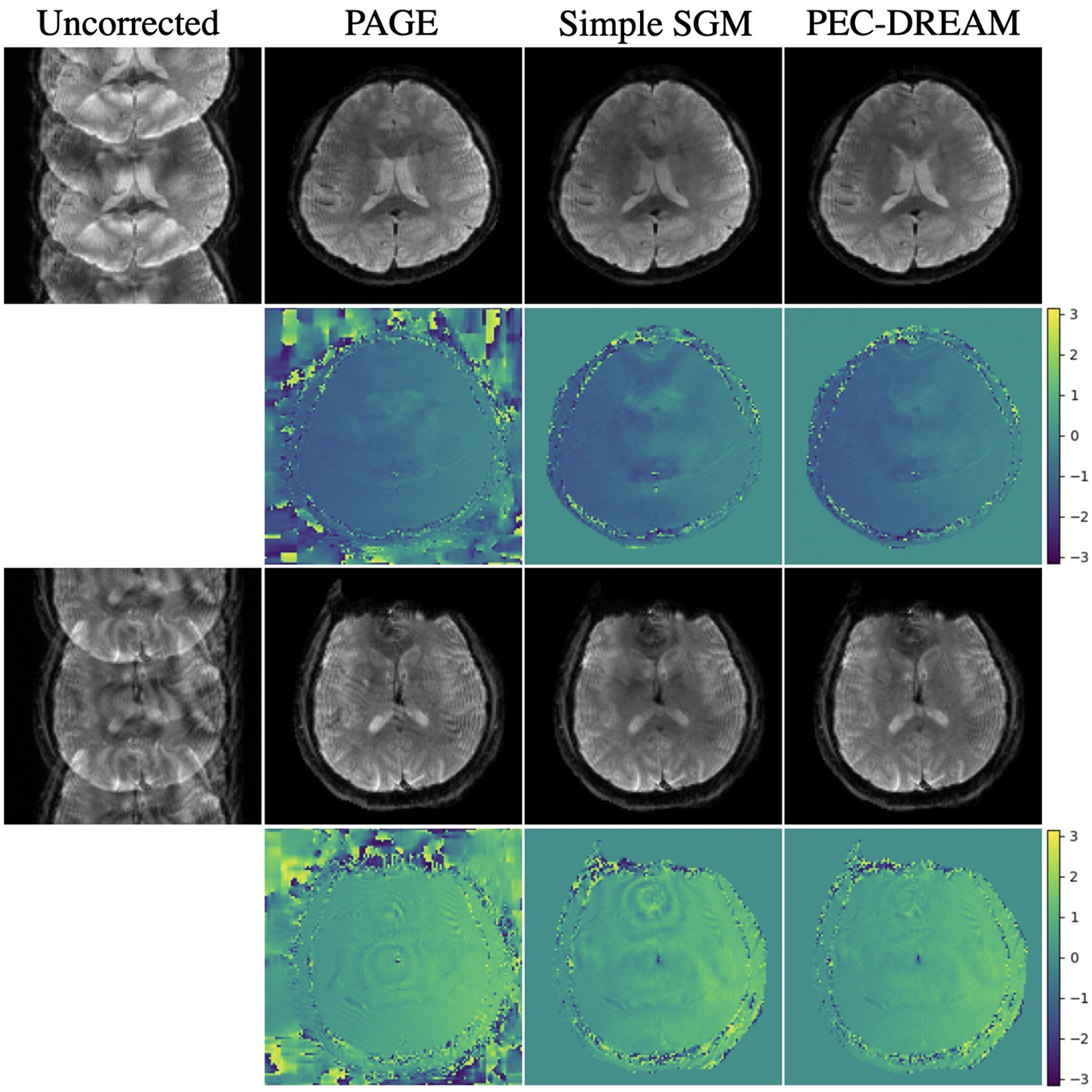
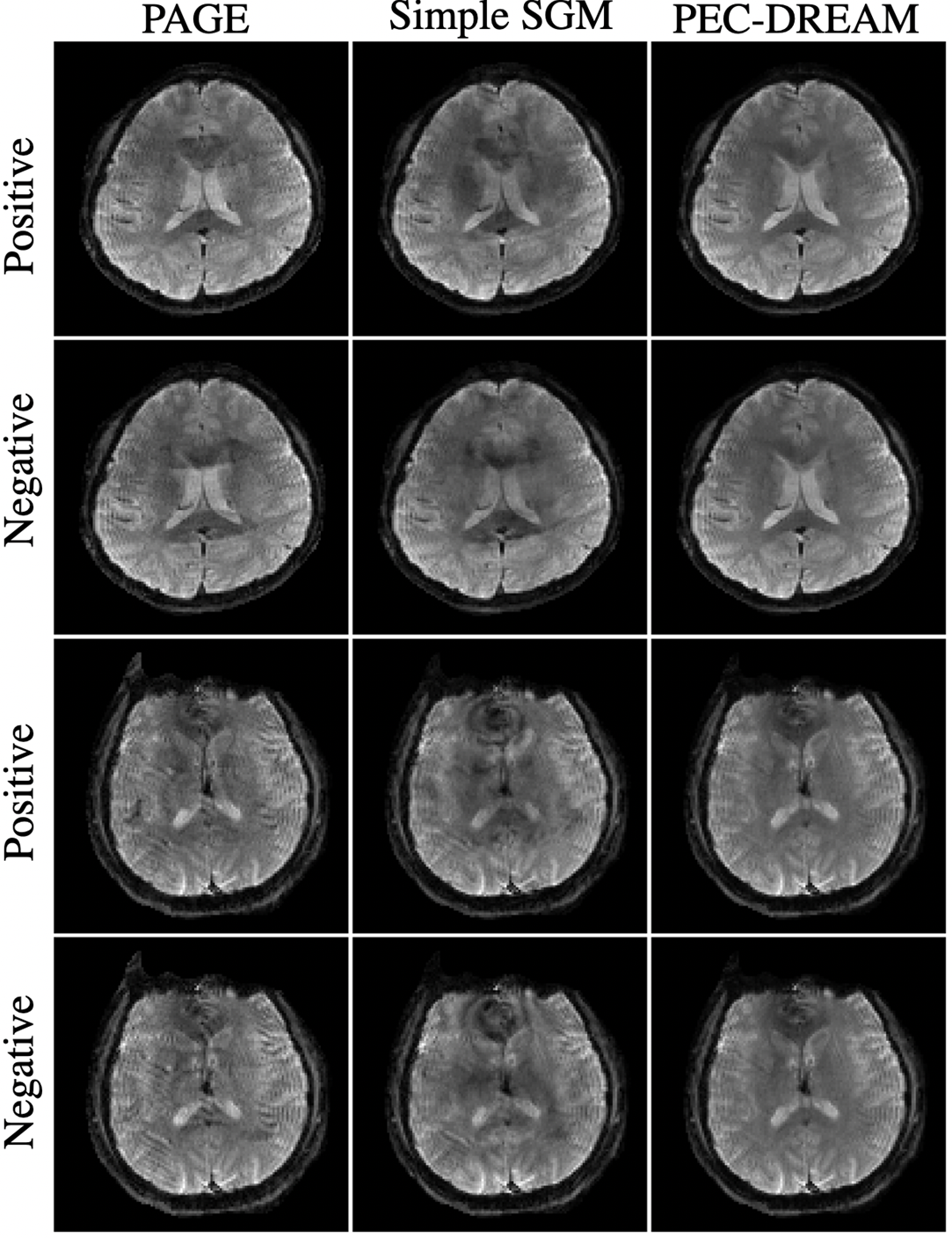
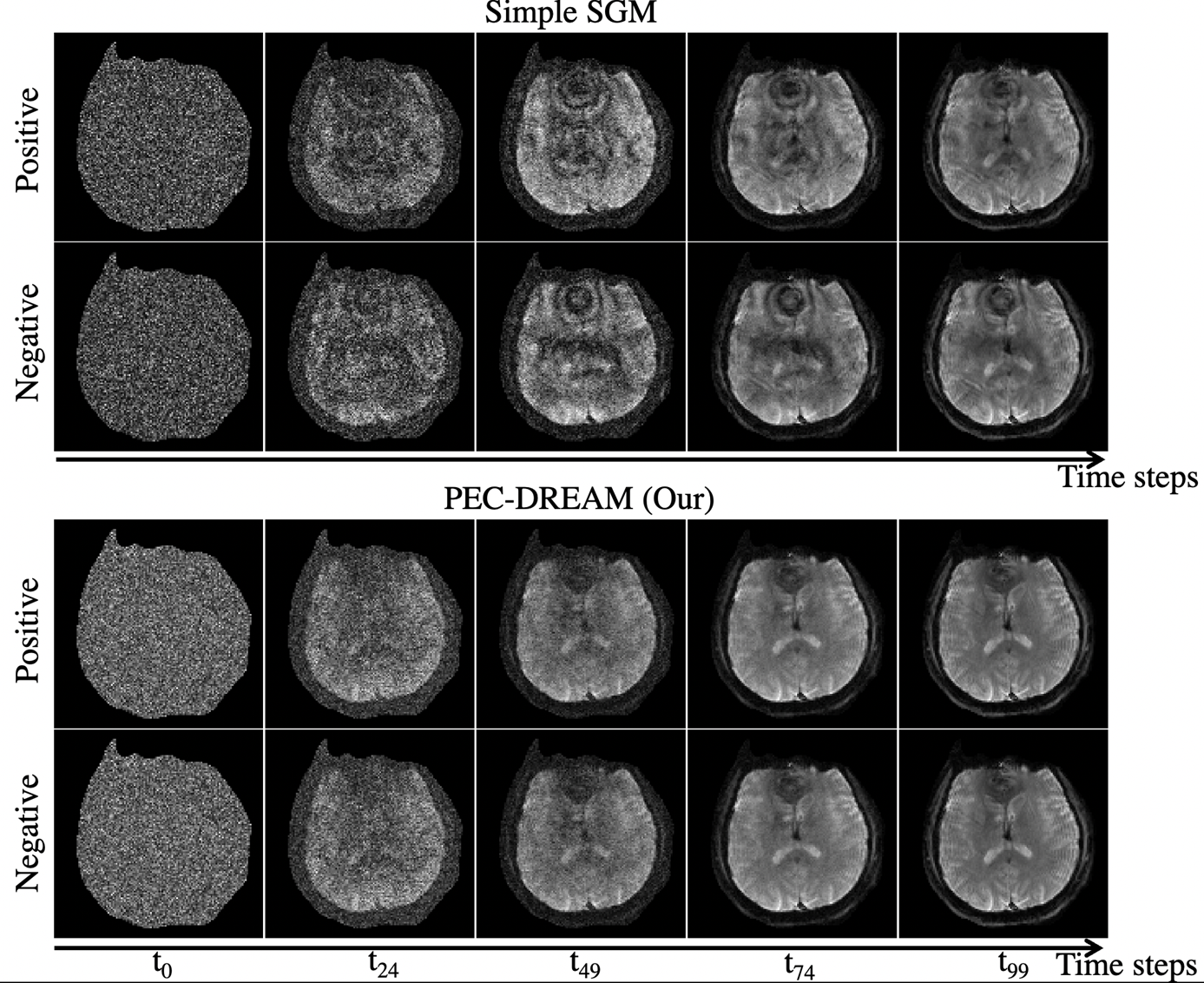
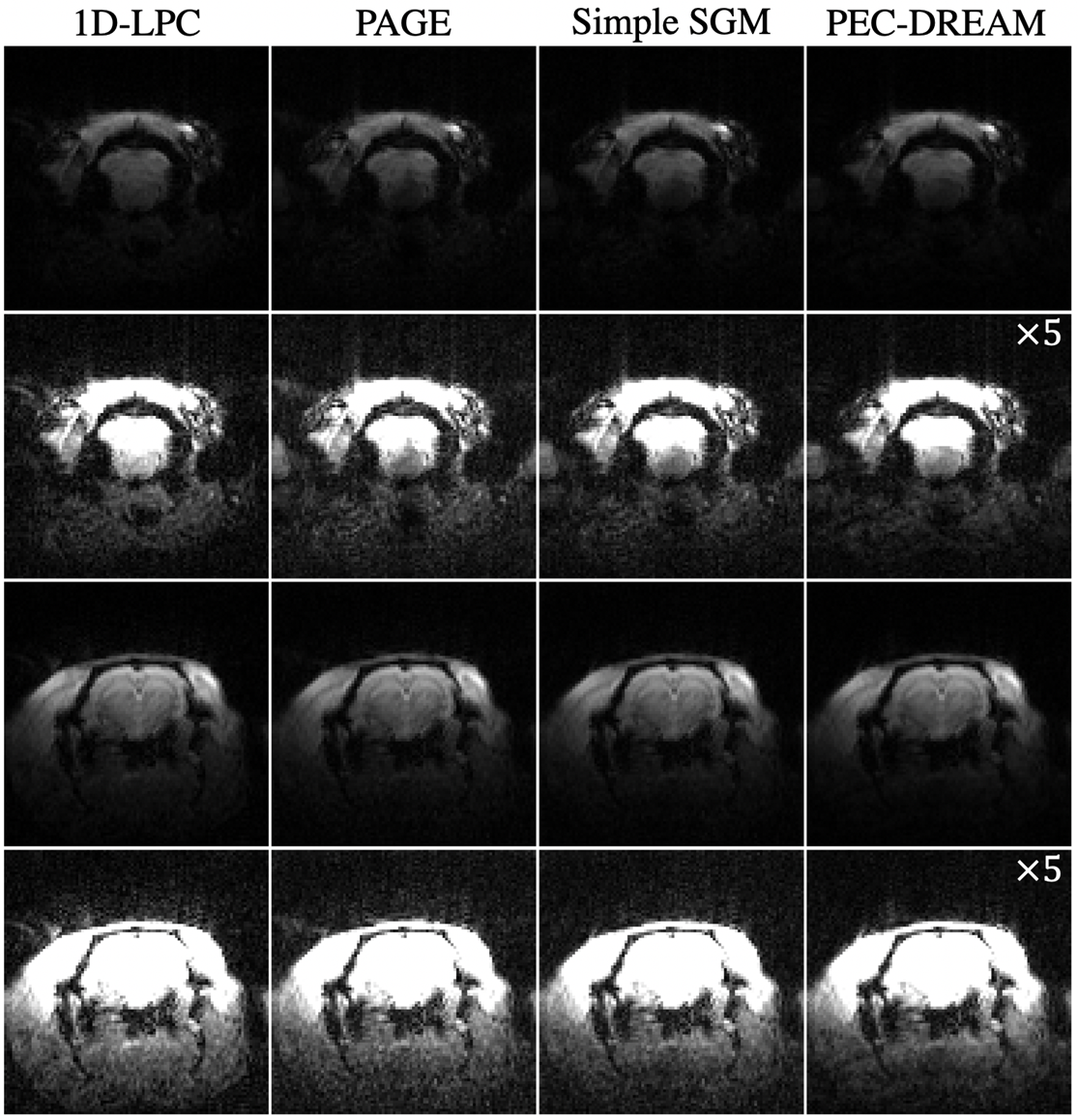
In our experiments, we compared our approach with Phased Array Ghost Elimination (PAGE)10, Simple SGM (similar to the proposed method but without magnitude consistency), and the proposed PEC-DREAM. As depicted in Fig. 2, PEC-DREAM exhibits fewer artifacts in the final magnitude images. As shown in Fig. 3, our method demonstrates greater robustness in recovering positive and negative echo images. As revealed in Fig. 4, it is evident that image magnitude consistency is an essential component in our proposed method. Importantly, the results in Fig. 5 underscore that PEC-DREAM, initially trained on human data, can directly reconstruct datasets acquired using SMS sampling in a rat brain, and leads to less ghosting than other methods as demonstrated by enhanced brightness images. This achievement is often very challenging for many deep learning approaches.Discussion and Conclusion
Across all comparative experiments, our approach outperforms PAGE and Simple SGM based ghost correction. Moreover, when compared to Simple SGM, it becomes evident that our proposed image magnitude consistency constraint is highly effective and crucial. Notably, our PEC-DREAM approach showcases zero-shot generalization capabilities, excelling not only with human brain data, but also with the out-of-distribution rat brain SMS accelerated data without fine-tuning. This ability is likely due to the step-by-step reverse diffusion process. In this study, we used model pretrained on structural imaging data. In the future, we plan to include EPI data training for even more robust phase error correction.Acknowledgements
This work was supported in part by the National Natural Science Foundation of China under Grant 62101348, the Shenzhen Higher Education Stable Support Program under Grant 20220716111838002, and the Natural Science Foundation of Top Talent of Shenzhen Technology University under Grants 20200208, GDRC202117, and GDRC202134.References
1. Liu, Y., Lyu, M., Barth, M., Yi, Z., Leong, A. T., Chen, F., ... & Wu, E. X. (2019). PEC‐GRAPPA reconstruction of simultaneous multislice EPI with slice‐dependent 2D Nyquist ghost correction. Magnetic Resonance in Medicine, 81(3), 1924-1934.
2. Xie, V. B., Lyu, M., Liu, Y., Feng, Y., & Wu, E. X. (2018). Robust EPI Nyquist ghost removal by incorporating phase error correction with sensitivity encoding (PEC‐SENSE). Magnetic resonance in medicine, 79(2), 943-951.
3. Lyu, M., Barth, M., Xie, V. B., Liu, Y., Ma, X., Feng, Y., & Wu, E. X. (2018). Robust SENSE reconstruction of simultaneous multislice EPI with low‐rank enhanced coil sensitivity calibration and slice‐dependent 2D Nyquist ghost correction. Magnetic Resonance in Medicine, 80(4), 1376-1390.
4. Song, Y., Durkan, C., Murray, I., & Ermon, S. (2021). Maximum likelihood training of score-based diffusion models. Advances in Neural Information Processing Systems, 34, 1415-1428.
5. Chung, H., & Ye, J. C. (2022). Score-based diffusion models for accelerated MRI. Medical image analysis, 80, 102479.
6. Luo, G., Blumenthal, M., Heide, M., & Uecker, M. (2023). Bayesian MRI reconstruction with joint uncertainty estimation using diffusion models. Magnetic Resonance in Medicine, 90(1), 295-311.
7. Luo, G., Wang, X., Blumenthal, M., Schilling, M., Rauf, E. H. U., Kotikalapudi, R., ... & Uecker, M. (2023). Generative Image Priors for MRI Reconstruction Trained from Magnitude-Only Images. arXiv preprint arXiv:2308.02340.
8. Di Martino, A., Yan, C. G., Li, Q., Denio, E., Castellanos, F. X., Alaerts, K., ... & Milham, M. P. (2014). The autism brain imaging data exchange: towards a large-scale evaluation of the intrinsic brain architecture in autism. Molecular psychiatry, 19(6), 659-667.
9. Di Martino, A., O’connor, D., Chen, B., Alaerts, K., Anderson, J. S., Assaf, M., ... & Milham, M. P. (2017). Enhancing studies of the connectome in autism using the autism brain imaging data exchange II. Scientific data, 4(1), 1-15.Chicago
10. Kellman, P., & McVeigh, E. R. (2006). Phased array ghost elimination. NMR in Biomedicine: An International Journal Devoted to the Development and Application of Magnetic Resonance In vivo, 19(3), 352-361.
Figures