0343
Clinically Feasible Diffusion Reconstruction for Highly-Accelerated Cardiac Cine MRI1United Imaging Intelligence, Burlington, MA, United States, 2Biomedical Imaging Research Institute, Cedars-Sinai Medical Center, Los Angeles, CA, United States, 3Department of Bioengineering, UCLA, Los Angeles, CA, United States, 4Department of Radiation Oncology and Winship Cancer Institute, Emory University, Atlanta, GA, United States, 5Department of Biomedical Informatics, Emory University, Atlanta, GA, United States, 6UIH America, Inc., Houston, TX, United States
Synopsis
Keywords: AI/ML Image Reconstruction, Heart
Motivation: The currently limited quality of accelerated cardiac cine reconstruction may potentially be improved by the emerging diffusion models, but the clinically unacceptable long processing time poses a challenge.
Goal(s): To develop a clinically feasible diffusion-model-based reconstruction pipeline to improve the image quality of cine MRI.
Approach: A multi-in-multi-out diffusion enhancement model together with fast inference strategies were developed to be used in conjunction with a reconstruction model.
Results: The diffusion reconstruction reduced spatial and temporal blurring in prospectively undersampled clinical data, as validated by experts’ inspection. The 1.5s/video processing time enabled the approach to be applied in clinical scenarios.
Impact: The proposed diffusion reconstruction pipeline provides a practical solution to cardiac cine reconstruction with enhanced quality for clinical usage. This pipeline may be transfered to the clinical application of other diffusion-based methods.
Introduction
Accelerated cardiac cine MRI enables imaging heart motion with shortened or even no breath-holding, thus useful for heart function evaluation in patients. The challenge of a clinical feasible high acceleration centers around the need to reconstruct images from greatly undersampled data within acceptable time. While deep learning (DL) approaches based on convolutional neural networks (CNN) achieved remarkable performance in de-aliasing, their results still suffer from spatial and temporal blurring.1,2Denoising diffusion probabilistic models (DDPM)3 are an emerging class of generative models, able to provide realistic images. Diffusion-model-based reconstruction have shown potential in improving image quality.4-9 However, inference with diffusion models relies on an iterative process. For reconstructing 2D multi-coil complex MRI data, minutes to hours of processing time was reported,4,6-9 which makes diffusion models infeasible in clinical usage. This is more challenging to cine MRI since a video from one slice contains ~20 images, with ~8 slices covering the whole heart.
In this study, we aim to develop a clinically feasible diffusion reconstruction pipeline. A partial diffusion procedure was adopted for a conditional diffusion model, which was constructed to perform enhancement on magnitude data of initial CNN reconstructions, with pseudo data consistency to ensure data fidelity. A multi-in-multi-out processing was designed for dynamic images for speeding up and temporal consistency. With common settings, we achieved diffusion reconstruction with orders of speed-up at an additional 1.5 sec per cine video. The approach underwent evaluation by experts on real-world clinical data.
Methods
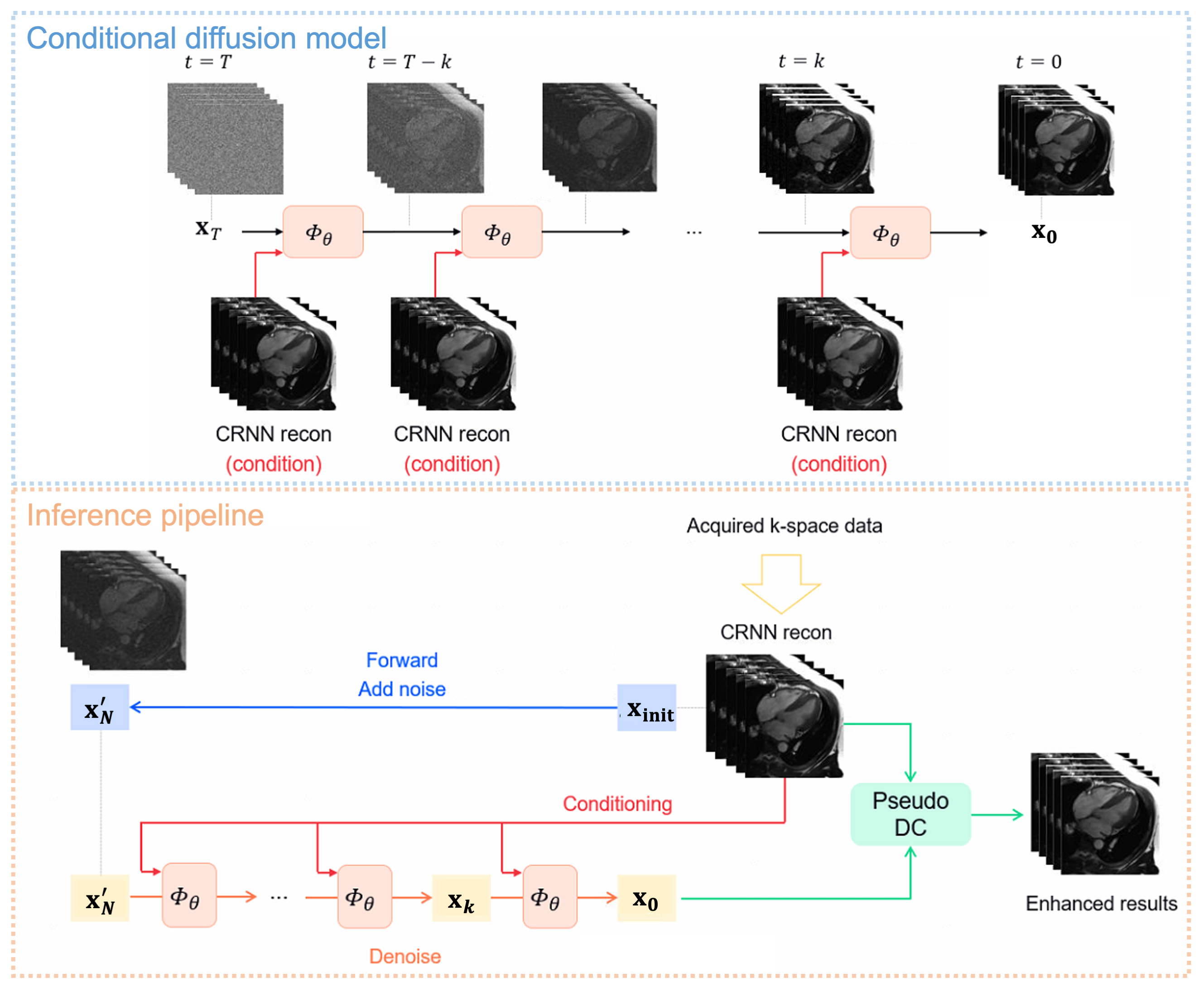
Diffusion-based enhancement for magnitude MRIA single-step residual convolutional recurrent neural network (CRNN)1 took the raw k-space and generated initial de-aliased images but with remaining spatial and temporal blurring. A conditional diffusion model input the magnitude image of this DL reconstruction (DLrecon) and made enhancements to it based on the prior knowledge it learned from paired DLrecon and fully sampled images.
Fast diffusion sampling
Applying diffusion models involves a progressive denoising process from Gaussian noises. Instead of the original DDPM method with 1000 steps, an improved DDPM10 with 50 steps was used. Additionally, during inference, a simulated intermediate step was generated by adding noises to the DLrecon, from which the denoising process started, thereby further shortening the inference to 10 steps.11
Multi-in-multi-out model
Considering the 2D+time nature of cine data, a multi-in-multi-out strategy was adopted to improve temporal consistency, in which three consecutive cardiac phases were concatenated as channels. This parallel design also sped up the processing.
Pseudo data consistency
Since CRNN reconstruction already enforced data fidelity, a pseudo data consistency (pDC) step was designed on the magnitude images, where the k-space of enhanced images within sampled region was replaced with the ones of DLrecon.
Data and experiments
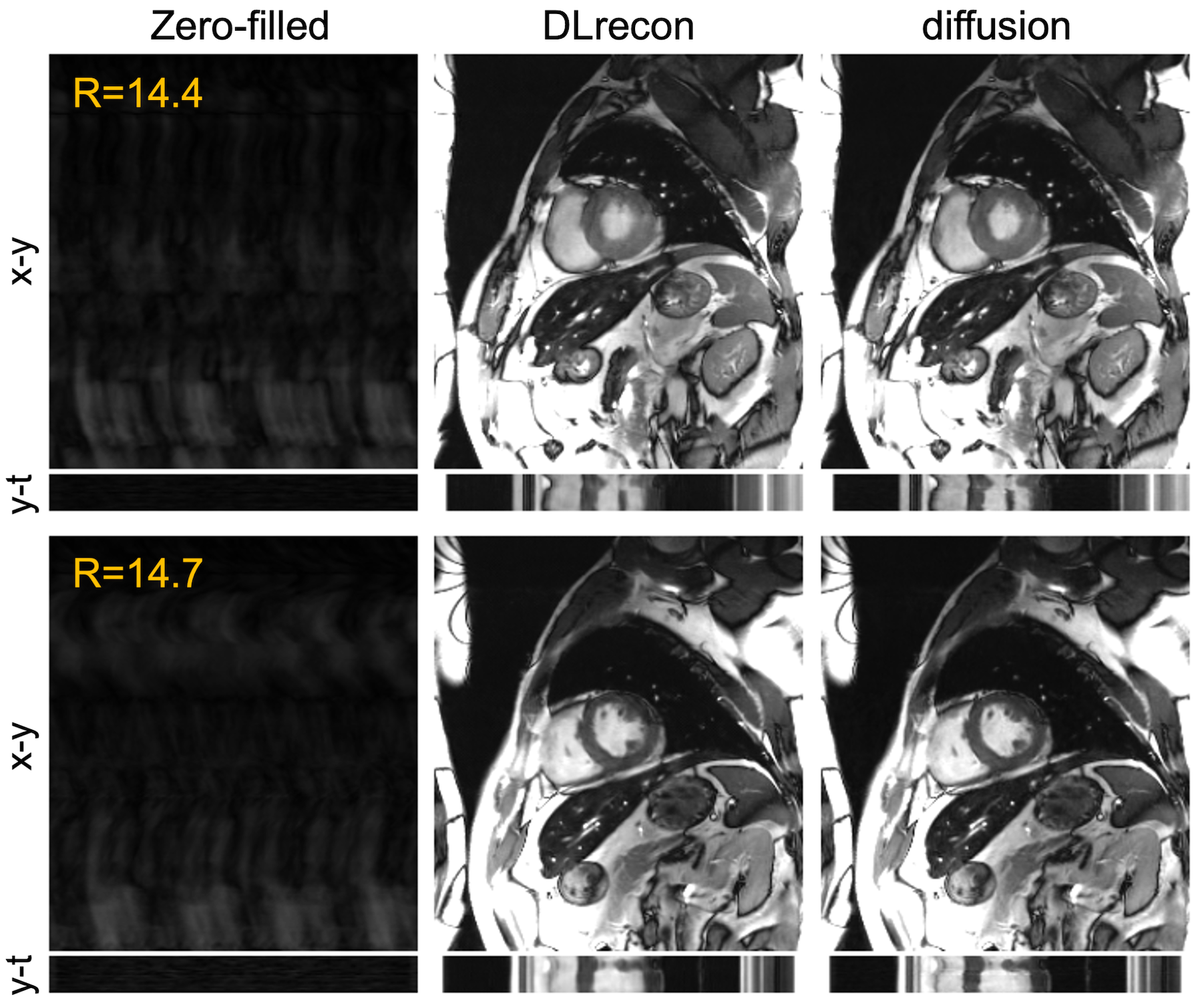
Cine bSSFP data were collected from volunteers with local IRB approval on 3T MRI scanners (uMR790, UIH, Shanghai, China). Retro-cine data of 1071 cine videos from 43 subjects were split into train/validation/test sets with a ratio of 6/2/2. Real-time undersampling masks (acceleration x8~16) were retrospectively applied. Additional real-time cine of 16 videos from two subjects were acquired to test the approach in real-world scenarios. Imaging parameters include spatial resolution 1.82x1.82 mm2 and temporal resolution 34ms and 42ms for retro and real-time, respectively. Two experienced (>10yr) experts provided rankings for quality evaluation.
Results
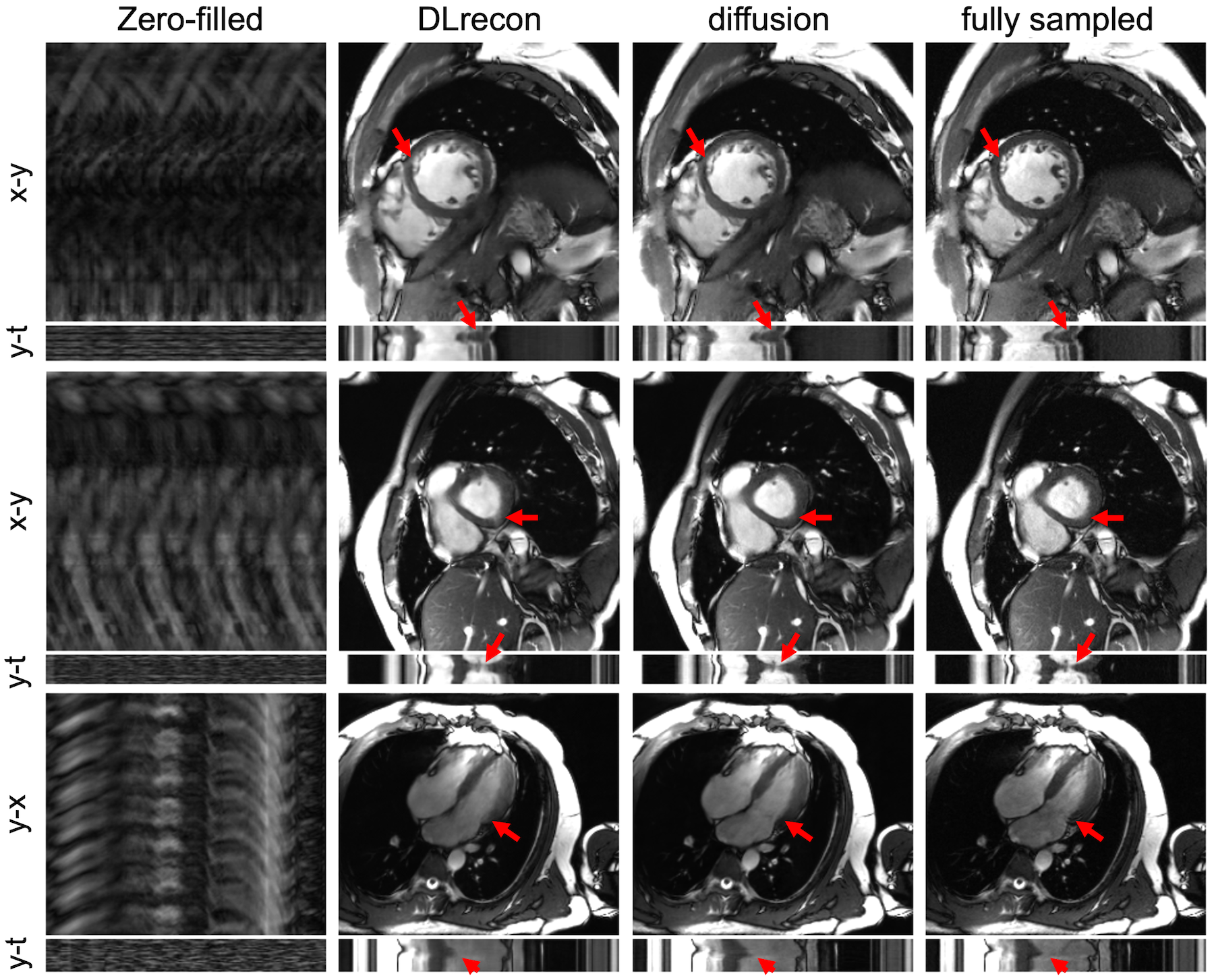
As shown in Figure 2, the diffusion model provided images with sharper edges and details as well as less motion blurring than the original DLrecon. Experts’ inspection further confirmed this improved sharpness and quality (Table 1). Results in real-time cine were consistent with the retro-cine ones.The average processing time for one 25-phase slice is 1.5s on a Tesla V100 GPU, which is much faster (>3600) than other diffusion reconstruction methods (Table 2).
Discussion
The proposed framework provides high-quality cine images at a time cost of additional 0.06s per image, which is orders faster than existing ones. For sequential multi-slice cine scans, this translates to about an additional 1.5s for the whole stack, making diffusion-based reconstruction applicable in clinical settings.Images from the diffusion-based method are sharper both spatially and temporally than DLrecon. The diffusion results give cleaner images than the fully-sampled, and are preferred in overall quality given its balanced performance between noise and sharpness.
In this work, the method was implemented in PyTorch with a common setup. In future, the processing time can be further shortened via parallel programming model such as TensorRT.
Conclusion
A diffusion reconstruction pipeline was developed that can be translated to clinical usage, as supported by the validated improved image quality and a 1.5s/slice fast inference speed.Acknowledgements
No acknowledgement found.References
1. Chen EZ, Chen X, Lyu J, et al. Real-time cardiac cine MRI with residual convolutional recurrent neural network. arXiv preprint arXiv:200805044. 2020.
2. Hauptmann A, Arridge S, Lucka F, Muthurangu V, Steeden JA. Real‐time cardiovascular MR with spatio‐temporal artifact suppression using deep learning–proof of concept in congenital heart disease. Magn Reson Med. 2019;81(2):1143-1156.
3. Ho J, Jain A, Abbeel P. Denoising diffusion probabilistic models. Advances in neural information processing systems. 2020;33:6840-6851.
4. Chung H, Ye JC. Score-based diffusion models for accelerated MRI. Medical image analysis. 2022;80:102479.
5. Song Y, Shen L, Xing L, Ermon S. Solving inverse problems in medical imaging with score-based generative models. arXiv preprint arXiv:211108005. 2021.
6. Jalal A, Arvinte M, Daras G, Price E, Dimakis AG, Tamir J. Robust compressed sensing mri with deep generative priors. Advances in Neural Information Processing Systems. 2021;34:14938-14954.
7. Luo G, Blumenthal M, Heide M, Uecker M. Bayesian MRI reconstruction with joint uncertainty estimation using diffusion models. Magn Reson Med. 2023;90(1):295-311.
8. Peng C, Guo P, Zhou SK, Patel VM, Chellappa R. Towards performant and reliable undersampled MR reconstruction via diffusion model sampling. Paper presented at: International Conference on Medical Image Computing and Computer-Assisted Intervention2022.
9. Gungor A, Dar SU, Ozturk S, et al. Adaptive diffusion priors for accelerated MRI reconstruction. Med Image Anal. 2023;88:102872.
10. Nichol AQ, Dhariwal P. Improved denoising diffusion probabilistic models. Paper presented at: International Conference on Machine Learning2021.
11. Chung H, Sim B, Ye JC. Come-closer-diffuse-faster: Accelerating conditional diffusion models for inverse problems through stochastic contraction. Paper presented at: Proceedings of the IEEE/CVF Conference on Computer Vision and Pattern Recognition2022.
Figures