0300
The Rugby Connectome: A Longitudinal Analysis of Structural Connectivity in an Adolescent Cohort with Repeated Head Impacts1Auckland Bioengineering Institute, University of Auckland, Auckland, New Zealand, 2Mātai Medical Research Institute, Tairāwhiti-Gisborne, New Zealand, 3Department of Ophthalmology, University of Auckland, Auckland, New Zealand, 4Vision Research Foundation, Auckland, New Zealand, 5General Electric Healthcare, Victoria, Australia, 6School of Computer Science, Faculty of Science, University of Auckland, Auckland, New Zealand, 7Faculty of Medical and Health Sciences & Centre for Brain Research, University of Auckland, Auckland, New Zealand
Synopsis
Keywords: Structural Connectivity, Adolescents
Motivation: Evidence suggests that repeated head impacts which do not produce conscious changes in cognition, may have detrimental effects on neurological function and brain micro-structure.
Goal(s): Our study aims to quantify longitudinal changes in structural connectivity within a cohort of young rugby players throughout a rugby season.
Approach: Using head impact data and advanced MRI techniques including whole brain tractography from multi-shell diffusion MRI, structural connectivity adjacency matrices were derived from tractograms and analyzed using graph theory.
Results: Global clustering coefficient increased significantly from preseason to mid-season and post-season. These changes correlated with measures of cumulative head impact exposure.
Impact: Data from our adolescent rugby cohort offers a rare opportunity to document the longitudinal effect of repeated head impact exposure on structural connectivity. The structural connectivity changes we observed may not be indicative of clinically relevant brain injury.
Introduction
Rugby involves a significant amount of collision contact, which can lead to mild traumatic brain injury (mTBI). Evidence suggests that repeated head impacts which do not produce conscious changes in cognition, may also have detrimental effects on neurological function and brain microstructure (1, 2). One method to quantify disrupted brain structural integrity is the analysis of structural connectivity networks (3). Structural connectivity networks are constructed by estimating the connectivity between predefined brain regions using methods such as full brain tractography (4). Numerous studies have examined structural connectivity differences between mTBI and control patients in an outpatient setting (5, 6), yet there is a scarcity of research on the effects of exposure to repeated head impacts through participation in sport. This study seeks to explore how repeated head impacts, recorded by sensor-equipped mouthguards, influence network topology metrics.Method
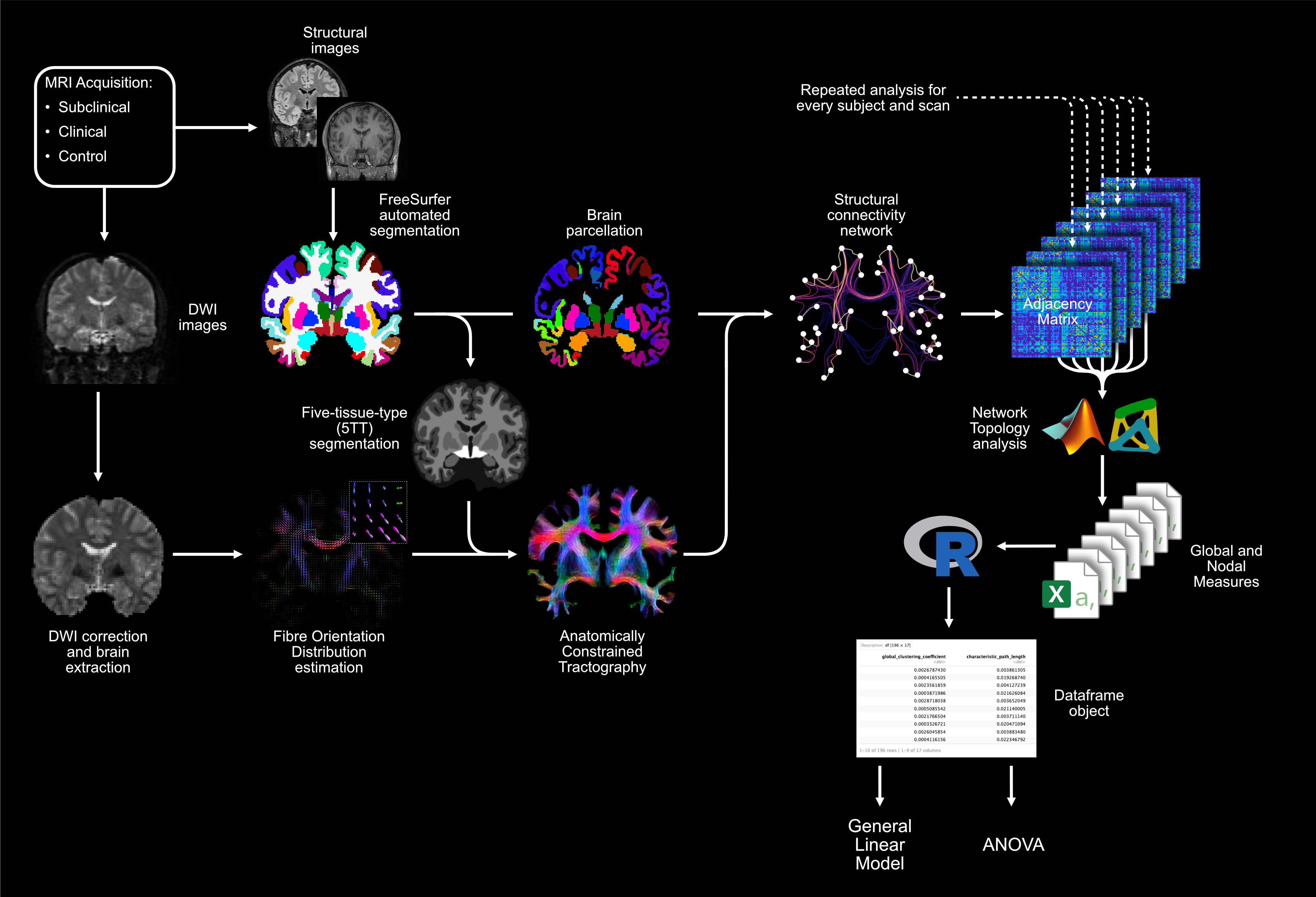
Thirty-seven players aged 14-18 years, were invited to participate in the study. Those with a prior concussion within the last six months were excluded. Multi-shell spin-echo diffusion-weighted scans, 3D T1-weighted, and T2-FLAIR scans were acquired using a 3T GE SIGNA Premier MRI scanner. Scans were acquired during the early season (n=37), mid-season (n=22), and post-season (n=23). A HitIQ® sensor mouthguard custom-moulded for each player captured the linear and angular acceleration of head impacts in rugby players, with data from a season being filtered and weighted for temporal proximity with higher weights given to more recent hits (7). DWI images were pre-processed using a standard MRtrix3 (8) and FSL (9) pipeline that included removing noise, Gibbs ringing artifacts, and correcting for motion and eddy current-induced distortions. Structural connectivity matrices were generated using FreeSurfer (10) and MRtrix3 (4). All included T1 and T2 raw images were segmented using the Desikan-Killiany (DK) parcellation scheme (11). The output was used to generate a five-tissue-type (5TT) image. Fibre orientation distributions (FODs) were produced and Anatomically Constrained Tractography (ACT) tracked streamlines throughout the brain (Figure 1). Network metrics such as global efficiency, clustering coefficient, and small-worldness were calculated using Brain Connectivity Toolbox in MATLAB (12). Statistical analyses carried out in R (13) , employed mixed linear models accounting for variables like age and brain volume, and controlled for subject-specific effects. Comparisons of network connectivity at different time points within the rugby season were made using Threshold-free Network Based Statistics, integrating demographic factors and brain volume as main effects in the General Linear Model (14).Results
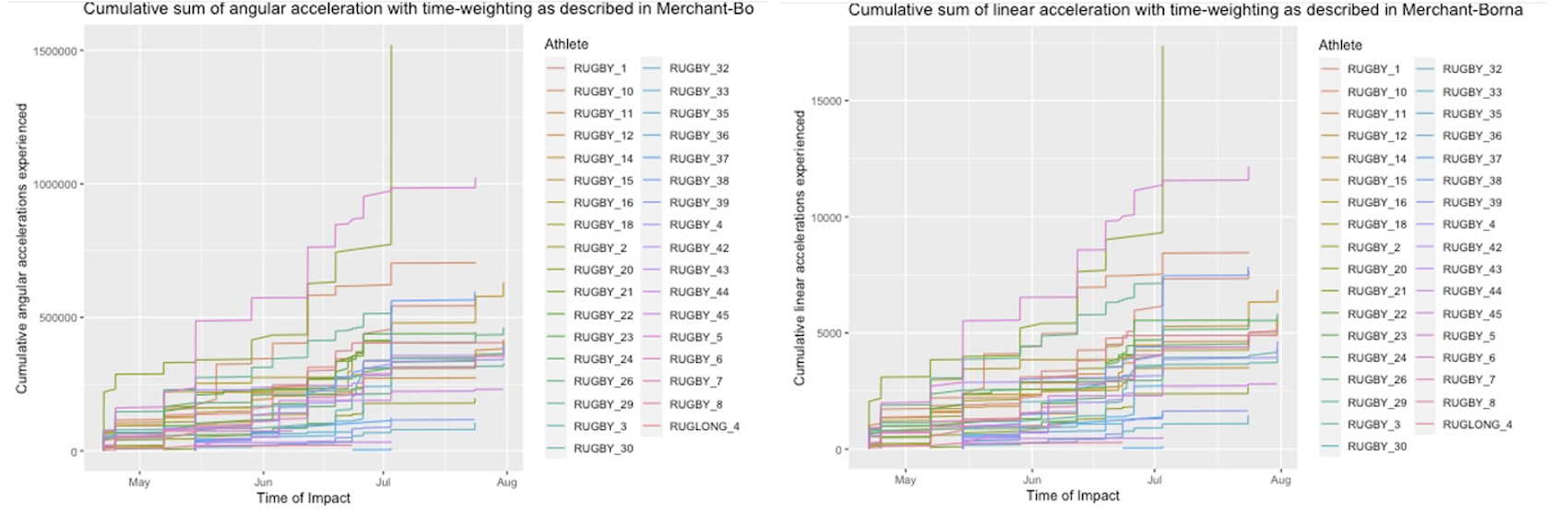
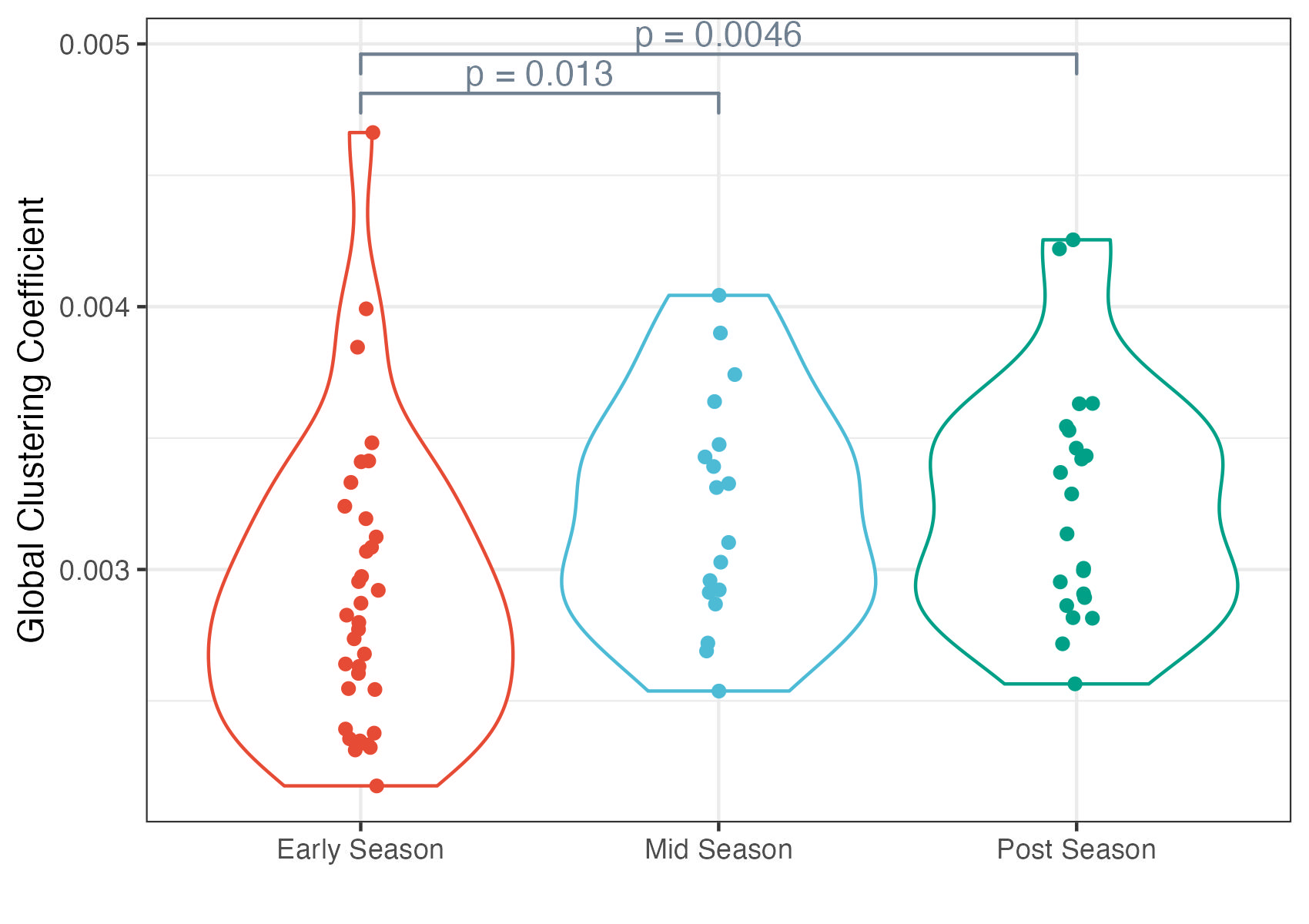
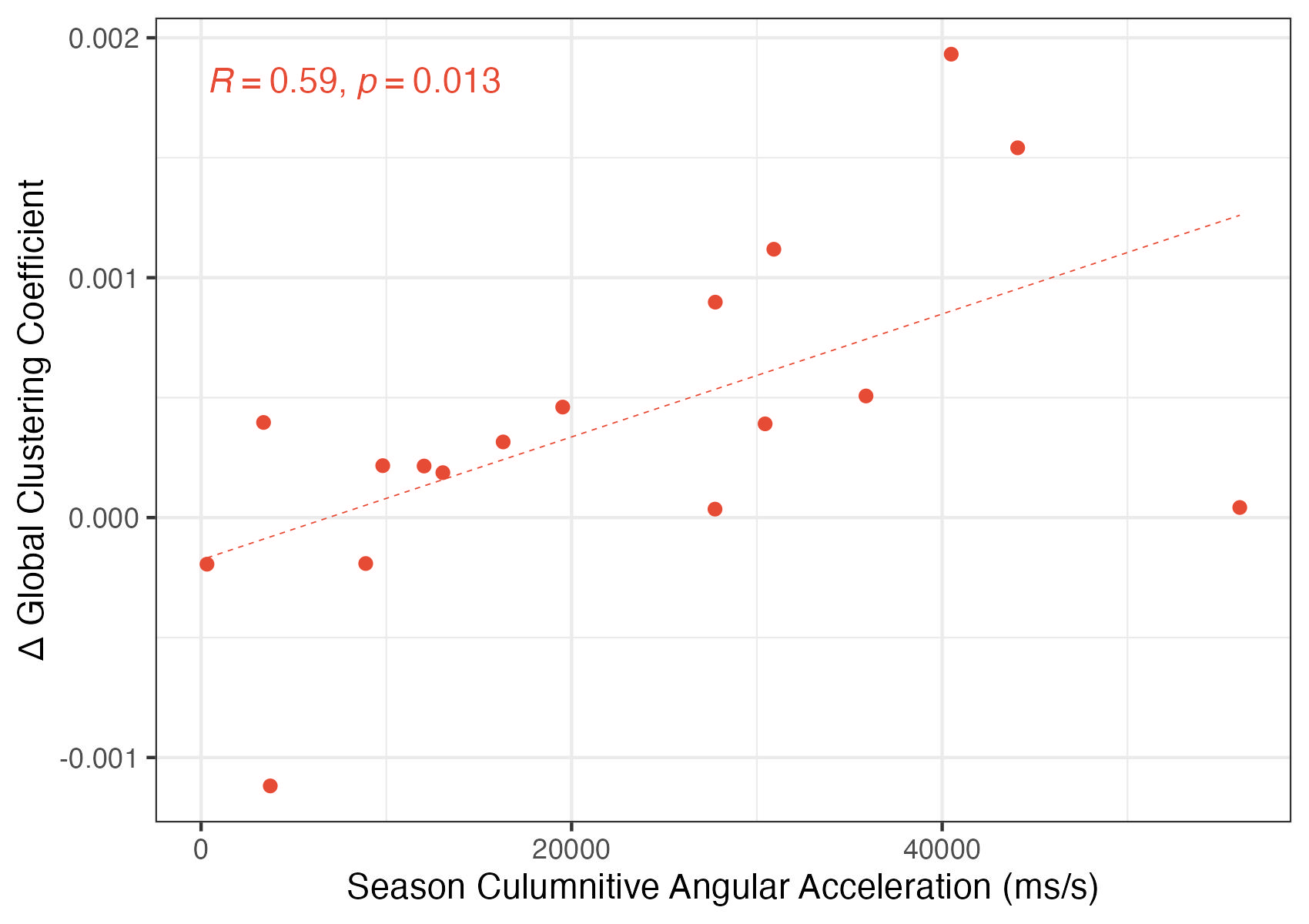
Kinematic mouthguard data for all players were analysed and visually inspected for the entire rugby season (Figure 2). Quantification of network topology with graph theory showed that global clustering coefficient significantly increased from early season to mid-season (p=0.013) and post season (p=0.0046; Figure 3). Using Threshold Free Network Based Statistics, no significant differences in connectivity between individual regions were detected, raising the possibility that exposure to repeated head impacts has not had a significant impact on any specific brain regions in this cohort. Moderate correlation was found between changes in global clustering coefficient and measures of angular acceleration (R=0.59, p=0.013; Figure 4).Discussion
Significant increases in global clustering coefficient—a metric related to the redundancy within a network—was observed within rugby players over the course of a rugby season. Global clustering coefficient characterises the formation of triangular structures and repetition within a weighted network. Increases in clustering coefficient could reflect an increased flexibility and function overlap within the network (15). Previous studies focused on those with mTBI and TBI demonstrated decreased global clustering coefficient (16) and global efficiency in those with mTBI and TBI (17, 18), suggesting brains subject to trauma have more segregated and spatially localised network topology. However, it is worth noting that rugby players in the current study have not experienced clinically diagnosed mTBI during the season. To our knowledge, only a single study has studied longitudinal changes in network measures throughout a sports season (19), and they only observed changes in modularity. Preliminary accelerometer data indicates a possible dose dependent response between cumulative head impact exposure and increases in clustering coefficient. Network based statistics was unable to detect any specific connections which were different from early season to post season.Conclusion
Alterations in global clustering coefficient may represent adaptive brain rewiring in response to repeated head impact exposure. A larger sample size is required to determine whether the lack of significant alterations in other network metrics and network-based statistics is due to a genuine lack of effect.Acknowledgements
This work is supported by Kānoa - Regional Economic Development & Investment Unit, New Zealand; and the Catalyst Strategic Fund from Government Funding administered by the New Zealand Ministry of Business Innovation and Employment; and the Hugh Green Foundation. We would like to acknowledge the support of GE Healthcare for assistance with the MRI protocol.References
1. Bailes JE, Petraglia AL, Omalu BI, Nauman E, Talavage T. Role of subconcussion in repetitive mild traumatic brain injury: A review. Journal of Neurosurgery JNS. 2013;119(5):1235-45.
2. Gregory DM, Kim Barber F, Staci T, Ryan G, Christopher AD, Jonathan D, et al. Altered brain microstructure in association with repetitive subconcussive head impacts and the potential protective effect of jugular vein compression: a longitudinal study of female soccer athletes. British Journal of Sports Medicine. 2019;53(24):1539.
3. Rubinov M, Sporns O. Complex network measures of brain connectivity: uses and interpretations. Neuroimage. 2010;52(3):1059-69.
4. Smith RE, Tournier JD, Calamante F, Connelly A. Anatomically-constrained tractography: improved diffusion MRI streamlines tractography through effective use of anatomical information. Neuroimage. 2012;62(3):1924-38.
5. Osmanlıoğlu Y, Parker D, Alappatt JA, Gugger JJ, Diaz-Arrastia RR, Whyte J, et al. Connectomic assessment of injury burden and longitudinal structural network alterations in moderate-to-severe traumatic brain injury. Hum Brain Mapp. 2022;43(13):3944-57.
6. Ware AL, Yeates KO, Geeraert B, Long X, Beauchamp MH, Craig W, et al. Structural connectome differences in pediatric mild traumatic brain and orthopedic injury. Human Brain Mapping. 2022;43:1032-46.
7. Merchant-Borna K, Asselin P, Narayan D, Abar B, Jones CM, Bazarian JJ. Novel Method of Weighting Cumulative Helmet Impacts Improves Correlation with Brain White Matter Changes After One Football Season of Sub-concussive Head Blows. Ann Biomed Eng. 2016;44(12):3679-92.
8. Tournier JD, Smith R, Raffelt D, Tabbara R, Dhollander T, Pietsch M, et al. MRtrix3: A fast, flexible and open software framework for medical image processing and visualisation. NeuroImage. 2019;202:116137.
9. Woolrich MW, Jbabdi S, Patenaude B, Chappell M, Makni S, Behrens T, et al. Bayesian analysis of neuroimaging data in FSL. NeuroImage. 2009;45(1, Supplement 1):S173-S86.
10. Fischl B, van der Kouwe A, Destrieux C, Halgren E, Ségonne F, Salat DH, et al. Automatically Parcellating the Human Cerebral Cortex. Cerebral cortex (New York, NY 1991). 2004;14(1):11-22.
11. Desikan RS, Ségonne F, Fischl B, Quinn BT, Dickerson BC, Blacker D, et al. An automated labeling system for subdividing the human cerebral cortex on MRI scans into gyral based regions of interest. NeuroImage. 2006;31(3):968-80.
12. Rubinov M, Kötter R, Hagmann P, Sporns O. Brain connectivity toolbox: a collection of complex network measurements and brain connectivity datasets. NeuroImage. 2009;47:S169.
13. R, Core, Team. R: A Language and Environment for Statistical Computing. R Foundation for Statistical Computing; 2023.
14. Baggio HC, Abos A, Segura B, Campabadal A, Garcia-Diaz A, Uribe C, et al. Statistical inference in brain graphs using threshold-free network-based statistics. Hum Brain Mapp. 2018;39(6):2289-302.
15. Chapter 8 - Motifs, Small Worlds, and Network Economy. In: Fornito A, Zalesky A, Bullmore ET, editors. Fundamentals of Brain Network Analysis. San Diego: Academic Press; 2016. p. 257-301.
16. Raizman R, Tavor I, Biegon A, Harnof S, Hoffmann C, Tsarfaty G, et al. Traumatic Brain Injury Severity in a Network Perspective: A Diffusion MRI Based Connectome Study. Scientific Reports. 2020;10(1):9121.
17. Yuan W, Wade SL, Babcock L. Structural connectivity abnormality in children with acute mild traumatic brain injury using graph theoretical analysis. Hum Brain Mapp. 2015;36(2):779-92.
18. Yuan W, Wade SL, Quatman-Yates C, Hugentobler JA, Gubanich PJ, Kurowski BG. Structural Connectivity Related to Persistent Symptoms After Mild TBI in Adolescents and Response to Aerobic Training: Preliminary Investigation. J Head Trauma Rehabil. 2017;32(6):378-84.
19. Dudley J, Yuan W, Diekfuss J, Barber Foss KD, DiCesare CA, Altaye M, et al. Altered Functional and Structural Connectomes in Female High School Soccer Athletes After a Season of Head Impact Exposure and the Effect of a Novel Collar. Brain Connect. 2020;10(6):292-301.
Figures