0261
Predicting Pathogenic DNA Damage Repair Gene Mutations in Prostate Cancer Patients: A Multi-Center MRI Radiomics Study1Department of Radiology, West China hospital, Chengdu, China
Synopsis
Keywords: Prostate, Prostate
Motivation: Pathogenic DDR gene alterations are associated with aggressive disease and poor outcomes among prostate cancer (PCa) patients.
Goal(s): To develop a radiomics-based pre-testing model for identifying DDR mutation carriers among PCa patients.
Approach: A total of 225 patients from three centers with both multiparameter MRI and genetic DDR mutations testing were included. Radiomic models were established based on T2WI and ADC sequences of MRI images. The predictive values were validated in both internal and external validation cohorts.
Results: The radiomics-based model exhibited an AUC of 0.835 in the training dataset, 0.824 in the internal validation dataset, and 0.836 in the external validation dataset.
Impact: In the current study, we introduced a noninvasive radiomics feature-based tool designed to predict pDDRg mutations in prostate cancer patients. External validation of the novel tool by datasets from other medical centers revealed a high predictive accuracy for pDDRg mutations.
Introduction
Pathogenic mutations of DNA damage repair genes (pDDRg) convey important prognostic and predictive information in prostate cancer (PCa). Recent prospective clinical trials targeting pDDRg mutations have illuminated that a significant percentage of men with metastatic or advanced prostate cancer harboring germline and/or somatic mutations in DDR genes would benefit from PARP inhibitors and platinum-based chemotherapies 1-5. A noninvasive pre-testing predictive tool is therefore urgently needed to find out potential patients harboring pDDRg mutations while reducing unnecessary genetic testing and eventually achieving the cost-effectiveness of genetic screening procedures.In this study, we aimed to develop an MRI-based radiomics model capable of assessing the likelihood of harboring pDDRg mutations in patients with prostate cancer. Subsequently, we rigorously validate its predictive value in two external validation cohorts.
Methods
Patients with both multiparameter MRI before prostate biopsy and genetic testing information for DDR mutations from May 2015 to Dec 2021 were included in this study. Training and internal validation datasets came from consecutive patients in West China Hospital. The external validation dataset consisted of patients from Fudan University Shanghai Cancer Center and Sun Yat-sen Memorial Hospital. Variants, including single-nucleotide variants and insertions/deletions (indels), were detected in a total of 18 DDR genes.All cases underwent prostate MRI scanning. Two radiologists with at least 5 years of experience in genitourinary imaging analyzed the T2WI and ADC mapping sequences, blinded to clinicopathological and genetic information. The lesions were annotated on both sequences. The intraclass correlation coefficient (ICC) value was calculated by using the feature pairs for the two radiologists. A total of 1675 radiomic features were extracted from the T2WI and ADC MRI sequences.
To construct the radiomic model, we first removed features with low reproducibility (ICC < 0.7). A least absolute shrinkage and selection operator regression was used to select mutation-related features with non-zero coefficients. A radiomics model was constructed to estimate the probability of DDR mutations, which was calculated by a logistic regression model using the selected features.
The performances of discrimination, calibration, and clinical utility were evaluated by the area under the ROC curve (AUC), the Hosmer-Lemeshow test, calibration plots, and decision curve analysis (DCA). Stratified analyses were also performed within different subgroups of all patients. A two-sided P < 0.05 was considered statistically significant.
Results
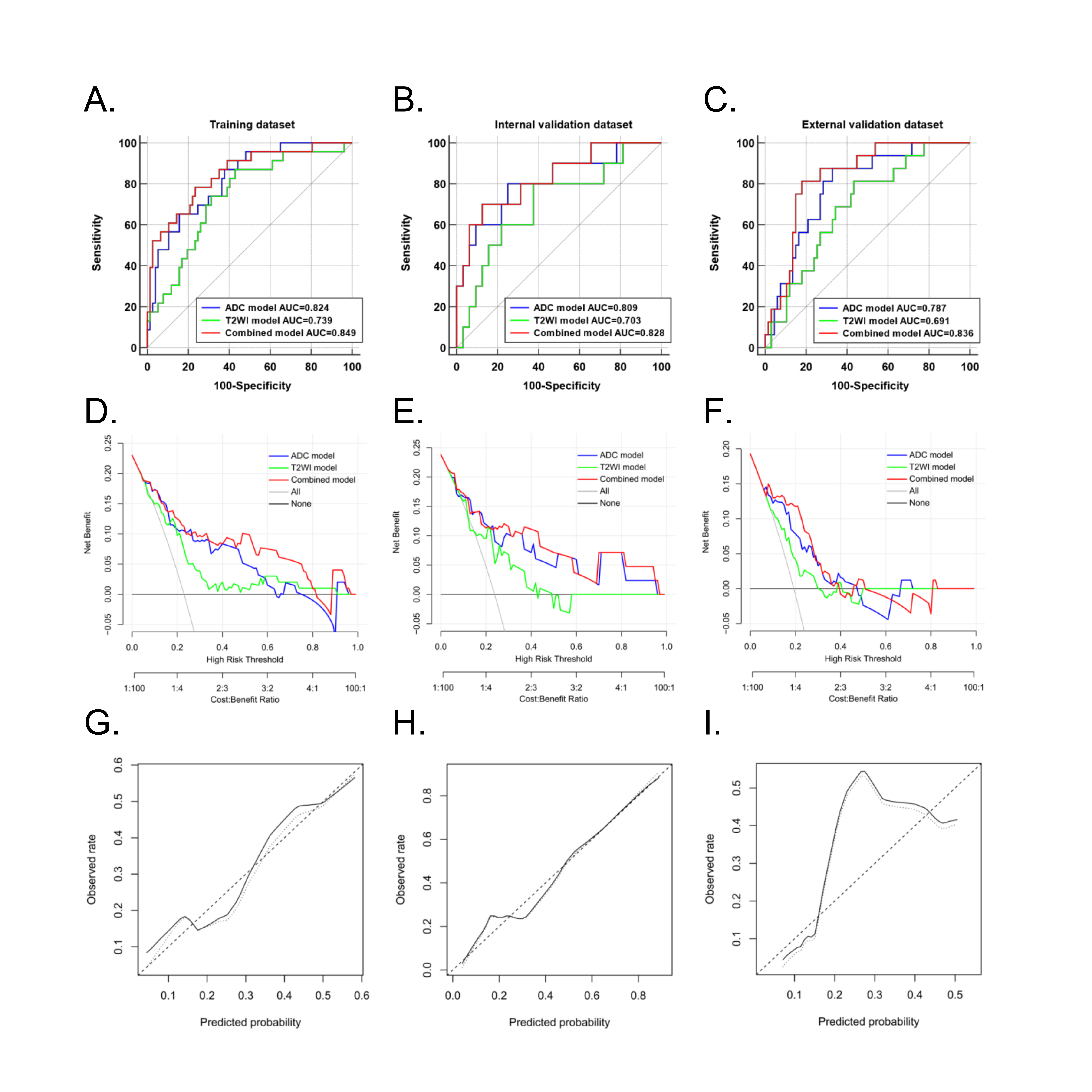
A total of 225 patients were included in this study. In aggregate, pDDRg mutations were detected in 48/225 cases. We randomly divided the total cohort from center one into the training (n=101), and internal validation (n=41) cohort. External validation was conducted using data from 83 patients obtained from two additional medical centers.A combined predictive model incorporating seven T2WI features and six ADC features was constructed. The performances were summarized in Figure 1. The combined model attained an AUC of 0.835 (95%CI: 0.746-0.902) and 0.824 (95%CI: 0.677-0.923) in the training and internal validation cohorts. The Hosmer-Lemeshow test yielded a non-significant statistic (P=0.484). Besides, calibration curves demonstrated the predicted rates of pDDRg mutations correlated favorably with the actual rates observed. Moreover, decision curve analysis also exhibited satisfactory positive net benefits across a range of threshold probabilities for models forecasting pDDRg mutations. The external validation indicated that the MRI-based radiomics model achieved an AUC of 0.836 (95%CI: 0.738-0.908). Besides, the calibration curves and decision curves also showed the commendable performance of the radiomics model in the external validation.
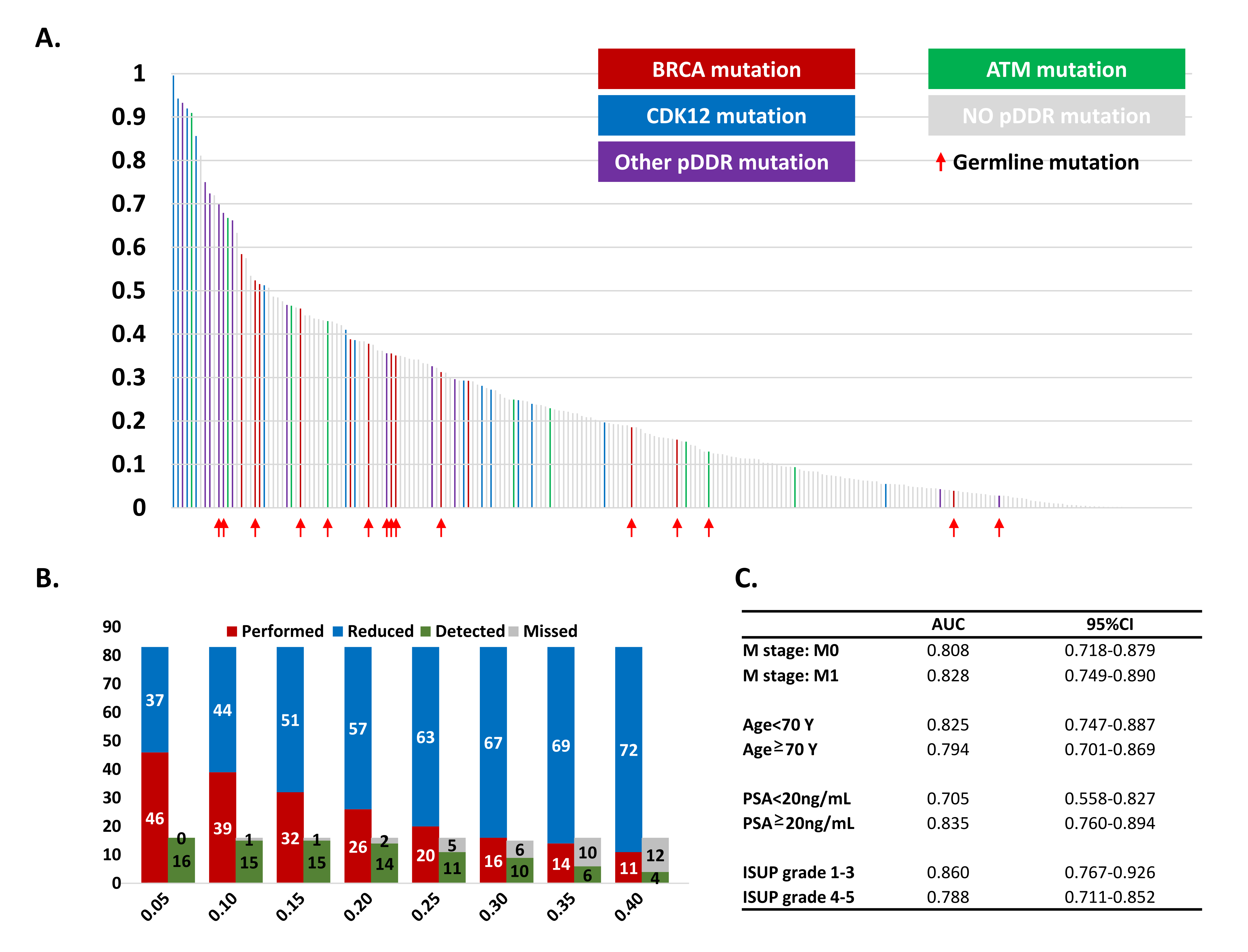
We evaluated the predictive power of the radiomics model in patients with different baseline characteristics. The results demonstrated that the model's predictive accuracy was concordant, regardless of metastatic status, age, ISUP grading, baseline serum PSA level, or somatic/germline pDDRg mutations (Figure 2.).
Discussion
Genetic testing for PCa is rapidly driven by the principles of precision medicine. The detection of pDDRg mutations is of great significance in both predicting clinical outcomes 6,7 and assisting treatment decision-making among patients with prostate cancer 1-5. In the present study, we delved into an in-depth investigation of the predictive capability of MRI-based radiomics features in determining the likelihood of pDDRg mutation in patients with PCa. Our approach involved the development of a sophisticated radiomics model, utilizing 13 radiomics features extracted from T2WI and ADC sequences. This radiomics feature-based model demonstrated remarkable performance during external validation across multicenter, reaffirming its robust predictive capability across different patient subgroups.Conclusion
we conceived an MRI-based radiomics model that exhibits satisfactory performance in predicting the possibility of pDDRg mutation carriers among the prostate cancer population. Our model stands as a valuable tool for steering precise genetic testing and curtailing superfluous genetic screening in PCa patients.Acknowledgements
NoneReferences
1. Thiery-Vuillemin A, de Bono J, Hussain M, Roubaud G, Procopio G, Shore N, et al. Pain and health-related quality of life with olaparib versus physician's choice of next-generation hormonal drug in patients with metastatic castration-resistant prostate cancer with homologous recombination repair gene alterations (PROfound): an open-label, randomised, phase 3 trial. The Lancet Oncology 2022;23(3):393-405 doi: 10.1016/S1470-2045(22)00017-1.
2. Agarwal N, Azad AA, Carles J, Fay AP, Matsubara N, Heinrich D, et al. Talazoparib plus enzalutamide in men with first-line metastatic castration-resistant prostate cancer (TALAPRO-2): a randomised, placebo-controlled, phase 3 trial. Lancet (London, England) 2023;402(10398):291-303 doi: 10.1016/S0140-6736(23)01055-3.
3. Abida W, Patnaik A, Campbell D, Shapiro J, Bryce AH, McDermott R, et al. Rucaparib in Men With Metastatic Castration-Resistant Prostate Cancer Harboring a BRCA1 or BRCA2 Gene Alteration. Journal of clinical oncology: official journal of the American Society of Clinical Oncology 2020;38(32):3763-72 doi: 10.1200/JCO.20.01035.
4. Mateo J, Carreira S, Sandhu S, Miranda S, Mossop H, Perez-Lopez R, et al. DNA-Repair Defects and Olaparib in Metastatic Prostate Cancer. The New England journal of medicine 2015;373(18):1697-708 doi: 10.1056/NEJMoa1506859.
5. Mota JM, Barnett E, Nauseef JT, Nguyen B, Stopsack KH, Wibmer A, et al. Platinum-Based Chemotherapy in Metastatic Prostate Cancer With DNA Repair Gene Alterations. JCO Precis Oncol 2020;4:355-66 doi: 10.1200/po.19.00346.
6. Olmos D, Lorente D, Alameda D, Cattrini C, Romero-Laorden N, Lozano R, et al. Presence of somatic/germline homologous recombination repair (HRR) mutations and outcomes in metastatic castration-resistant prostate cancer (mCRPC) patients (pts) receiving first-line (1L) treatment stratified by BRCA status. American Society of Clinical Oncology; 2023.
7. Castro E, Romero-Laorden N, Del Pozo A, Lozano R, Medina A, Puente J, et al. PROREPAIR-B: A Prospective Cohort Study of the Impact of Germline DNA Repair Mutations on the Outcomes of Patients With Metastatic Castration-Resistant Prostate Cancer. Journal of clinical oncology : official journal of the American Society of Clinical Oncology 2019;37(6):490-503 doi: 10.1200/JCO.18.00358.
Figures