0191
A Self-supervised Physics-informed Reconstruction Error Compensation Neural Network for Magnetic Resonance Electrical Property Tomography1Department of Medical Engineering, Chiba University, Chiba, Japan, 2Science & Technology Research Laboratories, Cresco, Tokyo, Japan, 3Digital Architecture Research Center, National Institute of Advanced Industrial Science and Technology, Tokyo, Japan, 4Center for Frontier Medical Engineering, Chiba University, Chiba, Japan, 5Engineering Product Development Department, Singapore University of Technology and Design, Singapore, Singapore, 6Department of Surgery, National University of Singapore, Singapore, Singapore
Synopsis
Keywords: Electromagnetic Tissue Properties, Electromagnetic Tissue Properties
Motivation: The recent physics-informed neural network (PINN) for Magnetic resonance electrical properties tomography (MREPT) still reply on ground truth as boundary conditions for back propagations.
Goal(s): It is aimed to propose a PINN that uses only the residuals of an MREPT analytic model rather than ground truth data.
Approach: A PINN framework which uses the aforementioned residuals to guide the network learning process of an neural network, enhancing the accuracy and reliability of the reconstruction, was proposed to compensate for the conductivity reconstruction errors of the Stabilized-EPT.
Results: The results show increased accuracy of the reconstruction of conductivity for both normal and tumorous tissues.
Impact: Feasibility of more accurate conductivity reconstruction without any ground truth information is demonstrated. This may lead to practical cancer detection.
Introduction
Electrical properties (EPs) are expected as biomarkers for early cancer detection1,2,3. MREPT is a technique to non-invasively estimate EPs of tissues from MRI measurements. MREPT based on analytical models suffer from the artifacts caused by sensitivity to noise4 and homogeneity assumpution1.To address these problems, learning based neural network (NN) approaches5, 6 and analytical model modification approaches7, or a hybrid of both8, 9, 10 have been taken.
Inda et al. introduced a Physics-Informed (PI) NN, which integrates physical principles into NN learning process for low-SNR MREPT10. However, it is noteworthy that their approach relies partially on information of ground truth.
We aim to experimentally justify the following two propositions in connection with our previous work12, 13.
- Without any ground truth information, only with residuals of partial differential equation (PDE) of an analytical model, Stabilized-EPT, it is possible for a NN to learn to reconstruct EPs.
- It is more effective for the NN to learn to predict reconstruction errors with regard to the EPs by the Stabilized-EPT than to predict the EPs directly11.
Method
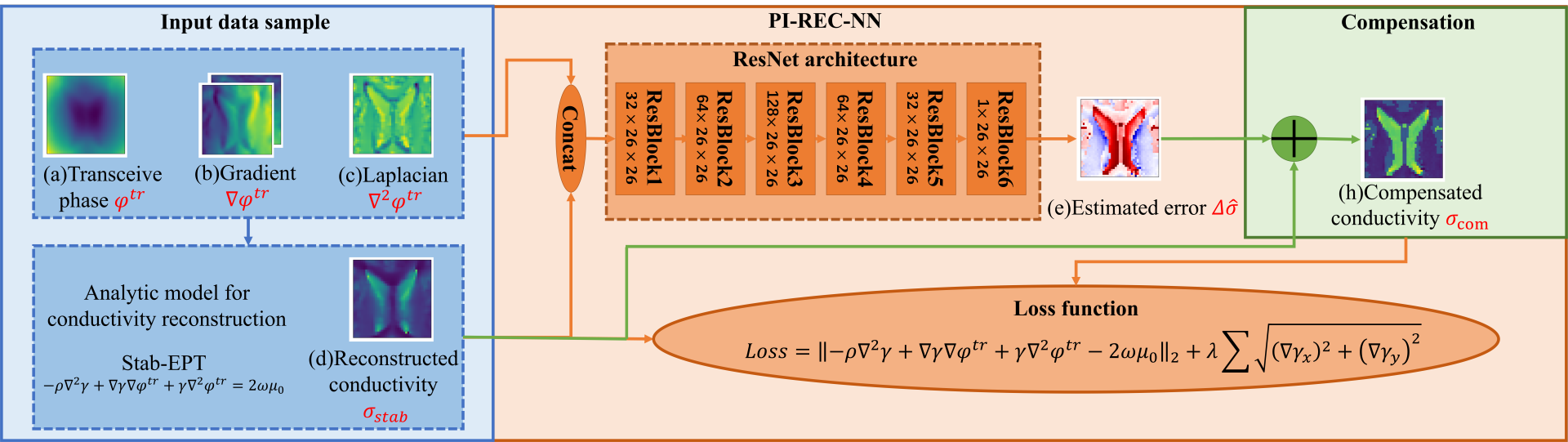
The NN, proposed and named as PI-REC-NN (PI Reconstruction Error Compensation NN) is illustrated by Figure 1.The inputs of PI-REC-NN are transceive phase $$$\varphi^{tr}$$$, its first-order deviation $$$\nabla\varphi^{tr}$$$, its second-order deviation $$$\nabla^{2}\varphi^{tr}$$$ and conductivity $$$\sigma_{stab}$$$ reconstructed through Stablized-EPT7.
The output of PI-REC-NN is the error $$$\Delta\hat{\sigma}$$$ which is used to compensate for conductivity $$$\sigma_{stab}$$$. The loss function of PI-REC-NN is the L2-normalization of the PDE residual of Stabilized-EPT, as shown in Equation (1).
$$L_{Residual}=\left \Vert {-\rho\nabla^2\gamma+\nabla\gamma\nabla\varphi^{tr}+\gamma\nabla^2\varphi^{tr}-2\omega\mu_0} \right \Vert_2\tag{1}$$
where $$$\rho$$$ is a diffusion coefficient, $$$\gamma$$$ is the inverse of conductivity $$$\sigma$$$, $$$\omega$$$ is Lamour frequency of MR system, $$$\mu_0$$$ is the permeability of vacuum. The inverse of conductivity $$$\gamma$$$ is calculated from the compensated conductivity, and its first-order and second-order derivatives are computed by automatic differentiation function of NNs.
TV regularization has been employed in a related MREPT method14 to suppress large spatial variation. In this study, it is used to constrain the gradient of conductivity, especially around boundary. A weight was used to balance to two terms, as shown in Equation (2):
$$Loss=L_{Residual}+\lambda{L_{TV}}(\gamma)\tag{2}$$
Two distinct data samples were employed: a double circular sample and a digital human head sample (Ella, sim4life@ZMT) with a tumor region.
Besides, a PI Electrical Properties Estimation (PI-EPE) model using the same neural network structure with the same input features but directly predicting conductivity was implemented for comparison.
Results and Discussion
Figure 2 demonstrates that, trained with only the PDE residual, PI-REC-NN could achieve a much better reconstruction (SSIM:0.502) than PI EPE (SSIM:0.077). The PI-REC-NN even significantly improved the NRMSE, though, could not improve SSIM of the Stabilized-EPT.Table in Figure 3 shows each term of the PDE residual. Even for the ground truth, the PDE residual is not 0. This can be attributed to numerical errors in the computation of gradients and Laplacians, especially around boundary area. It means that only PDE residual is impossible to guide the learning properly.
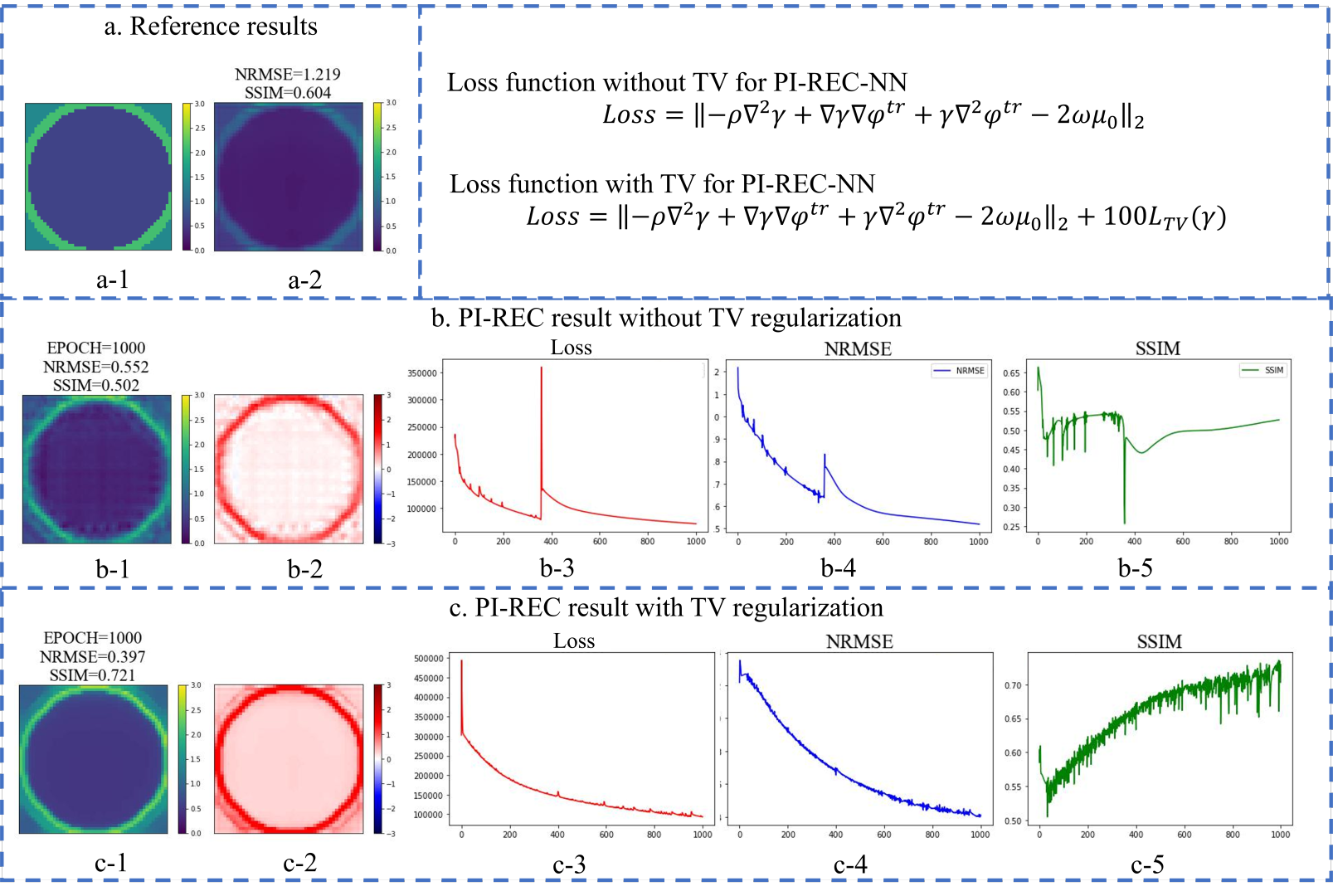
Figure 4 shows the PI-REC-NN results of the double circular sample when the TV regularization is applied with a weight as 100 or 0. The learning curve (Figure 4(c-3, c-4, c-5)) indicates that the application of TV regularization leads to enhanced stability in the learning process. And Figure 4(c-1) demonstrates better NRMSE and SSIM values than those of the Stabilized-EPT (Figure 4(a-2)). However, when compared to the ground truth (Figure 4(a-1)), there is a diffused boundary which caused boundary thickness reduction. Moreover, with the TV, the output of PI-REC-NN, $$$\Delta\hat{\sigma}$$$(Figure 4(c-2)) shows a clearer compensation pattern.
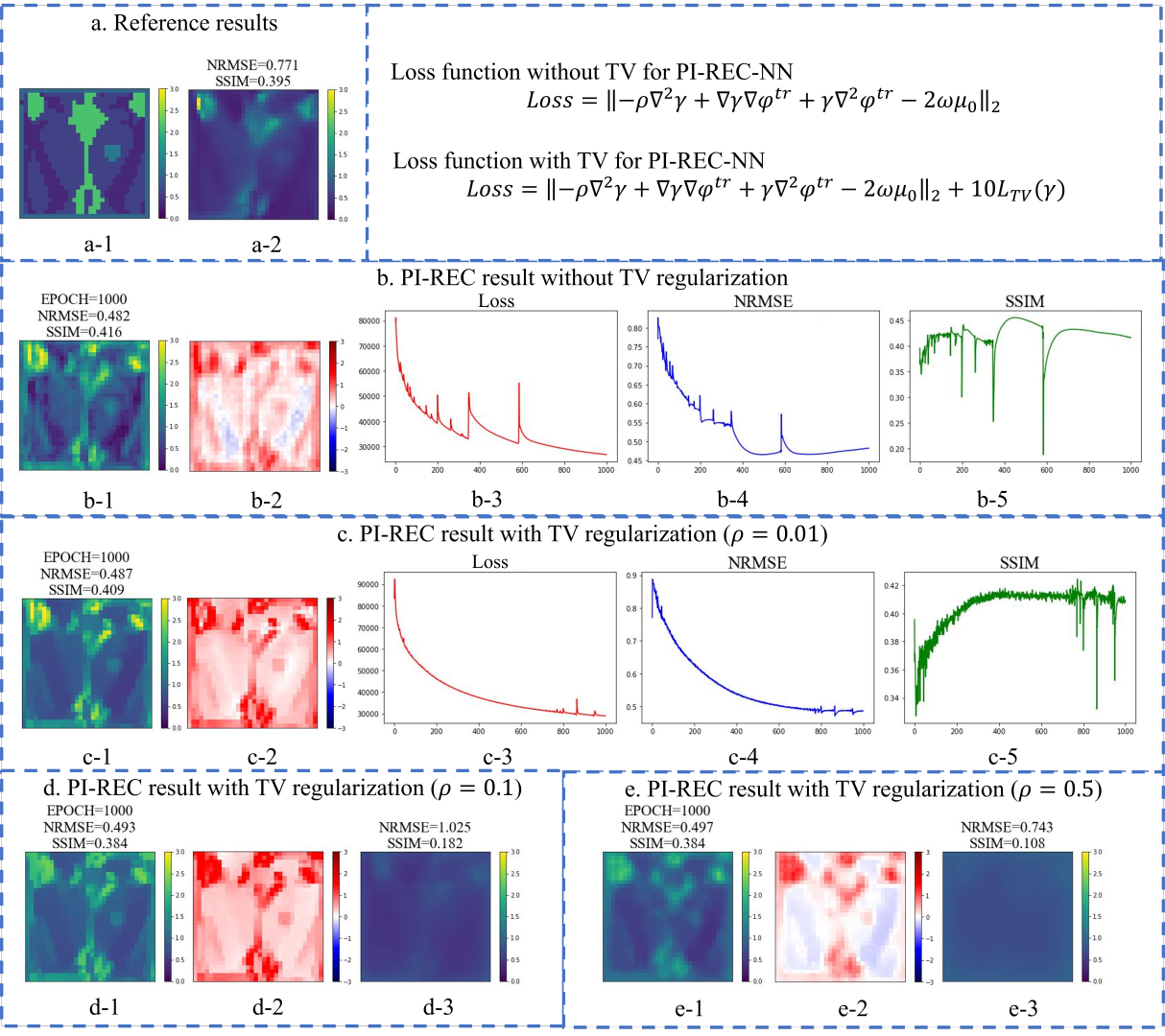
Figure 5 presents the PI-REC-NN compensation for the digital human head sample. For this sample, the weight was set to 10. With TV, the PI-REC-NN (Figure 5(c-1)), achieved a more distinct boundary than the Stabilized-EPT (Figure 5(a-2)) and the PI-REC-NN without TV (Figure 5(b-1)). However, the application of TV, as seen in Figure 5(c-1), leads to a slight deterioration in both NRMSE and SSIM. Figure 5(c, d, e) demonstrates that PI-REC-NN could achieve certain levels of compensation for reconstructions by Stabilized-EPT with different parameters.
The weight of TV was decided by trial-and-error for different samples. Further efforts are needed to identify the weight without any ground truth information. The way to determine weights of multiple loss-terms in PI-NN area15 can be referred.
Conclusion
Our study demonstrates the feasibility of using residual of PDE of an analytical model to guide the learning process, in the absence of ground truth information. As a future direction, we intend to generalize this PI-REC-NN framework on more samples, eventually, on clinical data.Acknowledgements
No acknowledgement found.References
- Leijsen R, Brink W, van den Berg C, Webb A, Remis R. Electrical properties tomography: A methodological review. Diagnostics. 2021;11(2):176.
- Tha KK, Katscher U, Yamaguchi S, Stehning C, Terasaka S, Fujima N, Kudo K, Kazumata K, Yamamoto T, Van Cauteren M, et al. Noninvasive electrical conductivity measurement by MRI: a test of its validity and the electrical conductivity characteristics of glioma. Eur Radiol. 2018;28:348-355.
- Mori N, Tsuchiya K, Sheth D, Mugikura S, Takase K, Katscher U, Abe H. Diagnostic value of electric properties tomography (EPT) for differentiating benign from malignant breast lesions: comparison with standard dynamic contrast-enhanced MRI. Eur Radiol. 2019;29:1778-1786.
- Shin J, Kim JH, Kim DH. Redesign of the Laplacian kernel for improvements in conductivity imaging using MRI. Magn Reson Med. 2019;81(3):2167-2175.
- Mandija S, Meliadò EF, Huttinga NRF, Luijten PR, van den Berg CAT. Opening a new window on MR-based electrical properties tomography with deep learning. Sci Rep. 2019;9(1):8895.
- Inda AG, Huang SY, Mandija S, Yu W. Linear versus non-linear dimensionality reduction for MREPT. In: Proceedings of the 2nd International Workshop on MR-based Electrical Properties Mapping (IMEP 2018), Utrecht, Netherlands, March 2019.
- Li C, Yu W, Huang SY. An MR-based viscosity-type regularization method for electrical property tomography. Tomography. 2017;3(1):50-59.
- Inda AG, Huang SY, İmamoğlu N, Yu W. Physics-coupled neural network magnetic resonance electrical property tomography (MREPT) for conductivity reconstruction. IEEE Trans Image Process. 2022;31:3463-3478.
- Inda AG, Huang SY, İmamoğlu N, Yu W. Machine-learning-enhanced stabilized cr-MREPT for noise-robust and artifact-reduced electrical properties reconstruction. In: 2020 IEEE International Conference on Computational Electromagnetics (ICCEM); 2020. p. 130-132.
- Inda AG, Huang SY, İmamoğlu N, Qin R, Yang T, Chen T, Yuan Z, Yu W. Physics informed neural networks (PINN) for low SNR magnetic resonance electrical properties tomography (MREPT). Diagnostics. 2022;12(11):2627.
- Jegou H, Douze M, Schmid C. Product quantization for nearest neighbor search. IEEE Trans Pattern Anal Mach Intell. 2010;33(1):117-128.
- Qin R, Inda AG, Zhou Z, Enomoto Y, Yang T, İmamoğlu N, Gomez-Tames J, Huang SY, Yu W. Rec-nn: A reconstruction error compensation neural network for magnetic resonance electrical property tomography (MREPT). In: Proceedings of the 45th Annual International Conference of the IEEE Engineering in Medicine and Biology Society. IEEE; 2023.
- Qin R, Inda AG, Zhou Z, Enomoto Y, Yang T, İmamoğlu N, Gomez-Tames J, Huang S, Yu W. Is Laplacian indispensable to Magnetic Resonance Electrical Property Tomography (MREPT) - An analysis from the perspective of Reconstruction Error Compensation Neural Networks. In: 2023 XXXVth General Assembly and Scientific Symposium of the International Union of Radio Science (URSI GASS); 2023. p. 1-4.
- Sun X, Lu L, Qi L, Mei Y, Liu X, Chen W. A robust electrical conductivity imaging method with total variation and wavelet regularization. Magn Reson Imaging. 2020;69:28-39.
- Wang S, Sankaran S, Wang H, Perdikaris P. An Expert's Guide to Training Physics-informed Neural Networks. arXiv preprint arXiv:2308.08468. 2023.
Figures