0040
DeepGrasp4D: A General Framework for Highly-Accelerated Real-Time 4D Golden-Angle Radial MRI Using Deep Learning1Bernard and Irene Schwartz Center for Biomedical Imaging, Department of Radiology, New York University Grossman School of Medicine, New York City, NY, United States, 2Center for Advanced Imaging Innovation and Research (CAI2R), Department of Radiology, New York University Grossman School of Medicine, New York City, NY, United States, 3Department of Electrical and Computer Engineering, NYU Tandon School of Engineering,, New York City, NY, United States
Synopsis
Keywords: Image Reconstruction, Image Reconstruction
Motivation: Time-resolved real-time 4D MRI demands high imaging speed to achieve high spatial and temporal resolution. While conventional iterative reconstruction methods can accomplish this, they require substantial temporal correlations and impose a significant computational burden.
Goal(s): This study proposes DeepGrasp4D, a deep learning technique tailored to efficiently reconstruct real-time 4D MR images with reduced temporal correlations and shortened scan times.
Approach: DeepGrasp4D was developed based on an unrolled network that incorporates an explicit low-rank constraint and a temporal total variation constraint, enabling efficient reconstruction of 4D images from continuously acquired golden-angle radial k-space.
Results: DeepGrasp4D enables accurate 4D MRI reconstruction at high acceleration rates.
Impact: The proposed DeepGrasp4D technique enables efficient and reliable 4D MRI reconstruction from golden-angle radial data acquired with shortened scan times and reduced temporal correlations. This can be useful in various applications such as DCE-MRI or MRI-guided radiotherapy.
Introduction
Time-resolved 4D MRI, also known as real-time 4D MRI, can be a useful technique in different clinical applications. For example, in current clinical practice, real-time 4D MRI has been used in dynamic contrast-enhanced MRI (DCE-MRI) exams with a continuous acquisition to generate different contrast phases1. 4D MRI could also provide advantages for treatment planning in MRI-guided radiotherapy compared to standard 4D CT2. Recently, a new real-time 4D MRI technique based on Golden-angle Radial Sparse Parallel (GRASP) MRI has been proposed3, 4, 5, referred to as Grasp4D in this work, which employs a combination of low-rank subspace and spatiotemporal constraints to achieve time-resolved 4D imaging at a sub-second temporal resolution. However, the capacity to attain high temporal resolution in Grasp4D largely depends on the presence of substantial temporal correlations derived from continuous data acquisition over an extended duration. This results in prolonged scan times, increased computational demands, and consequently, slow reconstruction speed. In this work, we propose a deep learning approach, called DeepGrasp4D, to reconstruct real-time 4D MRI from golden-angle radial data acquired with shortened scan times and thus reduced temporal correlations, while enabling efficient image reconstruction.Methods
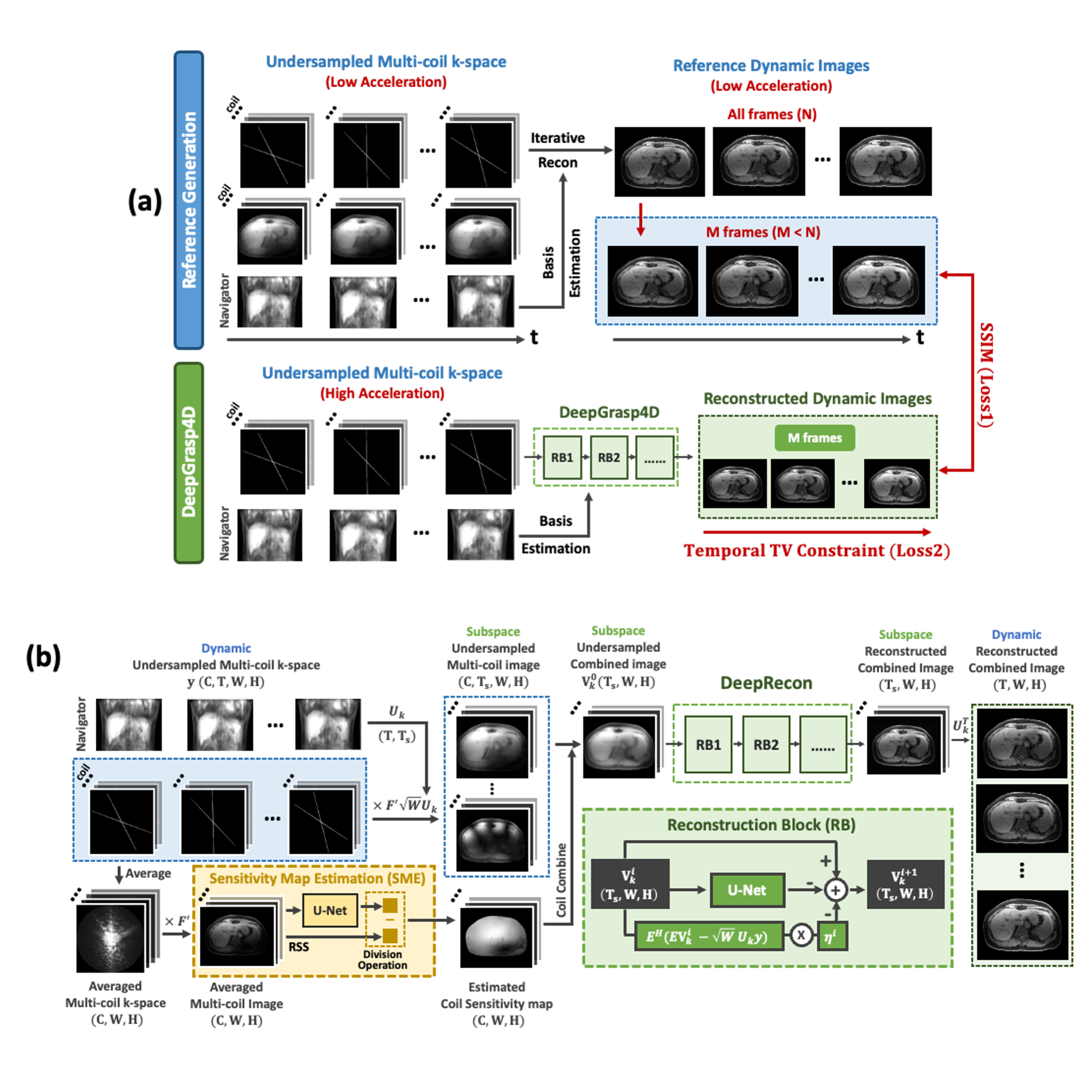
The overall training pipeline for DeepGrasp4D is shown in Figure 1(a). DeepGrasp4D employs an unrolled neural network that incorporates a low-rank subspace constraint and a temporal total variation (TV) constraint to reconstruct real-time 4D images from continuously acquired golden-angle radial data. The training references were generated from data with sufficient temporal correlations/frames (N frames, low acceleration) using Grasp4D to ensure good image quality. DeepGrasp4D was then performed on a subset of the data with reduced temporal frames/correlations (M frames, M<N). DeepGrasp4D employs two loss functions, one enforcing a structural similarity index measure (SSIM) loss between the reconstructed and corresponding reference images and the other one enforcing a temporal total variation (TV) constraint on the reconstructed images.The DeepGrasp4D framework consists of a reconstruction module and coil sensitivity estimation module, as shown in Figure 1(b). The reconstruction module employs an unrolled network to model iterative gradient descent updates by estimating the gradient of the regularization function using a convolutional neural network (CNN). A temporal basis is estimated from the acquired k-space data3, compressing the dynamic images into a subspace, which reduces the computational burden for reconstruction and, simultaneously, decreases the degrees of freedom to improve the quality of reconstruction. The network directly reconstructs subspace coefficients, from which 4D images are generated using a temporal basis. The coil sensitivity estimation module6 employs a small U-Net to estimate coil sensitivity maps employed in the reconstruction process from averaged multi-coil k-space data.
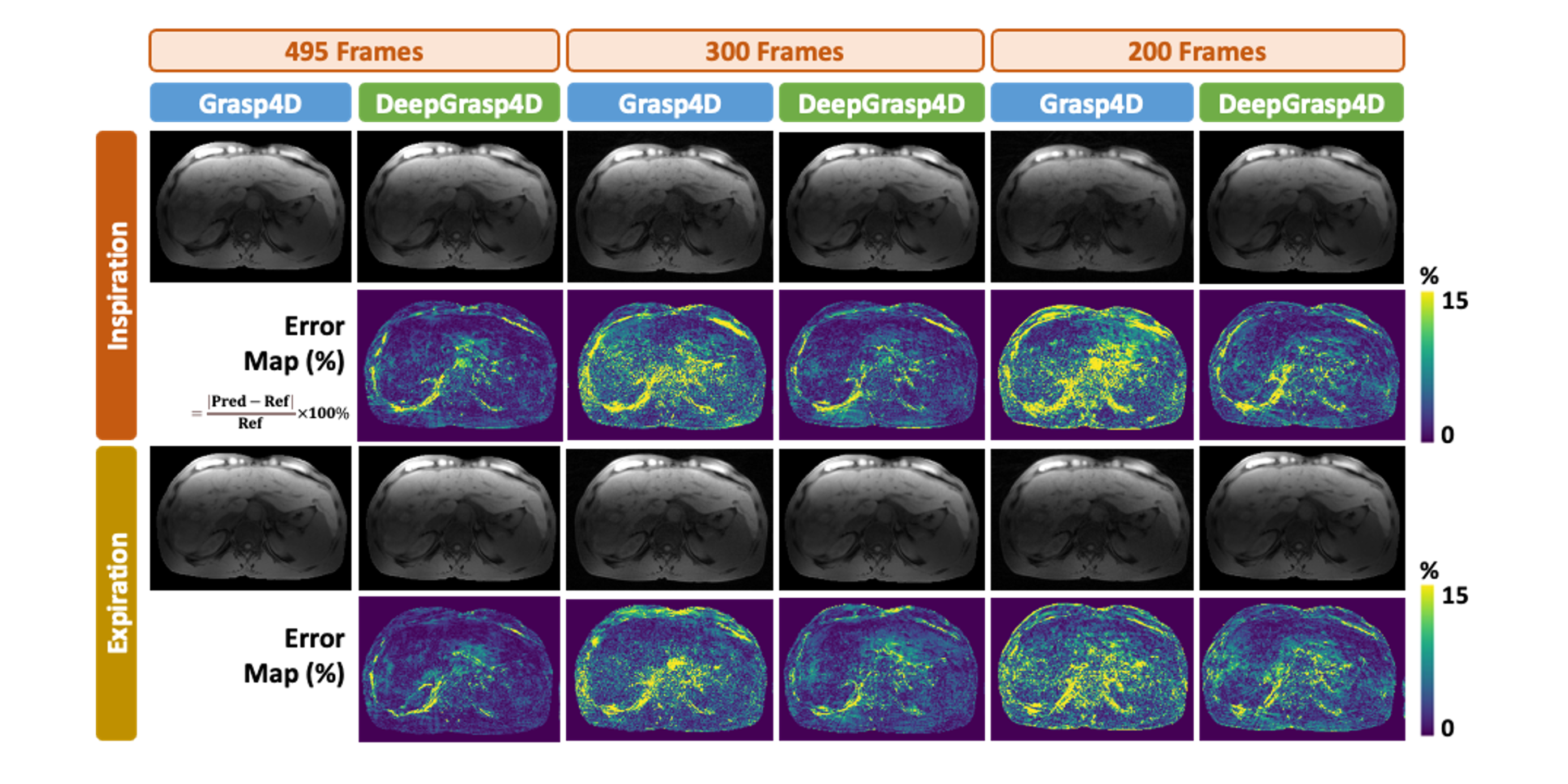
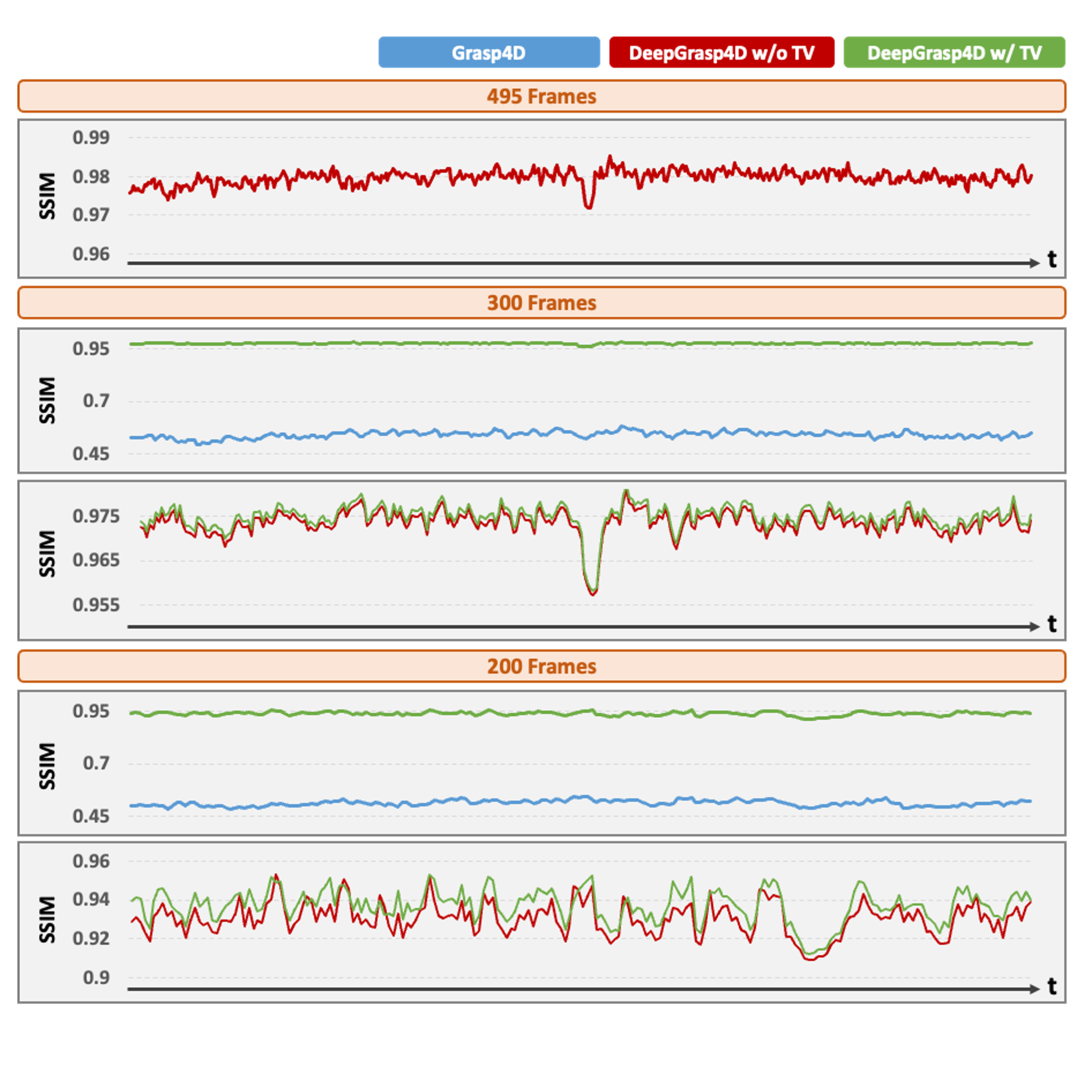
50 (37 for training, 4 for validation, 9 for testing) real-time 4D liver datasets (38 slices for each) were used to evaluate DeepGrasp4D. Each data generated a total of 495 temporal 3D frames (2 spokes for each frame in each slice) that are used as references for training. DeepGrasp4D was then performed in three settings for reconstructing (1) all the 495 frames, (2) 300 frames only, and (3) 200 frames only. Note that reducing the number of dynamic frames decreases temporal correlations and thus the performance of standard Grasp4D reconstruction. The temporal TV constraint was applied to DeepGrasp4D for reconstructing 300 and 200 frames.
Results
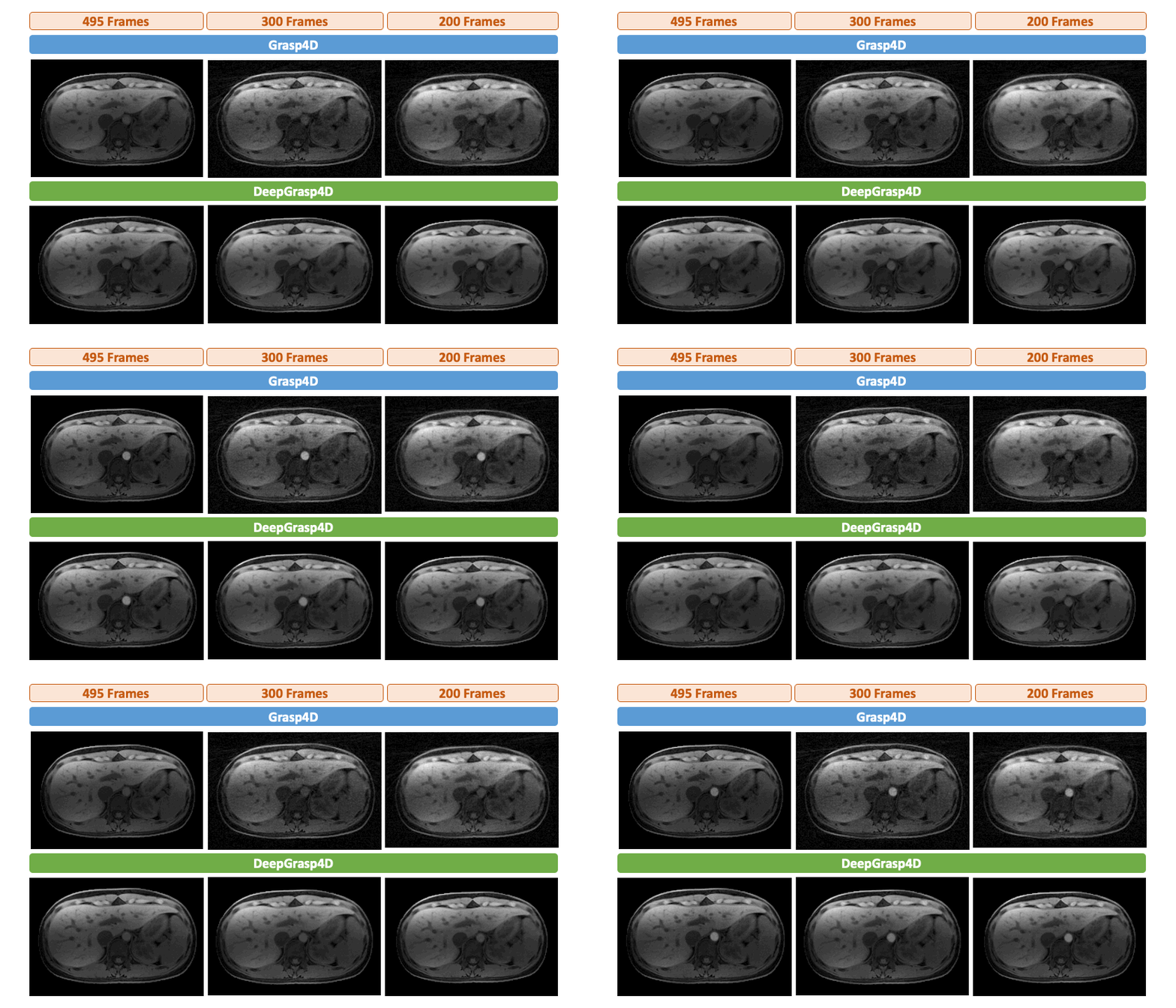
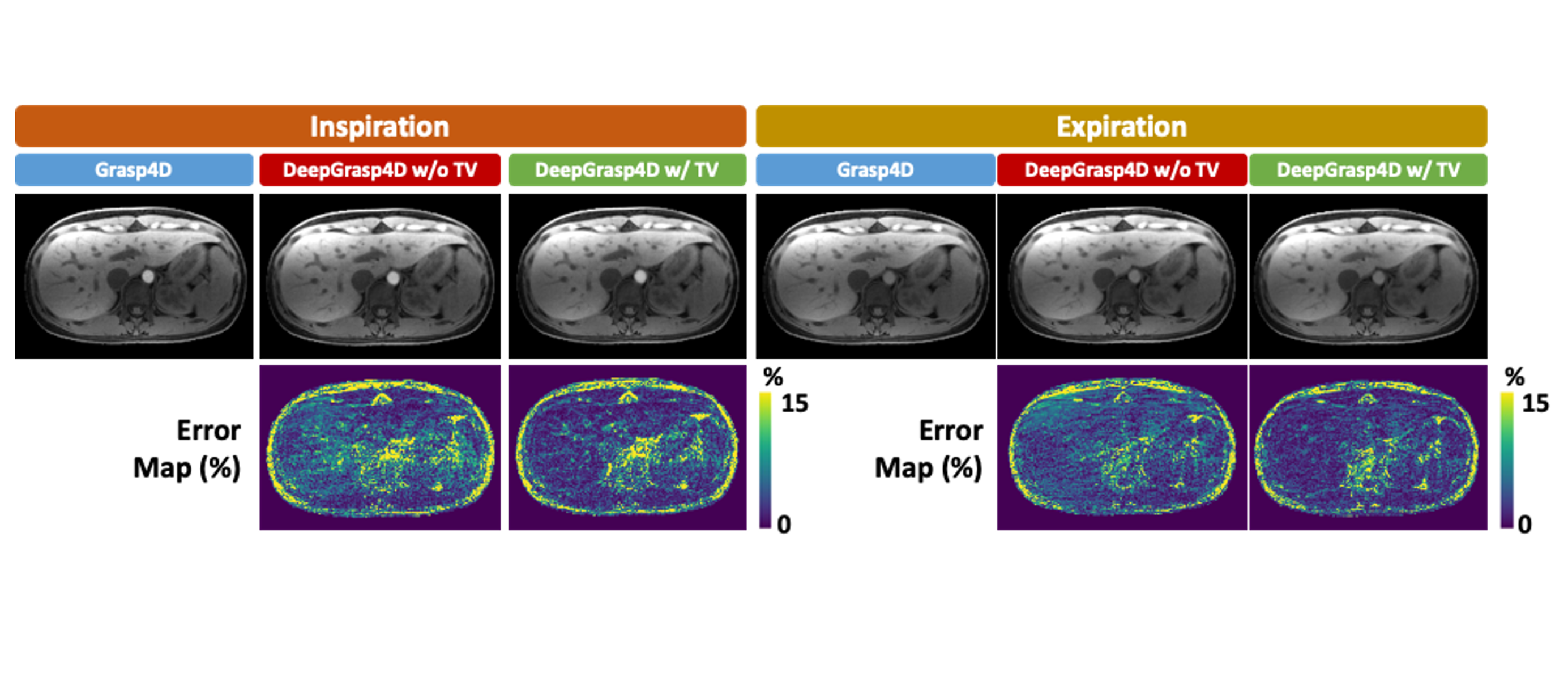
Figure 2 and Figure 3 (video) show two cases comparing the reconstructed images from the DeepGrasp4D and Grasp4D with different numbers of frames. The results suggest that DeepGrasp4D enables improved image reconstruction compared to Grasp4D with reduced temporal frames/correlations based on the error maps.Figure 4 shows another case comparing two frames (at inspiratory and expiratory phases) of 300-frame DeepGrasp4D with and without TV. The results suggest that incorporating a temporal TV constraint into the framework can improve reconstruction quality as shown in the error maps.
Figure 5 summarizes the quantitative comparison of DeepGrasp4D w/ TV, DeepGrasp4D w/o TV, and Grasp4D across all the testing datasets (n=9) in each frame in terms of SSIM. The results indicate that DeepGrasp4D can achieve more than 97% SSIM score for all of the frames. With the reduced temporal correlations, DeepGrasp4D still enables more accurate reconstruction than Grasp4D. As indicated by the green and red curves, incorporating a temporal TV constraint can further improve the reconstruction quality with the reduced temporal correlation.
Conclusion
This work introduces DeepGrasp4D, a deep learning approach for highly-accelerated real-time 4D MRI. Compared to a conventional 4D MRI reconstruction, DeepGrasp4D allows for more efficient and accurate image reconstruction with reduced temporal correlations. This can improve reconstruction speed and scan time, which holds great potential for clinical translation.Acknowledgements
This work was supported by the NIH (R01EB030549, R21EB032917, and P41EB017183) and was performed under the rubric of the Center for Advanced Imaging Innovation and Research (CAI2R), an NIBIB National Center for Biomedical Imaging and Bioengineering.References
1. Feng, Li, et al. "Compressed sensing for body MRI." Journal of Magnetic Resonance Imaging 45.4 (2017): 966-987.2. Stemkens, Bjorn, Eric S. Paulson, and Rob HN Tijssen. "Nuts and bolts of 4D-MRI for radiotherapy." Physics in Medicine & Biology 63.21 (2018): 21TR01.
3. Feng L, Wen Q, Huang C, Tong A, Liu F, Chandarana H: GRASP-Pro: imProving GRASP DCE-MRI through self-calibrating subspace-modeling and contrast phase automation. Magn Reson Med 2020; 83:94–108.
4. Feng, Li. "Live‐view 4D GRASP MRI: A framework for robust real‐time respiratory motion tracking with a sub‐second imaging latency." Magnetic Resonance in Medicine (2023).
5. Feng, Li. "4D golden‐angle radial MRI at subsecond temporal resolution." NMR in Biomedicine 36.2 (2023): e4844.
6. Sriram, Anuroop, et al. "End-to-end variational networks for accelerated MRI reconstruction." Medical Image Computing and Computer Assisted Intervention–MICCAI 2020: 23rd International Conference, Lima, Peru, October 4–8, 2020, Proceedings, Part II 23. Springer International Publishing, 2020.
Figures