0016
HD-Movienet: High-definition 4D MRI using 3D radial kooshball acquisition and deep learning reconstruction1Department of Medical Physics, Memorial Sloan Kettering Cancer Center, New York City, NY, United States, 2Department of Radiology, Memorial Sloan Kettering Cancer Center, New York City, NY, United States
Synopsis
Keywords: AI/ML Image Reconstruction, Image Reconstruction
Motivation: State-of-the-art motion-resolved 4D MRI techniques lack sufficient spatial resolution and efficient acquisition and reconstruction for application in clinical practice.
Goal(s): To develop HD-Movienet, a deep learning-based method to efficiently acquire and reconstruct 4D MRI with approximately 1mm isotropic resolution using 3D radial acquisitions.
Approach: HD-Movienet uses accelerated half-spoke (UTE) and full-spoke (T1-weighted) 3D radial kooshball acquisition and image-time-coil deep learning 4D reconstruction without k-space data consistency.
Results: HD-Movienet can enable 4D MRI with isotropic 1.1mm resolution, 4 minutes of scan time, and reconstruction of less than 7 seconds to image patients with lung tumors.
Impact: Deep learning-based HD-Movienet reconstruction enables motion-resolved 4D MRI technique with isotropic 1.1mm resolution, 4 minutes of scan time, and reconstruction of less than 7 seconds for robust radiation-free imaging of patients with mobile tumors.
INTRODUCTION
Motion-resolved 4D MRI based on 3D radial kooshball sampling and sparse reconstruction provides superior imaging of the lungs and abdomen, and access to physiological information based on respiration motion1-3. 3D radial sampling enables imaging with a high isotropic resolution that facilitates multiplanar reformation and improves performance over stack-of-stars sampling. However, it also limits application in clinical practice due to longer acquisition and reconstruction times. The latter is a significant bottleneck, given the use of iterative compressed sensing algorithms. Deep learning is a powerful alternative to accelerate the acquisition and reduce the reconstruction time4. For instance, Movienet has recently proposed to reconstruct 4D MRI from accelerated radial stack-of-stars data without the need for k-space data consistency, which significantly reduced the reconstruction time to 1-2 seconds and accelerated the acquisition by a factor of 1.55,6.This work presents High-Definition Movienet (HD-Movienet), a deep learning network based on Movienet, to reconstruct 4D MRI with high isotropic resolution using a new data processing workflow to exploit 5D (3D+time+coil) correlations. The performance of HD-Movienet is compared against XD-GRASP using ultra-short-echo-time (UTE) and T1-weighted 3D radial kooshball acquisitions on volunteers and patients with lung tumors.
METHODS
3D radial kooshball acquisition: Free-breathing lung MRI was performed on a 3T MRI scanner (Elition, Philips Healthcare) with a 28-channel coil using a prototype 3D radial sequence (VASP)7. Half-spoke (UTE) and full-spoke (T1-weighted) VASP acquisitions (Figure 1) were performed on 10 healthy volunteers and 9 patients with lung tumors. The sequence parameters were as follows: TR/TE=3.7/0.12ms, flip angle=5°, voxel size=1.1mm isotropic, scan time=6:33min for half-spoke (UTE) acquisition and TR/TE=5.1/1.55ms, flip angle=5°, voxel size=1.1mm isotropic, scan time=6:31min for full-spoke (T1-weighted) acquisitions.HD-Movienet structure: 4D reconstruction involved motion sorting and network reconstruction (Figure 2). The acquired 3D k-space data were sorted into 10 motion states using the amplitude of the respiratory motion signal obtained from the VitalEye camera. 3D NUFFT was performed for each motion state and coil channel to obtain 5D aliased images (x, y, z, time, coil). The input to the network was in coronal orientation, and Movienet processed each coronal slice in parallel to accelerate the reconstruction process. The coronal orientation was selected after comparing performance with axial and sagittal orientations.
HD-Movienet training: The network was trained using 5D images corresponding to 60% of the spokes, resulting in a 1.67-fold acquisition acceleration. The target was reconstructed with XD-GRASP8 using all spokes (100%) and an L1-loss function similar to the original implementation of Movienet for stack-of-stars trajectories5,6. Two networks were trained using a Linux computer with two 80GB GPU boards (A-100, NVIDIA), one for UTE and the other one for T1-weighted full-spoke acquisitions.
HD-Movienet testing: Three datasets (not included in training) were used to test the performance of HD-Movienet with 60% of the spokes (scan time=4min) against XD-GRASP with 100% of the spokes (scan time=6:30min).
RESULTS
The average reconstruction time for HD-Movienet 4D MRI was less than 7 seconds, which is significantly faster than iterative XD-GRASP reconstruction in the order of 10 minutes using an optimized implementation in Python that uses GPUs. Despite the 1.67-fold acquisition acceleration, HD-Movienet presented similar motion imaging and image quality to XD-GRASP on a patient with a large lung tumor (Figure 3), a small lung tumor with reduced lung function (Figure 4), and a healthy volunteer with normal lung function (Figure 5).DISCUSSION
The scan time reduction and significant reconstruction time reduction presented by HD-Movienet will promote the use of 4D MRI with isotropic resolution in clinical practice. Currently, state-of-the-art 4D MRI uses stack-of-stars acquisition8,9, which limits resolution along the slice dimension and the performance of multiplanar reformatting. Moreover, HD-Movienet presents high performance for both UTE and T1-weighted acquisitions, which can be used to optimize parenchyma visualization and motion imaging, respectively. One key factor to reduce the reconstruction time to less than 10 seconds was to process each coronal slice in parallel—other orientations required to include more slices at a time, which reduced performance. Lung imaging represents an initial application, but HD-Movienet can generally be applied at anatomical locations affected by respiratory motion.CONCLUSION
HD-Movienet enables motion-resolved 4D MRI with an isotropic resolution of 1.1x1.1x1.1 mm3, scan time of 4 min and less than 7 seconds for image reconstruction, which will promote the use of 4D MRI in clinical practice to guide radiotherapy of mobile tumors and obtain physiological information related to motion, for example, lung capacity.Acknowledgements
The work was supported by NIH grant R01-CA255661.References
1. Wu C, Krishnamoorthy G, Yu V, Subashi E, Rimner A, Otazo R. 4D lung MRI with high-isotropic-resolution using half-spoke (UTE) and full-spoke 3D radial acquisition and temporal compressed sensing reconstruction. Physics in Medicine and Biology. 2023;68(3):035017-035017.2. Iwasawa T. Three-dimensional Ultrashort Echo Time MRI: A More Sensitive Tool for Monitoring Patients with Cystic Fibrosis. Radiology. 2023;308(1):e231367.
3. Feng L, Delacoste J, Smith D, et al. Simultaneous Evaluation of Lung Anatomy and Ventilation Using 4D Respiratory-Motion-Resolved Ultrashort Echo Time Sparse MRI. Journal of Magnetic Resonance Imaging. 2018;49(2):411-422.
4. Pal A, Rathi Y. A review and experimental evaluation of deep learning methods for MRI reconstruction. The journal of machine learning for biomedical imaging. 2022;1:001. Accessed October 26, 2023. https://www.ncbi.nlm.nih.gov/pmc/articles/PMC9202830/
5. Murray V, Syed S, Crane CH, et al. Movienet: Deep space–time‐coil reconstruction network without k‐space data consistency for fast motion‐resolved 4D MRI. Magnetic Resonance in Medicine. 2023;1-15.
6. Murray V, Siddiq S, Jafari R, Wu C and Otazo R 2023 MRI-Movienet: fast motion-resolved 4D MRI reconstruction exploiting space-time-coil correlations without k-space data consistency Proc. Intl. Soc. Mag. Reson Med. 31 5485.
7. Krishnamoorthy G, Smink J, Tourais J, Breeuwer M, Kouwenhoven M. Variable anisotropic FOV for 3D radial imaging with spiral phyllotaxis (VASP). Magnetic Resonance in Medicine. 2020;85(1):68-77.
8. Feng L, Axel L, Chandarana H, Block KT, Sodickson DK, Otazo R. XD-GRASP: Golden-angle radial MRI with reconstruction of extra motion-state dimensions using compressed sensing. Magnetic Resonance in Medicine. 2015;75(2):775-788.
9. Wu C, Murray V, Syed S, et al. Real-time 4D MRI using MR signature matching (MRSIGMA) on a 1.5T MR-Linac system. Physics in Medicine and Biology. 2023; 68(16):185015.
Figures
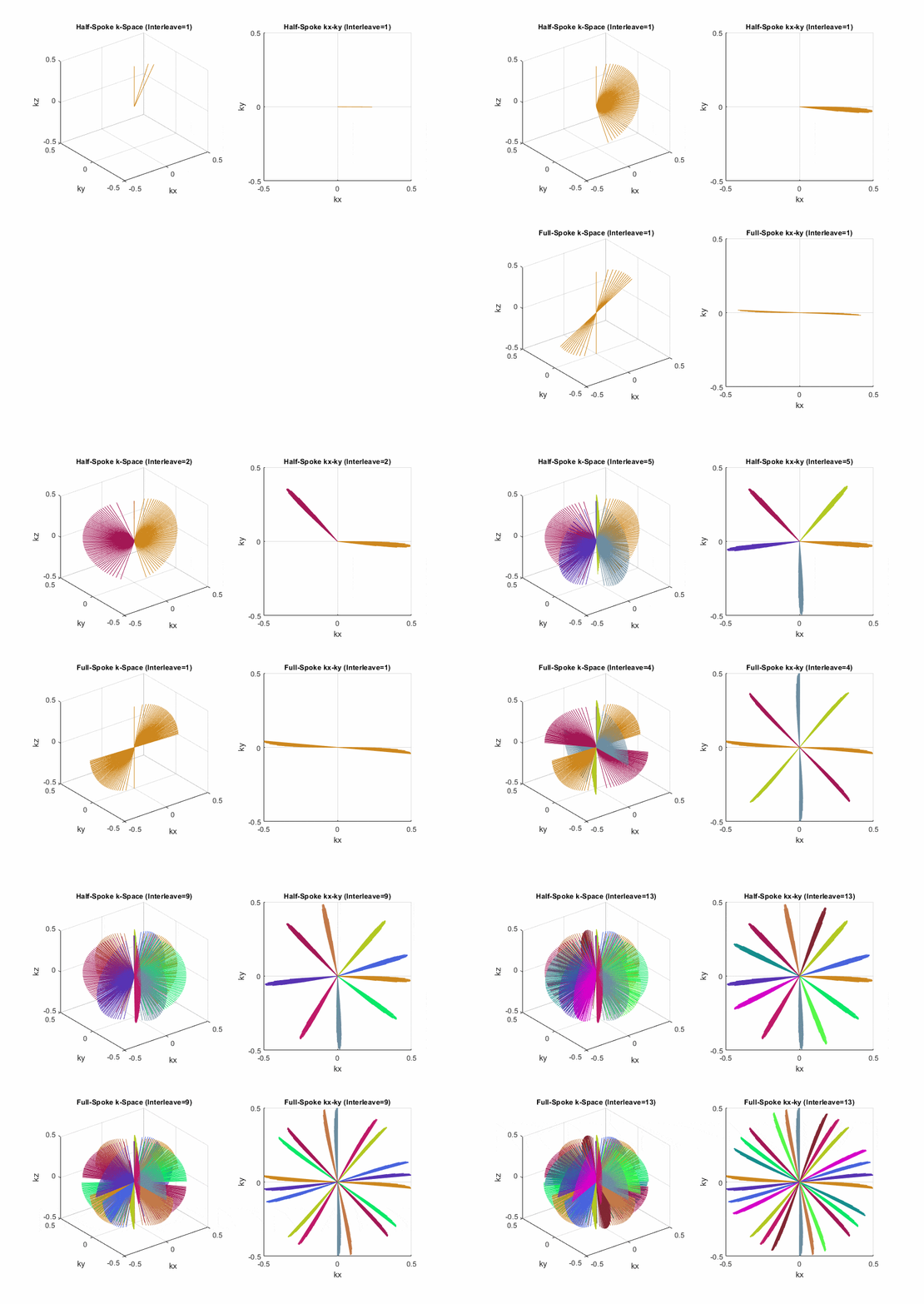
Figure 1. Half-spoke (UTE with TE of 0.12ms) and full-spoke (T1-weighted with TE of 1.55ms) VASP k-space trajectories. This example includes 13 interleaves ordered with a golden-angle spiral phyllotaxis pattern. The kx-ky projection (right) illustrates that the interleaves are spaced uniformly according to golden-angle rotation in the azimuthal direction.
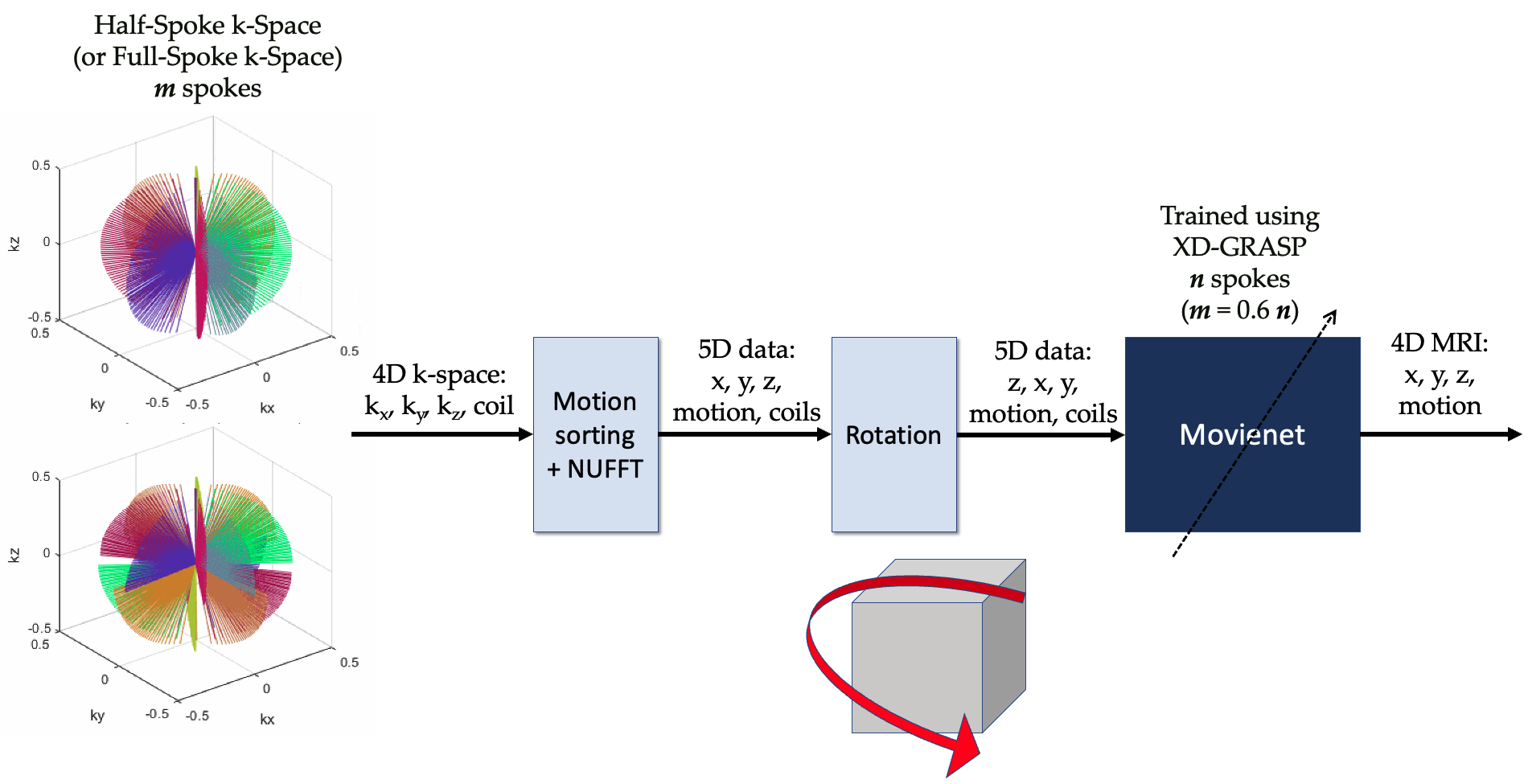
Figure 2. High-definition 4D MRI using 3D radial kooshball acquisition and Movienet reconstruction. The respiratory motion signals from the VitalEye camera installed on the scanner are used to sort the k-space data into 10 motion states. The 5D image is generated using 3D NUFFT in each motion state and coil, and reformatted to the coronal view for Movienet reconstruction. Movienet was trained using XD-GRASP acquired during 6:30 minutes as a reference, but the input used only data acquired during the first 4 minutes, resulting in a scan time reduction of 2.5 minutes.
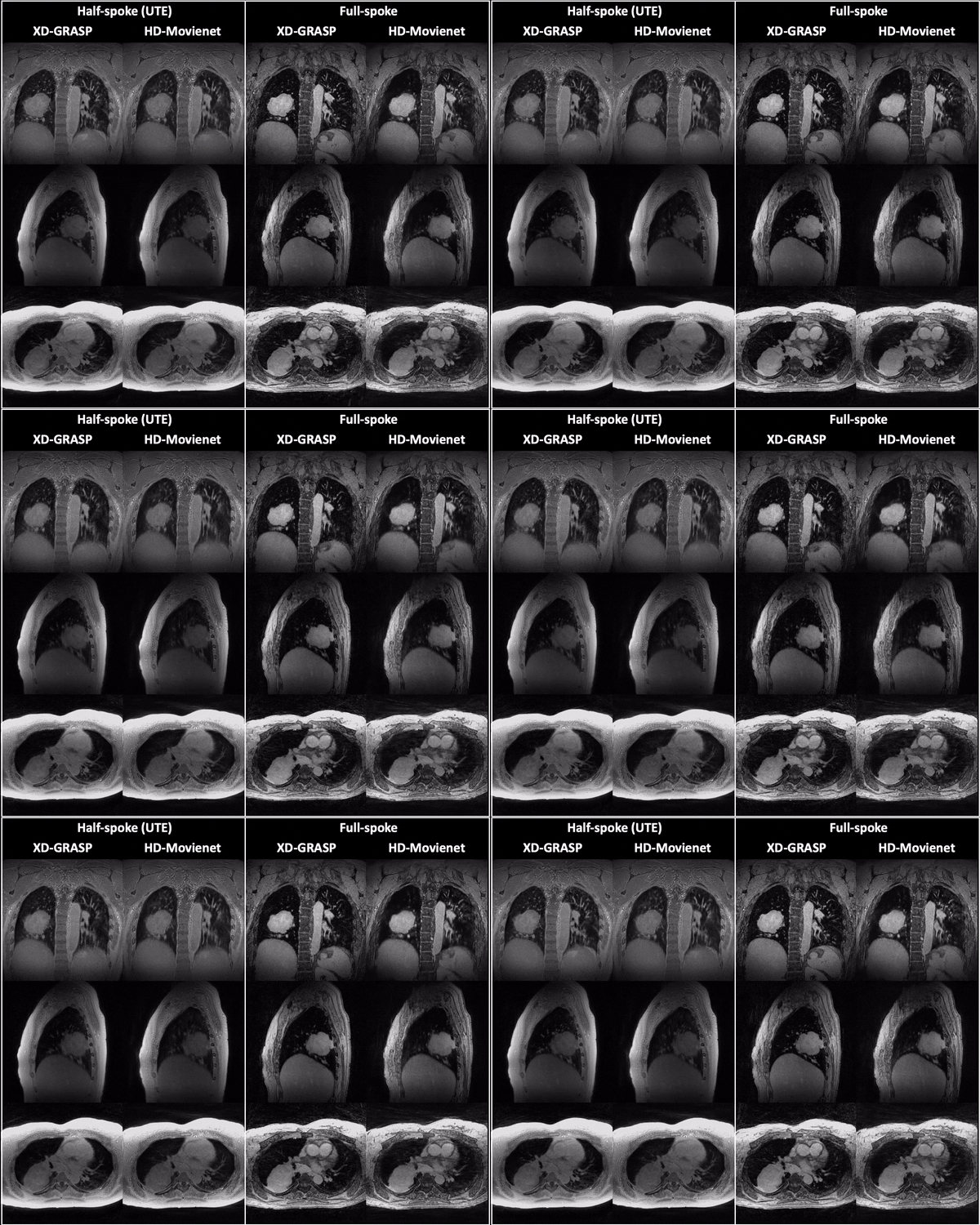
Figure 3. Half-spoke (UTE) and full-spoke (T1-weighted) 4D MRI from a patient with a large lung tumor (7.7x5.0cm) in the right lower lobe. HD-Movienet (acquisition time=4min) presents similar motion imaging performance and improved image quality (reduced streaking artifacts) compared to XD-GRASP (acquisition time≈6:30min) despite the 1.67-fold imaging acceleration and 7-second reconstruction time.
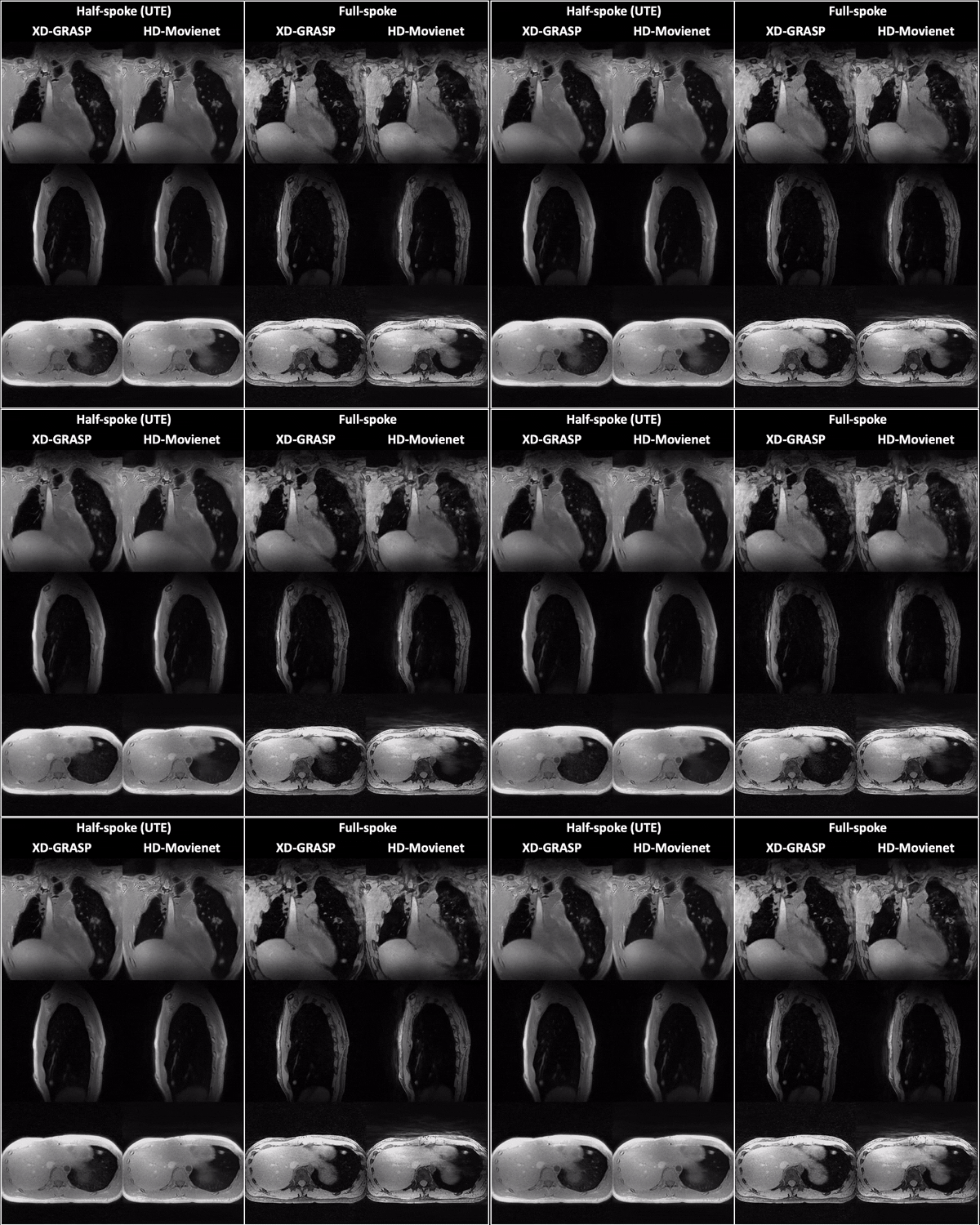
Figure 4. Half-spoke (UTE) and full-spoke (T1-weighted) 4D MRI from a patient with lung tumors in the inferior lingula (0.9x0.8cm) and superior lingula (1.9x1.4cm) and limited lung function. HD-Movienet (acquisition time=4min) presented similar motion imaging performance and slightly lower image quality (increased streaking artifacts) compared to XD-GRASP (acquisition time≈6:30min) with a 1.67-fold acquisition acceleration.
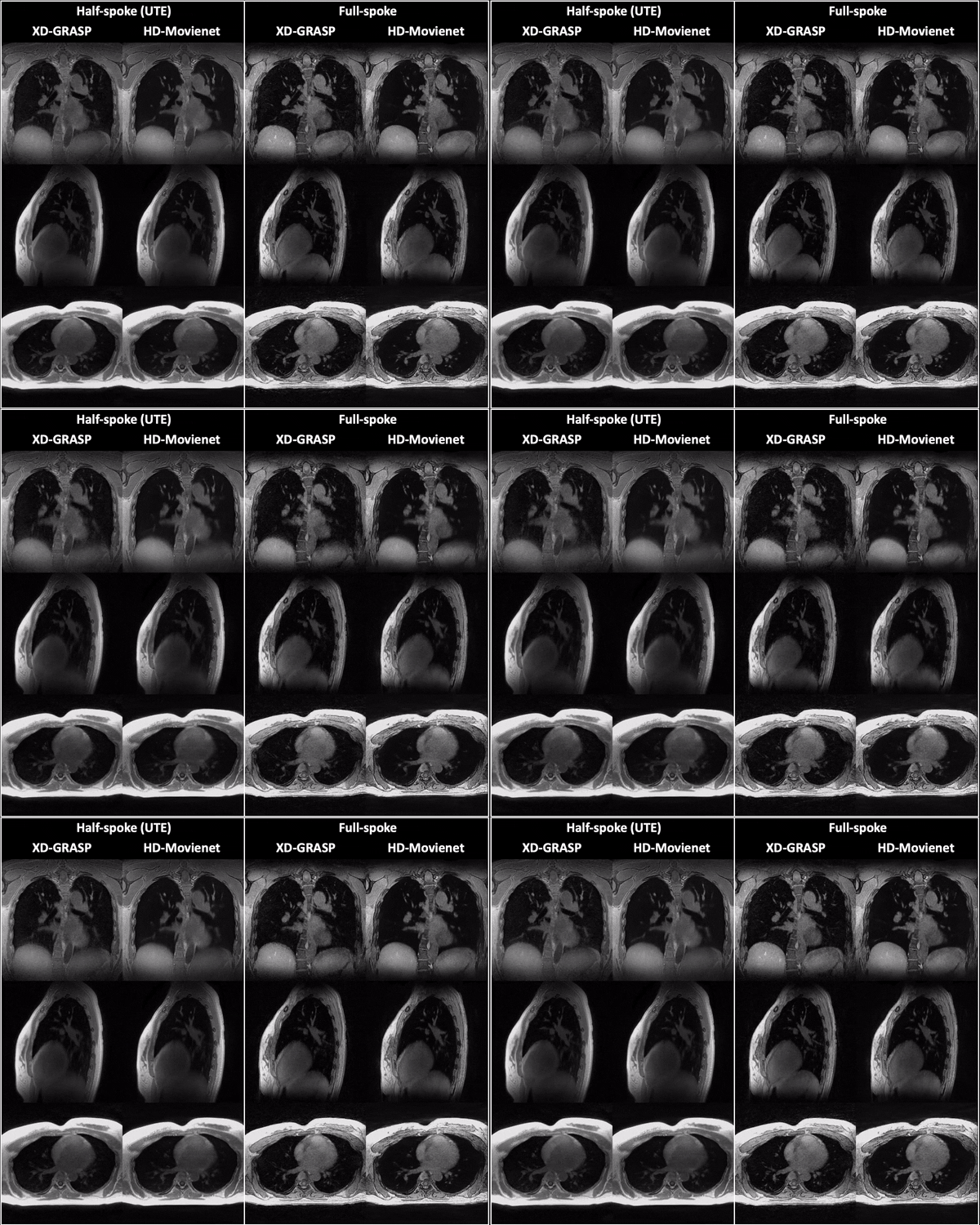
Figure 5. Half-spoke (UTE) and full-spoke (T1-weighted) 4D MRI from a healthy volunteer (34 years, female). HD-Movienet (acquisition time=4min) presented similar motion imaging performance and image quality compared to XD-GRASP (acquisition time≈6:30min) despite the 1.67-fold imaging acceleration and 7-second reconstruction time. The healthy volunteer example shows that HD-Movienet can image motion on a subject with normal lung functionality, which would be important to differentiate from patients with reduced lung function.