0014
DE-NIK: Leveraging Dual-Echo Data for Respiratory-Resolved Abdominal MR Reconstructions Using Neural Implicit k-Space Representations1Institute of Machine Learning in Biomedical Imaging, Helmholtz Center Munich, Munich, Germany, 2School of Computation, Information and Technology, Technical University of Munich, Munich, Germany, 3Millenium Institute for Intelligent Healthcare Engineering, Santiago, Chile, 4School of Medicine and Health, Technical University of Munich, Munich, Germany, 5Philips GmbH, Hamburg, Germany, 6School of Biomedical Engineering and Imaging Sciences, King's College London, London, United Kingdom, 7School of Engineering, Pontificia Universidad Católica de Chile, Santiago, Chile
Synopsis
Keywords: AI/ML Image Reconstruction, Machine Learning/Artificial Intelligence
Motivation:
Neural implicit k-space representations (NIK) enable binning-free respiratory-resolved MR reconstructions in a data-driven manner. The multi-dimensionality of MR, i.e., provided in dual-echo acquisitions, is expected to improve reconstruction performance and allows for further echo-processing.
Goal(s): A Dual-Echo-NIK that takes advantage of the redundant data present in two echoes and enables subsequent water-fat-separation.
Approach: We propose three Dual-Echo-NIK variants trained (1) individually, (2) jointly and (3) in an echo-modulated way. Motion-resolved echo and water-fat reconstructions are evaluated on a free-breathing phantom simulation and in-vivo.
Results: Quantitative simulations demonstrate improved performance for the modulated Dual-Echo-NIK. In-vivo reconstructions reveal sharper reconstructions when both echoes are utilized.
Impact: The Dual-Echo Neural Implicit k-space Representations indicate how echo information can lead to improved motion-resolved reconstructions, including subsequent water-fat separations. Echo-modulation can further enhance reconstruction performance and offers the potential to reduce acquisition times for training data.
Introduction
Respiration induces non-negligible artefacts in abdominal MR imaging. Motion-resolved reconstruction techniques attempt to overcome this challenge by separating the acquired data into multiple motion states (MS) using a respiratory navigation signal1,2.Neural implicit representations of k-space (NIK) have been proposed to generate binning-free motion-resolved reconstructions3,4. In a data-driven manner, a network is trained to predict k-space values for a spatio-temporal coordinates $$$v$$$. Training is conducted with the acquired trajectory $$$k_{x},k_{y}$$$ and related respiratory navigator points $$$nav$$$. At inference, any unseen spatial and temporal point can be sampled. However, previous approaches are limited to single-echo data, although MR sequences like Dixon5 provide more echoes. We propose to use this additional information to leverage anatomical redundancies and enable subsequent water-fat separation.
Our contributions are three-fold: First, we present the first Dual-Echo-NIK (DE-NIK), investigating three distinct training strategies. Second, we introduce a novel strategy to handle data redundancies by NIK layer modulation. Third, we demonstrate the efficacy of adding the echo dimension on dual-echo and water-fat reconstructions of simulated and in-vivo free-breathing acquisitions.
Methods
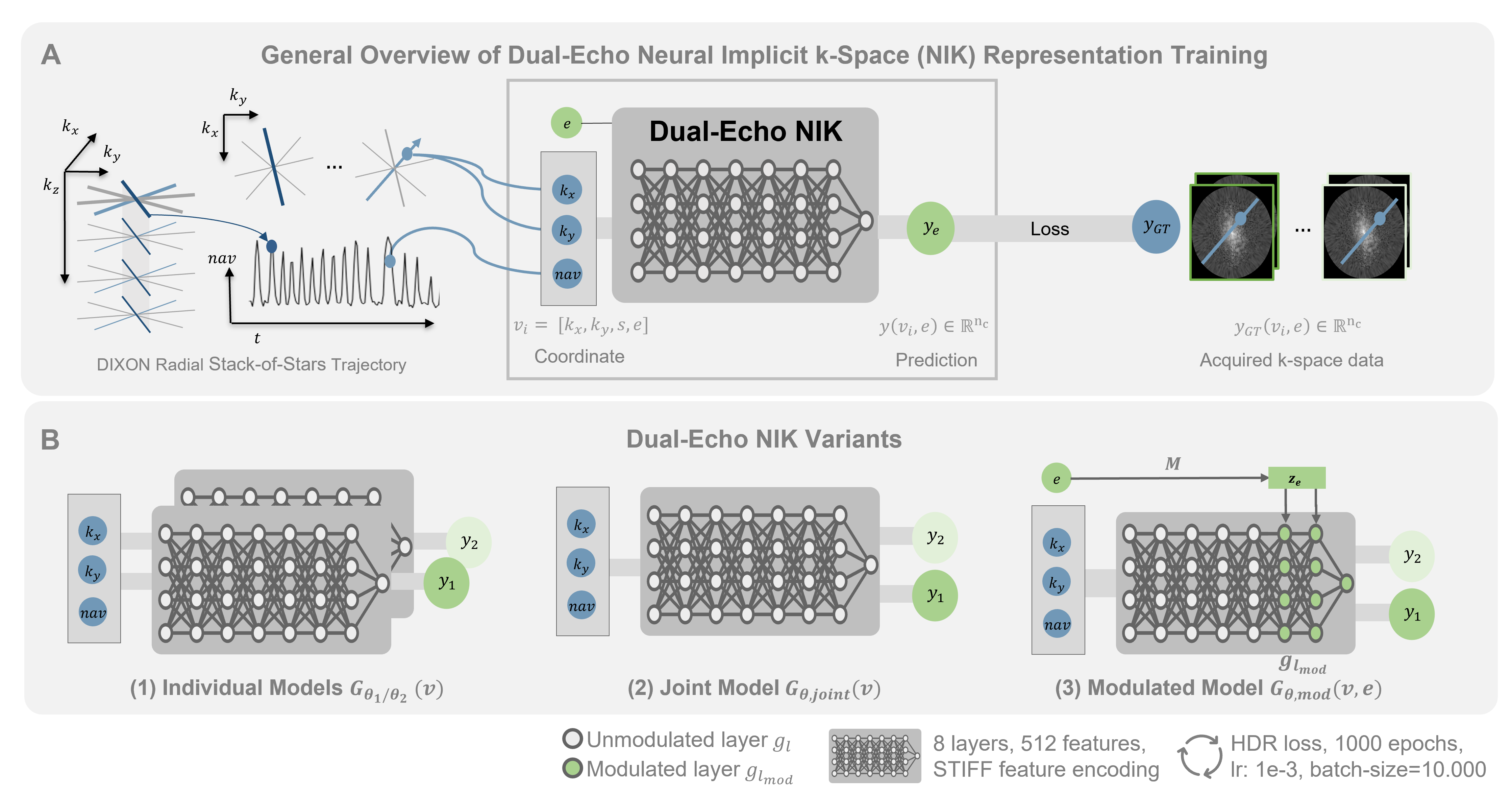
Dual-Echo Neural Implicit k-Space RepresentationsClassic NIK3,4 consists of an multi-layer-perceptron $$$G_\theta(v)$$$ with $$$L$$$ layers $$$g_l$$$ and SIREN6 activations $$$\psi$$$ (Fig.1A). Parameters $$$\theta$$$ are learned with $$$N$$$ acquired coordinates $$$v_i=(nav_i, k_{xi},k_{yi}) \in \mathbb{R}^{3}, i=1,2,\dots,N$$$ to predict the corresponding coil intensity values $$$y_{i} \in \mathbb{R}^{n_c}$$$:
$$ \theta^* = \arg \min_\theta \left\|G_\theta(v) - y\right\|_2^2 \text{ where } G_\theta = g_L \cdot g_{L-1} \cdot ... \cdot g_1 \text{ and } g_l = \psi(w_l \cdot g_{l-1} + b_l) \text{ and } \psi(x) = \sin(\omega_0 \cdot x + b_0) $$
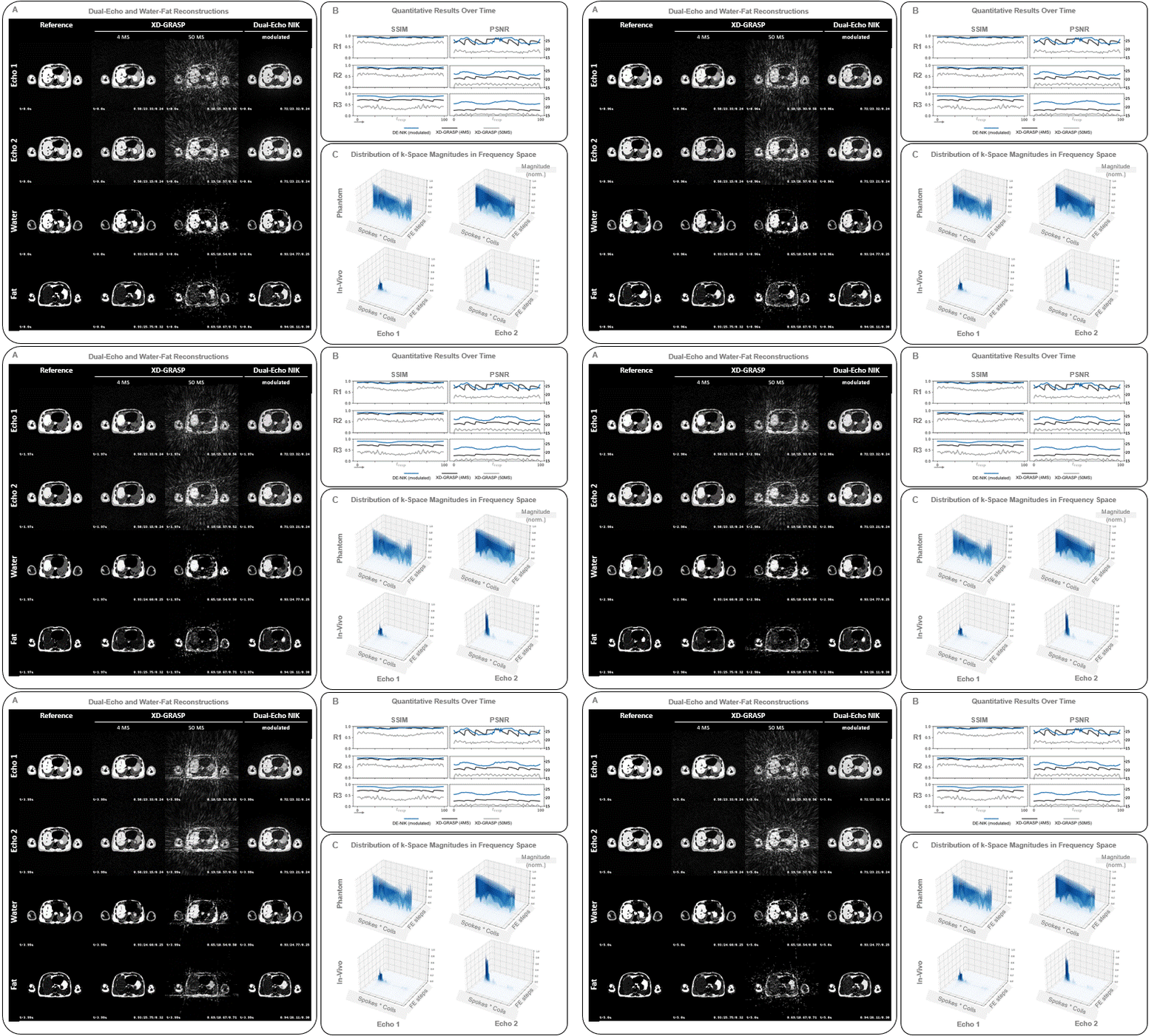
Given k-space data $$$y_{i,e}$$$ for multiple echoes $$$e$$$, dual-echo reconstructions can be obtained by training individual models $$$[e_1,e_2] = [G_{\theta,1}(v), G_{\theta2}(v)]$$$ or a joint model $$$[e1,e2] = G_{\theta,joint}(v)$$$ with all echoes stacked as output (Fig. 1B). To take advantage of the redundant anatomical information, we further propose a modulated model $$$[e_1,e_2] = G_{\theta,mod}(v,e)$$$ (Fig.1B.2), consisting of echo-independent $$$g_l$$$ and echo-modulated $$$g_{l_{mod}}$$$ layers. Since different frequency distribution are expected for $$$y_{i,e}$$$ (higher low-frequency magnitudes / less low-frequency components for in-phase echo, see Fig.3C), we allow for echo-dependent modulation of the activation function frequency $$$\omega_0$$$. Specifically, we replace $$$\omega_0$$$ with vector $$$\alpha_{l}$$$ dependent on a latent $$$\mathbf{z_e}$$$ obtained with a linear layer $$$M(e)$$$:
$$ \omega_0 = \alpha_{l} = \sigma(w_{\alpha,l}[\mathbf{z_e}, \alpha_{l-1}] + b_\alpha) \text{ and } \alpha_{0} = \sigma(w_{\alpha,l}[\mathbf{z_e}]) \text{ with } \mathbf{z_e}=M(e) \text{ for } {l_{mod} } $$
All models are trained with a high-dynamic-range loss3 and STIFF features7. Code is available under https://github.com/vjspi/DE-NIK
Evaluation
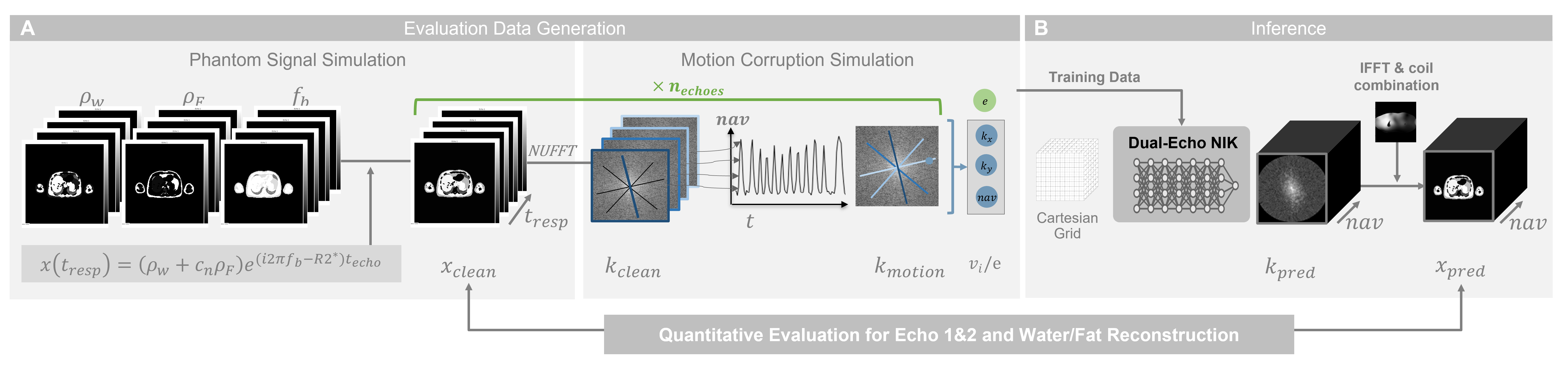
For quantitative evaluation, we simulate free-breathing acquisition with the XCAT phantom8 (Fig.2). We create water/fat/susceptibility maps9,10 for 100 time points $$$t_{resp}$$$ within one breathing cycle to simulate a complex dual-echo signal $$$x_{clean}$$$ for $$$T_e$$$. NUFFT is applied to obtain radial motion-free k-space data $$$k_{clean}$$$, which is merged into one motion-affected k-space $$$k_{motion}$$$ based on an extracted lung-liver-edge navigator. After training the proposed models with $$$k_{motion}$$$ for R=1,2,3, the predicted $$$x_{pred}$$$ is quantitatively evaluated with SSIM/PSNR/NRMSE.
We further validate reconstructions of a free-breathing golden-angle stack-of-star acquisition (3T, Ingenia Elition X, Philips Healthcare) with FOV=450$$$\times$$$450$$$\times$$$252mm³, flip angle=10°, voxel-size=1.5$$$\times$$$1.5$$$\times$$$3mm3, TR/TE1/TE2=4.9/1.4/2.7ms, Tshot=395ms, 601/600 spokes/FE-steps (~R=1.5). Due to computational complexity and anisotropic resolution, further processing is conducted on 2D-slices as proof-of-principle. Coil sensitivity maps are estimated using ESPIRiT10. Water-fat signals are obtained with a dual-echo adapted multi-resolution graph-cut algorithm5,11.
Results
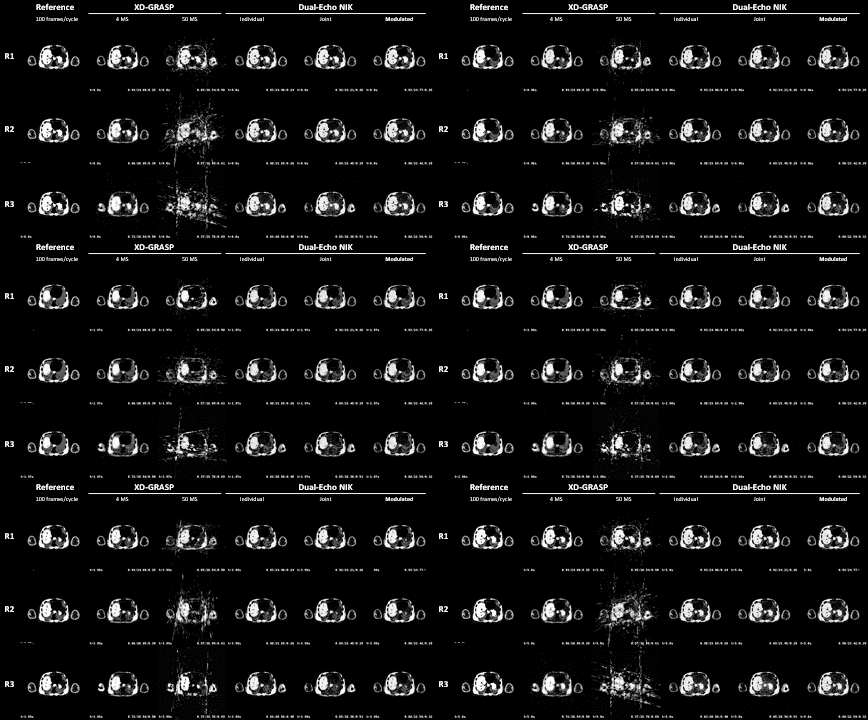
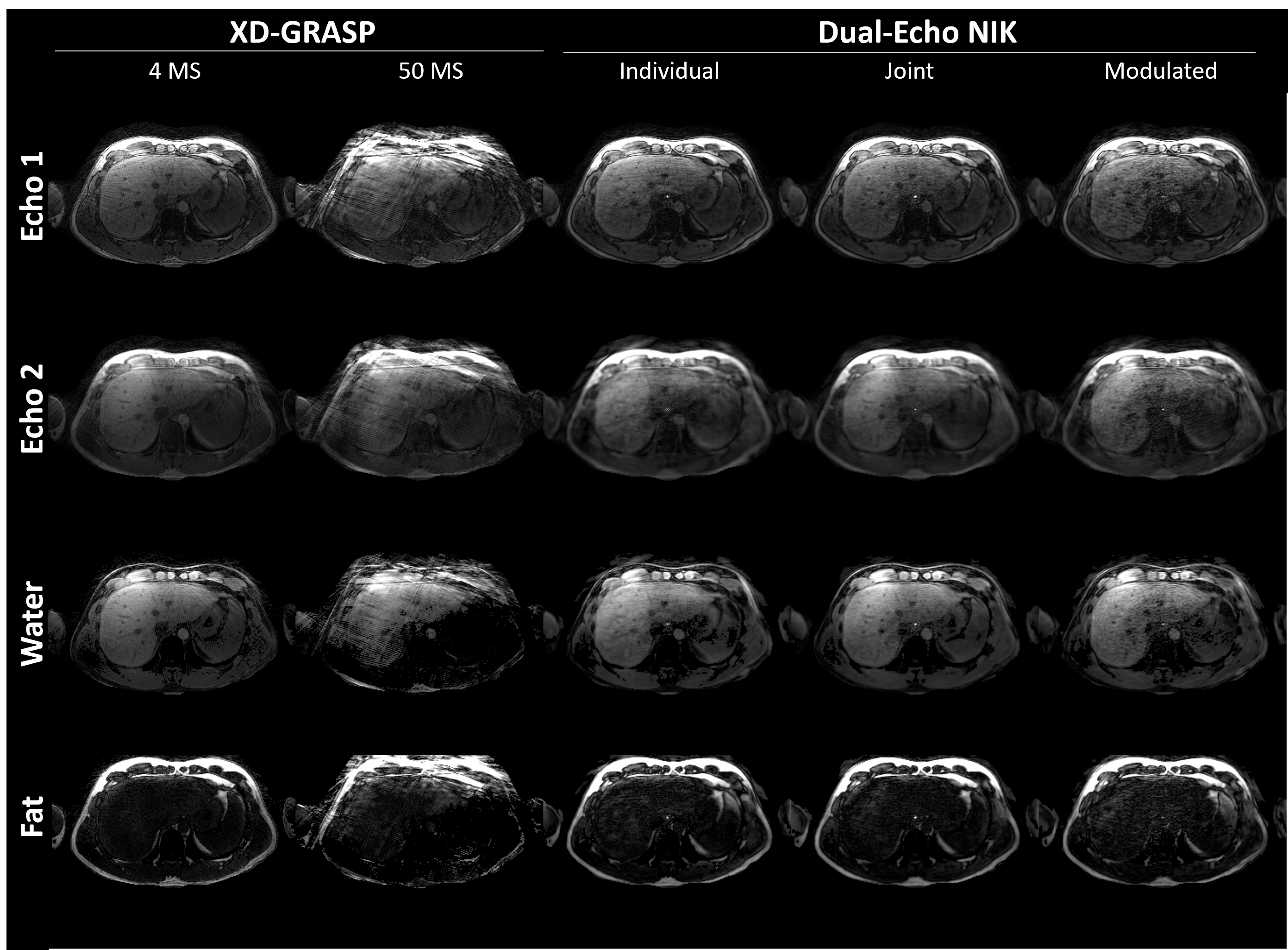
Blurring-free dynamic respiratory-resolved reconstructions for $$$e_1, e_2$$$, water and fat can be obtained with the proposed DE-NIKs (Fig.3A), also at increased acceleration rates (Fig.4). Improved motion resolution is quantitatively supported by improved SSIM/PSNR of all DE-NIK variants compared to XD-GRASP. In particular with reduced amounts of training data (R3), the modulated DE-NIK quantitatively performs best (Fig.3C/Fig.4). End-exhale reconstructions show, that DE-NIKs encounter streaking artefacts albeit high temporal resolution, while reducing motion blurring (Fig.5). In particular for individual DE-NIK, $$$e_2$$$-reconstructions appear more blurry, while joint and modulated seem to benefit from the additional information during training for more detailed $$$e_2$$$ and subsequent water-reconstructions.Discussion and Conclusion
The proposed DE-NIKs enable blurring-free and respiratory-resolved echo/water/fat reconstructions at high temporal resolution. We show that exposing DE-NIK to both echoes in the training procedure enhances reconstruction performance. Currently, joint DE-NIK trains fastest (2hr). Yet, the modulated version offers the potential to generalize the echo-dependent part over multiple subjects, thereby decreasing training complexity. Further development needs to address the strong variation in k-space distributions of different echoes and consider increased in-vivo complexity, such as less reliable navigators and multiple coils. Concluding, inclusion of dual-echo information into NIK does not only allow for extended applications such as water-fat-separation, but may also enable reduced acquisition times due to a reduced amount of spokes required for training.Acknowledgements
The authors acknowledge research support from Philips Healthcare. V.S. and H.E. are supported by the Helmholtz Association under the joint research school "Munich School for Data Science - MUDS".References
[1] Feng L, Axel L, Chandarana H, Block KT, Sodickson DK, Otazo R. XD-GRASP: Golden-angle radial MRI with reconstruction of extra motion-state dimensions using compressed sensing. Magnetic Resonance in Medicine 2016; 75:775–788. 10.1002/mrm.25665 '%3E%3Crect id='Rectangle_515' data-name='Rectangle 515' width='12.5' height='6.5' transform='translate(661 98)' fill='%23fff'/%3E%3Cpath id='Path_1430' data-name='Path 1430' d='M0,0,3.962,4H0Z' transform='translate(672.288 91)' fill='%23fff'/%3E%3Cg id='picto-support-e-books' transform='translate(661 91)'%3E%3Cg id='Group_699' data-name='Group 699' transform='translate(2.445 8.827)'%3E%3Cg id='Group_698' data-name='Group 698' transform='translate(2.625)'%3E%3Cpath id='Path_1267' data-name='Path 1267' d='M34.475,35.928V35.4H32.732V38.27h.647V37.114H34.4v-.529H33.379v-.657Z' transform='translate(-29.619 -35.373)' fill='%23d52b1e'/%3E%3Cpath id='Path_1268' data-name='Path 1268' d='M22.32,35.615a1.829,1.829,0,0,0-1.168-.307,5.693,5.693,0,0,0-.871.06V38.19a5.482,5.482,0,0,0,.732.043,2.036,2.036,0,0,0,1.315-.37A1.462,1.462,0,0,0,22.8,36.7,1.28,1.28,0,0,0,22.32,35.615Zm-1.168,2.111a1.18,1.18,0,0,1-.224-.013V35.832a1.315,1.315,0,0,1,.293-.025.821.821,0,0,1,.9.912A.888.888,0,0,1,21.152,37.726Z' transform='translate(-20.281 -35.308)' fill='%23d52b1e'/%3E%3C/g%3E%3Cpath id='Path_1269' data-name='Path 1269' d='M11.521,35.539a1.36,1.36,0,0,0-.87-.23,5.138,5.138,0,0,0-.871.06v2.836h.638V37.177a1.66,1.66,0,0,0,.22.013,1.311,1.311,0,0,0,.926-.3.923.923,0,0,0,.262-.683A.841.841,0,0,0,11.521,35.539Zm-.888,1.152a1.075,1.075,0,0,1-.216-.016v-.849a1.064,1.064,0,0,1,.266-.026c.323,0,.5.158.5.422C11.187,36.516,10.976,36.691,10.633,36.691Z' transform='translate(-9.78 -35.309)' fill='%23d52b1e'/%3E%3C/g%3E%3Cpath id='Path_1270' data-name='Path 1270' d='M15.228,3.552,11.686.027V0H4.53l-1.345,0v7.02H0v6.529H3.185V16H15.247l0-12.448Zm-3.6,9.252H.744V7.776H11.626Zm.061-9.252V.991L14.26,3.552Z' fill='%23d52b1e'/%3E%3C/g%3E%3C/g%3E%3Cg id='Path_1429' data-name='Path 1429' transform='translate(21.445 -2.124)' fill='%235dd95d'%3E%3Cpath d='M 9.249787330627441 17.17169380187988 L 4.762476921081543 12.68437480926514 L 7.214956283569336 10.23189544677734 L 9.015677452087402 12.03262424468994 L 9.369227409362793 12.38618469238281 L 9.722777366638184 12.03262424468994 L 16.32264709472656 5.432744979858398 L 18.65010833740234 7.760213375091553 L 9.249787330627441 17.17169380187988 Z' stroke='none'/%3E%3Cpath d='M 9.249578475952148 16.46436309814453 L 17.94319725036621 7.760422229766846 L 16.32264709472656 6.139865875244141 L 10.07633686065674 12.38618469238281 L 9.369227409362793 13.09329414367676 L 8.662117004394531 12.38618469238281 L 7.214955806732178 10.93901634216309 L 5.469596385955811 12.68437480926514 L 9.249578475952148 16.46436309814453 M 9.249997138977051 17.87900352478027 L 4.05537748336792 12.68437385559082 L 7.214957237243652 9.524794578552246 L 9.369227409362793 11.67907428741455 L 16.32264709472656 4.725644111633301 L 19.35699653625488 7.76000452041626 L 9.249997138977051 17.87900352478027 Z' stroke='none' fill='%23fff'/%3E%3C/g%3E%3C/svg%3E%0A "Show in Citavi")
[2] Spieker V, Eichhorn H, Hammernik K, Rueckert D, Preibisch C, Karampinos DC, Schnabel JA. Deep Learning for Retrospective Motion Correction in MRI: A Comprehensive Review. IEEE Transactions on Medical Imaging 2023; PP. 10.1109/TMI.2023.3323215
[3] Huang W, Li HB, Pan J, Cruz G, Rueckert D, Hammernik K. Neural Implicit k-Space for Binning-Free Non-Cartesian Cardiac MR Imaging. In: "Information Processing in Medical Imaging (Frangi A, de Bruijne M,Wassermann D, Navab N, Eds.), Cham, 2023. pp. 548–560
[4] Spieker V, Huang W, Eichhorn H, Stelter J, Weiss K, Zimmer VA, Braren RF, Karampinos DC, Hammernik K, Schnabel JA. ICoNIK: Generating Respiratory-Resolved Abdominal MR Reconstructions Using Neural Implicit Representations in k-Space. https://arxiv.org/abs/2308.08830
[5] Eggers H, Brendel B, Duijndam A, Herigault G. Dual-echo Dixon imaging with flexible choice of echo times. Magnetic Resonance in Medicine 2011; 65:96–107. 10.1002/mrm.22578
[6] Sitzmann V, Martel J, Bergman A, Lindell D, Wetzstein G. Implicit Neural Representations with Periodic Activation Functions. Advances in Neural Information Processing Systems 2020; 33:7462–7473
[7] Catalán T, Courdurier M, Osses A, Botnar R, Costabal FS, Prieto C, “Unsupervised reconstruction of accelerated cardiac cine MRI using Neural Fields”, https://arxiv.org/abs/2307.14363
[8] Maril N, Collins CM, Greenman RL, Lenkinski RE. Strategies for shimming the breast. Magnetic Resonancein Medicine 2005; 54:1139–1145. 10.1002/mrm.20679
[9] Collins CM, Yang B, Yang QX, Smith MB. Numerical calculations of the static magnetic field in three-dimensional multi-tissue models of the human head. Magnetic resonance imaging 2002; 20:413–424.10.1016/s0730-725x(02)00507-6
[10] Uecker M, Lai P, Murphy MJ, Virtue P, Elad M, Pauly JM, Vasanawala SS, Lustig M. ESPIRiT–an eigenvalue approach to autocalibrating parallel MRI: where SENSE meets GRAPPA. Magnetic Resonance in Medicine 2014; 71:990–1001. 10.1002/mrm.24751
[11] Stelter JK, Boehm C, Ruschke S, Weiss K, Diefenbach MN, Wu M, Borde T, Schmidt GP, Makowski MR, Fallenberg EM, Karampinos DC. Hierarchical Multi-Resolution Graph-Cuts for Water-Fat-Silicone Separation in Breast MRI. IEEE Transactions on Medical Imaging 2022; 41:3253–3265.10.1109/TMI.2022.3180302.
Figures