Clinical applications of Hyperpolarized 13C and 129Xe MRI
Gigin Lin1
1Chang Gung Memorial Hospital, Taipei, Taiwan
1Chang Gung Memorial Hospital, Taipei, Taiwan
Synopsis
Keywords: Contrast mechanisms: Hyperpolarization, Cross-organ: Cancer, Education Committee: Clinical MRI
Hyperpolarized (HP) MRI is an emerging imaging technique to enhance signals of gases (helium-3 or xenon-129) or liquids (carbone-13), to highlight body's internal structures and metabolic processes. Traditional MRI provides detailed images of the anatomy of the body, and HP MRI goes further by providing information about metabolic processes in real-time. Based on its non-invasive and non-irritation nature, HP MRI has gained attentions in wide range of potential clinical applications, including cancer, heart, lung, brain, and metabolic disorders. In this talk we will discuss the clinical potentials of HP MRI through exploring the ongoing research and clinical trials.Hyperpolarized (HP) MRI is an emerging imaging technique to enhance signals of gases(helium-3 or xenon-129) or liquids (carbone-13), to highlight body's internal structures and metabolic processes. Traditional MRI provides detailed images of the anatomy of the body, and HP MRI goes further by providing information about metabolic processes in real-time.Based on its non-invasive and non-irritation nature, HP MRI has gained attentions in wide range of potential clinical applications, including detection and diagnosis, monitor treatment response in prostate, breast and other cancers; lung disease such as asthma, chronic obstructive pulmonary disease (COPD), and cystic fibrosis; metabolism of the brain, cardiovascular and skeletal muscles. We will discuss the clinical potentials of HP MRIthrough exploring the ongoing research and clinical trials, to reveal more uses for this cutting-edge imaging technology.
Acknowledgements
This study was funded by National Science and Technology Council, Taiwan (NSTC 110-2628-B-182A) and Chang Gung Medical Foundation grant CLRPG3K0024, CMRPG3M073.We thank the helps from Dr. Ching-Yi Hsieh, Dr. Ying-Chieh Lai, Dr. Yenpo Lin, Kuan-Ying Lu, Dr. Rolf F Schulte, Dr. Albert Chen, and HMTRC, UCSF, supported by NIBIB and NIH Grant P41EB013598.References
- Cunningham CH, Lau JY, Chen AP, et al. Hyperpolarized 13C Metabolic MRI of the Human Heart: Initial Experience. Circ Res. 2016;119(11):1177-1182. doi:10.1161/CIRCRESAHA.116.309769
- Wang ZJ, Ohliger MA, Larson PEZ, et al. Hyperpolarized 13C MRI: State of the Art and Future Directions. Radiology. 2019;291(2):273-284. doi:10.1148/radiol.2019182391
- Gallagher FA, Woitek R, McLean MA, et al. Imaging breast cancer using hyperpolarized carbon-13 MRI. Proc Natl Acad Sci U S A. 2020;117(4):2092-2098. doi:10.1073/pnas.1913841117
- Granlund KL, Tee SS, Vargas HA, et al. Hyperpolarized MRI of Human Prostate Cancer Reveals Increased Lactate with Tumor Grade Driven by Monocarboxylate Transporter 1. Cell Metab. 2020;31(1):105-114.e3. doi:10.1016/j.cmet.2019.08.024
- Park JM, Harrison CE, Ma J, et al. Hyperpolarized 13C MR Spectroscopy Depicts in Vivo Effect of Exercise on Pyruvate Metabolism in Human Skeletal Muscle. Radiology. 2021;300(3):626-632. doi:10.1148/radiol.2021204500
Figures
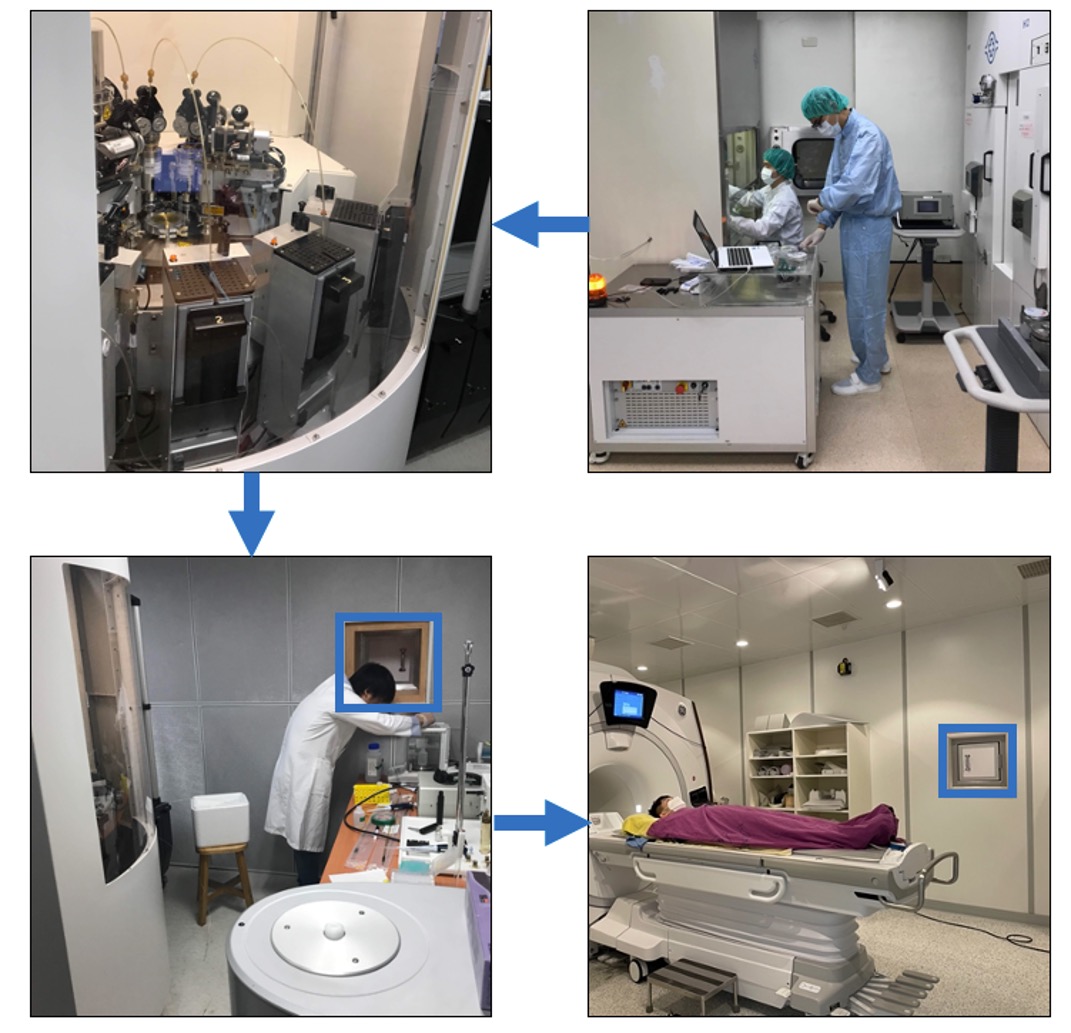
Hyperpolarized 13C MRI preparation process.
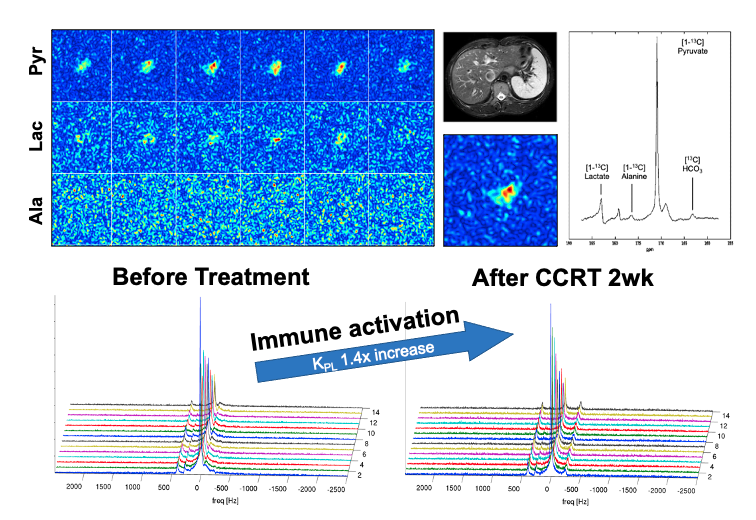
Hyperpolarized 13C MRI monitoring immune activation following radiotherapy.