5422
Correlation between body fat distribution characteristics and human body parameters based on magnetic resonance imaging1Medical Imaging Department, Peking University ShenZhen Hospital, ShenZhen, China, 2Peking University ShenZhen Hospital, ShenZhen, China, 3Shenzhen Institutes of Advanced Technology(SIAT), ShenZhen, China
Synopsis
The study explores the correlation between fat distribution characteristics and traditional anthropometric indexes.37 volunteers were scanned with whole-body transverse MR PDFF(Proton Density Fat Fraction) images, covering from neck to knee.In the fat distribution characteristics based on magnetic resonance whole-body imaging, only the proportion of whole-body fat volume showed moderate correlation with traditional ergonomic indexes, and other indexes had low correlation with ergonomic indexes.the correlation between the whole-body fat distribution characteristics based on PDFF image and body mass index (BMI) ,waist to hip ratio (WHR) was analyzed. Different from the anthropometric indexes, the distribution characteristics of body fat show great differences between sexes.
Introduction
With the development of economy and society and the change of life style, the number of obese people in China has gradually increased in recent years. The number of obese people has reached about 90 million [1], which has surpassed the United States to become the country with the largest number of obese people and a major health challenge.The traditional Body Mass Index (BMI) is widely used to assess the degree of obesity [1]. However, many studies have found that it is lack of specificity to measure and analyze obesity and disease risk assessment only based on BMI [2].Methods
The 3.0T magnetic resonance clinical scanner (uMR790, Shanghai Lianying, Shanghai, China) was used for the collection of magnetic resonance images of all volunteers.37 volunteers were scanned with whole-body transverse magnetic resonance PDFF images, covering from neck to knee, About 160 PDFF images were obtained from each volunteer.The total adipose tissue (TAT) is segmented by using the automatic fat segmentation method based on deep learning, and the distribution maps of subcutaneous adipose tissue (SAT) and internal adipose tissue (IAT) are obtained. Finally, the correlation between the whole-body fat distribution characteristics based on PDFF image and body mass index (BMI) ,waist to hip ratio (WHR) was analyzed.Results
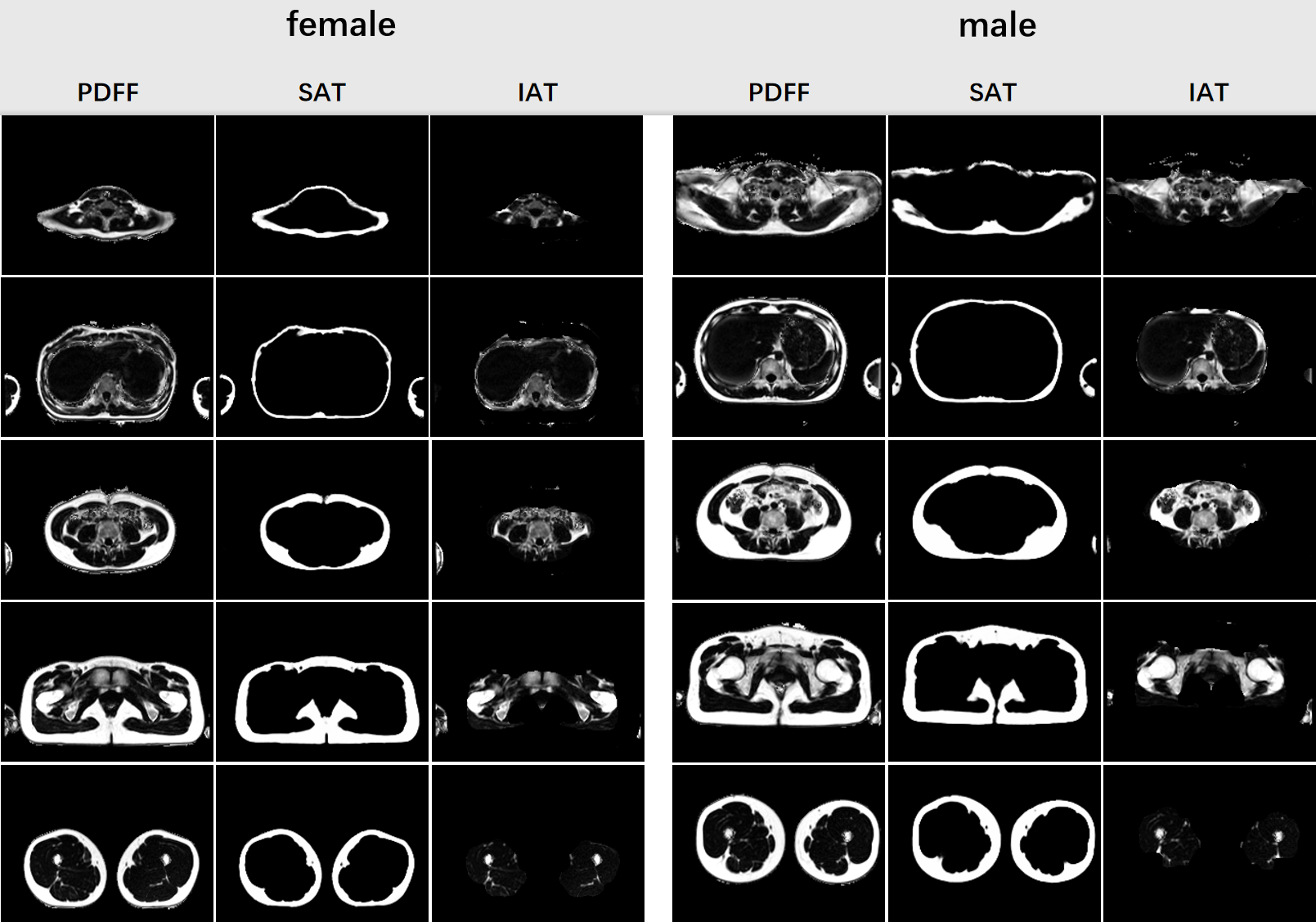
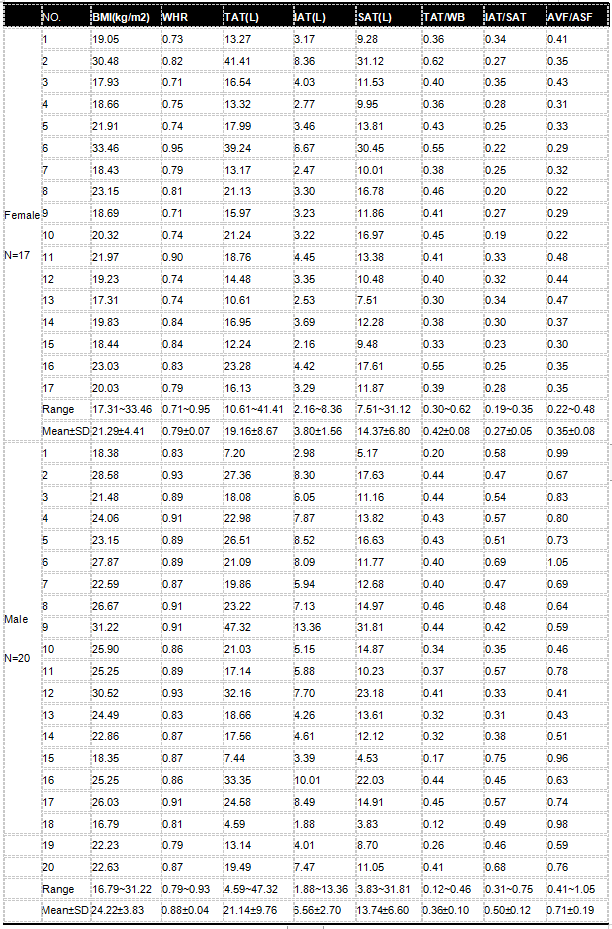
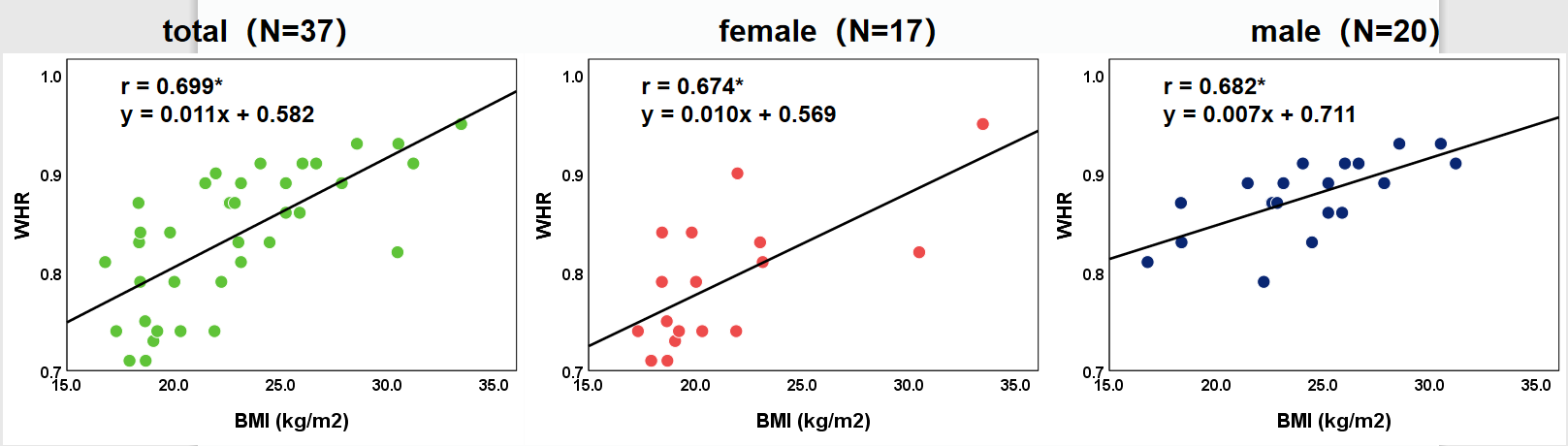
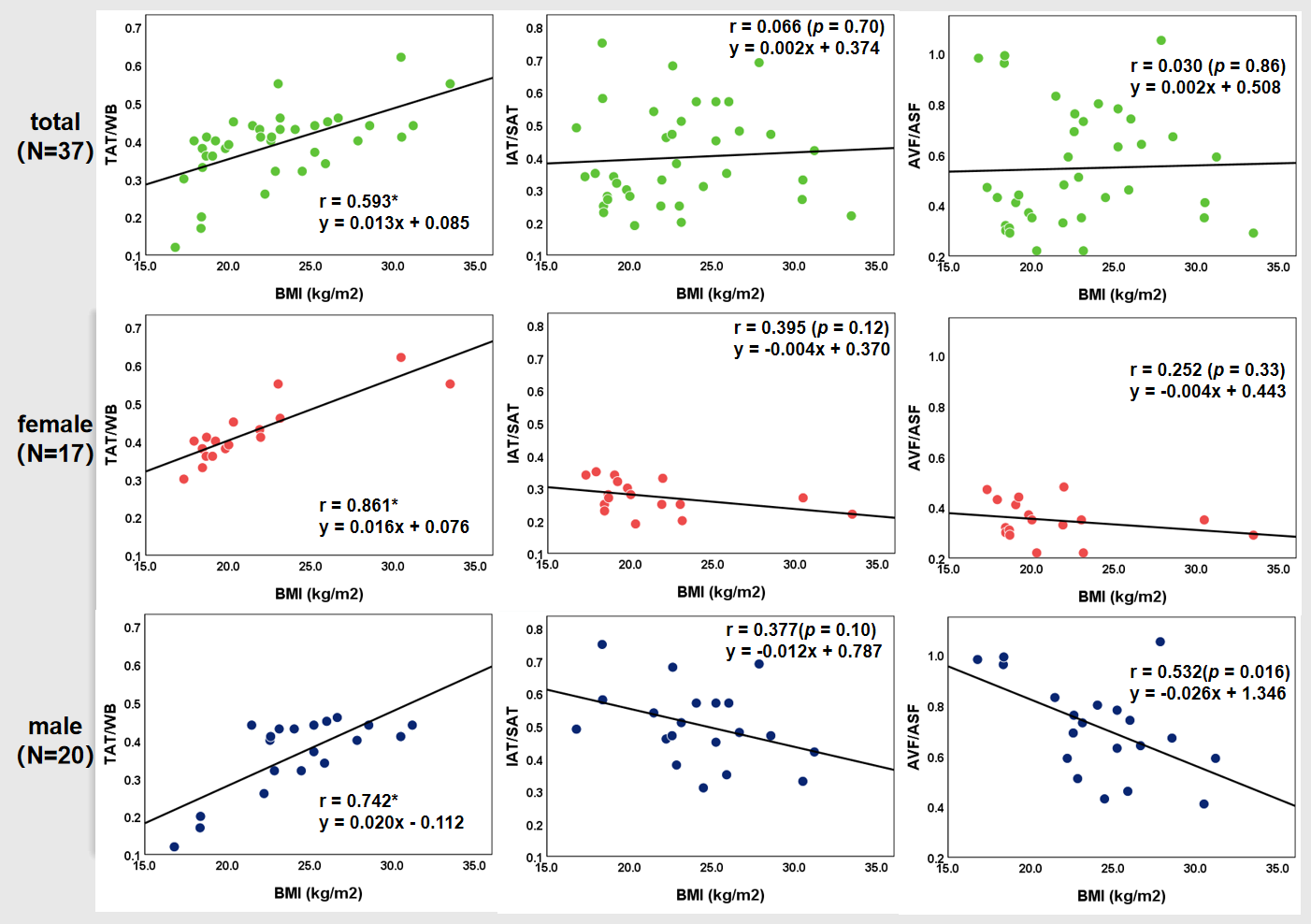
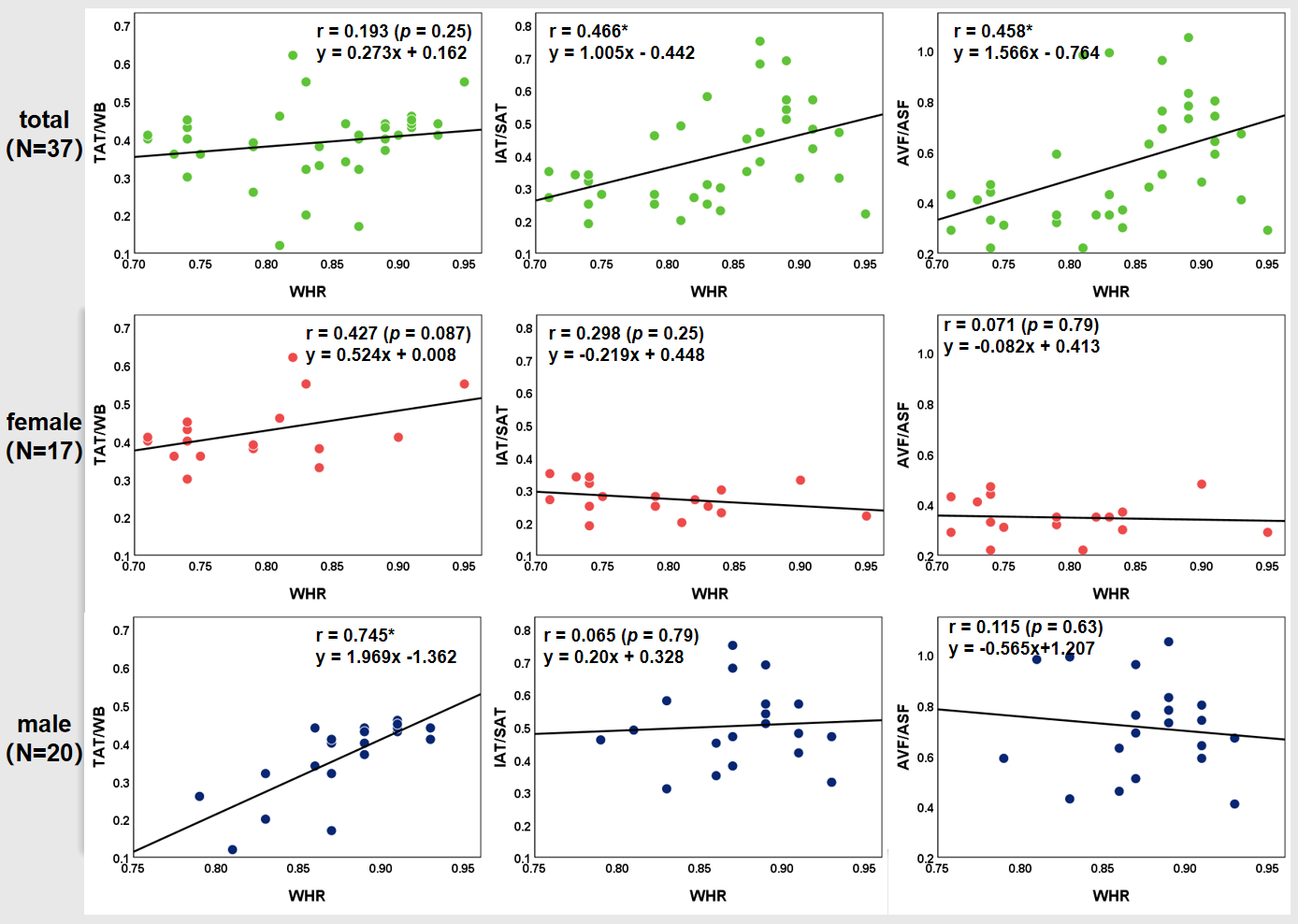
In this study, 37 volunteers (age range: 22-37 years, 25.78 ± 3.55) were collected, including 17 female volunteers (age range: 22-37 years, 26.59 ± 3.49) and 20 male volunteers (age range: 22-32 years, 25.10 ± 3.05).Figure 1 shows the PDFF imageS of each part of the body of a female volunteer and a male volunteer.According to gender classification, the complete information of the anthropometric parameters BMI and waist hip ratio (WHR), adipose tissue volume (TAT, SAT and IAT), internal fat percentage (IAT/SAT), total body fat volume ratio (TAT/WB) and abdominal internal subcutaneous fat ratio (AVF/ASF) of 37 volunteers are shown in Figure 2.The results of statistical analysis showed that there was no significant difference between the BMI index of female volunteers (21.29 ± 4.41) and that of male volunteers (p=0.04).The ergonomic parameters BMI and WHR had significant linear correlation (p<0.01) in all volunteers (n=37), female volunteers (n=17) and male volunteers (n=20), and the linear correlation coefficients were 0.699, 0.674 and 0.682 respectively, as shown in Figure 3.Comparing the BMI of all volunteers (N=37) with the fat distribution characteristics of TAT/WB, IAT/SAT and AVF/ASF, it was found that BMI only showed a significant linear correlation with TAT/WB (r=0.593), and almost no linear relationship with IAT/SAT and AVF/ASF (p=0.70 and 0.86 respectively), as shown in Figure 4.These results all show that the fat hoarding pattern shows a large difference between women and men, and this difference is difficult to be reflected in BMI.Waist hip ratio (WHR) is considered to be better than BMI in reflecting the accuracy and specificity of metabolic related disease risk. This study found that WHR had significant linear correlation with TAT/WB index only in the male group (r=0.745), as shown in Figure 5.In summary,in the fat distribution characteristics based on magnetic resonance whole-body imaging, only the proportion of whole-body fat volume showed moderate correlation with traditional ergonomic indexes, and other indexes had low correlation with ergonomic indexes. Different from the anthropometric indexes, the distribution characteristics of body fat show great differences between sexes.Discussion
The MR proton density fat fraction whole-body imaging proposed in this paper takes into account the two major needs of fat tissue recognition and fat deposition quantification.The defects and deficiencies of this study are mainly due to the small number of people included in the study, and only for young and middle-aged healthy volunteers aged 20-40. Therefore, the main conclusions can only be partially applied to young healthy volunteers.Based on the fat volume of each part, this paper further extracted the fat distribution characteristics of TAT/WB, IAT/SAT and AVF/ASF,TAT/WB index shows the ratio of total body fat volume to total body volume, which is similar to the traditional body fat rate. It can also be seen from the correlation analysis that this indicator is highly correlated with BMI and can be used to assess the overall obesity level of human body. IAT/SAT index shows the ratio of human internal fat to total fat, which shows the tendency of fat accumulation under the skin or in the internal organs, and has high value in predicting the risk of metabolic diseases [5-6].Conclusion
The whole body fat distribution characteristics based on magnetic resonance imaging can provide a new means and tools for the study of obesity.Acknowledgements
This work was supported by the ShenZhen Institutes of Advanced Technology(SIAT).
References
[1] NCD Risk Factor Collaboration. Trends in adult body-mass index in 200 countries from 1975 to 2014: a pooled analysis of 1698 population-based measurement studies with 19·2 million participants [J]. The Lancet, 2016, 387(10026):1377-1396.
[2] John J Reilly, Asmaa El-Hamdouchi, Adama Diouf, Andries Monyeki, Serge A Somda. Determining the worldwide prevalence of obesity [J]. The Lancet, 2018, 391(10132): 1773-1774.
[3] Chao Zou, Chuanli Cheng, Yangzi Qiao, Qian Wan, Changjun Tie, Min Pan, Dong Liang, Hairong Zheng, Xin Liu. Hierarchical iterative linear-fitting algorithm (HILA) for phase correction in fat quantification by bipolar multi-echo sequence [J]. Quantitative Imaging in Medicine and Surgery, 2019, 9(2):247-262.
[4] Chuanli Cheng, Chao Zou, Changhong Liang, Xin Liu, Hairong Zheng. Fat-water separation using a region growing algorithm with self feeding phasor estimation [J], Magnetic Resonance in Medicine. 2017, 77(6): 2390-2401
[5] Stefan, N., Causes, consequences, and treatment of metabolically unhealthy fat distribution. The lancet Diabetes & endocrinology, 2020. 8(7): 616-627.
[6] B. M. Kaess, A. Pedley, J. M. Massaro, J. Murabito, U. Hoffmann & C. S. Fox. The ratio of visceral to subcutaneous fat, a metric of body fat distribution, is a unique correlate of cardiometabolic risk [J]. Diabetologia, 2012, 55: 2622–2630
Figures