5411
The potential role of FT - CMR for detecting left ventricular dysfunction in patients with PSP: a case control study
Pengfei Peng1, Xun Yue1, jia yu sun1, and Pengfei Peng1
1Radiology, West China Hospital, Sichuan University,, Chengdu, China
1Radiology, West China Hospital, Sichuan University,, Chengdu, China
Synopsis
The potential role of feature tracking - CMR for detecting left ventricular dysfunction in patients with PSP
Background:
Progressive supranuclear palsy (PSP) is a common atypical parkinsonism. Parkinson's syndrome not only presents typical motor symptoms, but also cardiovascular autonomic dysfunction, such as postural hypotension, which is one of the most serious features of autonomic dysfunction(1). In the case of pathologically elevated blood pressure, the patient's heart function may be affected to some extent. PSP determination has little to do with cardiac function. Feature tracking - Cardiac magnetic resonance(CMR) is sensitive to early cardiac dysfunction and can be used to evaluate the global and local motion status of the left ventricular myocardium. The purpose of this study was to conduct a cross-sectional study of PSP patients and healthy controls using cardiac magnetic resonance myocardial strain to investigate the presence of early subclinical cardiac dysfunction in PSP patients.
Methods and Materials:
All CMR examinations were performed on a 3.0 T MRI scanner (uMR 790, United Imaging, Shanghai, China). Our study included 20 patients with progressive supranuclear palsy (PSP group) and 25 healthy controls (control group). The segmented balanced steady-state free-precession sequence was used for the retrospective ECG-gated standard cine CMR scans of all participants. The short-axis images were analyzed in CVI42 (Circle Cardiovascular Imaging, Calgary, Alberta, Canada), by a radiologist with 2 years’ experience in CMR. Independent T test was performed to compare five continuous LV measurements: ejection fraction (LVEF), LV end-diastolic mass (LVEDM), end-diastolic volume (LVEDV), end-systolic volume (LVESV), and stroke volume (LVSV). The strain parameters include global longitudinal strain(GLS), global circumferential strain(GCS) and global radial strain (GRS).
Results:
There was a statistically significant difference between PSP patients and controls regarding global circumferential strain (p = 0.03), left ventricular ejection fraction (p = 0.02).
Conclusion:
PSP patients were found to have slightly lower global circumferential strain and left ventricular ejection fraction than healthy controls. There may be subclinical impairment of cardiac function in patients with PSP.
Progressive supranuclear palsy (PSP) is a common atypical parkinsonism. Parkinson's syndrome not only presents typical motor symptoms, but also cardiovascular autonomic dysfunction, such as postural hypotension, which is one of the most serious features of autonomic dysfunction(1). In the case of pathologically elevated blood pressure, the patient's heart function may be affected to some extent. PSP determination has little to do with cardiac function. Feature tracking - Cardiac magnetic resonance(CMR) is sensitive to early cardiac dysfunction and can be used to evaluate the global and local motion status of the left ventricular myocardium. The purpose of this study was to conduct a cross-sectional study of PSP patients and healthy controls using cardiac magnetic resonance myocardial strain to investigate the presence of early subclinical cardiac dysfunction in PSP patients.
Methods and Materials:
All CMR examinations were performed on a 3.0 T MRI scanner (uMR 790, United Imaging, Shanghai, China). Our study included 20 patients with progressive supranuclear palsy (PSP group) and 25 healthy controls (control group). The segmented balanced steady-state free-precession sequence was used for the retrospective ECG-gated standard cine CMR scans of all participants. The short-axis images were analyzed in CVI42 (Circle Cardiovascular Imaging, Calgary, Alberta, Canada), by a radiologist with 2 years’ experience in CMR. Independent T test was performed to compare five continuous LV measurements: ejection fraction (LVEF), LV end-diastolic mass (LVEDM), end-diastolic volume (LVEDV), end-systolic volume (LVESV), and stroke volume (LVSV). The strain parameters include global longitudinal strain(GLS), global circumferential strain(GCS) and global radial strain (GRS).
Results:
There was a statistically significant difference between PSP patients and controls regarding global circumferential strain (p = 0.03), left ventricular ejection fraction (p = 0.02).
Conclusion:
PSP patients were found to have slightly lower global circumferential strain and left ventricular ejection fraction than healthy controls. There may be subclinical impairment of cardiac function in patients with PSP.
Acknowledgements
No acknowledgement found.References
1. Milazzo V, Di Stefano C, Vallelonga F, Sobrero G, Zibetti M, Romagnolo A, Merola A, Milan A, Espay AJ, Lopiano L, Veglio F, Maule S. Reverse blood pressure dipping as marker of dysautonomia in Parkinson disease. Parkinsonism Relat Disord. 2018 Nov;56:82-87.Figures
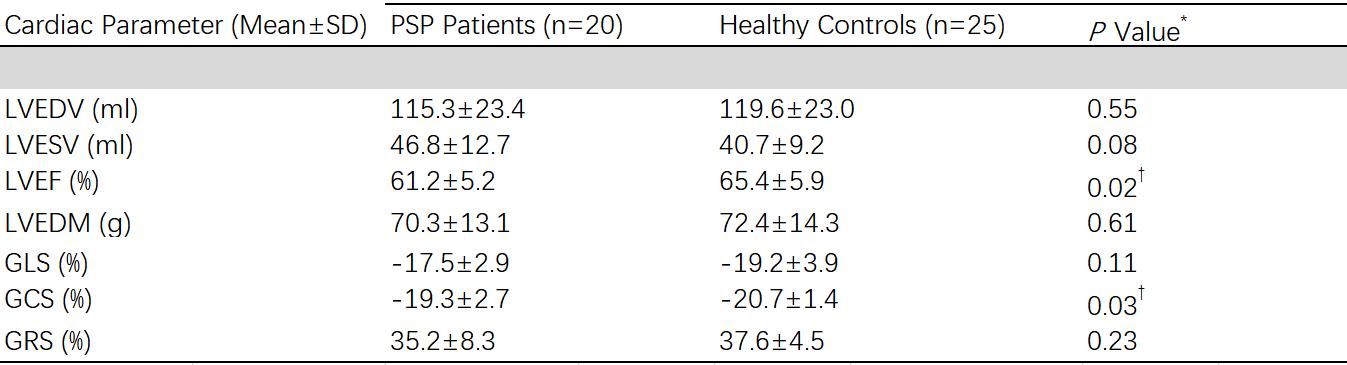
CMR parameters in PSP patients and controls.
DOI: https://doi.org/10.58530/2023/5411