5408
Evaluation the intramedullary severity and prognosis of early MRI in adult cervical spinal cord injury without radiologic abnormalities
Yuan Liu1, Peng Sun2, and Xiangchuang Kong1
1Department of Radiology, Union Hospital, Tongji Medical College, Huazhong University of Science and Technology, Wuhan, China, 2Philips Healthcare, Beijing, China
1Department of Radiology, Union Hospital, Tongji Medical College, Huazhong University of Science and Technology, Wuhan, China, 2Philips Healthcare, Beijing, China
Synopsis
The mpMRI biomarkers could be insightful for pathogenesis and prognosis in early-stage SCIWORA.
Purpose: Previous research showed early MRI imaging characteristics added little in the determination of spinal abnormalities and prognosis in cervical spinal cord injury without radiologic abnormalities (SCIWORA) . Our study mainly used early multiparametric MRI (mpMRI) to evaluate the correlation of quantitative biomarkers with the intramedullary severity and prognosis in the adult cervical SCIWORA .
Method: 24 patients with cervical SCIWORA and 16 controls with cervical spondylosis were enrolled in this study and underwent MRI examination with conventional MRI, multi-echo FFE T2*w image (mFFE), and diffusion tensor image (DTI) (Ingenia 3.0T, Philips Healthcare, the Netherlands). We divided the patients into SCIWORAh with macrohaemorrhage and SCIWORAno without haemorrhage based on BASIC score. The Brain and Spinal Injury Center (BASIC) score, intramedullary edema length (Ledema), and compression ratio (CR) were measured by conventional MRI and mFFE. Fractional anisotropy (FA) and mean diffusion (MD) were calculated at the injured segment. The histogram parameters at the region of interest (ROI) including the mean and 10% values (FAmean and FA10%, MDmean and MD10%), were obtained respectively. American Spinal Injury Association (ASIA) grades were recorded in the acute stage and follow up. Between-group comparative analysis and correlations between these biomarkers and ASIA scores were evaluated in R package with patient age as covariance.
Result: SCIWORAh patients showed significantly lower values compared with SCIWORAno ( MD10% and FA10%, p = 0.0022 and 0.0064 , respectively) and controls (MD10%, p = 0.0075), whereas the FAmean and MDmean values showed no significant difference. No significant differences were shown in DTI indicators between the SCIWORAno and the controls. BASIC sore and Ledema were correlated with ASIA grades in the early stage (n=19, r=0.642 and 0.719, p=0.003 and 0.001, respectively) , whereas Ledema and MD10% were correlated with ASIA grades at follow up (n=16, r=0.531* and 0.545, p=0.034 and 0.029, respectively ).
Conclusion: Intramedullary macrohaemorrhage in SCIWORA influence the FA10% and MD10% in the early stage, which might be related to the slightly increased iron content and decreased myelin in the bleeding area. Intramedullary edema length and MD10% are useful parameters for severity and predictors of outcome. The mpMRI biomarkers could be insightful for pathogenesis and prognosis in early-stage SCIWORA.
Method: 24 patients with cervical SCIWORA and 16 controls with cervical spondylosis were enrolled in this study and underwent MRI examination with conventional MRI, multi-echo FFE T2*w image (mFFE), and diffusion tensor image (DTI) (Ingenia 3.0T, Philips Healthcare, the Netherlands). We divided the patients into SCIWORAh with macrohaemorrhage and SCIWORAno without haemorrhage based on BASIC score. The Brain and Spinal Injury Center (BASIC) score, intramedullary edema length (Ledema), and compression ratio (CR) were measured by conventional MRI and mFFE. Fractional anisotropy (FA) and mean diffusion (MD) were calculated at the injured segment. The histogram parameters at the region of interest (ROI) including the mean and 10% values (FAmean and FA10%, MDmean and MD10%), were obtained respectively. American Spinal Injury Association (ASIA) grades were recorded in the acute stage and follow up. Between-group comparative analysis and correlations between these biomarkers and ASIA scores were evaluated in R package with patient age as covariance.
Result: SCIWORAh patients showed significantly lower values compared with SCIWORAno ( MD10% and FA10%, p = 0.0022 and 0.0064 , respectively) and controls (MD10%, p = 0.0075), whereas the FAmean and MDmean values showed no significant difference. No significant differences were shown in DTI indicators between the SCIWORAno and the controls. BASIC sore and Ledema were correlated with ASIA grades in the early stage (n=19, r=0.642 and 0.719, p=0.003 and 0.001, respectively) , whereas Ledema and MD10% were correlated with ASIA grades at follow up (n=16, r=0.531* and 0.545, p=0.034 and 0.029, respectively ).
Conclusion: Intramedullary macrohaemorrhage in SCIWORA influence the FA10% and MD10% in the early stage, which might be related to the slightly increased iron content and decreased myelin in the bleeding area. Intramedullary edema length and MD10% are useful parameters for severity and predictors of outcome. The mpMRI biomarkers could be insightful for pathogenesis and prognosis in early-stage SCIWORA.
Acknowledgements
No acknowledgement found.References
No reference found.Figures
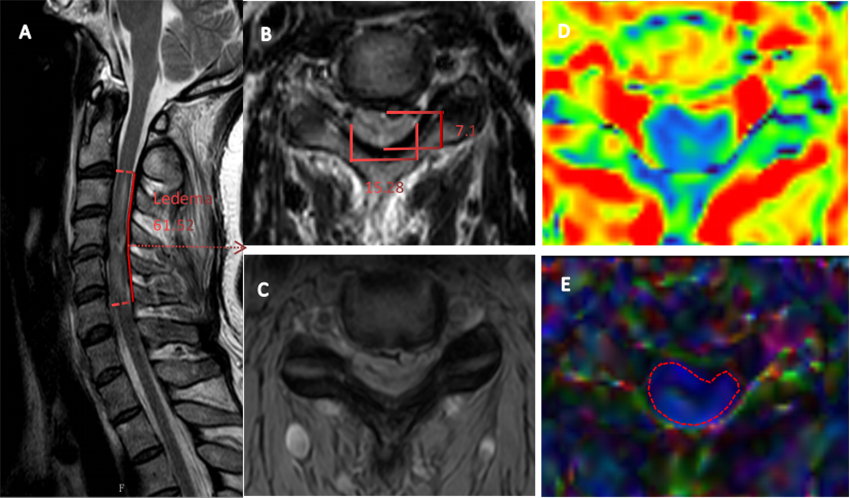
Figure 1. (A)Measurements of length of edema(Ledema) in the midsagittal T2-weighted image; (B) Measurements of Compression ratio using transection T2w image in the injured segment.(C) Correction of the intramedullary macrohaemorrhage using multi-echo FFE T2*w image with the signal reduction along the echo time in the haemorrhage segment.(D) and (E) Color map of MD and FA direction in the injured segment. Measurements of FA and MD values: Outline the whole injured spinal cord segmentation and calculated the mean and 10% lower values using 3D Slicer (https://www.slicer.org/)
DOI: https://doi.org/10.58530/2023/5408