5404
Application of diffusion-weighted imaging of fast spin echo sequences based on compressed sensing in nasopharyngeal imaging1Department of Diagnostic Radiology, Xijing Hospital, Air Force Medical University, Xi'an, China
Synopsis
There are two imaging options for nasopharyngeal DWI, one is EPI self-selected echo sequence, and the other is fast spin echo sequence. The two sequences are completely different in the way of reading signals, and each has its own advantages and disadvantages. Traditional EPI imaging has high distortion, and its advantages are fast scanning speed, while TSE sequence has small deformation, but it takes a long time. It takes nearly 4 minutes to scan a complete nasopharynx. In view of the long scanning time and distortion, we put forward two questions. The first question is how to shorten the imaging time while ensuring the image quality; the second question is what is the optimal compression factor for nasopharynx?
Objective
To investigate the effects of compressed sensing acceleration factors on the quality of nasopharyngeal rapid spin echo diffusion-weighted imaging (TSE-DWI)Methods and Data
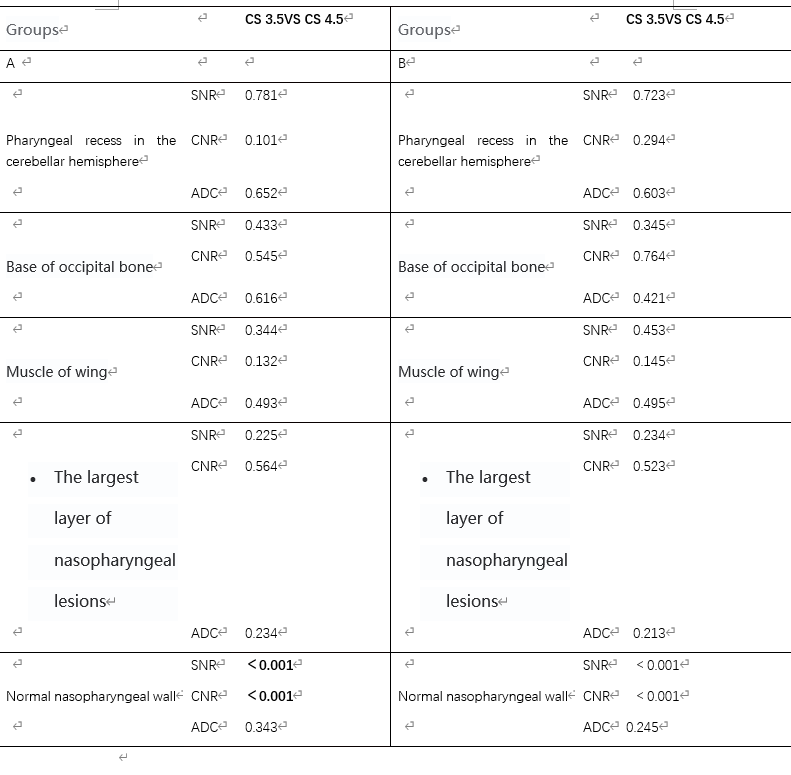
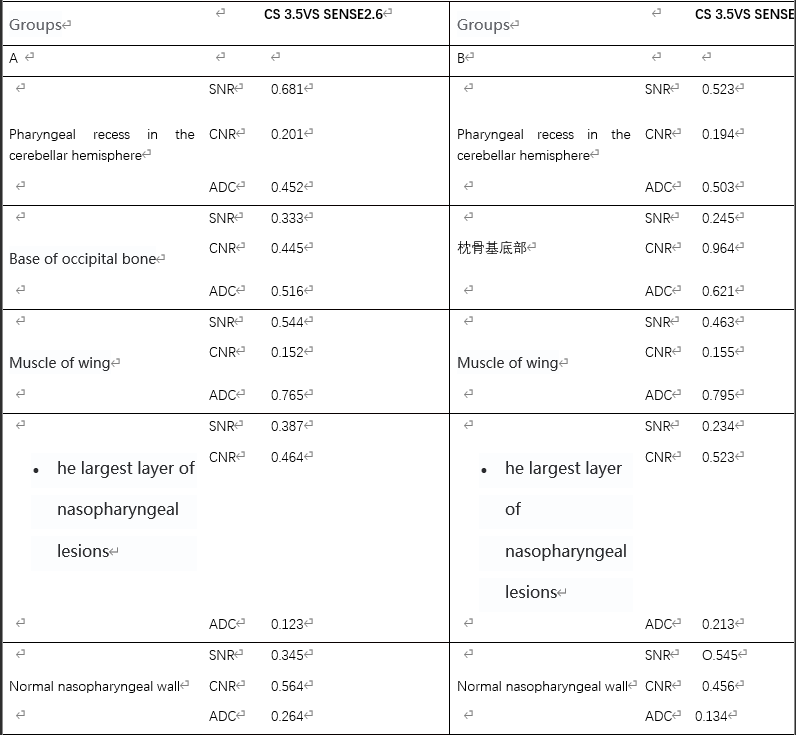
A total of 25 patients with nasopharyngeal carcinoma and 25 healthy volunteers (group A and group B) were successively recruited. All volunteers underwent plane echo imaging diffuse-weighted imaging (EPI-DWI) with scanning time of 35s and TSE-DWI combined with traditional parallel acquisition technology (SENSE) or (CS), with AF of 2.6 for SENSE. CS AF is 2.6, 3.6, 5.6, 7.6, The corresponding scanning time was 146s, 146s, 114s, 89s and 75s, respectively. Group A and group B were in EPI-DEI and TSE-DWI On the image b=1000s/mm², the cerebellar hemisphere at the level of pharyngeal crypt, the base of occipital bone, the inner wing, the maximum level of normal turbinate and nasopharyngeal carcinoma lesions were selected, and the ROI was defined to measure the performance diffusion coefficient (ADC) and signal strength (SI), and the background signal strength (air) was taken as the standard deviation. Signal-to-noise ratio (SNR) and contrast-to-noise ratio (CNR) between lesions and normal tissues were calculated. Firedman was used to examine the differences in ADC values, SNR, CNR and subjective scores of TSE-DWI in groups A and B with different AF cerebellar hemispheres, occipcipal base, and nasopharyngeal carcinoma lesions. If the difference was statistically significant, the Wilcoxon test was used for pairwise comparison. Then, the optimal AF was selected and compared with EPIResult
The image quality subjective scores of the two groups of observers were consistent (Kappa values 0.782, 0.871, 0.853), and the magnetic susceptibility pseudo-film scores, geometric deformation degree scores, SNR and CNR of TSE-DWI images were superior to EPI-DWI images (P values < 0.001). The contrast and ADC values of tumor foci in TSE-DWI images were not significantly different from those in EPI-DWI images (P value ≥0. 001). When AF of TSE-DWI group was compared with that of EPI-DWI group, when AF increased to 5.6, SNR, CNR and image score of cerebellar hemisphere, base of occiput and nasopharyngeal carcinoma lesions showed significant differences compared with SENSE2.6. When TSE-DWI CS3.6 was compared with EPI-DWI, The SNR and CNR of cerebellar hemisphere and occipital base showed statistical difference and higher score.Conclusions
Compared with traditional EPI-DWI sequences, TSE-DWI sequences can effectively improve the nasopharyngeal geometric deformation artifacts. The scanning time of TSE-DWI combined with CS was gradually shortened with the increase of AF. When CS is 3.6, the scanning time of SENSE2.6 is 23.25% shorter than that of conventional SENSE2.6. CS3.6 is clinically recommended for nasopharyngeal TSE-DWI sequence scanning for patients with nasopharyngeal space occupyingAcknowledgements
No acknowledgement found.References
Chen Wenbo, CAI Guanhui, Zhang Bin, et al. Preliminary study on the prediction of sensitivity to radiotherapy and chemotherapy in nasopharyngeal carcinoma by voxelin-irrelevant motion MRI. Does the Chinese journal of radiology, 2019 (7) : 549-554. The DOI: 10.3760 / cma. J.i SSN. 1005-1201.2019.07.004
Yang Jing, Liu Yangying Qiu, Liu Na, et al. Effects of different compressed sensing factors on the analysis of "swallowtail sign" in brain SWI. Journal of Magnetic Resonance Imaging, 2022,13 (05):89-93. DOI:10.12015/issn.1674-8034.2022.05.016
Figures