5388
A Primer on Blockchain in Radiology — Data Ownership and Beyond1Yale School of Medicine, New Haven, CT, United States, 2Yale University, New Haven, CT, United States, 3Mayo Clinic Arizona, Phoenix, AZ, United States
Synopsis
Keywords: Data Processing, Machine Learning/Artificial Intelligence, Data Security, Data Ownership, Technology
Cryptocurrency may be volatile, but the technology behind it is here to stay!
Blockchain has the potential to impact our work and to change the way we own, store, use or interact with imaging data altogether. Blockchain, essentially, trumps the traditional data solutions and is thus, the future of imaging databases. By achieving the perfect balance between data security and data sharing, it unlocks myriad of opportunities to advance patient care, improve our work ethic and bolster our research. Our work hopes to inspire you to experiment with any of the many applications we mention in our educational exhibit!
Summary and Objectives:
1. Describe blockchain as a decentralized system needed to make patient data more secure and portable (for patients), and more accessible (for practitioners, researchers and administrators).2. List the applications of blockchain in the field of Radiology.
3. Elaborate on the utility of blockchain databases in management of imaging data in clinical practice.
4. Highlight the role of blockchain in complementing the functions of Artificial Intelligence in image processing and analysis, and safeguarding Clinical Trials.
Background:
Data ownership is intimately tethered to data sharing and usage. Currently, HIPAA considers institutions as the rightful owners of the data they produce, yet allows them to share it with third parties only once it has been de-identified. With state-of-the-art facial recognition softwares, however, even de-faced MRs can now potentially be traced back to individuals. Moreover, the very nature of centrally controlled traditional databases makes them prone to cyberattacks and data leaks. With far greater emphasis on patient data ownership than ever before, many states in the US are in fact on the cusp of legislatively following in the footsteps of the EU’s GDPR by granting patients more rights over their data. Since any security lapse or illicit behavior fractures the trust of patients, it thwarts unfettered data sharing and unequivocally undermines the extent of our work.In the light of these observations, we, as radiologists, need to be fully aware of and prepared for any possible changes to data ownership laws because not only do we harvest prodigious amounts of data, but also depend on it for furthering our understanding of our subject matter through original research, AI integration and clinical trials. In this educational exhibit, we pose the ingenious use of blockchain as a preferable alternative to the use of traditional databases.
Introduction:
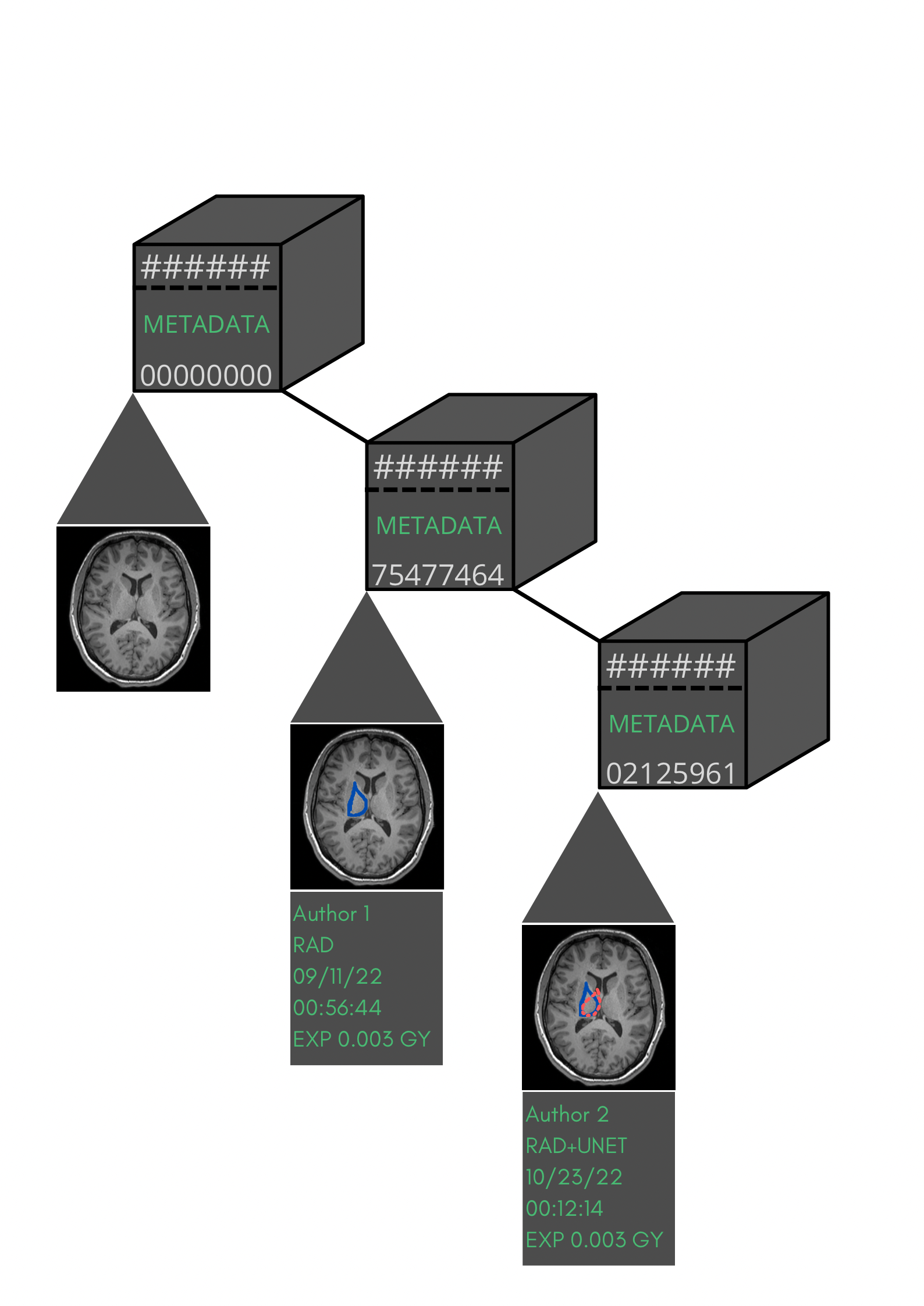
Popularized by cryptocurrency after the financial crisis of 2009, but permeating fields beyond finance ever since, Blockchain is a shared digital ledger that keeps track of transactions and events by storing a vast range of metadata in a “box” and links it to other boxes via a “chain” which serves as a trail. Due to its decentralized character, a new block only joins the chain once a consensus is reached between the nodes across the system. Finally, the addition is cemented with a “hash” — a unique alphanumeric key which locks the box — making the chain inherently immutable.Materials and Methods:
A literature review was aimed at identifying articles concerning blockchain and imaging data and/or radiology. The articles retrieved were amalgamated with insights drawn from experts on data ownership through a dedicated and exhaustive informatics journal club. Together, these serve as the basis of this educational exhibit.Results and Conclusions:
This educational exhibit introduces blockchain as an invaluable tool for securing, transmitting and analyzing imaging data in Radiology. Blockchain provides us with the distinct ability to measure the contribution of each radiologist in the form of an annotation on a scan (e.g. Boodoo et al.) or input in a lengthy radiology report through use of metadata generated as a result of each action, and to even determine if the said contribution is from a human or an AI algorithm — down to its version. Through elaborate use of metadata, Blockchain’s applications go far beyond those of traditional record keeping. For instance, it can also be used to gauge the amount of radiation exposure incurred by the patient with each procedure or for adjudicating billing claims at each scan. Additionally, it makes cross-institutional ‘dynamic consenting’ possible by allowing patients to modify their consent without having to fill forms to repeatedly report important details, such as allergies to contrast material, at every admission.The shared non-modifiable digital ledger keeps track of all events in a systematized way.This allows for imaging data to be stored locally while metadata can be uploaded on the blockchain, safeguarded through a private key owned by the patient, and subsequently used as a pointer to locate the stored image once patient grants access to it.
Such advancements in processing imaging datasets efficiently and securely through blockchain also augment the amount of high quality data available for training phase of AI algorithms. One of the more unique benefits of superimposing blockchain over AI algorithms, however, is the ability to have human oversight over the workings of AI. Similar mechanism can also be employed to ascertain the safety of clinical trials by making the data tamper-proof.
Acknowledgements
No acknowledgement found.References
Reference One:
Tagliafico, A. S., Campi, C., Bianca, B., Bortolotto, C., Buccicardi, D., Francesca, C., Prost, R., Rengo, M., & Faggioni, L. (2022). Blockchain in radiology research and clinical practice: current trends and future directions. La Radiologia Medica, 127(4), 391–397. https://doi.org/10.1007/s11547-022-01460-1
Reference Two:
Abdullah, S., Rothenberg, S., Siegel, E., & Kim, W. (2020). School of Block–Review of Blockchain for the Radiologists. Academic Radiology, 27(1), 47–57. https://doi.org/10.1016/j.acra.2019.06.025
Reference Three:
Kotter, E., Marti-Bonmati, L., Brady, A. P., & Desouza, N. M. (2021). ESR white paper: blockchain and medical imaging. Insights into Imaging, 12(1). https://doi.org/10.1186/s13244-021-01029-y
Figures