5311
Changes in excitation/inhibition balance in infants with brain injury evaluated by MEGA-edited MRS
Hui LIhong1, Lin Liangjie2, Cui Linfei2, Yan Chenyu1, Wei Wenjin1, Zhang Yong1, and Meng Yun1
1The First Affiliated Hospital of Zhengzhou University, Zhengzhou, China, 2Clinical and Technical Support, Philips Healthcare, Beijing, China
1The First Affiliated Hospital of Zhengzhou University, Zhengzhou, China, 2Clinical and Technical Support, Philips Healthcare, Beijing, China
Synopsis
Keywords: Prenatal, Pediatric
In this study, Infants with a history of encephalopathy at born and normal infants were performed the advanced J-edited 1H MR spectroscopy technique (MEGA-PRESS) for observing the changing of excitation/inhibition (E/I) balance of the infants. The results showed significantly difference in Glx [Cr] concentrations between the two groups, and loss of excitation/inhibition (E/I) balance in infants with a history of encephalopathy. The changing of excitation/inhibition (E/I) balance can partial explain the underlying metabolic mechanism.Introduction
Excitation/inhibition (E/I) balance of neurotransmitters is vital for maintaining normal brain functions , while the influence of prematurity-related brain injury to homeostatic regulation and maintenance of the E/I ratio in infant brain is rarely reported. The advanced J-edited 1H MR spectroscopy technique (MEGA-PRESS) enables reliable determination of local concentrations of brain metabolites, including the excitation neurotransmitters of glutamate and the inhibitory neurotransmitter gamma-aminobutyric acid (GABA) in the brain[1]. This study aims to explore the changes in brain excitation/inhibition balance in the prefrontal cortex of infants with brain injury, which may help understand the underlying metabolic mechanism.Method
11 infants (group 1, birth at 28-38 weeks) with a history of encephalopathy at born and 7 healthy neonates (group 2, birth at 28-40 weeks) were enrolled in this study. All of them underwent MRI/MRS scans on a 3.0 T scanner (Ingenia Meta, Philips Healthcare, Best, the Netherlands) equipped with a 32-channel head coil. Preterm infants performed MRI scans after reaching term-equivalent age. MRI scans included conventional MRI, high resolution whole-brain T1-weighted three-dimensional (3D) structural Image and MEGA-PRESS. The T1-weighted 3D images used for MRS voxel localization were acquired with major parameters as: TR = 8.2 ms; TE = 3.7 ms; slice thickness = 1 mm; matrix size = 256×256; FOV = 24×24 cm2; and flip angle = 8°. The MEGA-PRESS sequence was used for GABA and Glx (glutamate+glutamine) editing, the MRS voxels were set in the frontal lobe on the midline above the genu of the corpus callosum (Fig 1), and the major parameters were: voxel size = 3×3×3 cm3, TR =2000 ms; TE = 68 ms; spectral bandwidth = 2000, on/off frequencies = 1.9/7.5 ppm; signal averages = 96; and acquisition time = 6 min 30 s. The VAPOR scheme was used for water suppression. J-edited spectra were processed and quantitatively analyzed using the Gannet tools on the MATLAB software (Figure 2). The structural MPRAGE images were then segmented into gray matter, white matter, and cerebrospinal fluid using SPM12, and the voxel for MRS acquisition was aligned to the MPRAGE image for tissue segmentation. The GABA and Glx levels were quantified with reference to the creatine (GABA[Cr] and Glx[Cr]) and water (GABA[Water] and Glx[Water], corrected for brain tissue segmentation) signals, respectively. Two independent samples t-test was used to analyze the differences in GABA and Glx levels between the two groups.Result
2 infants with encephalopathy and 1 healthy neonate were excluded because of head motion. 5 infants with encephalopathy showed abnormal findings including intraventricular hemorrhage and/or white matter abnormality; All healthy neonates were negative on T2WI; Infants with encephalopathy had higher concentrations of Glx [Cr] (0.101 ± 0.128 vs. 0.084 ± 0.007, p = 0.00, Table 1) in the right frontal lobe compared with that of healthy neonates . No significantly difference in GABA[Cr]between the two groups.Discussion
GABA and glutamate are principal neurotransmitters essential for late gestational brain development and play a vital role in fetal and neonatal brain development. Advances in MRS have allowed for the direct non-invasive in-vivo estimation of both glutamate and also gamma-aminobutyric acid (GABA), the principal excitatory and inhibitory neurotransmitters in the central nervous system respectively[2] . A loss of the excitation/inhibition (E/I) balance in the neural circuit has emerged as a common neuropathological feature in many neurodevelopmental disorders, it have been associated with a variety of neurologic disorders including Autism spectrum disorder, Pediatric Epilepsy [3,4,5]. The GABA and glutamatergic neurotransmitter systems undergo rapid maturation during the crucial late gestation and early infant stage, and are at-risk of disruption after preterm birth. Previous studies have described the changing of GABA and glutamate of infants [3,4,5]. Less is known about the role of excitation/inhibition (E/I) balance in the infants brain with injury. In this study , we found higher concentrations of Glx [Cr] in infants with history of brain injury compared with that of healthy neonates, but no significantly difference in GABA[Cr]between the two groups, the excitation/inhibition (E/I) balance will be disturbed. We supposed that part of the mechanism of brain injury can be explained by modulations of the E/I balance.conclusion
MEGA-edited MRS technique can be used to detecte the Excitation/inhibition (E/I) balance of neurotransmitters in infants with brain injury, it may provides new insights on the diagnosis and prognosis of brain injuryAcknowledgements
No acknowledgement found.References
1. Terpstra M et al. (2006) Detection of an antioxidant profile in the human brain in vivo via double editing with MEGA-PRESS. Magn Reson Med 56:1192–1199 2. Mescher M, Merkle H, Kirsch J, Garwood M, Gruetter R. Simultaneous in vivo spectral editing and water suppression. NMR Biomed 1998; 11: 266–72. doi: 10.1002/(SICI)1099-1492(199810)11:6<266::AID-NBM530>3.0.CO;2-J [PubMed] [CrossRef] [Google Scholar] [Ref list 3. Wei.L et al. (2022) Excitation and Inhibition Imbalance in Rett Syndrome .Front Neurosci. 2022; 16: 825063. 4. Li-Rong Sh et al. (2019), Pediatric Epilepsy Mechanisms: Expanding the Paradigm of Excitation/Inhibition Imbalance . Children (Basel). 2019 Feb; 6(2): 23. 5. Lorenza Culotta et al. (2020), Exploring the mechanisms underlying excitation/inhibition imbalance in human iPSC-derived models of ASD. Mol Autism. 2020; 11: 32. 6. Sudeepta K. et al. (2021); GABA and glutamate in the preterm neonatal brain: In-vivo measurement by magnetic resonance spectroscopy. Neuroimage. 2021 Sep; 238: 118215. 7. Sudeepta K. et al. (2019);Age and Sex Influences Gamma-aminobutyric Acid Concentrations in the Developing Brain of Very Premature Infants Sci Rep. 2020; 10: 10549.Figures
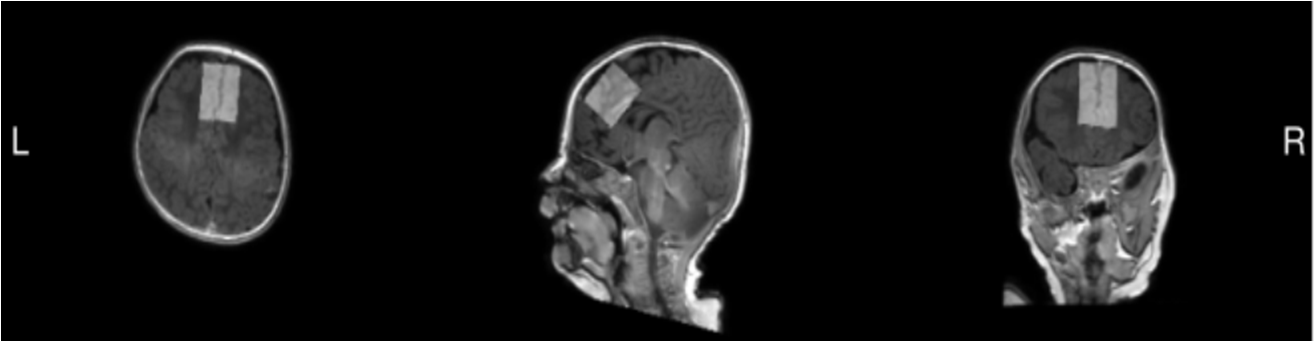
MRS voxel placement in the frontal lobe
on the midline above the genu of the corpus callosum: (a) Axial, (b) Sagittal and (c) Coronal views.
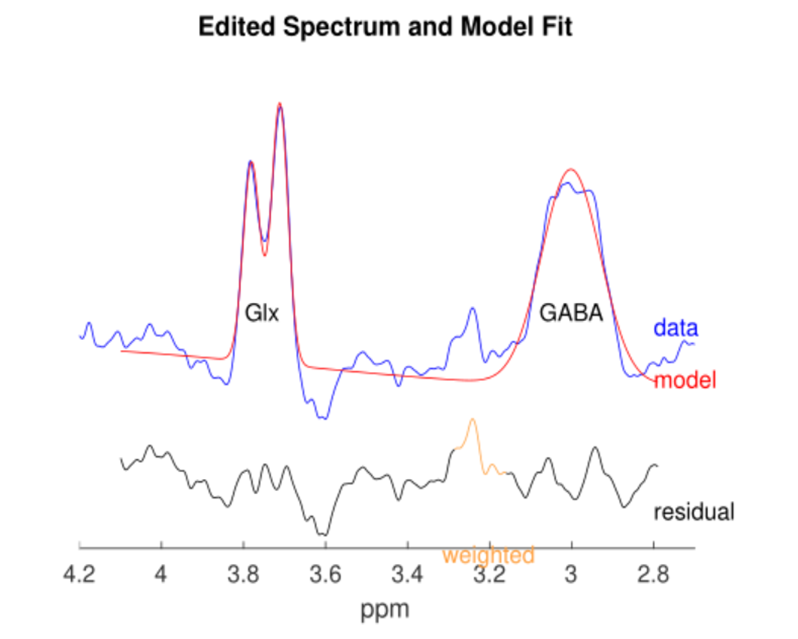
Representative GABA + and Glx edited
spectra of a infants .
DOI: https://doi.org/10.58530/2023/5311