5303
Functional Brain Alterations in Children with Autism Spectrum Disorder after Fecal Microbiota Transplantation1Department of Radiology, Shanghai Tenth People’s Hospital, Tongji University School of Medicine, Shanghai, China, 2Philips Healthcare, Shanghai, China
Synopsis
Keywords: Neuro, fMRI (resting state)
MRI is an important tool available to detect brain functional and structural abnormalities of autism spectrum disorder (ASD) patients. In this study, we combined fecal microbiota transplantation (FMT) and neuroimages to follow-up and explore the change in functional activity in children with ASD. The combination of FMT and MRI can provide a new imaging perspective for understanding the neural mechanism of gut microbiota in ASD.
Introduction
Autism spectrum disorder (ASD) has been widely recognized as a complex neurodevelopmental disorder characterized by stereotyped and repetitive behaviors as well as social-communication deficits. Currently, the pathogenesis and mechanisms of ASD are unknown and there is still no specific treatment for ASD. Gut microbiota is known to play the main role in regulating health and disease and modulating brain function and social behavior1. Gastrointestinal dysfunction becomes one of the most prevalent physiological symptoms of ASD. The most representative method is fecal microbiota transplantation (FMT) . FMT is a therapy that transplants the gut microbiota from healthy people into the intestine of patients to reconstruct the gut microbiota. The previous study suggested that FMT can help improve the symptoms of ASD2. Neuroimaging provides an objective basis for clinical functional changes and is helpful in the follow-up of changes in ASD. Amplitude of low-frequency fluctuation (ALFF) , Regional Homogeneity (ReHo) and Degree centrality (DC) based on resting-state fMRI are useful data-driven methods to characterize brain function and activity. This study combined FMT and resting-state functional MRI (rs-fMRI) to evaluate the functional changes in the brain regions and explore the mechanisms and relationships between FMT and ASD.Methods
Six children completed the FMT treatment and rs-fMRI in this study from June 2021 to November 2022. Resting-state fMRI images were acquired on an Ingenia CX 3.0-T MRI scanner (Philips Healthcare, Best, the Netherlands) with a 32-channel head coil. All children were examined under sedation using chloral hydrate and a caregiver and a doctor for each participant were present throughout the duration of the scan. The preprocessing of resting-state fMRI data was performed in MATLAB R2013b (Mathworks, Natick, MA) with RESTplus software.3 The first ten time points of fMRI data were removed. Because of using multiband scanning, slice timing was not performed.4 After realigning, nobody had excessive head motion (≥±3 mm in any axis). Then the processed images were then normalized by DARTEL toolbox using T1 image new segment. A Gaussian Glter with 6mm FWHM was used to smooth the data (for ReHo and DC analysis, this step was performed during ReHo and DC calculation). The Friston 24 motion parameters, white matter, and cerebrospinal Nuid signals were regressed as covariates. Finally, band-pass Gltering (0.01–0.08 Hz) was performed to remove the edects of high-frequency noise (for ALFF analysis, the ALFF calculation replaced this step). To explore the functional alterations between the two groups, two-sample t-tests were performed on the ALFF, ReHo and DC maps.Results
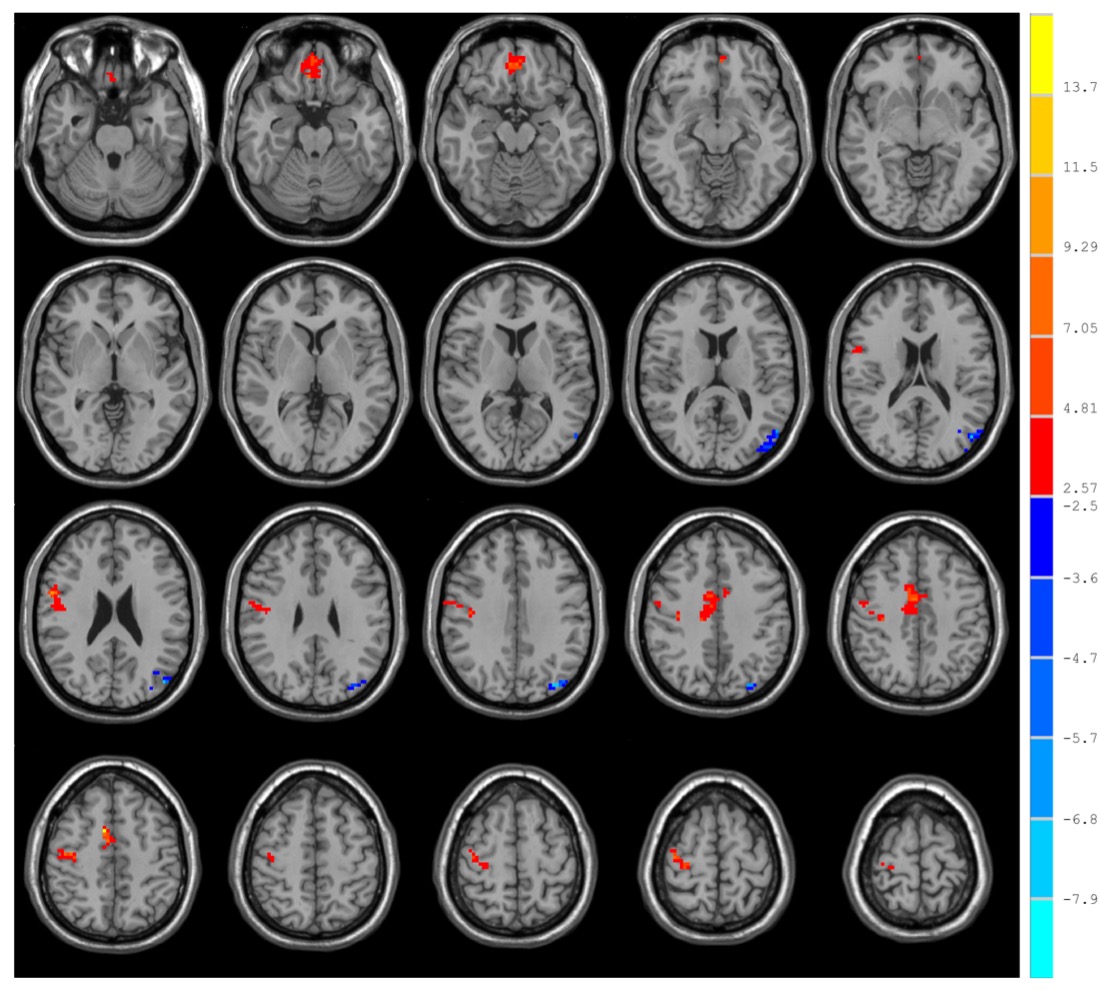
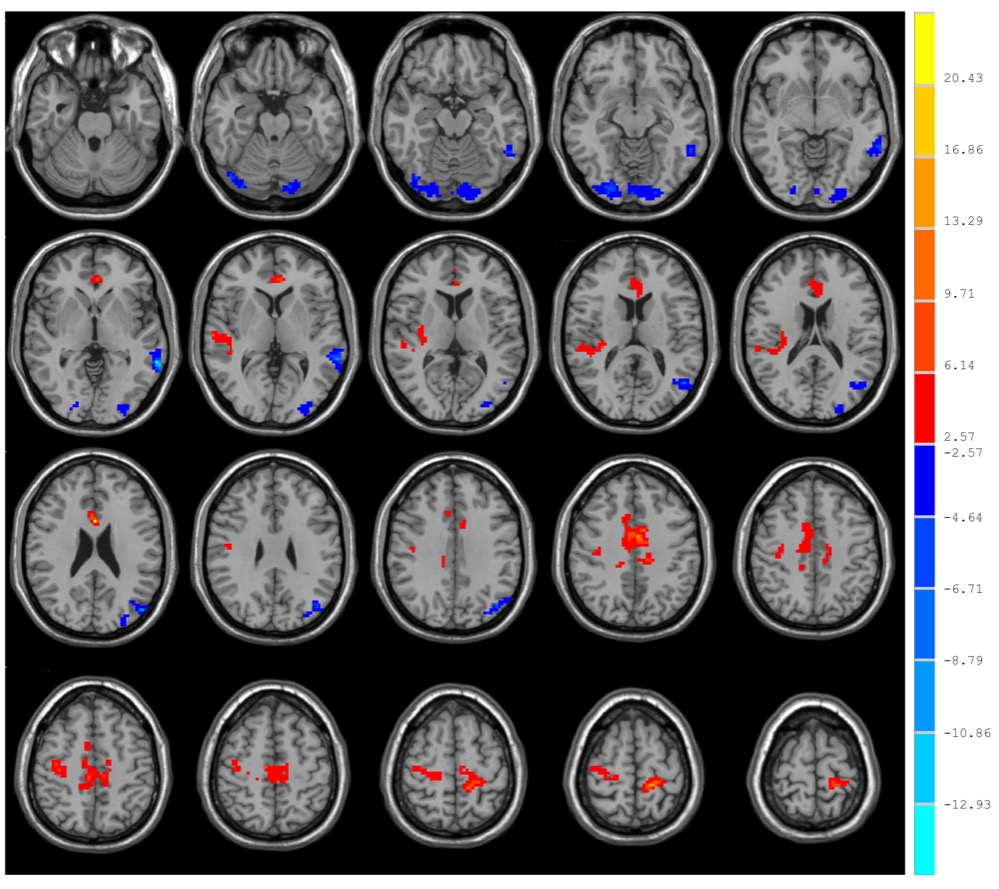
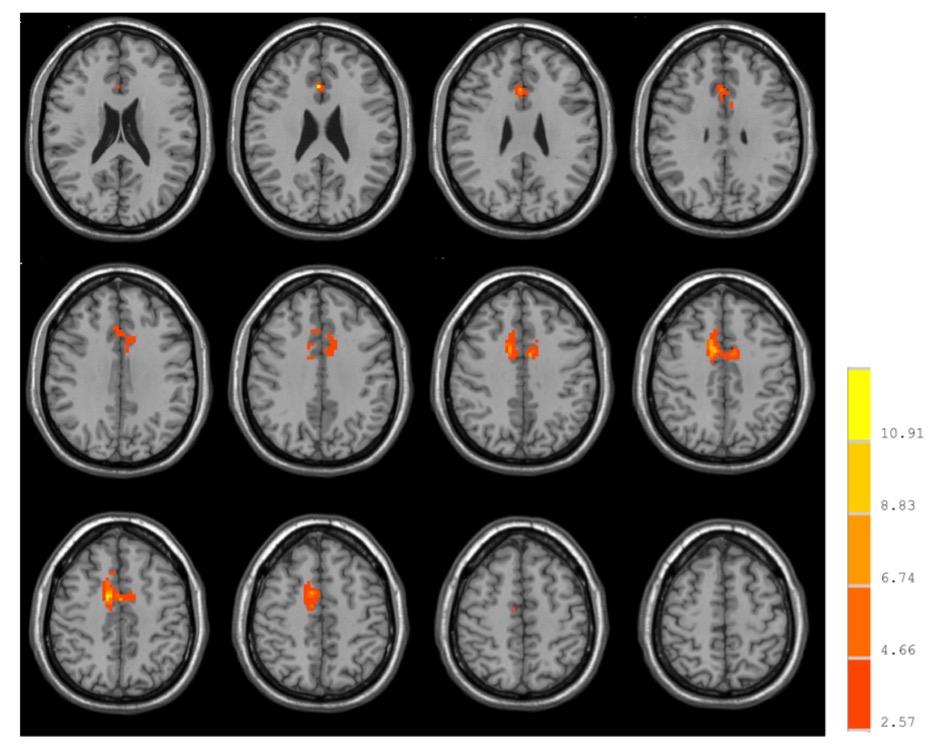
After FMT treatment, ASD children showed increased ALFF in the left gyrus rectus, right precentral gyrus, right supplementary motor area, whild showed decreased ALFF in the left middle occipital gyrus. The ReHo was higher in the anterior cingulate gyrus, right superior temporal gyrus and bilateral postcentral gyrus and lower in the bilateral inferior occipital gyrus, left middle temporal gyrus and left middle occipital gyrus. The DC only increased in the bilateral supplementary motor area. (p < 0.001, cluster size > 200 clusters) (Fig 1-3).Discussion
ALFF and ReHo is a useful method to characterize local spontaneous brain activity in fMRI studies, demonstrating neural intensity and neural coherence.5 After FMT treatments, ALFF and ReHo in the frontal and temporal lobes were increased, which meant neuronal activities increased in these regions and became the underlying mechanism of improvements. DC is an index of the total weights of connections for a node or region in the brain. In this study, after FMT treatment, the increased DC value in the bilateral supplementary motor area in ASD means that the importance of the regions is increased in the whole brain, which could help explain the improvements of symptoms in ASD. Many previous studies have examined the gut microbial composition using a single omics approach, and it is the first study that combining FMT and brain imaging to explore the complex interactions contributing to pathophysiology and symptom generation in ASD. Until now, the sample size was relatively small, and these findings should be validated further.Conclusion
FMT can improve the symptoms of ASD and influence the brain functional activity. After FMT treatment, brain activities in the frontal and temporal lobes increased, while functional activities decreased in the occipital regions. Combining FMT and MRI can provide a new imaging perspective for understanding the neural mechanism and assist clinical follow-up of ASD.Acknowledgements
We would like to thank Shanghai Tenth People’s Hospital and Philips Healthcare for supporting this research. We also thank all participants and their families for their cooperation in this study.References
1. Kang D W, Adams J B, Gregory A C, Borody T, Chittick L, Fasano A, et al. Microbiota Transfer Therapy alters gut ecosystem and improves gastrointestinal and autism symptoms: an open-label study. Microbiome, 2017, 5: 10.
2. Bibbo S, Ianiro G, Gasbarrini A, Cammarota G. Fecal microbiota transplantation: past, present and future perspectives. Minerva Gastroenterol Dietol, 2017, 63: 420-430.
3. Jia X, Wang J, Sun H, Zhang H, Liao W, Wang Z, et al. RESTplus: an improved toolkit for resting-state functional magnetic resonance imaging data processing. Science Bulletin, 2019, 64: 953-954.
4. Smitha K A, Arun K M, Rajesh P G, Joel S E, Venkatesan R, Thomas B, et al. Multiband fMRI as a plausible, time-saving technique for resting-state data acquisition: Study on functional connectivity mapping using graph theoretical measures. Magn Reson Imaging, 2018, 53: 1-6.
5. Lv H, Wang Z, Tong E, Williams L M, Zaharchuk G, Zeineh M, et al. Resting-State Functional MRI: Everything That Nonexperts Have Always Wanted to Know. American Journal of Neuroradiology, 2018, 39: 1390-1399.
Figures