5278
A 3T Helmholtz coil with either reduced or maximized radiation damping effects1Max Planck Institute for Human Cognitive and Brain Sciences, Leipzig, Germany
Synopsis
Keywords: Non-Array RF Coils, Antennas & Waveguides, Ex-Vivo Applications, Tiltable RF Coil, Radiation Damping
Radiation damping (RD) effects may confound experiments targeted at the quantification of MR contrast parameters, in particular, in experiments in small ex-vivo specimens performed with dedicated coils supporting a high filling factor. To address this problem, a long-known principle during reception with coil arrays (preamplifier decoupling) was also applied in the transmit branch of the TxRx switch. Furthermore, adding an extra λ/4 cable between coil and TxRx switch allows to switch between minimum and maximum RD with otherwise almost equal coil characteristics. This may be further exploited for for testing pulse sequences with regards to potential RD effects.Introduction
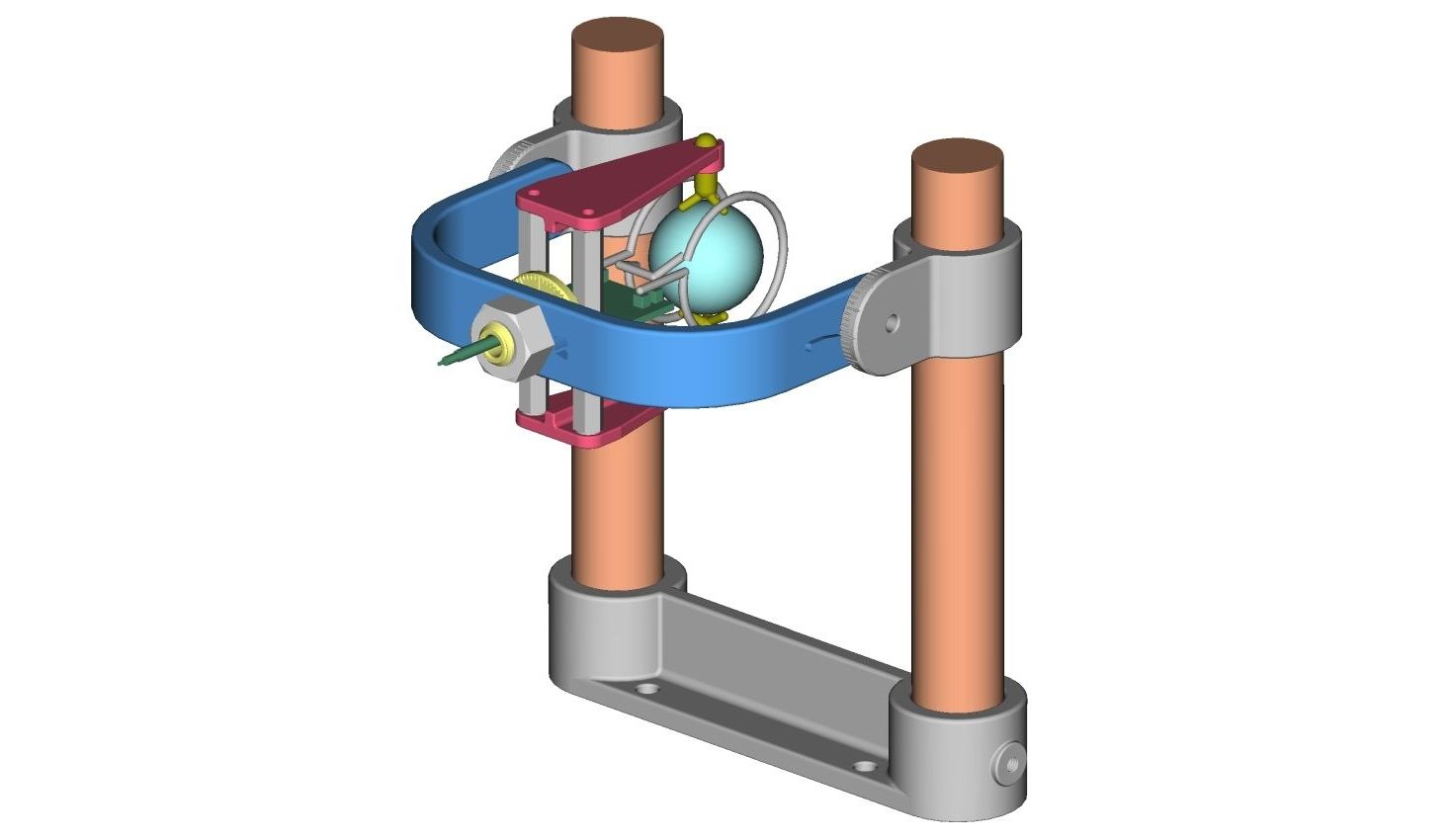
Quantitative investigations of small changes in tissues properties, such as reference experiments for studying the so-called inhomogeneous magnetization transfer, cross-relaxation between multiple spin pools or the orientation dependence of MRI contrast, require an accurate experimental setup. In particular, measurements with small specimen volumes on human-scale MRI scanners benefit from dedicated small coils supporting a high signal-to-noise ratio (SNR) and sufficient B1 homogeneity. Here we designed and built a TxRx single-channel Helmholtz coil for experiments in small ex-vivo samples or phantoms on 3T clinical scanners. To further support orientation-dependent measurements, the sample including the coil elements can be tilted independently around two axes (Figure 1). An unwanted side effect of the high filling factor was relevant radiation damping (RD)1,4 observed in initial relaxation measurements in model systems. Surprisingly, the RD effects were strong enough to dominate the behavior of the spin system and, consequently, quantitative measurements. Therefore, the effect could not be ignored but had to be avoided or sufficiently reduced.Methods
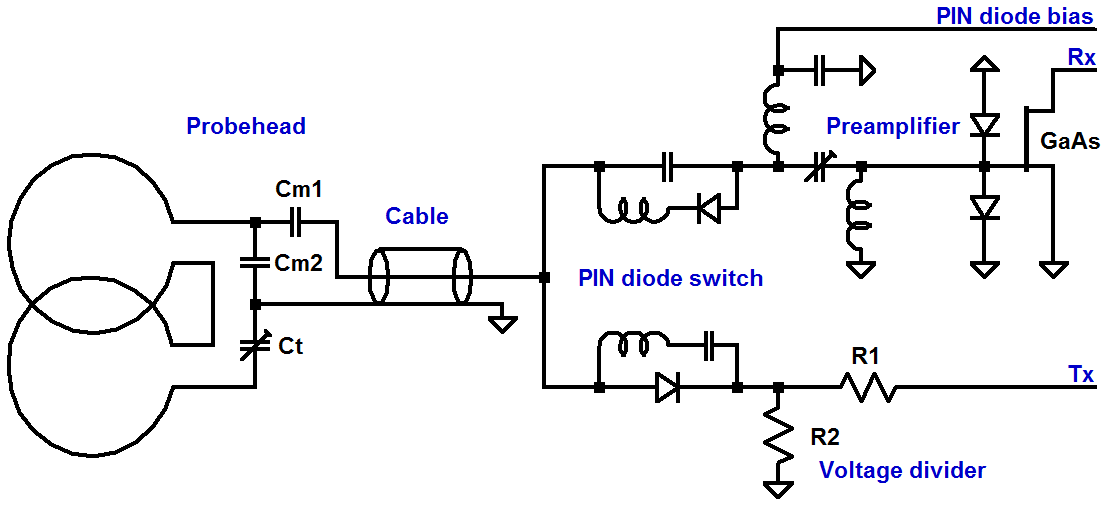
Most of the mechanical parts for the coil assembly were designed with CAD and then 3D-printed. The final Helmholtz coil consists of two loops of 2mm diameter silver-plated copper wire connected in series, radius and spacing of the loops are 16mm. The basic idea for the TxRx switch was published by Hoult and Delauriers3 and was modified as follows: First, an active biased PIN-diode switch was added. Second, the LC circuit was replaced by a resistive voltage divider for impedance reduction in the Tx branch (Figure 2).Experimental data were acquired on a MAGNETOM Skyrafit (Siemens Healthineers, Erlangen, Germany). 3D-printed spheres of various diameters were filled with 0.135mM MnCl2 solution and used as model systems. Different strategies were implemented for relaxometry measurements, including non-spatially resolved inversion recovery experiments. To shed more light on the interaction between the spin-system and the coil, pulse-width arrays6 were utilized as simple and illustrative experiments. The amount of RD (caused by coherent transverse magnetization) was quantified by comparing RD-free relaxation following 90° excitation to a relaxation experiment in the presence of RD. This approach is known as RAdiation Damping Difference SpectroscopY (RADDSY)7.
Results and Discussion
Bench-top measurements yielded a high Q-factor of the empty coil of about 470. For initial measurements, the phantom-loaded prototype coil was connected to a standard TxRx switch via a 50Ω coaxial cable of random length. These experiments indicated that the reference voltage for a 180° pulse was only a few volts and too low for the scanner’s automatic adjustment routines. Additionally, inversion-recovery experiments yielded characteristic deviations of RD unless appropriate crusher gradients were integrated.Well-known hardware-based methods to reduce RD, such as a low coil filling factor or active electronic feedback, could not be applied because they are associated with either poor SNR or high circuit complexity, respectively. As a solution, the fact that GaAs FET-based MRI preamplifiers usually have very low input impedances at optimal noise matching was utilized in the new TxRx switch (Figure 2). Hence, the major part of the input signal is reflected back due to the power mismatch. With a suitable phase shift (cable length), a destructive interference is achieved and the loop currents and, thus, RD are reduced to a minimum without degrading the SNR. Note that the same principle is known as preamplifier decoupling2. Because radiation damping already occurs during the excitation pulse, where it cannot be suppressed by crusher gradients, a corresponding mismatch is also appropriate in the Tx branch. The associated loss of B1 efficiency was even beneficial in this case, as it increased the reference voltage to approx. 85V.
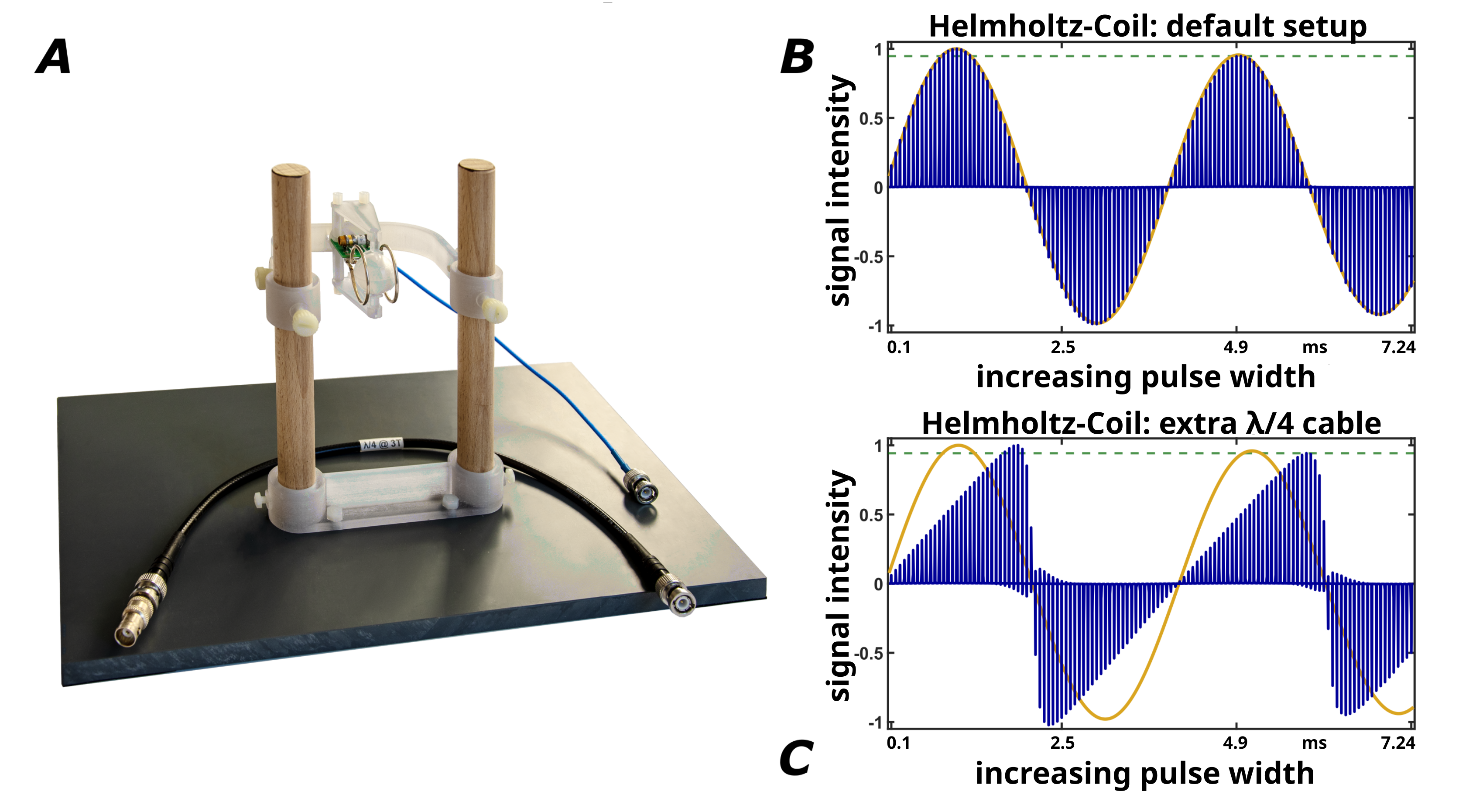
If the cable length is extended by λ/4, the induced loop currents reach a maximum8. Thus, insertion of a cable of appropriate length between the coil and the TxRx switch achieves changing from minimum to maximum RD with otherwise nearly identical coil characteristics. This simple setup permits convenient checks whether pulse sequence may be impacted by RD or if a concept for RD suppression works. Both cases were verified experimentally with pulse-width arrays (Figure 3). Quantitative estimations of RD using the RADDSY sequence yielded a ratio of 32 between minimum and maximum coil current. This corresponds to an approx. 16fold RD reduction compared to a 50Ω termination achieved by a simple integration of a suitable cable length. Further improvements seem possible by reducing losses (coax cable, PIN-diode switch) and increasing the mismatch (preamplifier, Tx voltage divider).
The required fixed matching (Figure 2) had little disadvantage in all investigated coil loading scenarios. An S11 < –15dB was always achieved when the coil was tuned using a vector network analyzer. If required, modified probeheads can be easily built for different loadings.
Conclusion
A small single-channel Helmholtz coil was designed, built, and characterized with bench-top and MR-derived metrics. Using the default setup, RD is effectively suppressed during Rx as well as during Tx mode. Simply adding a λ/4 cable maximizes RD, which yields a suitable setup to test and optimize pulse sequences for exploring or mitigating RD effects.Acknowledgements
No acknowledgement found.References
[1] Bloembergen N, Pound RV. Radiation damping in magnetic resonance experiments. Phys. Rev. 1954; 95(1): 8–12.
[2] Roemer PB, Edelstein WA, Hayes CE, Souza SP, Mueller OM. The NMR phased array. Magn. Reson. Med. 1990; 16(2):192–225.
[3] Hoult DI, Deslauriers R. Elimination of signal strength dependency upon coil loading–an aid to metabolite quantitation when the sample volume changes. Magn. Reson. Med. 1990; 16: 418–424.
[4] Guéron M. A coupled resonator model of the detection of nuclear magnetic resonance: Radiation damping, frequency pushing, spin noise, and the signal-to-noise ratio. Magn. Reson. Med. 1991; 19: 31–41.
[5] Broekaert P, Jeener J. Suppression of radiation damping in NMR in liquids by active electronic feedback. J. Magn. Reson. 1995; 113(1): 60–64.
[6] Keifer PA. 90° pulse width calibrations: How to read a pulse width array. Concepts Magn. Reson. 1999; 11(3): 165.
[7] Szantay C, Demeter A. Radiation damping diagnostics. Concepts Magn. Reson. 1999; 11(3): 121–45.
[8] Hoult DI, Bhakar B. NMR signal reception: Virtual photons and coherent spontaneous emission. Concepts Magn. Reson. 1997; 9(5): 277–297.
Figures